
Nearshore sales development reps have changed the math on outbound entirely — but only if you know how to read the numbers. Most founders and revenue leaders who invest in an outsourced SDR program spend the first 90 days looking at the wrong metrics: call volume, email open rates, raw activity counts. Those numbers feel like traction. They rarely tell you whether your program is actually generating pipeline value worth keeping. This guide gives you the exact framework to measure true ROI — inputs, formulas, benchmarks, and the hidden costs most analyses miss entirely.
What Does "ROI of an Outsourced SDR Program" Actually Mean in 2026?
ROI in a sales development context is not just closed revenue divided by program cost. That calculation has a 9-to-18-month lag built into it — by the time a deal closes from an SDR-sourced lead, you've already made three billing decisions without data. Real SDR ROI is a multi-layer metric that captures pipeline value created, AE time unlocked, and cost-per-qualified-meeting relative to what you'd pay to generate the same meeting internally.
The foundational formula is straightforward:
SDR Program ROI = ((Pipeline Value Generated − Total Program Cost) ÷ Total Program Cost) × 100
Pipeline value is calculated using your average deal size multiplied by the number of sales-qualified leads (SQLs) your SDR produced, multiplied by your historical SQL-to-close rate. If your average deal is $24,000, your SDR booked 18 SQLs in a quarter, and your close rate is 25%, the pipeline value is $108,000. If the program costs $7,500 for that quarter, ROI is 1,340%. That's the ceiling case — but the formula holds at every performance level.
According to RAIN Group (2024), nearly half of B2B sales organizations are evaluating their SDR programs on the wrong leading indicators — prioritizing dials and emails over qualified pipeline contribution. If you want to understand whether your outsourced program is working, you have to anchor every metric back to pipeline dollars, not activity volume.
The 5 Core Metrics That Drive SDR ROI Measurement in 2026
Every SDR program — regardless of whether it's nearshore, offshore, or in-house — should be tracked against five core metrics. Miss any one of them and your ROI calculation will be structurally incomplete.
1. Cost Per Qualified Meeting (CPM)
Divide your total monthly program cost by the number of sales-qualified meetings booked that month. A nearshore SDR at $2,500/month who books 12 SQLs delivers a CPM of $208. The same calculation for an in-house SDR — factoring salary, benefits, tools, and management overhead — typically runs $600–$900 per qualified meeting, according to SHRM's workforce cost benchmarking data (2024).
2. Pipeline Coverage Ratio
Your pipeline coverage ratio is the total dollar value of SDR-sourced pipeline divided by your quarterly revenue target. Best-in-class B2B teams maintain a 3x to 4x coverage ratio. If your quarterly target is $300,000, your SDR program should be generating $900,000 to $1.2M in qualified pipeline. Anything below 2.5x signals that either volume or qualification quality is broken.
3. SQL-to-Close Rate (by SDR source)
This is the single most revealing number in your SDR ROI stack. Tag every deal in your CRM by lead source — SDR-sourced, inbound, referral, paid — and track close rates separately. If SDR-sourced deals close at 18% versus referral deals at 38%, that gap should inform how you price the program, not whether you kill it. A lower close rate is often a qualification problem, not a channel problem — and it's fixable. If you're evaluating a nearshore model versus building in-house, our full comparison of outsourced versus in-house SDR hiring ROI breaks down exactly where the cost curves diverge.
4. Ramp Time to First SQL
Every SDR program has a ramp period — the weeks between start date and first booked qualified meeting. For nearshore SDRs working US business hours with pre-trained AI tools, ramp time runs 2–3 weeks. For an offshore team on an 8-hour time zone gap, ramp stretches to 6–10 weeks because every feedback loop — call review, script iteration, objection handling — takes 24 hours to close instead of 24 minutes.
5. AE Time Reclaimed
This metric is almost always left off ROI calculations, and it's a significant omission. Your Account Executives are your highest-cost sales assets. Every hour they spend prospecting, sequencing, and booking their own meetings is an hour not spent closing. Track AE prospecting hours before and after SDR deployment. According to Salesforce's State of Sales report (2024), the average AE spends 28% of their week on prospecting and pipeline generation activities that an SDR should own. Recapturing that time has a direct revenue multiple.
How Nearshore vs. Offshore vs. In-House SDR Programs Compare on ROI in 2026
The decision between nearshore, offshore, and in-house SDR models is not just a cost decision — it's a compounding ROI decision. Each model has a different cost structure, ramp curve, and pipeline quality profile. The table below shows how these models benchmark against the five core metrics.
| Metric | In-House SDR | Offshore SDR | Nearshore SDR (Rose) |
|---|---|---|---|
| Monthly All-In Cost | $6,500–$9,000 | $1,200–$1,800 | $2,500 flat |
| Ramp Time to First SQL | 4–8 weeks | 6–10 weeks | 2–3 weeks |
| Time Zone Alignment (US hrs) | Full | Partial (6–10 hr gap) | Full (Latin America) |
| English Proficiency Standard | Native | Variable (4–6/10) | Screened 8/10+ minimum |
| AI Tool Pre-Training | DIY (you build it) | Rare | Included (role-specific AI copilot) |
| Recruiting + HR Overhead | On you | On you or agency | Fully managed by Rose |
| Replacement Guarantee | None (rehire cost) | Rare, slow | Free replacement if not a fit |
| Contract Commitment | Full employment | 3–12 month lock-in typical | No long-term contract (30-day notice) |
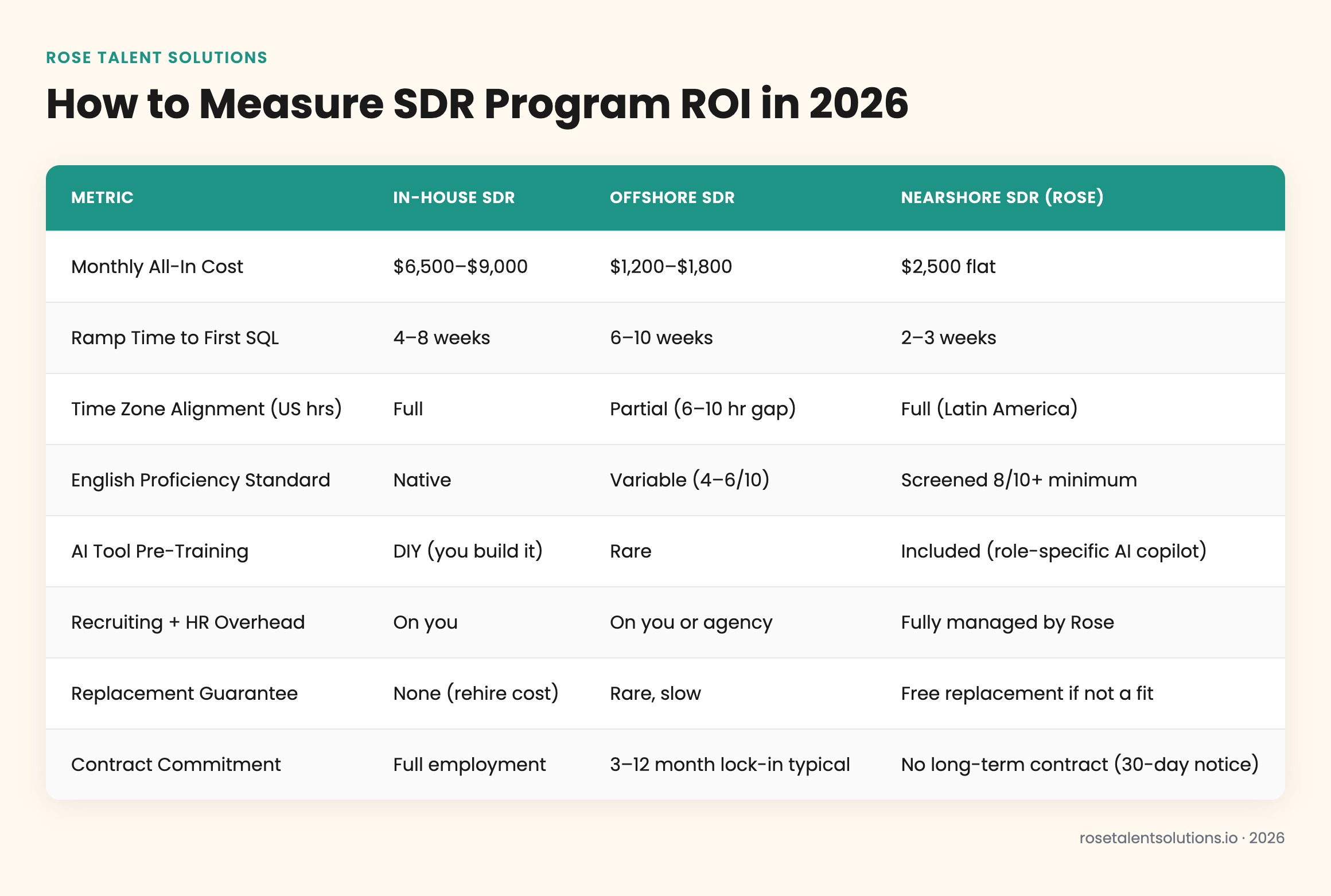
The offshore cost advantage looks compelling on paper — until you factor in the 6–10 week ramp delay, the feedback-loop friction created by time zone gaps, and the typical 60–90 day cancellation clauses. At $1,500/month for 10 weeks of near-zero pipeline contribution, you've spent $3,750 before your first qualified meeting. A nearshore program at $2,500 that books its first SQL in week two compresses that break-even window dramatically. For a detailed look at what total program cost actually looks like across models, see our breakdown of how much an outsourced sales development rep actually costs.
How to Build a Simple SDR ROI Tracker (Step-by-Step for 2026)
You don't need expensive BI tooling to track SDR ROI accurately. A shared spreadsheet updated weekly is sufficient for most companies under $10M ARR. Here's the exact process to set one up and maintain it.
Set Your Cost Baseline
Log every dollar associated with the program: monthly retainer (e.g., $2,500), any sequencing tools (Apollo, Outreach, Salesloft), and internal manager time (hours × loaded hourly rate). This is your monthly cost denominator.
Tag Every SDR-Sourced Lead in Your CRM
Create a mandatory "Lead Source: SDR – [Rep Name]" field in Salesforce, HubSpot, or your CRM of choice. Every opportunity created from an SDR-booked meeting gets this tag — no exceptions. This makes downstream close-rate analysis possible.
Calculate Weekly Pipeline Value
Each Friday, pull the total value of open opportunities created from SDR sources that week. Multiply by your historical SQL-to-close rate to get expected pipeline value. This is your leading ROI indicator before deals close.
Track Cost Per Qualified Meeting Monthly
Divide total monthly program cost by meetings that your AEs marked as "qualified" post-call — not just meetings booked. Volume without qualification inflates this number and hides real program performance.
Review and Recalibrate at 30/60/90 Days
Month one is ramp and calibration — don't draw ROI conclusions yet. Month two is your first real data point. Month three is when patterns emerge. Use 90-day cohorts to evaluate whether to expand, optimize, or change direction.
One underrated lever in this process is sequencing quality. If your SDR is running personalized, high-volume cold email campaigns correctly, your pipeline input rate will compound each month as replies, referrals, and follow-up timing stack. If you want to understand how the email side of SDR operations scales, our post on how outsourced SDRs handle cold email at scale covers the infrastructure and sequencing logic in detail.

What Hidden Costs Destroy SDR ROI Calculations — and How to Catch Them
Most SDR ROI calculations are optimistic because they omit three cost categories that materially change the math. Catching these before you run your analysis is the difference between a decision and a rationalization.
1. Manager and enablement time. Someone on your team is reviewing call recordings, editing scripts, running weekly syncs, and coaching objection handling. If that's your VP of Sales at $180,000 base, two hours per week equals roughly $3,460 in annual loaded cost per SDR. Include it in your denominator. Fully managed nearshore programs — where recruiting, HR, and ongoing management are handled by the agency — eliminate most of this cost at the source.
2. Tool stack costs. A single SDR typically needs a sequencing platform ($100–$150/month), data enrichment ($75–$200/month), and a dialer ($50–$100/month). That's $225–$450 per month in tooling that never appears in the headline retainer cost. Factor it in every time.
The hidden cost of an offshore SDR program isn't the hourly rate — it's the 6–10 hour timezone gap that adds a full business day to every feedback loop, script iteration, and qualification handoff. Over a 90-day ramp, that compounding delay costs you 8–12 qualified meetings you'll never get back.
3. Churn and rehire cost. The average SDR tenure in the US is 14 months, according to LinkedIn Talent Insights (2024). Every time a rep churns, you restart your ramp clock — burning 4–10 weeks of pipeline contribution and incurring another recruiting cycle. Programs that include a no-cost replacement guarantee absorb this risk. Programs that don't pass it directly to your ROI calculation as a recurring tax.
According to Gartner's sales development benchmarking research (2024), companies that account for all three hidden cost categories in their SDR ROI models report program costs that are 35–55% higher than their initial estimates — and make meaningfully different vendor decisions as a result.
If your business model requires a high volume of qualified outbound meetings — SaaS, professional services, commercial real estate — the ROI case for a well-structured nearshore SDR program is strong. Our guide on how to hire outsourced SDR services for SaaS companies walks through the specific qualification criteria and handoff protocols that drive the highest SQL-to-close rates in software sales contexts.
How to Benchmark Your SDR ROI Against 2026 Industry Standards
Raw numbers only matter in context. Here are the benchmarks your program should be measured against based on current industry data.
- Cost Per Qualified Meeting (CPM): $150–$300 is best-in-class for nearshore outsourced programs. $500+ signals either low booking volume or overweight tooling costs.
- SQLs per SDR per month: 10–18 is the typical range for a fully ramped B2B SDR working a well-defined ICP. Under 8 SQLs/month consistently warrants a sequencing audit before a personnel decision.
- Pipeline coverage ratio: 3x–4x your quarterly revenue target. Below 2.5x means your program is undersized relative to your growth goal.
- SDR-sourced SQL-to-close rate: 18–28% is typical. Below 15% usually indicates an ICP definition or qualification rubric problem, not a program failure.
- Ramp time to first SQL: Under 3 weeks for nearshore (with AI pre-training). 6–10 weeks for offshore without structured onboarding.
"Most companies evaluate their SDR programs at 30 days and make decisions based on activity data. The right evaluation window is 90 days, and the right metric is pipeline contribution per dollar spent — not calls made or emails sent." — Kyle Coleman, Chief Marketing Officer at Copy.ai (2024)
Coleman's point is particularly relevant when evaluating nearshore versus offshore programs. The 30-day window almost always favors whoever looks busiest on activity dashboards. The 90-day window — measuring pipeline dollars per program dollar spent — is where the real structural advantages of time zone alignment, English proficiency, and AI-enabled ramp speed become visible in the numbers. To learn more about how Rose's AI copilot advantage accelerates SDR ramp and pipeline contribution, the detail is on that page.
Signs Your SDR ROI Is Healthy
- CPM trending down month-over-month as volume scales
- SQL-to-close rate stable or improving (qualification rubric is working)
- AE prospecting hours declining while close rates hold
- Pipeline coverage consistently above 3x quarterly target
- First SQL booked within 14–21 days of program start
Warning Signs Your ROI Calculation Is Off
- You're measuring dials and emails instead of qualified meetings booked
- Tooling costs not included in program cost denominator
- No CRM tagging — you can't isolate SDR-sourced pipeline
- Evaluating at 30 days instead of 90-day cohorts
- Manager enablement time not counted in total cost
Rose Talent Solutions builds and deploys nearshore SDR teams across the full outbound stack — from ICP definition and sequencing setup through to qualified meeting delivery and CRM handoff. Every team member ships with a role-specific AI copilot pre-trained on your tools, your ICP, and your objection landscape, so ramp time compresses and pipeline contribution starts faster. The program runs at $2,500/month, flat, with no long-term contract — and if the team member isn't the right fit, we replace them at no additional cost. When you're ready to build a program you can actually measure, start here.