
Why Tenant Communication Breaks Down — and How Nearshore VAs Fix It in 2026
Nearshore virtual assistants have become the fastest-growing hire in residential property management, and the reason is straightforward: tenant communication is eating your day. Every maintenance request, lease renewal question, late-rent call, and move-out inquiry lands in your inbox and demands a response — ideally within the hour. When you manage tenant communication with a virtual assistant who is based in Latin America, working your time zone, and fluent in English, that entire layer comes off your plate without any overnight delay or language friction.
According to Buildium's State of the Property Management Industry Report (2024), 61% of residents say responsiveness is the single most important factor in their rental experience — ranking above unit condition and even rent price. That single stat reframes the entire staffing decision: tenant communication is not an administrative task, it is a retention driver.
The problem is not that property managers do not care. It is that the volume is unmanageable solo. A portfolio of 50 units generates an average of 8–12 tenant touchpoints per day across email, phone, and maintenance portals. At 100 units, you are looking at 20-plus interactions before lunch. The only scalable solution is to build a communication layer that operates without you in every routine interaction — and a trained virtual assistant is that layer.
How to Set Up a Virtual Assistant to Manage Tenant Communication: A 2026 Step-by-Step Process
The biggest mistake property managers make when hiring a VA is treating them like a part-time helper. To properly manage tenant communication with a virtual assistant, you need to position them as the single point of contact for all routine inbound work — with clear escalation rules for anything that requires your licensed judgment. Here is exactly how that setup looks in practice.
Map Every Inbound Channel
List every place tenants can reach you: main email, maintenance request portal, Google Voice or dedicated phone number, text line, and any community portal inside AppFolio or Buildium. Your VA cannot own channels they do not have access to — audit these before day one.
Build a Response Playbook
Document the 20 most common tenant inquiries — maintenance requests, rent questions, lease renewals, noise complaints — and write a standard response template for each. Your VA personalizes and sends; they do not draft from scratch every time. This alone cuts average response time by more than half.
Set Escalation Triggers
Define what gets escalated to you immediately (habitability complaints, legal threats, requests for lease breaks) versus what the VA resolves independently (routine maintenance, move-in instructions, payment confirmations). Write this as a one-page decision tree your VA can reference without asking you.
Grant Software Access and Train on Your Workflows
Add your VA as a user in AppFolio, Buildium, or whatever PMS you use. Rose team members arrive with role-specific AI copilots already trained on these platforms, which means the software learning curve is measured in hours, not weeks. For a platform-specific walkthrough, see our guide to hiring an AppFolio virtual assistant.
Run a One-Week Shadow Period
Have your VA shadow your current communication handling for the first week — observing tone, timing, and how you handle tricky situations. By week two, they are handling the inbox with you reviewing. By week three, they own it independently with an end-of-day summary sent to you.

How Nearshore VAs Compare to Offshore and In-House Staff for Tenant Communication in 2026
Not all virtual assistants are equal for tenant-facing work. The most common mistake property managers make is hiring the cheapest offshore option — someone based in the Philippines or India — and then wondering why response quality drops and tenants complain. When you manage tenant communication with a virtual assistant, the role demands real-time English fluency, US business hour availability, and cultural familiarity with how American renters expect to be treated. Those three requirements alone eliminate most offshore options from serious consideration.
For a detailed breakdown of why geography matters here, see our analysis of nearshore vs. offshore VAs for property management. The short version: a 6–10 hour time zone gap means your "same-day" response arrives the next morning — which is exactly the responsiveness failure that drives non-renewals.
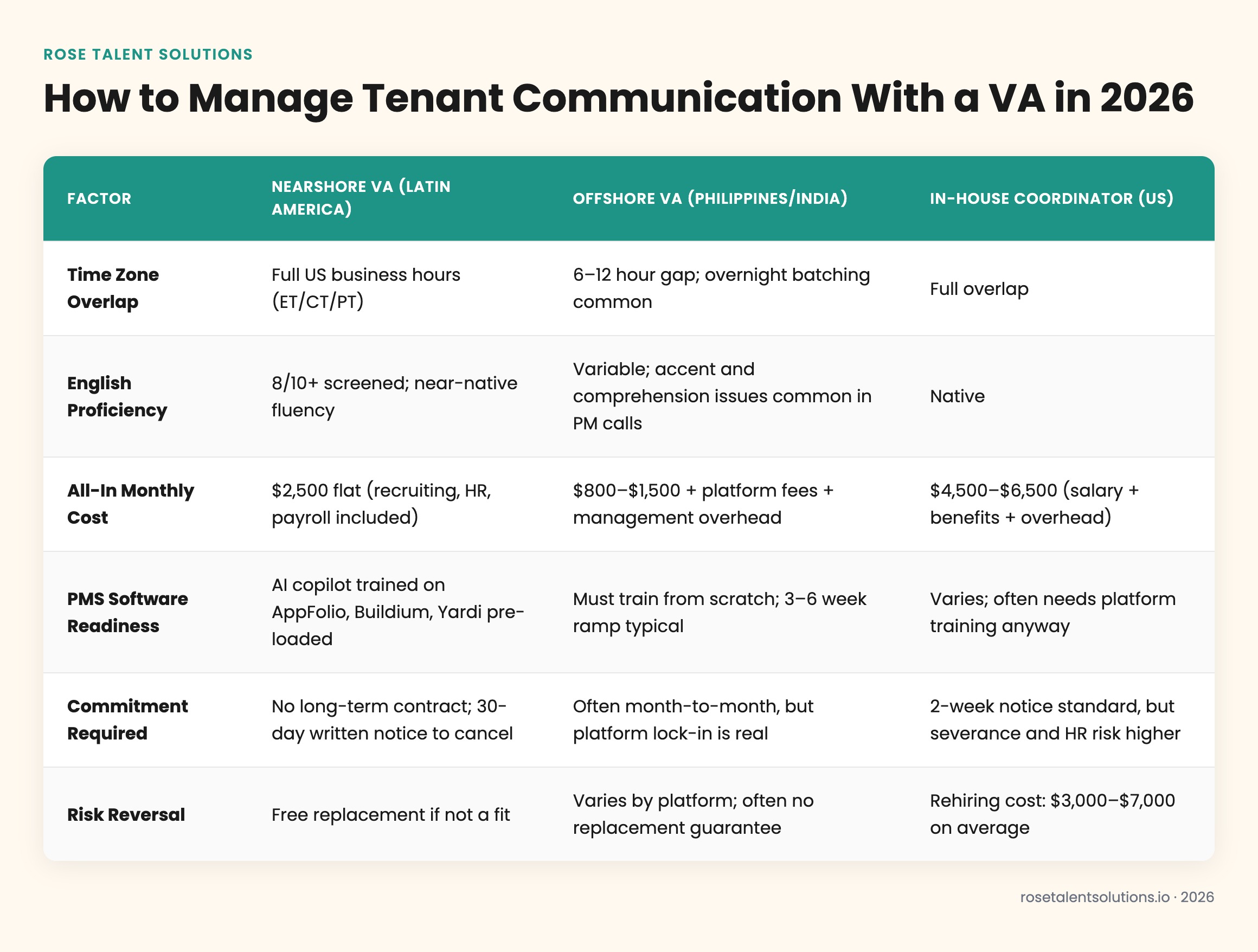
| Factor | Nearshore VA (Latin America) | Offshore VA (Philippines/India) | In-House Coordinator (US) |
|---|---|---|---|
| Time Zone Overlap | Full US business hours (ET/CT/PT) | 6–12 hour gap; overnight batching common | Full overlap |
| English Proficiency | 8/10+ screened; near-native fluency | Variable; accent and comprehension issues common in PM calls | Native |
| All-In Monthly Cost | $2,500 flat (recruiting, HR, payroll included) | $800–$1,500 + platform fees + management overhead | $4,500–$6,500 (salary + benefits + overhead) |
| PMS Software Readiness | AI copilot trained on AppFolio, Buildium, Yardi pre-loaded | Must train from scratch; 3–6 week ramp typical | Varies; often needs platform training anyway |
| Commitment Required | No long-term contract; 30-day written notice to cancel | Often month-to-month, but platform lock-in is real | 2-week notice standard, but severance and HR risk higher |
| Risk Reversal | Free replacement if not a fit | Varies by platform; often no replacement guarantee | Rehiring cost: $3,000–$7,000 on average |
"Responsiveness is no longer a differentiator in property management — it's table stakes. Managers who can't respond within two hours are losing renewals to competitors who can." — Tony Julianelle, CEO at Atlas Real Estate (2023)
What Tenant Communication Tasks a VA Can Own Completely in 2026
One of the most common questions property managers ask before they decide to manage tenant communication with a virtual assistant is: what can they actually handle without me? The honest answer is: more than you think. Routine tenant communication — the work that fills 70% of your day — is almost entirely delegable once your VA has your playbook and software access in place.
According to the National Association of Realtors' research division (2024), property managers spend an average of 2.5 hours per day on tenant communication alone — not including the mental overhead of context-switching between calls and critical decision-making. That is roughly 12–13 hours a week that a trained virtual assistant can absorb completely, returning that time directly to you for owner relations, leasing, and portfolio growth.
Here is what a well-trained tenant communication virtual assistant handles without you in the loop:
- Maintenance request intake and vendor dispatch — logging requests in AppFolio or Buildium, contacting approved vendors, confirming appointment windows, and following up on completion
- Rent reminder messages — sending templated reminders at day-minus-3, day-of, and day-plus-3 with payment portal links
- Lease renewal outreach — initiating renewal conversations 90 days out, sending renewal offers, tracking responses, and flagging non-responders to you
- Move-in and move-out coordination — sending checklists, scheduling inspections, and answering logistics questions so residents feel guided through the process
- After-hours voicemail triage — reviewing messages at start of business, categorizing by urgency, and responding or escalating before 9 a.m.
- Noise and neighbor complaints — acknowledging receipt, documenting the issue, and issuing first-contact notices per your established policy
- Portal message inbox management — clearing the AppFolio or Buildium resident portal daily so no message ages past 24 hours
If your portfolio includes an HOA component, the scope expands further. VAs can handle board communication, amenity reservation requests, and violation notices. We cover that in detail in our post on whether a virtual assistant can handle HOA management — the short answer is yes, with the right systems in place.
The hidden cost of slow tenant communication is not just resident dissatisfaction — it is turnover. According to the National Multifamily Housing Council (2023), the average cost to turn a single unit sits between $3,500 and $4,500 when you factor in vacancy loss, cleaning, and re-leasing fees. When you manage tenant communication with a virtual assistant consistently and responsively, you are directly attacking that cost with every interaction.
How to Choose the Right VA to Manage Tenant Communication: Nearshore Advantages vs. Common Trade-Offs
Hiring any virtual assistant for tenant-facing work involves trade-offs. The good news is that most of the real risks — time zone gaps, language barriers, software unfamiliarity — are specific to offshore hiring, not to the concept of using a virtual assistant to manage tenant communication in general. When you hire a nearshore VA through a structured staffing agency, those risks are substantially mitigated before your new team member ever touches your inbox.
According to SHRM's employee engagement research (2024), managers who use structured onboarding processes see new hires reach full productivity 50% faster than those who rely on ad-hoc training. A nearshore VA who arrives with a pre-loaded AI copilot for your specific PMS platform — AppFolio, Buildium, or Yardi — closes that ramp gap even further. For a deeper look at how that works specifically with Buildium, see our Buildium virtual assistant setup guide.
Nearshore VA — Strengths for Tenant Communication
- Real-time availability during US business hours — no overnight batching of tenant messages
- English proficiency screened to 8/10+ — tenants cannot tell they are not speaking with in-house staff
- Pre-trained on AppFolio, Buildium, and Yardi via role-specific AI copilot
- $2,500/mo flat — all recruiting, HR, and payroll management included
- No long-term contract — cancel with 30 days written notice; free replacement if not a fit
- Latin American cultural proximity to US norms in professional tenant communication
Common Trade-Offs to Plan For
- Still requires a documented playbook from you — virtual assistants perform better with clear SOPs in place
- Initial shadow period (typically one week) before full independent ownership of the inbox
- Emergency maintenance escalation protocols must be defined and written before the VA goes live
- Not a substitute for licensed property management judgment on legal or habitability matters
The real question is not whether a virtual assistant can manage your tenant communication. It is whether you have built the systems that let them succeed from day one. Agencies like Rose handle the recruiting, vetting, and HR — but the playbook and escalation rules have to come from you. That one-time setup investment pays back within the first 30 days of having a live VA in your inbox.
According to the U.S. Bureau of Labor Statistics (2024), demand for property, real estate, and community association managers is projected to grow 4% through 2032 — meaning the tenant communication volume problem will only intensify as portfolios scale. Building a VA-supported communication infrastructure now is the operational decision that separates managers who grow from managers who hit a ceiling at 80 units.
If you are ready to see how this fits your specific portfolio, the Rose intake process takes about 10 minutes and matches you with a pre-vetted candidate within roughly a week. Pricing is $2,500/month, full-time, with no long-term contract. For more on how the AI copilot component works across every tenant communication role, the AI advantage page walks through exactly what is pre-loaded for each position. And for a comprehensive overview of how virtual staffing fits the broader property management service model at Rose — including roles beyond communication like leasing coordination, accounts payable, and owner reporting — start there before your intake call.