
Why Nearshore Bookkeeping Is the 2026 Default for US Businesses
Nearshore bookkeeping — hiring a full-time, Latin America-based bookkeeper who works your exact US business hours — has moved from "interesting experiment" to standard operating procedure for thousands of small and mid-market businesses. The timezone overlap alone eliminates the single biggest complaint operators have about offshore hiring: the overnight message queue that turns a two-minute question into a two-day delay.
The numbers back this up. US businesses that outsource finance and accounting functions save between 40% and 60% compared to equivalent domestic hires, according to Deloitte's Global Outsourcing Survey (2023). That's not a rounding error — that's the difference between a $75,000/year in-house hire and a $30,000/year nearshore equivalent doing the same work in the same hours.
But "nearshore" isn't a guarantee of quality on its own. This guide breaks down exactly how to evaluate, hire, and onboard a bookkeeper from Latin America so you get the cost savings without the reliability problems that plague bad vendor relationships.
What Is a Nearshore Bookkeeper? (A 2026 Definition)
A nearshore bookkeeper is a finance professional based in a Latin American country — typically Colombia, Mexico, Argentina, or Costa Rica — who works full-time for a US, Canadian, or UK business during that client's standard business hours. Unlike offshore bookkeepers based in the Philippines or India (who typically work overnight shifts or split-hour schedules), nearshore bookkeepers overlap 100% with EST, CST, MST, and PST working days.
Nearshore bookkeepers handle the same scope as an in-house hire: accounts payable and receivable, bank reconciliations, payroll entries, month-end close, and financial reporting. The difference is cost structure and hiring model. Most are placed through staffing agencies that handle recruiting, vetting, payroll, and HR — so the client business pays one flat monthly rate and manages the person's daily work without managing employment compliance in a foreign country.
For a deeper look at what this role covers day-to-day, see Rose's overview of the nearshore bookkeeper role and what to expect from placement.
How to Vet a Nearshore Bookkeeper Before You Hire
Most hiring mistakes at this stage aren't about work ethic — they're about skipping the three verification steps that actually predict performance. Here's what to require before anyone touches your books.
1. English proficiency with a hard floor. Bookkeeping generates constant written communication: vendor emails, client billing questions, payroll disputes. You need someone who can write a clear, professional email without your review every time. An 8/10+ score on a standardized English proficiency screen (CEFR B2 or higher) is the minimum that reliably produces professional-grade written output. Rose's published bar is 8/10+, and it's non-negotiable for this reason.
2. Software-specific testing, not just resume claims. "Proficient in QuickBooks" on a resume means nothing without a scored practical assessment. Ask for a live screen-share walkthrough of a bank reconciliation or accounts payable workflow in your actual software. A bookkeeper who says they know QuickBooks but can't navigate the chart of accounts without coaching will cost you more in correction hours than you saved on salary. The same applies to Xero — if your business runs on Xero, require a Xero-certified candidate or one who can demonstrate live proficiency.
3. References from US clients specifically. Working for a local Latin American business is not the same as working for a US-based operator in real time. Ask for two to three US-client references and listen for specific answers: How did they handle month-end close deadlines under your timezone? How did they respond to urgent requests outside normal task scope?
"The number-one mistake small business owners make when hiring a virtual bookkeeper is conflating accounting credentials with operational reliability. A CPA who can't communicate proactively in your timezone is less valuable than a skilled bookkeeper who can." — Loren Feldman, Founder at 21 Hats (2024)
Nearshore vs. Offshore vs. Onshore Bookkeepers: How the 2026 Options Compare
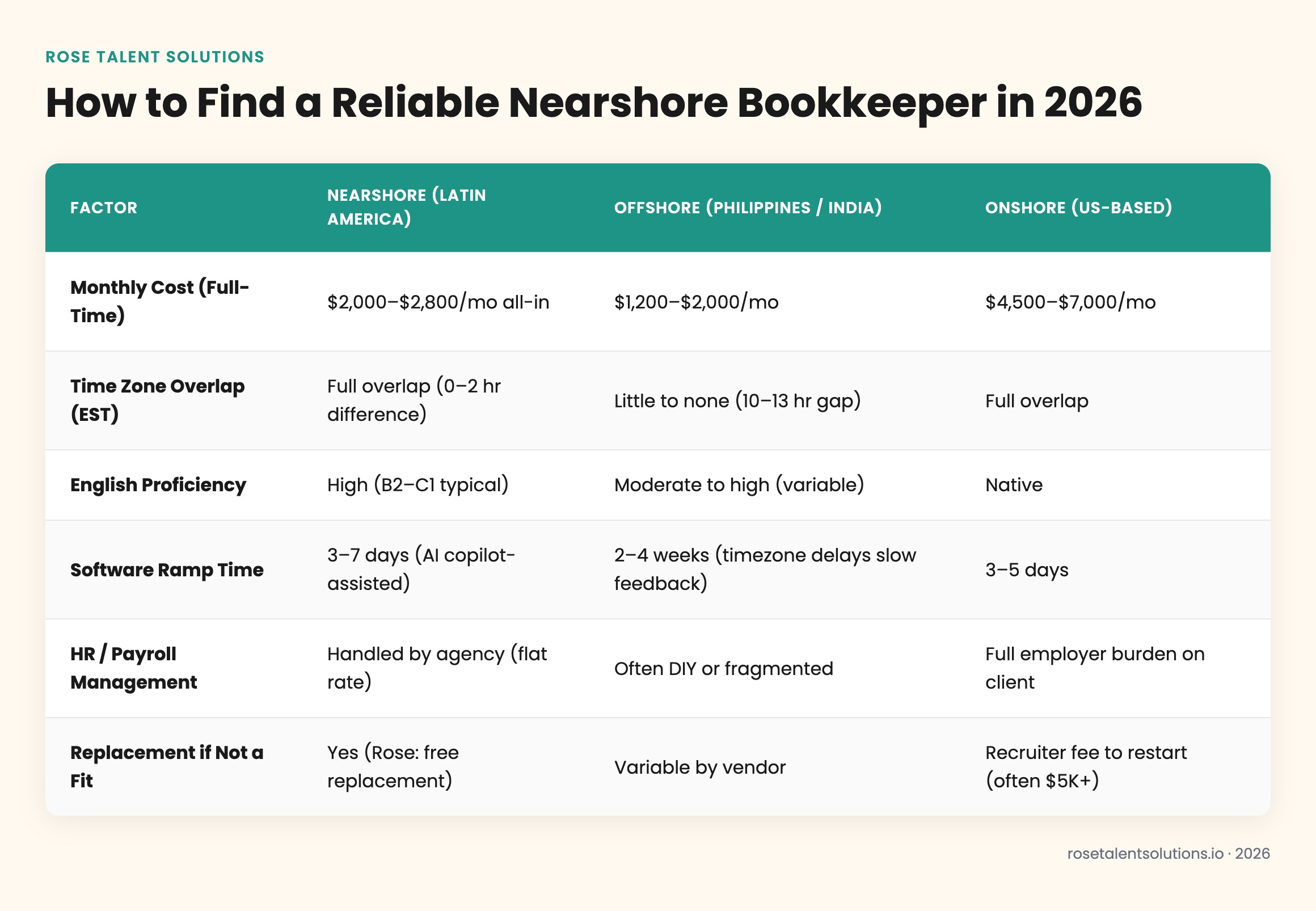
The three-way comparison matters because the terms get blurred in vendor marketing. "Virtual bookkeeper" can mean someone in the Philippines working overnight, a US-based freelancer on Upwork charging $45/hour, or a Latin America-based full-timer working 9-to-5 EST. The operating differences are significant.
| Factor | Nearshore (Latin America) | Offshore (Philippines / India) | Onshore (US-Based) |
|---|---|---|---|
| Monthly Cost (Full-Time) | $2,000–$2,800/mo all-in | $1,200–$2,000/mo | $4,500–$7,000/mo |
| Time Zone Overlap (EST) | Full overlap (0–2 hr difference) | Little to none (10–13 hr gap) | Full overlap |
| English Proficiency | High (B2–C1 typical) | Moderate to high (variable) | Native |
| Software Ramp Time | 3–7 days (AI copilot-assisted) | 2–4 weeks (timezone delays slow feedback) | 3–5 days |
| HR / Payroll Management | Handled by agency (flat rate) | Often DIY or fragmented | Full employer burden on client |
| Replacement if Not a Fit | Yes (Rose: free replacement) | Variable by vendor | Recruiter fee to restart (often $5K+) |
For businesses that run on Xero, the nearshore advantage compounds further. A bookkeeper trained specifically on Xero workflows — reconciliations, invoice automation, payroll integration — can take over your books without a months-long retraining period. Rose's Xero virtual bookkeeper placement guide covers what to look for in a Xero-certified candidate specifically.
How AI Copilots Make Nearshore Bookkeepers Faster in 2026
One development that separates 2026 nearshore hiring from what existed three years ago is the role-specific AI copilot. Every Rose team member ships with an AI copilot trained on their specific software stack — QuickBooks, Xero, Buildium, AppFolio, or others — so they're not learning your workflows from scratch on your dime.
What does this mean practically? A bookkeeper handling accounts payable can use their AI copilot to flag duplicate invoices, draft vendor payment reminders, and generate aging reports — tasks that would otherwise require either deep software expertise or a senior accountant's review. Rose's AI advantage is built into the placement, not sold as an add-on.
AI copilots don't replace bookkeeper judgment — they eliminate the low-value lookup tasks (where is this setting, how do I run this report) that slow down new hires. A bookkeeper with a well-trained copilot reaches full productivity in days, not weeks. That acceleration is worth more than the cost difference between nearshore and onshore.
The productivity impact of AI-assisted tools in finance is well-documented. According to McKinsey's research on generative AI's economic potential (2023), finance and accounting functions see up to 30% productivity gains from AI-assisted workflows — the highest of any back-office function measured.
If your bookkeeper also handles accounts payable, it's worth understanding exactly how that workflow functions in a virtual environment. Rose's detailed breakdown of how virtual bookkeepers handle accounts payable covers the tools, approval flows, and communication protocols that make remote AP management reliable.
How the Rose Talent Placement Process Works in 2026
If you're evaluating a staffing agency rather than hiring directly, understanding the placement process tells you how much operational risk you're absorbing. Here's how Rose's end-to-end process works — from intake call to first productive day.
Intake & Role Scoping
Rose's team maps your software stack, weekly task volume, and communication preferences. This call takes 30 minutes and produces a role spec used for matching — not generic sourcing.
Candidate Matching
Rose surfaces 2–3 pre-vetted candidates from Latin America who have already passed English proficiency screening (8/10+) and software-specific assessments for your tools. You interview them directly.
AI Copilot Configuration
Before day one, your bookkeeper's AI copilot is configured to your software and workflow — QuickBooks chart of accounts, Xero payroll integration, or whatever your stack requires.
Placement & Onboarding
Your bookkeeper starts within approximately 7 days of intake. Rose handles payroll, HR compliance, and ongoing management. You manage their daily work and priorities.
Replacement Guarantee
If the team member isn't the right fit, Rose replaces them at no additional cost. No long-term contract — the arrangement is month-to-month with 30 days written notice to cancel.
The flat rate is $2,500/month, all-in. That covers recruiting, vetting, payroll, HR, ongoing management, and the AI copilot. There's no separate placement fee, no benefits overhead, and no employer tax burden on your end. To see the full scope of what's included in a nearshore bookkeeping engagement, Rose's service page breaks down the task categories covered.
What to Avoid When Hiring a Nearshore Bookkeeper: 2026 Red Flags
The nearshore staffing market has grown fast enough that quality variance is real. These are the signals that a vendor or candidate will cost you more than they save.
Green Flags
- English proficiency score provided (not just "fluent English" in the bio)
- Software-specific assessment results available before interview
- US client references with contactable names
- Month-to-month terms — no long-term contract required
- Free replacement guarantee if not a fit (not a discount — a replacement)
- Agency handles payroll and HR; you don't touch foreign employment compliance
Red Flags
- No language proficiency standard stated or tested
- Placement in Philippines or India presented as "nearshore" (it isn't)
- Upfront placement fee separate from monthly rate
- Locked-in annual contracts with penalties
- No software testing — just resume review
- Agency can't name the country or city the bookkeeper is based in
One underrated red flag: agencies that can't tell you the specific Latin American country your bookkeeper will work from. Country matters because labor law, internet infrastructure, and professional education systems vary significantly across the region. Colombia, Mexico, and Argentina have large pools of finance-trained professionals with QuickBooks and Xero experience; vendors who hedge on location are often filling seats from wherever is cheapest at that moment.
According to SHRM's talent acquisition research (2024), companies that skip structured skills assessments in hiring see 2× the early turnover rate in remote roles compared to companies that use scored practical evaluations. For bookkeeping specifically, that early turnover means books in disarray during transition — a risk that a free replacement guarantee only partially mitigates.
If you're ready to skip the vetting process and go straight to placement, start your Rose intake call here — the team will match you with a pre-vetted bookkeeper within days.
The Bureau of Labor Statistics (2024) reports the median annual wage for a US-based bookkeeper at $47,440 — roughly $3,950/month before benefits, payroll taxes, and overhead. A nearshore bookkeeper through Rose at $2,500/month all-in represents a $1,400+/month savings with no employer burden. Across a year, that's more than $16,000 back in your operating budget.