
Nearshore virtual bookkeepers have quietly become the most cost-effective answer to a question every growing small business eventually asks: how much should I pay someone to do my QuickBooks? The honest answer is that it depends entirely on which hiring model you choose — and most business owners don't realize how wide the range actually is. You can spend $25 an hour on a part-time freelancer, or $6,000 a month on a US bookkeeping firm, and still end up with messy books if the fit isn't right. This guide breaks down every option with real 2026 numbers so you can make an informed decision.
What Does It Actually Cost to Outsource QuickBooks in 2026?
The market for QuickBooks bookkeeping help spans four distinct hiring models, each with a very different cost structure. Understanding them side by side is the fastest way to figure out where your money goes — and where it doesn't.
Freelance bookkeepers on platforms like Upwork or Bench typically charge $25–$80 per hour, depending on experience and specialization. At 20 hours a month — a realistic minimum for a small business with 200+ monthly transactions — you're looking at $500–$1,600/mo. That sounds reasonable until you realize you're also managing the relationship, handling sick days yourself, and hoping they don't disappear mid-quarter.
US-based bookkeeping firms usually price on a tiered monthly retainer, starting around $300/mo for micro-businesses and climbing past $3,000–$6,000/mo for businesses with payroll, inventory, or multi-entity structures, according to Intuit QuickBooks (2024). You get reliability and accountability — but you pay a significant premium for US overhead.
Offshore bookkeepers (Philippines, India) are the cheapest on paper — often $8–$15/hr — but the 10–13 hour timezone gap means questions you send at 3pm don't get answered until you're back in the office the next morning. If you run a business where same-day reconciliation or vendor payment approvals matter, that lag compounds fast. If you want to understand the full cost picture before choosing a model, our breakdown of QuickBooks virtual bookkeeper costs walks through every pricing variable in detail.
How the Four Hiring Models Compare in 2026
The table below maps out the four main options across the dimensions that matter most to a small business owner making this decision right now.
| Option | Typical Monthly Cost | Hours Covered | Timezone | Management Overhead | Risk Reversal |
|---|---|---|---|---|---|
| Freelancer (US/domestic) | $500–$2,000 | 10–30 hrs | Same | High (you manage) | None — you re-hire yourself |
| US Bookkeeping Firm | $1,500–$6,000+ | Varies by tier | Same | Low | Firm-level SLA only |
| Offshore VA (Philippines/India) | $400–$1,000 | 40 hrs | 10–13 hrs behind | High (you manage) | None |
| Nearshore VA (Latin America) | $2,500 flat | 40 hrs | Same as US | Low (Rose manages) | Free replacement if not a fit |
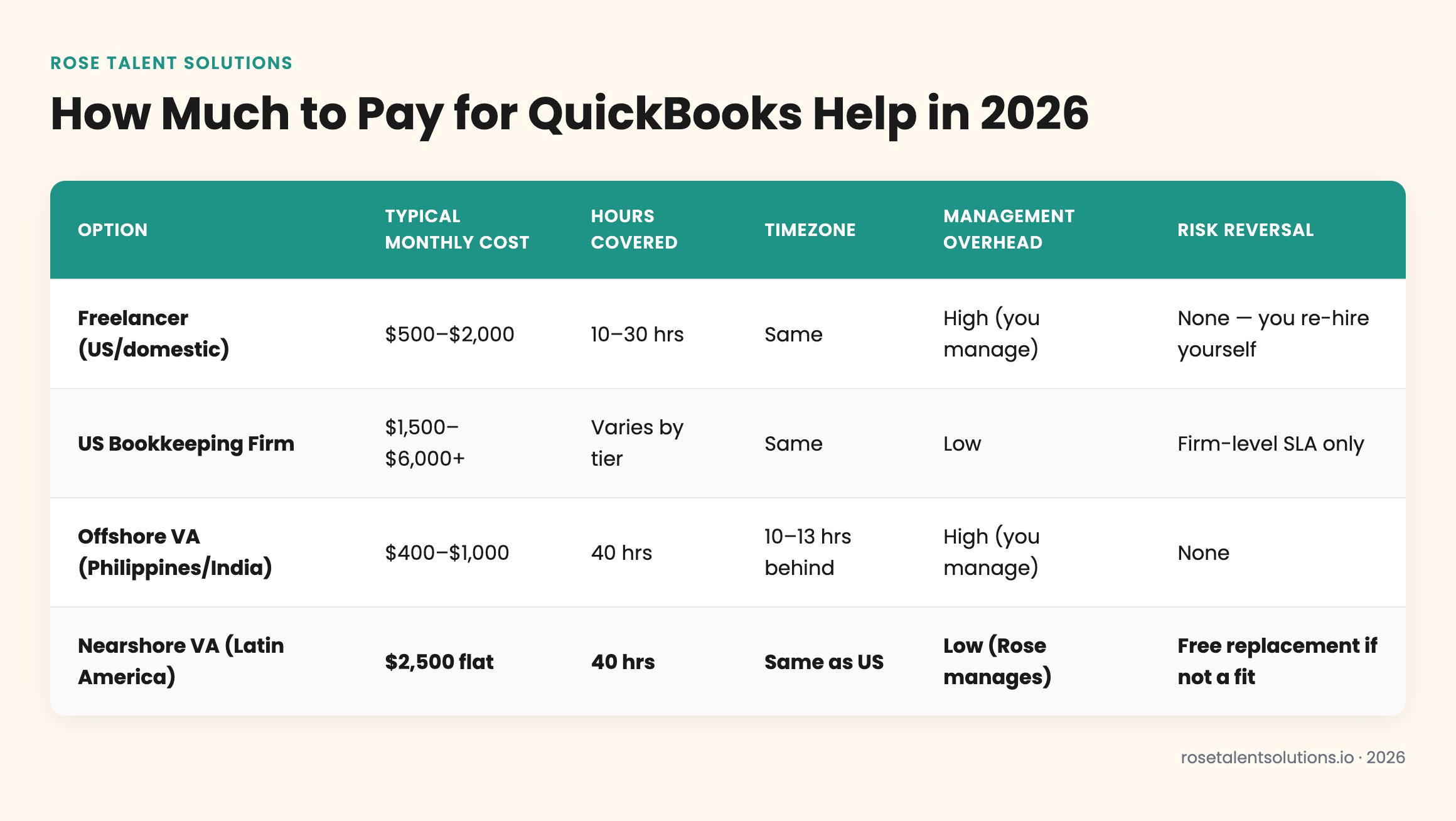
The nearshore model wins on total value when you're doing 40+ hours of bookkeeping work per month. You get a full-time person working your hours, managed by someone else, for less than the cost of a part-time US hire. That's the math most business owners don't run until they've already burned a few thousand dollars testing cheaper alternatives.
What Hidden Costs Do Most QuickBooks Pricing Guides Miss in 2026?
Most pricing guides compare sticker rates. They ignore the four costs that actually make freelance and offshore arrangements expensive in practice.
1. Recruiting and re-hiring time. The average small business owner spends 40+ hours finding, vetting, and onboarding a new bookkeeper, according to SHRM (2023). If your freelancer leaves mid-year, you absorb that cost entirely — plus the risk of books being in transition during your busiest period.
2. Software ramp time. QuickBooks Online, QuickBooks Desktop, and QuickBooks Enterprise each have different workflows. A generalist bookkeeper who hasn't lived in your specific version of QuickBooks for years will cost you corrections and cleanup time in the first 60–90 days. Rose's team members ship with a role-specific AI copilot pre-trained on QuickBooks workflows — which compresses onboarding dramatically.
3. Payroll tax and compliance overhead. When you hire a W-2 bookkeeper directly, you take on payroll taxes, benefits, and HR compliance. The IRS estimates employer payroll taxes add roughly 7.65% to every dollar of wages, plus benefits overhead on top of that, per IRS (2024). A fully-managed flat-rate model eliminates this entirely.
4. Opportunity cost of your own time. If you're currently doing your own QuickBooks — or reviewing someone else's sloppy work every weekend — that's founder time that compounds at whatever your hourly value is. According to Gallup's 2023 State of the Workplace report, small business owners who successfully delegate administrative functions report a 23% increase in time spent on growth activities.
How Does a Nearshore Bookkeeper Handle QuickBooks Differently Than a Generalist?
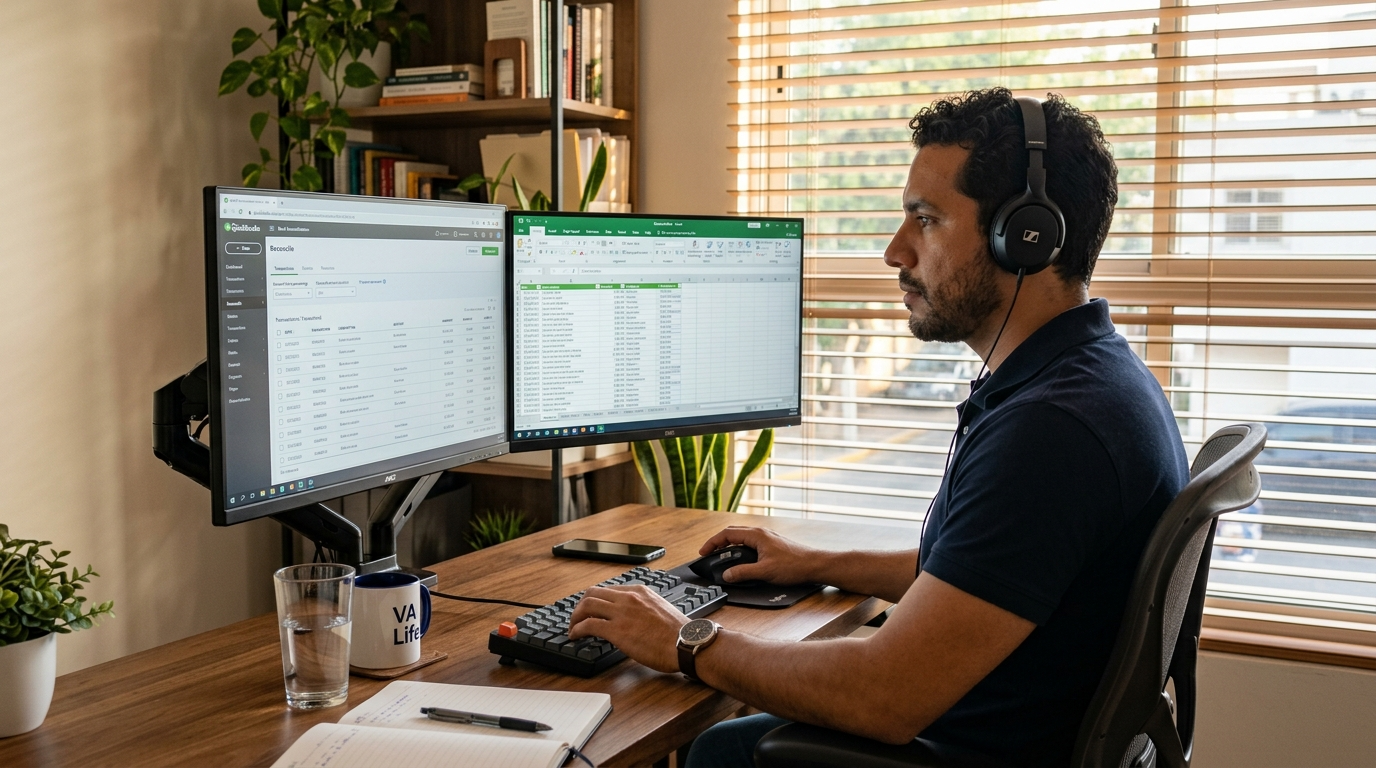
A nearshore virtual bookkeeper is a full-time remote professional based in Latin America, working US business hours, with English fluency and specialized training in the software you actually use. Unlike a generalist VA who handles email and scheduling alongside your books, a nearshore bookkeeper from Rose is dedicated to financial operations — QuickBooks reconciliation, accounts payable and receivable, month-end close, and reporting.
Rose's published English proficiency floor is 8/10 on standardized screening. That matters for bookkeeping specifically because vendor disputes, bank escalations, and client billing conversations all require clear written and verbal communication — not just data entry accuracy. If you're curious how this compares to other platforms, our guide on hiring a nearshore bookkeeper covers the vetting process in detail.
"The number-one mistake small business owners make with bookkeeping is treating it as a task rather than a function. When you hire a dedicated person for the function, your books stop being reactive and start being a management tool." — Rhondalynn Korolak, Business Author & Financial Strategist, On the Shoulders of Giants (2022)
The AI copilot advantage is worth calling out specifically for QuickBooks users. Every Rose team member is paired with a role-specific AI assistant trained on the QuickBooks workflows most relevant to your business — chart of accounts setup, bank feed categorization, class tracking, reporting templates. This isn't a generic chatbot; it's a tool that helps your bookkeeper move faster and catch errors earlier. Learn more about how this works on the AI advantage page.
The real cost of cheap QuickBooks help isn't the hourly rate — it's the re-hiring cycle, the ramp time, and the month-end fire drills that happen when your bookkeeper isn't fully dedicated to your books. A full-time nearshore specialist at $2,500/mo eliminates all three.
Is $2,500/Month Worth It Compared to DIY QuickBooks in 2026?
If you're currently doing your own QuickBooks, the calculation is simpler than it looks. The Bureau of Labor Statistics reports that bookkeeping, accounting, and auditing clerks earn a median wage of $47,440 per year ($22.81/hr) as of 2023. A full-time US bookkeeper with benefits and employer taxes realistically costs $55,000–$70,000 annually — or $4,583–$5,833/mo. At $2,500/mo flat, the nearshore model delivers roughly the same dedicated capacity at 43–57% of the fully-loaded cost.
Even if you're only spending 10–15 hours a month on your own books right now, the question isn't just what those hours cost — it's what they're worth. If your time is worth $150/hr as a business owner, those 15 hours represent $2,250 in opportunity cost. You're essentially already paying near $2,500/mo to do a job a trained specialist could do better. Many small businesses find this framing clarifying when they're on the fence.
It's also worth noting that outsourced bookkeeping has a direct impact on tax accuracy. The IRS estimates that small businesses overpay or underpay taxes due to bookkeeping errors at significant rates — poor categorization alone is one of the most common triggers for amended returns, according to IRS Small Business recordkeeping guidance (2024). A dedicated QuickBooks specialist reduces that exposure materially.
How to Get Started With a QuickBooks Virtual Bookkeeper in 2026
If you've decided a dedicated nearshore bookkeeper makes sense for your business, the process is straightforward. Rose handles recruiting, vetting, payroll, and ongoing HR — you just define the role and approve the match. There's no long-term contract, and if the team member isn't the right fit, Rose replaces them at no additional cost.
Define Your QuickBooks Scope
List what you need covered: reconciliation frequency, AP/AR volume, payroll integration, reporting cadence, and any specific QuickBooks version (Online, Desktop, or Enterprise). The clearer your scope, the faster the match.
Rose Recruits and Vets Candidates
Rose screens for QuickBooks proficiency, English fluency (8/10+ floor), and availability to work your business hours. You receive a shortlist of pre-vetted candidates — typically within a week of scoping.
Approve Your Match and Onboard
Once you approve your bookkeeper, Rose handles payroll and HR from day one. Your team member shows up on your Slack or Teams, joins your accounting workflow, and gets paired with their QuickBooks AI copilot.
Month-to-Month From There
At $2,500/mo flat, you're on a month-to-month arrangement. Cancel with 30 days' written notice — no penalties, no buyout clauses. If it's not working, Rose replaces the team member at no additional cost rather than leaving you to start over.
Many business owners start their research by comparing bookkeeping platforms before deciding between a dedicated person and a software-only solution. If you're also evaluating Xero as an alternative to QuickBooks, our guide on Xero virtual bookkeeping covers how the staffing model maps to that platform too. And if you're a small business owner who hasn't outsourced any back-office functions before, our overview of outsourcing bookkeeping for small businesses is a good starting point for understanding what to delegate first.
Why Nearshore Wins for QuickBooks
- Works your US business hours — real-time communication, no overnight lag
- Full-time dedicated capacity (40 hrs/week) for less than a part-time US hire
- Rose manages recruiting, payroll, HR — zero employer overhead for you
- AI copilot pre-trained on QuickBooks cuts ramp time significantly
- Free replacement if the fit isn't right — no re-hiring risk
Where It Might Not Fit
- Under ~$1M annual revenue with very low transaction volume — a part-time freelancer may suffice
- Businesses needing a US-licensed CPA for tax filing (a nearshore bookkeeper handles the books; your CPA files)
- Owners who prefer in-person presence for sensitive financial oversight
Ready to stop wondering what you should pay and start getting the right person in your books? You can get started with Rose in a single conversation — no lengthy intake forms, no sales cycle. Just a scoping call and a shortlist of pre-vetted QuickBooks bookkeepers ready to work your hours.