
Nearshore bookkeeping has changed the math on accounting costs — but before you decide who handles your books, you need to understand exactly what QuickBooks charges, what your accountant charges on top of that, and where businesses are quietly bleeding money. This guide breaks down every pricing layer of QuickBooks Accountant in 2026, compares the real total cost of different accounting models, and shows you a leaner path that growing businesses are choosing instead.
What Is QuickBooks Online Accountant — and Is It Really Free in 2026?
QuickBooks Online Accountant (QBOA) is a free platform Intuit provides to licensed accounting professionals. It lets CPAs, bookkeepers, and accountants manage multiple client files from a single dashboard without paying a separate subscription for each one. The accountant logs in, sees all client companies in one place, and can access QuickBooks tools, reports, and payroll features across every account they manage.
Here is the important distinction: QBOA itself costs the accountant $0. The cost question people are really asking — "how much is QuickBooks Accountant?" — usually means one of two things: (1) how much does the QuickBooks Online subscription cost that the accountant manages, or (2) how much does hiring a QuickBooks-fluent accountant actually cost per month. Both answers matter, and they are very different numbers.
According to Intuit's official QuickBooks pricing page (2026), QuickBooks Online plans for business clients currently range from $35/month (Simple Start) to $235/month (Advanced). Payroll add-ons push that figure higher. The software cost alone is just the floor — you still need a human to run it.
How Much Do QuickBooks Online Plans Cost in 2026?
The plan your accountant manages on your behalf is a real monthly line item. Intuit adjusts pricing regularly, and the 2026 rates reflect another round of increases. The table below shows current QuickBooks Online tiers, what is included, and which business size each fits. Small business software spending has become a material budget line: Statista's SMB software spending tracker (2024) shows cloud accounting software costs for small businesses rose 18% over the prior two years.
| QuickBooks Plan | Monthly Cost (2026) | Users | Key Features | Best For |
|---|---|---|---|---|
| Simple Start | $35/mo | 1 | Income/expense tracking, invoicing, basic reports | Solopreneurs, freelancers |
| Essentials | $65/mo | 3 | Bill management, time tracking, multi-currency | Small teams (2–10 employees) |
| Plus | $99/mo | 5 | Project profitability, inventory, class tracking | Growing SMBs, property managers |
| Advanced | $235/mo | 25 | Custom roles, batch invoicing, analytics, priority support | Scaling businesses, multi-entity |
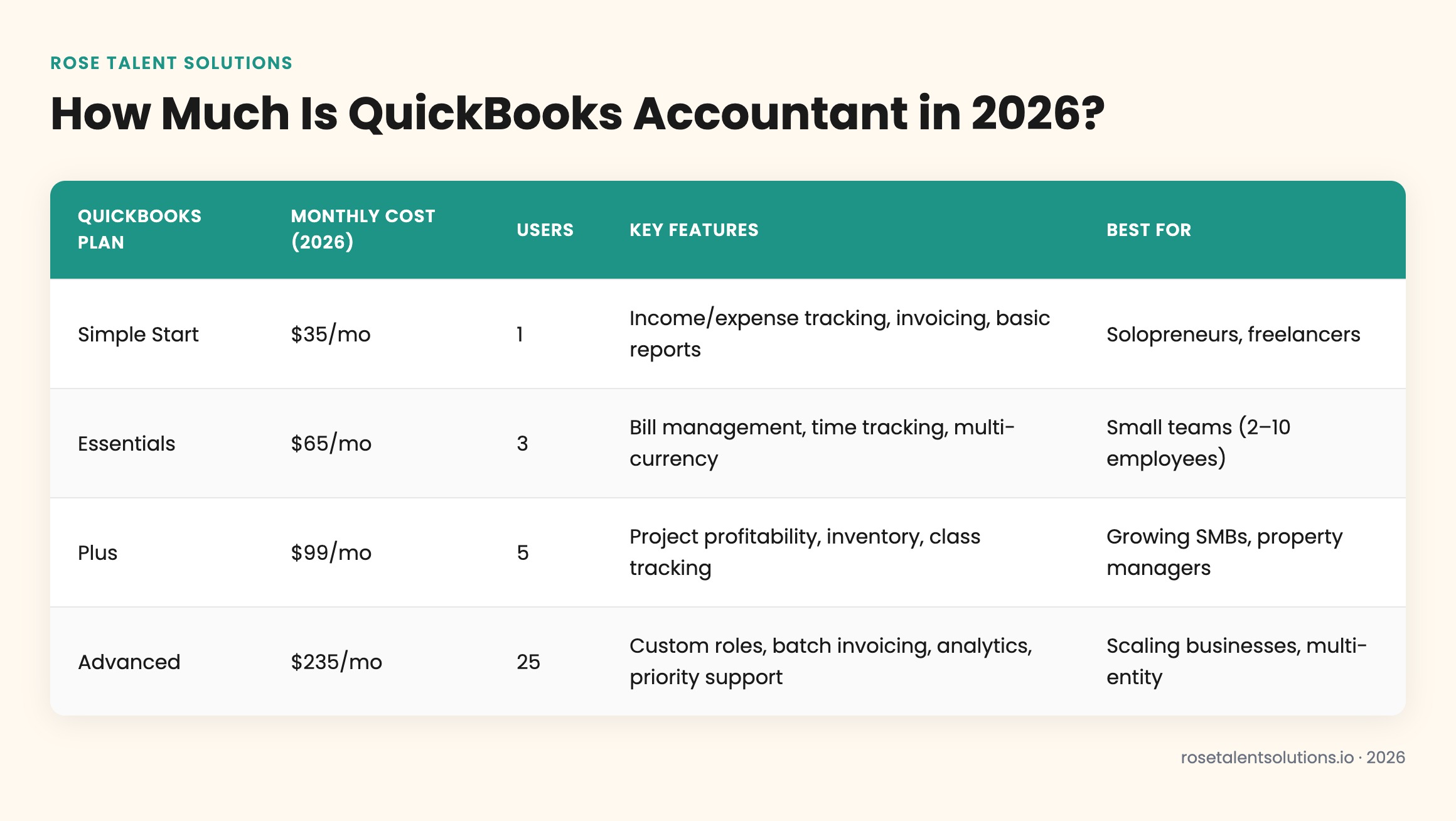
Most small and mid-size businesses land on the Plus plan at $99/month. That number sounds manageable — until you layer in the accountant's hourly rate on top. If your CPA bills 10 hours a month at $125/hour, your real QuickBooks accounting cost is $1,349/month, not $99.

How Much Does Hiring a QuickBooks Accountant Actually Cost in 2026?
This is where most business owners underestimate their spend. A QuickBooks-fluent accountant in the US commands a wide range depending on credential level and engagement type. Bookkeepers (non-CPA) typically charge $25–$60/hour. Staff accountants run $40–$80/hour. CPAs with QuickBooks ProAdvisor certification routinely bill $100–$200/hour for ongoing engagements, according to the U.S. Bureau of Labor Statistics Occupational Outlook (2025).
Full-time in-house accountants are even more expensive when you factor in salary, benefits, payroll taxes, and PTO. The median annual salary for an accountant in the US is $79,880, according to BLS Occupational Employment Statistics (2024) — that is roughly $6,657/month before employer taxes, health insurance, or a software seat. The American Institute of CPAs notes that demand for credentialed accounting professionals continues to outpace supply, which keeps billing rates elevated across all market segments, according to AICPA's Trends in the Supply of Accounting Graduates (2023).
If you are running a property management company, an e-commerce brand, or any business that processes 50+ transactions a month, you need consistent QuickBooks oversight — not an occasional CPA. That is the gap where many businesses are now looking at virtual bookkeepers. Our detailed breakdown of QuickBooks virtual bookkeeper costs covers exactly what you can expect to pay at each model.
How a Nearshore QuickBooks VA Compares to a US Accountant in 2026
A nearshore virtual assistant trained on QuickBooks handles the day-to-day accounting operations that eat most of a CPA's billable hours: categorizing transactions, reconciling bank feeds, managing accounts payable, generating monthly reports, and keeping your books audit-ready. These are not creative or judgment-heavy tasks — they are process tasks, and process tasks are exactly what a well-trained VA excels at.
The critical difference with a nearshore VA versus an offshore hire is time zone alignment. Latin America-based team members work US business hours — Eastern, Central, Pacific — so your bookkeeper is available when you are, not eight hours behind. You can jump on a five-minute Zoom to walk through a vendor dispute the same morning it lands in your inbox. That real-time availability is something Philippines- or India-based staff simply cannot match without working overnight shifts.
"The time zone thing sounds minor until you've waited 36 hours for a categorization fix because your offshore bookkeeper batches everything overnight. Real-time access to your financial data is a competitive advantage." — Loren Feldman, Editor-in-Chief at Inc. and host of the 21 Hats Podcast (2024)
Rose Talent's nearshore bookkeeping VAs arrive pre-trained on QuickBooks workflows — not just familiar with the software, but equipped with a role-specific AI copilot tuned to the exact version and modules your business uses. Learn more about how that works on the AI advantage page. This cuts ramp time dramatically compared to hiring a generalist and training them yourself.
For businesses that also use Xero, the same nearshore model applies — our post on working with a Xero virtual bookkeeper explains how the platform training differs and when Xero beats QuickBooks for your use case.

The true cost of a US accountant is not their hourly rate — it is their hourly rate multiplied by every hour of routine work that a trained VA could handle at a fraction of the price. Most QuickBooks accounting engagements are 70–80% process work and 20–30% judgment work. Splitting those tasks between a VA and a part-time CPA review is where the real savings live.
What Does $2,500/Month Actually Get You vs. $150/Hour in 2026?
At Rose Talent Solutions, the flat rate is $2,500/month for a full-time (40 hours/week) nearshore bookkeeping VA. That includes recruiting, vetting, payroll, HR administration, and ongoing management — nothing extra to add up. Compare that to a US accountant billing 40 hours/month at $125/hour: that is $5,000/month for part-time coverage with no HR overhead included. The math favors the nearshore model before you even factor in quality of output.
There is no long-term contract. If the team member is not a fit, Rose replaces them at no additional cost. That is the only risk reversal on the table — and it is a meaningful one, because the biggest fear most business owners have about hiring a VA is making a bad match and being stuck with it.
Accounts payable is one of the highest-volume, most error-prone tasks in any QuickBooks environment. Our guide on how virtual bookkeepers handle accounts payable walks through the exact workflow Rose VAs use to keep vendor invoices, bill payments, and aging reports clean without constant owner oversight.
For businesses specifically looking for a dedicated bookkeeping hire — not just a general admin — the nearshore bookkeeper guide covers the full hiring criteria, what to look for in screening, and how the Latin America talent pool stacks up against other regions on both cost and English proficiency.
How to Choose the Right QuickBooks Accounting Model in 2026
Choosing between a US CPA, a local bookkeeper, and a nearshore VA is not a one-size answer. It depends on your transaction volume, how complex your entity structure is, and how much judgment-level accounting work you actually need each month. A business processing 200+ QuickBooks transactions monthly with basic categorization needs is a very different situation from a multi-entity holding company with intercompany transfers and audit requirements.
Employee turnover in accounting roles compounds the cost problem. According to SHRM's employee turnover research (2024), replacing an accounting employee costs an average of 50–200% of their annual salary when you account for recruiting, onboarding, and lost productivity. That hidden cost rarely appears in a CFO's monthly variance report — but it is very real. A separate Gallup Workplace study (2023) found that voluntary turnover costs US businesses over $1 trillion annually, with finance and accounting roles among the hardest to backstop quickly. Nearshore staffing with a managed replacement guarantee eliminates that exposure entirely.
Nearshore QuickBooks VA — Pros
- $2,500/month flat, all-in — no hourly surprise invoices
- Full-time 40hrs/week dedicated to your books
- Works US business hours, real-time availability
- Pre-trained on QuickBooks + role-specific AI copilot
- No long-term contract; free replacement if not a fit
- English fluency screened at 8/10+ before placement
US-Based Accountant/CPA — Cons
- $100–$200/hour billing rate for routine tasks
- Often part-time coverage only at SMB budgets
- No built-in HR, payroll, or replacement support
- Onboarding and training costs fall on you
- High turnover: replacing an accounting employee costs 50–200% of annual salary (SHRM, 2024)
Businesses that want to see the full scope of what a nearshore accounting VA can own should start with the bookkeeping and accounting services page — it lists the exact task categories Rose VAs are trained to handle. When you are ready to move forward, the get started page walks you through the three-step intake process.
Define Your QuickBooks Scope
Tell Rose what QuickBooks plan you are on, your monthly transaction volume, and which tasks you want owned by a VA versus kept with your CPA for review. This takes about 15 minutes on an intake call.
Get Matched Within Days
Rose's recruiting team surfaces pre-vetted, QuickBooks-trained candidates from Latin America. Your first placement typically arrives within a week, not a month.
VA Onboards With an AI Copilot
Your new team member comes equipped with a role-specific AI copilot trained on QuickBooks workflows relevant to your industry — reducing ramp time from weeks to days.
The bottom line on QuickBooks accountant pricing in 2026: the software itself is manageable. The labor cost is where businesses overspend. A nearshore bookkeeping VA at $2,500/month flat is the most cost-efficient way to get full-time, software-fluent accounting coverage without signing a long-term contract or absorbing US employment overhead. Explore the bookkeeping and accounting VA services Rose offers, and see if the model fits your current books.