
How Much Does Outsourced Bookkeeping Cost for a Small Business in 2026?
Nearshore outsourced bookkeeping is one of the fastest-growing line items small business owners are cutting — and then immediately re-adding in a smarter form. The question of how much outsourced bookkeeping costs for a small business doesn't have a single answer, because the model you choose determines the real price. You don't cut bookkeeping. You cut the overhead baked into doing it wrong: the local hire with benefits, the freelancer who ghosts you at tax time, or the offshore contractor whose time zone means your books are always a day behind.
In 2026, small business owners choosing outsourced bookkeeping pick from four main structures: freelance platforms, accounting firm retainers, offshore staffing agencies, and nearshore staffing firms. Each has a different pricing mechanism — and a very different total cost once you factor in oversight, turnaround time, and who absorbs the risk when something goes wrong.
According to the U.S. Bureau of Labor Statistics (2024), the median annual wage for a bookkeeping clerk in the United States is $47,440 — or roughly $3,950/month before payroll taxes, benefits, or PTO. That's the baseline any outsourced bookkeeping cost needs to beat to make economic sense.
How Each Outsourced Bookkeeping Pricing Model Works in 2026
Every pricing model for outsourced bookkeeping sounds reasonable on the homepage. The differences show up on month three when your transaction volume spikes, your freelancer raises rates, or your accounting firm bills for "out-of-scope" cleanup work. Understanding how much outsourced bookkeeping costs for a small business means understanding each model's actual pricing mechanics — not just the headline rate.
Freelance platforms (Upwork, Fiverr, Belay): Hourly rates run $15–$60/hour depending on experience and geography. A 20-hour/month engagement at $35/hour is $700 — but bookkeeping rarely stays at 20 hours when your business grows. Platforms also charge 5–20% service fees on top of the freelancer rate. If you're comparing options, our breakdown of QuickBooks virtual bookkeeper costs goes deeper on platform vs. staffing pricing for QuickBooks-specific roles.
Accounting firm retainers: Small CPA firms typically charge $500–$2,500/month for bookkeeping retainers, with higher tiers for monthly close packages or CFO advisory. You're paying a firm's overhead — office space, partner salaries, malpractice insurance — and your books are often handled by a junior staff accountant you've never met.
Offshore staffing agencies (Philippines, India): Rates of $800–$1,500/month for a dedicated bookkeeper look attractive until you price in the 10–14 hour timezone gap, the average 3–6 week ramp time, and the hidden management burden on your side. Timezone misalignment turns every simple question into a 24-hour delay.
Nearshore staffing firms (Latin America): Flat rates of $2,000–$2,500/month for a full-time, dedicated bookkeeper who works your US business hours, speaks English at a professional level, and arrives pre-vetted and pre-trained on your software stack. Rose Talent Solutions charges $2,500/month all-in — recruiting, vetting, payroll, HR, and ongoing management included. No surprise invoices. No overages.
How the Four Outsourced Bookkeeping Models Compare Side by Side in 2026
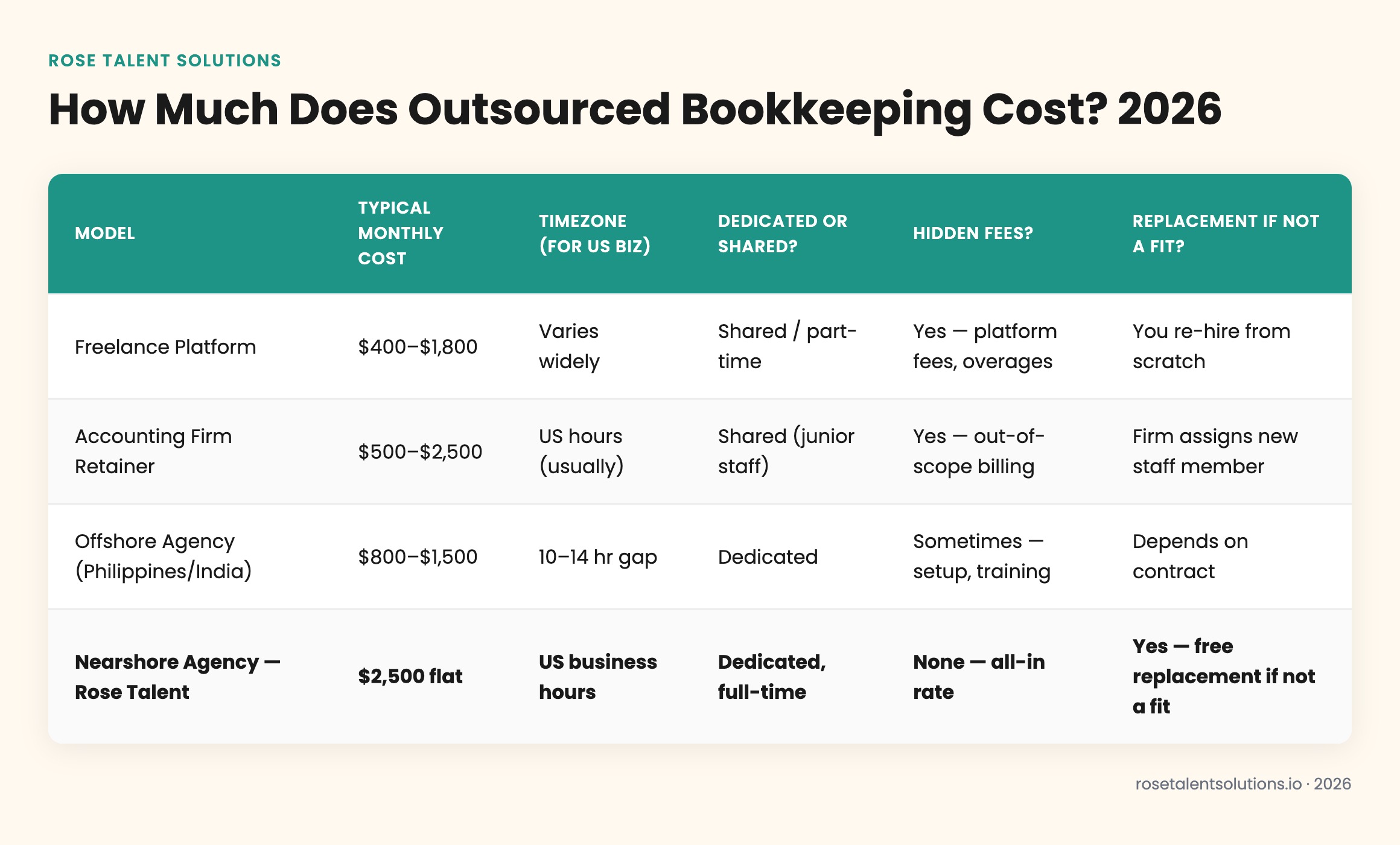
Cost-per-month is only one variable when calculating how much outsourced bookkeeping costs for a small business. Owners consistently underestimate the management tax — the time you spend chasing updates, re-explaining context, and fixing errors. The table below captures the full picture across four models. If you're doing your due diligence on whether to outsource your small business bookkeeping at all, this comparison is the right starting point.
| Model | Typical Monthly Cost | Timezone (for US biz) | Dedicated or Shared? | Hidden Fees? | Replacement if Not a Fit? |
|---|---|---|---|---|---|
| Freelance Platform | $400–$1,800 | Varies widely | Shared / part-time | Yes — platform fees, overages | You re-hire from scratch |
| Accounting Firm Retainer | $500–$2,500 | US hours (usually) | Shared (junior staff) | Yes — out-of-scope billing | Firm assigns new staff member |
| Offshore Agency (Philippines/India) | $800–$1,500 | 10–14 hr gap | Dedicated | Sometimes — setup, training | Depends on contract |
| Nearshore Agency — Rose Talent | $2,500 flat | US business hours | Dedicated, full-time | None — all-in rate | Yes — free replacement if not a fit |
What Hidden Costs Inflate the Real Price of Outsourced Bookkeeping?
The advertised rate is never the total cost. When small business owners ask how much outsourced bookkeeping costs, they rarely factor in turnover. According to SHRM (2023), the average cost to replace an employee is six to nine months of their salary. For a $47,000 bookkeeper, that's $23,000–$35,000 in replacement costs if the hire doesn't work out. Freelance churn is even higher — the average freelance engagement on Upwork lasts under six months before the client re-sources.
The hidden costs that inflate outsourced bookkeeping pricing for small businesses fall into four categories:
- Onboarding and ramp time: Every new bookkeeper needs 2–6 weeks to learn your chart of accounts, your close process, and your software. That's unbillable drag on your own calendar.
- Software licensing: Many freelancers expect you to supply QuickBooks Online, Xero, or Gusto access. Firm retainers often include it — but only in their higher tiers.
- Oversight and correction time: If your bookkeeper operates overnight and you check their work each morning, you are de facto a bookkeeping manager. That time has a cost.
- Error cleanup: The IRS recommends keeping business records for at least three years. Errors that compound over that period are exponentially more expensive to clean up than to prevent.
"Small businesses spend an average of 120 working hours per year on federal taxes alone — and bookkeeping errors are the single largest driver of that number." — National Small Business Association, NSBA 2024 Small Business Taxation Survey (2024)
The hidden cost of cheap outsourced bookkeeping for a small business isn't the hourly rate — it's the 4–6 hours per month you spend re-explaining context, checking for errors, and managing a contractor who isn't fully committed to your business. A dedicated nearshore bookkeeper working 40 hours/week on your books eliminates that management tax entirely.
How Rose Talent's Nearshore Bookkeeping Model Solves the Cost Problem in 2026
Rose Talent Solutions places dedicated, full-time bookkeepers from Latin America into US, Canadian, and UK small businesses at $2,500/month flat. That rate covers everything: recruiting, skills vetting, English proficiency screening (8/10 minimum), payroll, HR compliance, and ongoing performance management. You don't manage a contractor relationship — you manage the work output. For small businesses evaluating how much outsourced bookkeeping should cost, this all-in structure makes the math straightforward: one flat number, zero hidden fees.
Every bookkeeper Rose places ships with a role-specific AI copilot trained on their primary software — QuickBooks, Xero, FreshBooks, or whichever stack you use. That AI layer cuts onboarding time significantly and reduces the category of errors that stem from unfamiliarity with software workflows. If you're specifically evaluating Xero, the guide to hiring a Xero virtual bookkeeper covers what to look for in vetting and setup.
The engagement runs month-to-month. No long-term contract. Cancel with 30 days written notice. And if your bookkeeper isn't the right fit for your business, Rose replaces them at no additional cost — no re-recruiting fee, no gap in coverage.
According to Intuit QuickBooks (2024), small businesses that outsource bookkeeping to a dedicated professional — rather than managing it in-house or using a part-time freelancer — report spending 40% less time on financial administration per month. That time goes back into revenue-generating activity.
How to Get Started with Nearshore Outsourced Bookkeeping for Your Small Business
The process of getting a dedicated nearshore bookkeeper placed and productive is faster than most small business owners expect. Rose's matching and onboarding sequence runs on a defined timeline so you're not waiting 60 days for a hire to materialize. Here's how it works:
Discovery Call
You describe your business, your software stack, your transaction volume, and the specific tasks you need owned. Rose scopes the role and confirms the right skill profile.
Candidate Matching
Rose surfaces 2–3 pre-vetted candidates from Latin America who match your software requirements and have cleared the 8/10+ English proficiency screen. You review profiles and select.
Onboarding with AI Copilot
Your bookkeeper starts with a role-specific AI copilot trained on your software. Rose manages payroll and HR from day one — you focus on outputs, not administration.
Ongoing Management Support
Rose stays in the loop on performance. If anything isn't working, you have a direct line to swap the team member at no extra cost — no long-term contracts, no friction.
To see the full scope of bookkeeping and accounting roles Rose places — from AR/AP specialists to full-charge bookkeepers — visit the bookkeeping and accounting services page. When you're ready to move forward, start the matching process here.
Is Nearshore Outsourced Bookkeeping the Right Choice for a Small Business?
The nearshore model isn't right for every business at every stage. Here's an honest look at where it excels and where it doesn't — so you can decide whether the $2,500/month outsourced bookkeeping cost makes sense for your specific situation.
Nearshore Bookkeeping — Works Well When
- You need full-time coverage (30–40 hrs/week) but can't justify a $55K+ US salary with benefits
- Your books require daily attention — bank reconciliations, AR aging, expense categorization
- You want someone who works your hours and can jump on a Zoom for a 10-minute close review
- You use QuickBooks, Xero, FreshBooks, or another mainstream platform your bookkeeper can be trained on
- You've outgrown a part-time freelancer but aren't ready for an in-house finance hire
Consider Alternatives When
- You only need 5–10 hours/month of bookkeeping (a freelancer is cheaper at that volume)
- Your books require a licensed CPA for tax prep or audit defense (Rose places bookkeepers, not CPAs)
- Your industry has highly specialized compliance requirements that demand local licensing
For businesses at the $500K–$5M revenue range running QuickBooks or Xero and growing their transaction volume month over month, a dedicated nearshore bookkeeper at $2,500/month is almost always the better economic decision than a US hire or an accounting firm retainer. For a deeper look at what the nearshore bookkeeper model looks like specifically, the nearshore bookkeeper guide covers role scope, vetting criteria, and software specializations in detail.
According to Deloitte's Global Outsourcing Survey (2023), 57% of companies outsource to reduce costs, but 47% also cite the need to focus on core business functions as a primary driver. For small business owners, outsourcing bookkeeping to a nearshore professional does both simultaneously — and the all-in flat rate makes the ROI straightforward to calculate from month one.