
What Does Outsourced SDR Cost in 2026?
Nearshore outsourced SDRs are reshaping what US and Canadian businesses pay to build pipeline — and the price gap between provider models is wider than most buyers expect going in. If you've searched "outsourced SDR cost" hoping for a clean number, here it is: most engagements land between $3,000 and $12,000 per month, but that range hides enormous variation in what's actually included. Timezone alignment, technology stack, contract length, and meeting quality standards can swing your real cost-per-meeting by 3x or more.
This guide breaks down every cost layer — retainer models, per-meeting fees, hidden tech costs, onboarding investment, and the geographic pricing differences that most vendor comparison posts ignore. By the end, you'll know exactly what to ask before signing anything.
Sales development representative (SDR) outsourcing means hiring a third-party provider to handle outbound prospecting, cold outreach, and meeting-setting on your behalf. Unlike a full-cycle sales hire, an outsourced SDR is focused exclusively on top-of-funnel activity — generating qualified meetings that your closers convert. The "outsourced" model means the SDR is employed by the vendor, not you, which shifts payroll, benefits, and management overhead off your books.
How the 4 Types of Outsourcing Apply to SDR Hiring in 2026
Understanding the four classic outsourcing models helps you decode vendor pricing immediately. Onshore outsourcing means a US-based agency staffing US SDRs — highest cost, best cultural alignment, easiest compliance. Nearshore outsourcing means Latin America-based SDRs working your exact time zone — strong English, 30–50% lower cost than onshore. Offshore outsourcing means Philippines or India-based teams — lowest sticker price, but timezone gaps of 8–13 hours create real accountability problems for live prospecting. Professional employer organization (PEO) / co-employment models let you hire a dedicated SDR abroad through a staffing partner that handles payroll and HR while you manage the work.
For most US businesses running outbound prospecting, nearshore and PEO/co-employment models deliver the best balance of cost, availability, and quality control. The timezone factor alone is often the deciding variable — an SDR who can't call your prospects during their business day isn't generating pipeline; they're generating activity reports.

How Geographic Location Drives Outsourced SDR Cost Per Month
Geography is the single biggest lever on outsourced SDR pricing, yet most comparison articles collapse the whole market into one line. Here's the real breakdown by region for 2026:
| Model | Location | Monthly Cost Range | Timezone Fit (US East) | Avg. English Level | Typical Contract Length |
|---|---|---|---|---|---|
| Onshore Agency | United States | $8,000–$15,000+ | Perfect | Native | 6–12 month minimum |
| Nearshore Staffing | Latin America | $2,500–$5,000 | Same / overlapping | 8/10+ fluent | Month-to-month available |
| Offshore Agency | Philippines | $1,500–$3,500 | 8–13 hr gap | Variable | 3–6 month minimum |
| Offshore Agency | India | $1,200–$3,000 | 9–13 hr gap | Variable | 3–6 month minimum |
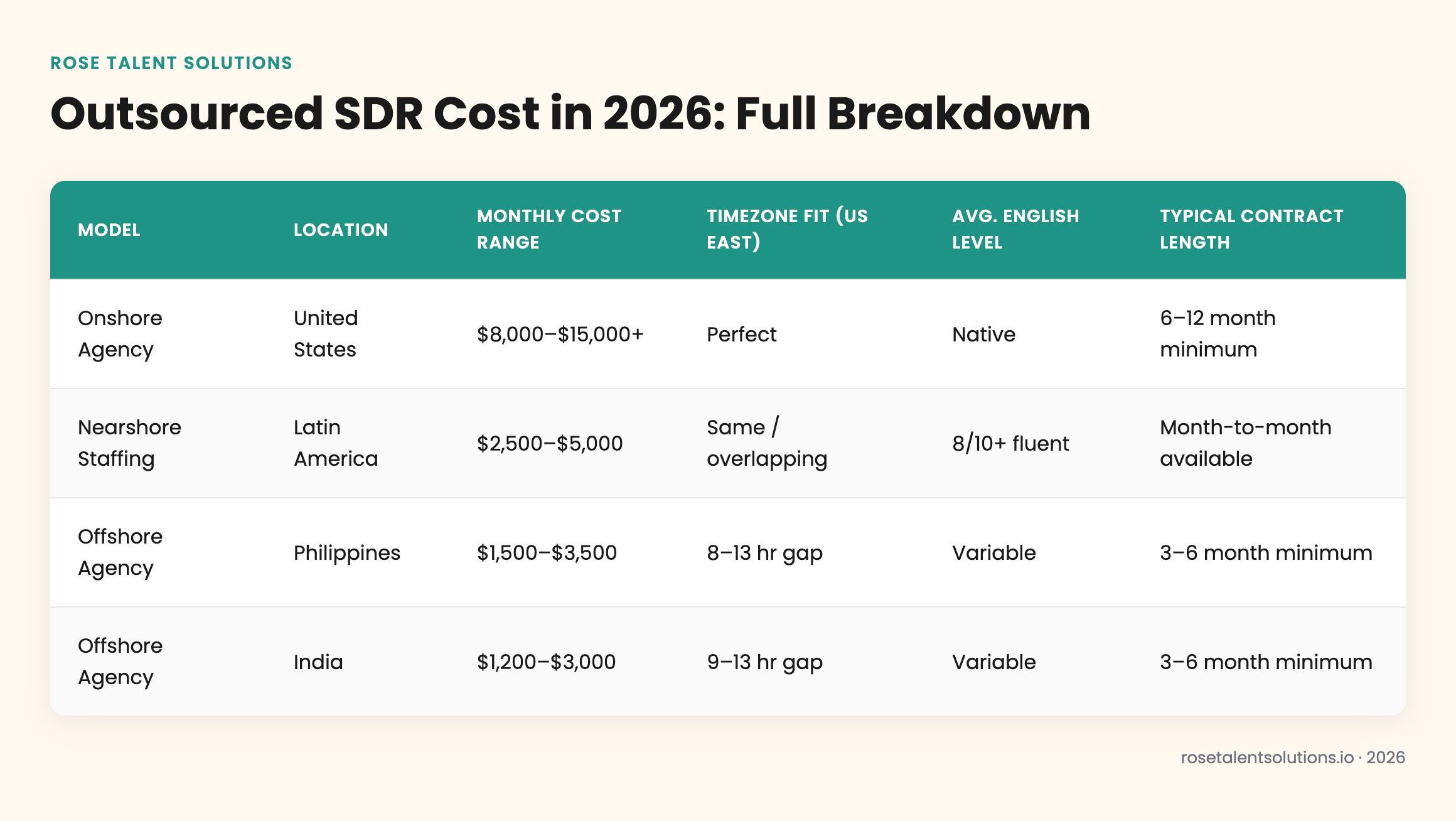
Figures reflect all-in agency retainer pricing for one dedicated SDR equivalent. Costs vary by ICP complexity and tech stack inclusions. Sources: Clutch, G2, and vendor-published pricing as of Q1 2026.
The offshore cost advantage looks compelling until you model the real workflow. A Philippines-based SDR working a 10-hour night shift to match EST business hours is either burning out or batching calls at off-peak times — both outcomes hurt conversion rates. According to the U.S. Bureau of Labor Statistics Monthly Labor Review (2023), worker productivity in roles requiring real-time communication drops measurably when forced into permanent off-hours schedules.
What Is Actually Included in Outsourced SDR Cost — And What Gets Added Later
This is the gap no competitor article covers adequately: technology stack costs that appear after you sign. Most outsourced SDR agencies quote a retainer that covers the human labor only. The tools your SDR needs to actually prospect — a sequencer, a dialer, a data provider, and a CRM seat — are frequently billed separately or passed through to you at retail rates.
A realistic technology stack for one SDR breaks down as follows: a sales engagement platform like Outreach or Salesloft runs $100–$150/seat/month; a dialer (Aircall, Dialpad, or Orum) adds $60–$130/month; a data provider like Apollo, ZoomInfo, or Clay runs $50–$800/month depending on contact volume; and a CRM seat (Salesforce or HubSpot) adds another $50–$150/month. That's $260–$1,230/month in tech overhead on top of your agency retainer that many vendor quotes don't mention until the SOW arrives.
Always ask any outsourced SDR vendor: "Does your monthly fee include the sequencer, dialer, and data provider — or are those passed through to me?" The honest ones answer immediately. Vendors who hedge are usually billing them separately at markup.
At Rose Talent Solutions, the AI copilot advantage is built into the flat $2,500/month rate. Every team member ships with a role-specific AI assistant trained on the exact tools they'll use in your stack — so your SDR isn't learning the software on your dime. According to McKinsey Digital Insights (2024), employees who use AI assistance in their workflow demonstrate 20–40% faster task completion on tool-dependent work. That's not a small number when your SDR's primary job is high-volume outreach sequencing.
How Ramp Time Inflates the True Outsourced SDR Cost Per Hour
Outsourced SDR cost per hour is a common comparison metric, but it's almost useless without factoring in ramp time — the weeks between contract start and first qualified meeting. Ramp time varies significantly by industry, and it's a cost multiplier that nobody prices into their "per hour" math.
In SaaS, a well-prepared outsourced SDR with a solid ICP brief and playbook typically hits their first qualified meeting in 2–4 weeks. In healthcare or financial services, compliance requirements, longer buying cycles, and harder-to-reach personas can push that to 6–10 weeks. During ramp, you're paying full retainer for sub-capacity output. According to SHRM's research on workforce productivity (2023), the average new sales hire reaches full productivity at week 12 — outsourced SDRs with strong onboarding documentation can cut that to 4–6 weeks, but only if you give them what they need.

The hidden onboarding cost is also real: estimating conservatively, your internal team will spend 15–25 hours in the first month on ICP documentation, playbook creation, tool access setup, and introductory calls. At a $150/hr internal time value, that's $2,250–$3,750 in invisible cost you never see on the vendor invoice. Build this into your ROI model from day one.
How Contract Terms and Exit Clauses Affect Your Total Outsourced SDR Cost
Most competitor articles skip this entirely. Contract structure is a significant cost risk. Onshore US agencies almost universally require 6–12 month minimum commitments, often with 60–90 day written notice requirements to cancel. If your SDR underperforms at month two, you may owe 4–10 more months of retainer regardless. That transforms a $9,000/month contract into a $90,000 commitment if you're locked into 10 months.
Red flags to watch in any outsourced SDR contract: auto-renewal clauses with short opt-out windows (typically 30–60 days before renewal), performance carve-outs that let the vendor define what counts as a "qualified meeting," and IP ownership language around the prospect lists your SDR builds on your behalf. If the vendor owns the contact data at termination, you lose the pipeline asset when you leave.
Month-to-Month Terms (Nearshore Model)
- Cancel with 30 days written notice — no long-term contract
- Replace underperforming SDR at no additional cost
- Scale up or pause based on actual pipeline needs
- Lower financial risk during ramp period
Long-Term Agency Contracts (Typical Onshore)
- 6–12 month minimums lock in cost regardless of performance
- 60–90 day cancellation notice windows
- Tech stack billed separately, often at markup
- Vendor may own prospect data at contract end
Rose Talent Solutions operates on month-to-month terms. Cancel with 30 days written notice — no long-term contract required. If your dedicated SDR isn't a fit, we replace them at no additional cost. That's the full risk reversal: one flat fee, no lock-in, free replacement if something isn't working.
How to Calculate Your Real Outsourced SDR Cost in 2026
A reliable outsourced SDR cost calculator doesn't need to be software — it needs the right inputs. Most buyers only price the retainer. Here's the complete formula:
Start with the Base Retainer
Get the all-in monthly fee from your vendor and confirm whether it includes a dedicated headcount or a fractional SDR team. Fractional models often deliver fewer than 20 dedicated hours per week — confirm the hours explicitly.
Add Technology Stack Costs
Itemize sequencer, dialer, data provider, and CRM costs. If the vendor doesn't include them, add your real monthly tech spend — typically $260–$1,230/month for one SDR.
Calculate Onboarding Time Cost
Estimate internal hours your team will spend in month one on ICP documentation, playbook prep, and setup. Multiply by your internal hourly rate or opportunity cost. Add this as a one-time upfront cost.
Factor in Ramp Period
Divide your monthly retainer by the number of qualified meetings expected at full ramp. Then multiply by your ramp period (weeks) to calculate your cost-per-meeting during the learning curve — this is where most ROI models break down.
Divide by Qualified Meetings at Steady State
Once ramped, your cost-per-meeting should be (monthly retainer + tech) ÷ meetings booked. Benchmark: competitive outsourced SDR programs target $300–$800 per qualified meeting at steady state, per industry averages from Sales Benchmark Index (2024).
If you're running a business that needs more than just SDR coverage — bookkeeping, admin, or client coordination alongside your sales function — Rose also places dedicated bookkeeping and accounting virtual staff and full-spectrum property management coordinators at the same $2,500/month flat rate. Many clients run two or three roles simultaneously once they see the per-role economics.
According to Deloitte's Global Outsourcing Survey (2023), 70% of companies that outsource cite cost reduction as the primary driver — but 40% say the actual savings fell short of projections because of hidden transition costs they didn't model in advance. The businesses that hit their ROI targets are the ones who built the full cost picture before signing, not after.
To see how the Rose model compares to building this role in-house, explore the AI advantage page — it explains how every Rose team member's AI copilot compresses ramp time and reduces the internal management load that typically eats the first 60 days of any new outsourced engagement.