
Nearshore software developers are reshaping how US, Canadian, and UK companies hire technical talent — and pricing is the first thing every founder or engineering manager wants to nail down before making a move. If you've been quoted $12,000–$18,000 a month for a US-based mid-level developer and the number made you wince, you're not alone. The nearshore model exists precisely because there's a better way to get the same caliber of engineering work done at a fraction of the fully-loaded domestic cost — with team members based in Latin America, not thousands of miles east in a completely different hemisphere.
This guide breaks down exactly what nearshore software developer rates look like in 2026, what drives the variance, and how to evaluate total cost — not just the hourly number you see on a marketplace listing.
According to the U.S. Bureau of Labor Statistics (2024), the median annual wage for software developers in the United States sits at $132,270 — a figure that does not include employer payroll taxes, benefits, PTO accrual, or recruiting costs. When you add those in, the real fully-loaded cost of a US developer is typically $160,000–$200,000 per year. Nearshore developers in Latin America deliver comparable technical output at a dramatically lower total cost without the timezone penalties that come with traditional remote hiring arrangements in far-distant time zones.
What Is a Nearshore Software Developer, Exactly?
A nearshore software developer is a full-time technical professional based in a geographically proximate country — typically in Latin America for US and Canadian businesses — who works standard North American business hours, communicates fluently in English, and integrates directly into your existing dev team. The "nearshore" label distinguishes this model from offshore outsourcing, where developers work asynchronously due to 8–12 hour time zone gaps.
Unlike a freelancer on Upwork or a body-shop contractor, a properly placed nearshore developer is dedicated exclusively to your company. They attend your standups, use your Jira board, push to your GitHub repos, and collaborate in real time with your onshore teammates. Real-time collaboration is the defining advantage that separates nearshore from every other distributed model — and it is why companies that switch rarely go back.
Rose Talent Solutions places nearshore developers based in Latin America who meet an 8/10+ English proficiency floor, pass technical vetting, and ship with a role-specific AI copilot trained on the tools your stack actually uses. If you want to understand the full model before diving into pricing, the dedicated nearshore developer team guide covers how these engagements are structured end to end.
How Much Does a Nearshore Software Developer Cost in 2026? The Real Numbers
Nearshore developer pricing in 2026 breaks into three distinct models: independent contractor marketplaces, boutique staffing agencies, and managed flat-rate staffing. Each has a different cost structure and a very different risk profile.
Marketplace / platform model: Platforms like Toptal, Deel, and Remote list Latin American developers at $25–$75/hour depending on seniority and specialization. At 40 hours/week, that is $4,000–$12,000/month before platform fees, which typically add another 10–20% on top. You handle recruiting, vetting, contracts, payroll compliance, and HR yourself — or pay additional fees for each service layer.
Project-based agencies: Traditional nearshore development agencies price by sprint or project scope. Monthly retainers for a single dedicated developer typically run $5,000–$9,000/month. These arrangements often embed the developer in the agency's management structure rather than yours, which creates communication layers that slow velocity.
Flat-rate managed staffing: Rose Talent Solutions charges $2,500/month flat for a full-time (40 hrs/week) dedicated nearshore developer. Recruiting, vetting, payroll, HR, and ongoing account management are all included. There is no long-term contract — cancel with 30 days written notice — and if the team member is not a fit, Rose replaces them at no additional cost.

According to SHRM's benchmarking research (2023), the average cost-per-hire for a software developer in the United States is $4,700 — and that is before the developer starts. Factor in 30–90 days to fill the role and another 30–60 days to reach full productivity, and the true ramp cost exceeds $20,000 per hire. The flat-rate managed staffing model eliminates that exposure entirely.
Nearshore vs. Offshore vs. Onshore: A 2026 Cost Comparison
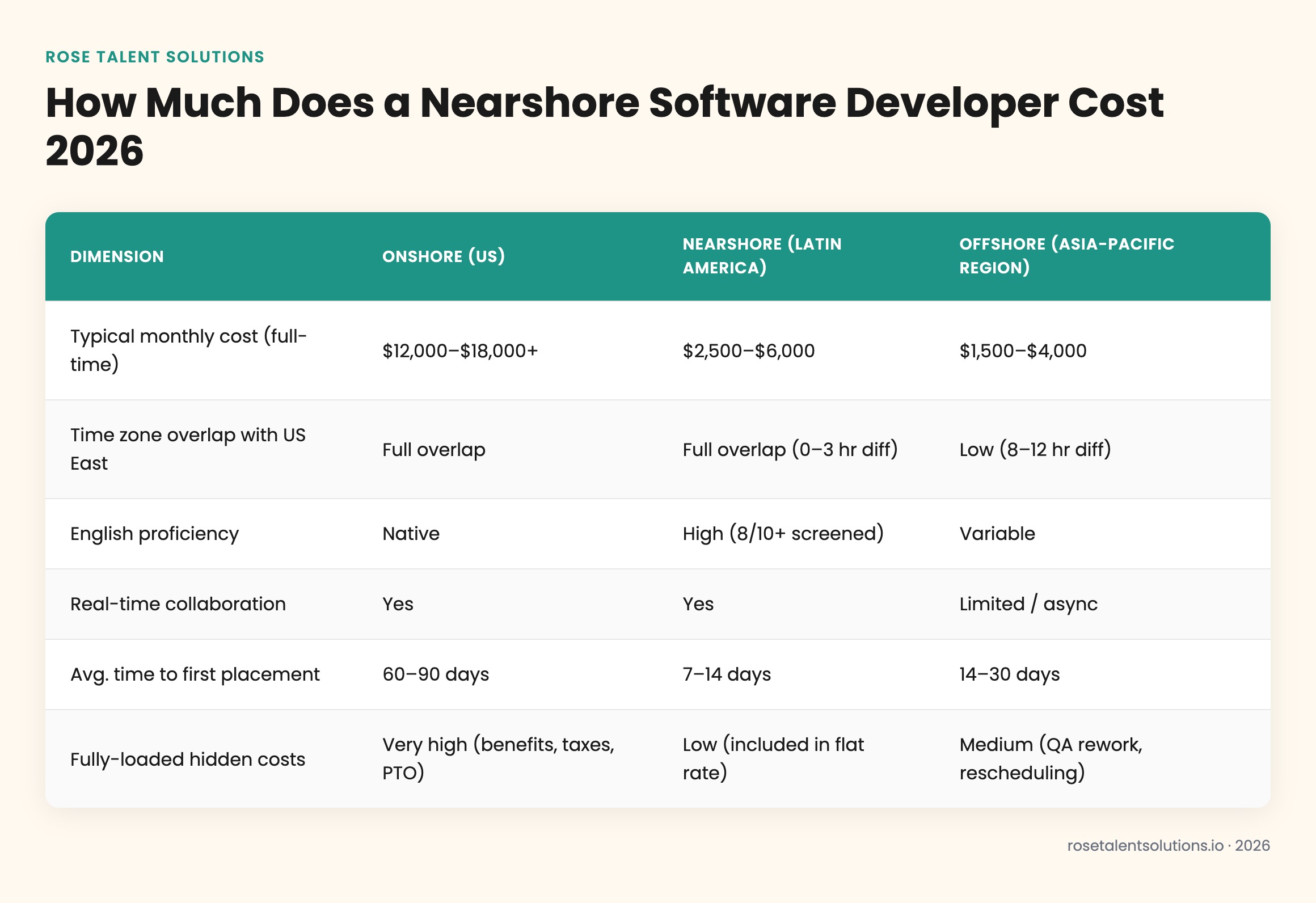
The table below maps the six dimensions that actually matter when you are making a hiring decision — not just the sticker rate. Asynchronous offshore arrangements are technically cheaper on the hourly line, but the hidden costs accumulate fast when you are debugging at 11pm because your developer's day started at 8am your time the following morning.
| Dimension | Onshore (US) | Nearshore (Latin America) | Offshore (Asia-Pacific region) |
|---|---|---|---|
| Typical monthly cost (full-time) | $12,000–$18,000+ | $2,500–$6,000 | $1,500–$4,000 |
| Time zone overlap with US East | Full overlap | Full overlap (0–3 hr diff) | Low (8–12 hr diff) |
| English proficiency | Native | High (8/10+ screened) | Variable |
| Real-time collaboration | Yes | Yes | Limited / async |
| Avg. time to first placement | 60–90 days | 7–14 days | 14–30 days |
| Fully-loaded hidden costs | Very high (benefits, taxes, PTO) | Low (included in flat rate) | Medium (QA rework, rescheduling) |
"The total cost of a software engineering hire goes well beyond salary. When you account for recruiting fees, benefits, payroll taxes, and the ramp time to full productivity, a $100K developer actually costs the business $140K–$160K in year one." — Josh Bersin, Global Industry Analyst & Founder at The Josh Bersin Company (2023)
What Drives Nearshore Developer Rate Variance in 2026?
Not all nearshore rates are equal, and understanding the levers helps you benchmark honestly. Four factors move the number the most: seniority, specialization, country, and staffing model overhead.
Seniority: A junior developer with 1–2 years of experience working through a managed staffing model might cost $2,500–$3,500/month all-in. A senior engineer with 7+ years and deep specialization in a niche stack could run $5,000–$7,000/month through a boutique agency. Rose's flat $2,500/month covers roles across that range because the model is built around right-fitting — not up-selling you on seniority you do not need.
Specialization: Full-stack generalists are priced differently from specialists. If you are looking specifically to hire a nearshore Node.js developer or someone with deep Python expertise, expect the market to reflect those skill premiums — though managed staffing models absorb much of that variance into a single flat number.
Country: Latin America is not monolithic. Argentina's developer market is particularly strong — the country produces over 115,000 engineering graduates annually according to Argentina's INDEC (2023) — with deep talent in Python, data engineering, and backend systems. Colombia, Mexico, and Brazil each have distinct talent pools and slightly different rate bands. If you want to go deep on the Argentina-specific market, the guide to hiring an Argentine software developer covers what makes that talent pool stand out.
Staffing model overhead: A platform like Toptal charges a 30–40% markup on developer time. Traditional agencies embed management overhead in their retainer. Rose charges $2,500/month flat — the same price regardless of how much recruiting time went into your placement. According to Gallup's workplace research (2023), replacing an employee costs approximately one-half to two times that employee's annual salary — making turnover risk one of the most underestimated line items in any technical hiring budget.
The hourly rate is almost never the real cost driver. The hidden costs — recruiting fees, onboarding time, rework from async miscommunication, and turnover — are what make distant offshore arrangements look cheap on paper and expensive in practice. A fully-loaded nearshore engagement at $2,500/month flat is almost always cheaper than a $25/hour async contractor when you model the full picture.

According to Stack Overflow's Developer Survey (2024), 62% of developers now work fully remotely, making geographic co-location a non-factor for most modern engineering teams. The question is not whether remote works — it is whether your remote developer is reachable during your working hours. Time zone alignment is the variable that separates nearshore from every other remote model, and it is the one factor you cannot buy your way out of on an hourly marketplace.
How Rose Talent Solutions Prices Nearshore Developer Placements in 2026
Rose's model is built around one number: $2,500/month, flat, for a full-time dedicated nearshore developer based in Latin America. There are no setup fees, no per-hire recruiting charges, and no seat licenses. Every team member ships with a role-specific AI copilot trained on the tools your stack uses — whether that is GitHub, Jira, VS Code extensions, or specific frameworks. You can learn more about how that works on the AI advantage page.
The replacement guarantee is straightforward: if the developer is not the right fit for your team, Rose finds a replacement at no additional cost. That is the only risk reversal on offer — and it is the right one, because fit is the variable that matters most in long-term engineering relationships.
Intake & Role Definition
Rose's team interviews you about your stack, team structure, and the specific role requirements — so the match is based on real criteria, not keyword matching on a resume.
Vetting & Shortlisting
Candidates are screened for English proficiency (8/10+ floor), technical skills, and culture fit. You receive a curated shortlist — typically within 7 days.
Interview & Selection
You interview your top candidates and make the call. Rose handles the offer, onboarding logistics, payroll setup, and HR paperwork.
Day-One Readiness
Your developer arrives with their AI copilot configured, your tools set up, and access provisioned — ready to attend standup and contribute on day one.
Is Nearshore Right for Every Software Development Need in 2026?
Nearshore works best for ongoing, embedded roles — the full-time developer who owns a feature area, manages a microservice, or runs your QA pipeline. It is not the right model for a one-off 20-hour project. If you need a specialist for a discrete deliverable, a project-based agency or freelance platform makes more sense. But if you are building a team or backfilling a headcount gap, nearshore full-time placement is almost always the higher-ROI path.
For teams exploring Python-heavy workloads, hiring a nearshore Python developer through a managed model gives you the language specialist you need without the six-figure salary commitment. According to McKinsey Digital (2023), companies that distributed technical work across nearshore teams reported 20–35% faster feature delivery cycles compared to purely onshore teams — driven primarily by lower turnover and faster backfill times when roles opened up.
Nearshore: Pros
- Full US business hours overlap — real-time standups, code reviews, and Slack responses
- Flat-rate pricing eliminates recruiting and HR overhead
- High English fluency (Rose screens at 8/10+)
- No long-term contract — cancel with 30 days written notice
- AI copilot included, configured for your specific stack
- Free replacement if the developer is not a fit
Nearshore: Cons
- Not the right fit for one-off or sub-20-hour projects
- Slightly higher base rate than deep async marketplaces on a pure hourly comparison
- Requires your team to invest in onboarding just as with any new hire
The bottom line on cost: if your fully-loaded US developer hire costs $160,000/year and a Rose nearshore developer costs $30,000/year with comparable technical output, the ROI math is not subtle. Ready to see who is available? The get started page walks you through the intake process in under five minutes.