
Nearshore bookkeepers have quietly become the most cost-efficient full-time option for US businesses in 2026 — but most owners don't realize that until after they've already overpaid. Whether you're weighing a local hire, a freelance platform, or a virtual staffing agency, the real answer to "how much does a bookkeeper cost" depends heavily on which model you choose. This guide breaks down every option with real numbers, so you can make the right call for your business.
What Does a Bookkeeper Actually Do in 2026?
A bookkeeper records daily financial transactions, reconciles bank statements, manages accounts payable and receivable, and prepares reports so your accountant (or you) can make informed decisions. A bookkeeper is not the same as a CPA or controller — they handle the ongoing data entry and categorization work that keeps your books clean and audit-ready.
In 2026, most bookkeepers also work inside cloud software like QuickBooks Online, Xero, FreshBooks, or industry-specific tools like AppFolio and Buildium. That software fluency is now table stakes — a bookkeeper who can't navigate your existing stack adds friction, not value. According to the U.S. Bureau of Labor Statistics (2024), there are over 1.5 million bookkeeping and accounting clerks employed in the US, making it one of the most common back-office roles in the country.
That $45,612 median is just base salary. Add payroll taxes (7.65% employer share), health benefits ($6,000–$8,000/year on average), paid time off, software licenses, and recruiting costs — and a single in-house bookkeeper can run $58,000–$68,000 per year all-in before you've bought a single office chair.
How Much Does a Bookkeeper Cost in 2026? Every Model Compared
There are four main ways to get bookkeeping done: hire in-house, use a freelancer or platform like Bench, outsource to a local firm, or staff a nearshore virtual bookkeeper. Each has a wildly different cost structure and level of coverage. Here's how they stack up.
| Hiring Model | Typical Monthly Cost | Hours/Week | Software-Trained | US Business Hours | Flexibility |
|---|---|---|---|---|---|
| In-House Employee | $4,800–$5,700/mo all-in | 40 hrs | You train them | Yes | Low — W-2, benefits, severance |
| US Freelancer | $1,600–$4,000/mo (variable) | 20–30 hrs typical | Varies widely | Usually | Medium — hourly, scope creep risk |
| Outsourced Firm (Local) | $500–$2,500/mo | Project-based | Generic only | Yes | Medium — retainer or per-service |
| Nearshore Virtual (Rose) | $2,500/mo flat | 40 hrs dedicated | Yes — role-specific AI copilot | Yes | High — month-to-month, 30-day notice |
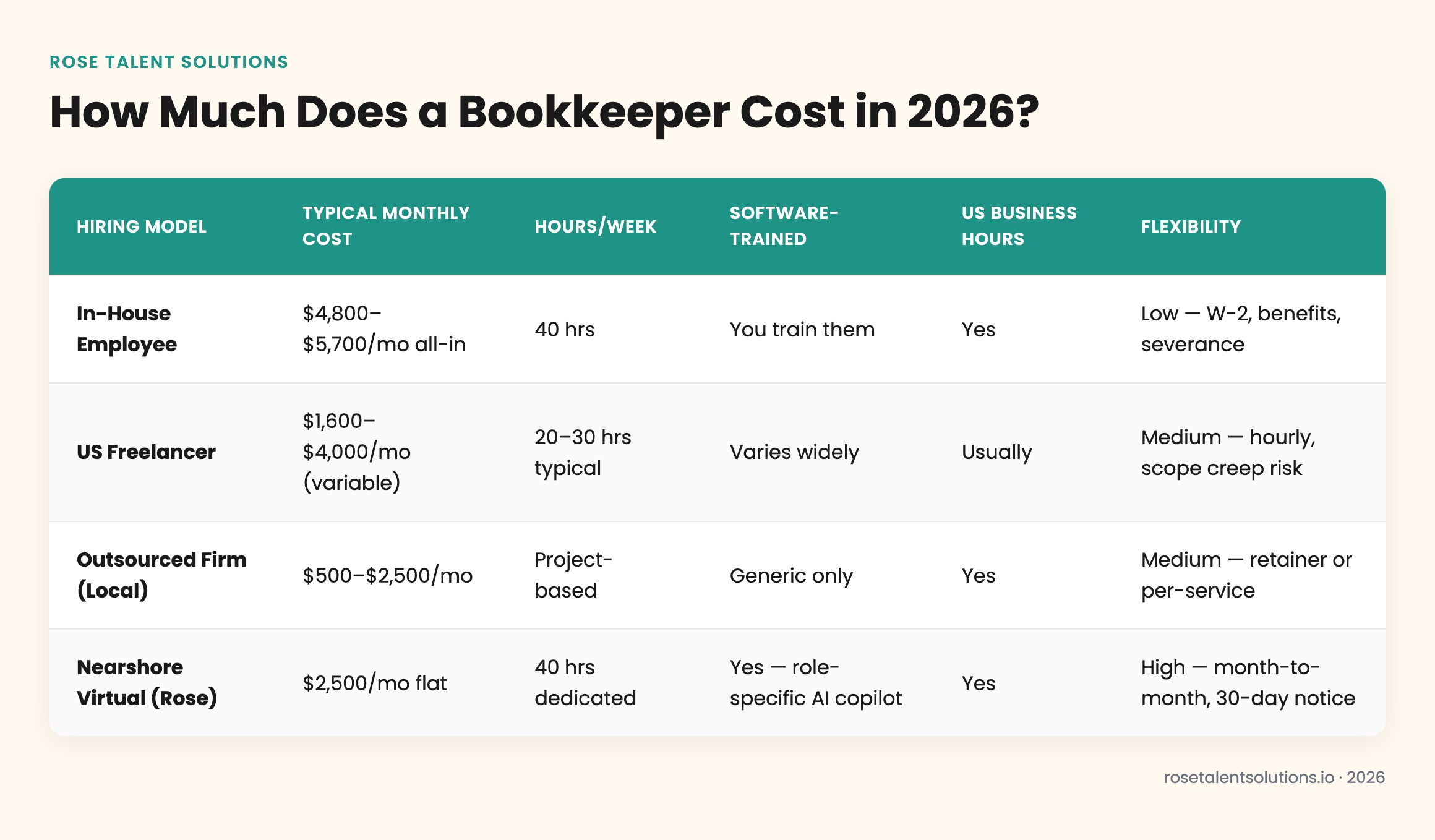
The comparison above makes one thing obvious: you're not just paying for hours — you're paying for availability, training, and accountability. A freelancer billing 20 hours a month doesn't have the same skin in the game as a dedicated full-time team member whose entire role is your books.
If you want to go deeper on what outsourced options specifically cost for smaller operations, our breakdown of how much outsourced bookkeeping costs for a small business walks through the pricing tiers in detail.
"The biggest mistake small business owners make is comparing bookkeeper hourly rates without factoring in the true cost of turnover, retraining, and downtime. A $18/hour local hire who leaves in six months costs you far more than a $2,500/month dedicated virtual bookkeeper who stays." — Rhamy Alejeal, CEO at People Processes (2023)
How Freelance Bookkeeper Costs Work in 2026 — And Where They Break Down
Freelance bookkeepers on platforms like Upwork, Fiverr, or Bench typically charge $20–$50/hour for US-based talent, and $10–$20/hour for offshore providers. On the surface, 10 hours a month at $25/hour sounds like a bargain at $250. But most growing businesses need far more than 10 hours — reconciling accounts, running payroll, managing AP/AR, and preparing monthly reports often takes 20–40 hours per month on its own.
According to SHRM (2023), the average cost to replace an employee is 50–200% of their annual salary. For a bookkeeper earning $45,000, that's $22,500–$90,000 in replacement costs every time someone leaves. Freelancers churn faster than employees — and every transition is a gap in your financial visibility.
There's also the training problem. Most freelancers come with general bookkeeping knowledge. If your business runs on QuickBooks Online with a specific chart of accounts, or you're a property manager using AppFolio, you're building their knowledge base on your dime and your clock. Our post on QuickBooks virtual bookkeeper costs breaks down exactly what you should expect to pay for someone who already knows the software cold.
The IRS estimates that US small businesses spend an average of roughly 80 hours per year on federal tax recordkeeping alone, according to IRS guidance on small business recordkeeping (2024). That's two full workweeks just keeping the government happy — before you've touched a single vendor invoice or payroll run.
The hidden cost of a freelance bookkeeper isn't the hourly rate — it's the hours you spend onboarding, correcting errors, and rehiring when they disappear. A dedicated nearshore bookkeeper with a role-specific AI copilot eliminates all three of those drag points.
What Does a Nearshore Bookkeeper Cost — And What Does "Nearshore" Mean?
A nearshore bookkeeper is a full-time virtual team member based in Latin America who works your business hours, communicates in fluent English, and operates inside your existing software stack. Unlike offshore outsourcing to the Philippines or India — which typically involves a 10–14 hour time zone gap and shared team arrangements — nearshore means real-time collaboration, same-day turnaround, and a single dedicated person who knows your business.
At Rose Talent Solutions, a nearshore bookkeeper costs $2,500/month flat. That's 40 hours per week, fully dedicated to your business. Recruiting, vetting, payroll, HR, and ongoing management are all included. There's no long-term contract — you can cancel with 30 days written notice. And if the team member isn't the right fit, Rose replaces them at no additional cost.
Every Rose bookkeeper also ships with a role-specific AI copilot trained on their primary software — whether that's QuickBooks, Xero, FreshBooks, or a property management platform like AppFolio or Buildium. That means faster onboarding, fewer errors, and a team member who can handle more complex tasks from day one. Learn more about how this works on our AI advantage page.
Rose's published English proficiency floor is 8/10 or higher on all candidate screens — which means communication quality is not an afterthought. It's a hiring filter. According to McKinsey & Company (2023), poor workplace communication costs businesses an estimated $1.2 trillion annually — making language fluency a financial decision, not just a preference.

How the True Cost of In-House Bookkeeping Adds Up in 2026
In-house hiring looks straightforward on a salary sheet, but the real number is almost always 30–40% higher than base pay. The Bureau of Labor Statistics Employer Costs for Employee Compensation (2024) report shows that employer costs for civilian workers average 30.9% above wages — covering Social Security, Medicare, unemployment insurance, health benefits, and paid leave.
On a $48,000 bookkeeper salary, that's roughly $14,800 in additional employer costs — bringing your real annual spend to about $62,800, or $5,230/month. And that's before you account for:
- Recruiting and job board fees ($2,000–$5,000 per hire)
- Software licenses and equipment ($500–$1,500/year)
- Onboarding time — typically 2–4 weeks before full productivity
- PTO coverage gaps during vacations and sick leave
- Severance or unemployment claims if things don't work out
When you stack those real costs against $2,500/month for a fully managed nearshore bookkeeper — where recruiting, payroll, HR, and ongoing management are already included — the math shifts fast. For context, Gallup (2023) estimates that voluntary employee turnover costs US businesses $1 trillion annually, driven largely by replacement and productivity loss. Bookkeeping roles are not immune to that churn.
If you're a small business owner specifically, the decision tree is even cleaner. Our guide on how to outsource bookkeeping for a small business walks through when it makes sense to keep it in-house vs. hand it off — and how to set your bookkeeper up for success from day one.
Nearshore Bookkeeper — Pros
- Full-time, 40 hrs/week dedicated to your business
- Flat $2,500/month — no payroll taxes, no benefits overhead
- Works US business hours in real time
- Software-trained with AI copilot (QuickBooks, Xero, AppFolio, etc.)
- Month-to-month — no long-term contract
- Free replacement if not a fit
In-House Employee — Cons
- $4,800–$5,700/month all-in true cost
- W-2 obligations: payroll taxes, benefits, PTO, unemployment
- Recruiting takes 4–8 weeks average
- You own the training — software, processes, culture
- High turnover risk in administrative roles
- Productivity gaps during onboarding and transitions
How to Get Started With a Nearshore Bookkeeper in 2026
The process is faster than most business owners expect. Rose handles the heavy lifting — sourcing, vetting, skills testing, English screening, and matching — so you're not reviewing 200 resumes or coordinating trial shifts.
Tell Rose What You Need
You share your software stack, volume of transactions, and any specific needs (payroll processing, AP/AR, reporting). This takes about 15 minutes on a call.
Rose Matches and Vets Candidates
Rose sources candidates from its Latin America network, screens for English proficiency (8/10+ floor), tests software skills, and presents you a shortlist — typically within days, not weeks.
You Interview and Select
You meet the finalist(s) and choose your bookkeeper. You're never assigned someone without your sign-off.
Onboarding With AI Copilot
Your new bookkeeper starts with a role-specific AI copilot already configured for your software. Ramp time is significantly compressed compared to a cold hire.
Rose Manages HR and Payroll
You manage the work. Rose handles payroll, compliance, and HR — so you never touch a Latin American employment contract or tax filing.
Ready to price it out for your specific situation? Head to Rose's get started page and describe your bookkeeping needs — the team typically responds same business day.
You can also explore the broader range of bookkeeping and accounting roles Rose places if you need more than one function covered — from AR specialists to full-charge bookkeepers to financial reporting coordinators.
According to the U.S. Census Bureau (2024), over 33 million small businesses operate in the United States — and the vast majority of them don't have a dedicated finance function. Nearshore bookkeeping exists precisely to close that gap without the overhead of a full in-house hire. For a deeper look at what makes the nearshore model work specifically for bookkeeping roles, see our full guide on the nearshore bookkeeper model and how it compares to both local and offshore alternatives.