
Nearshore virtual assistants have become one of the fastest-growing hires in property management — and rent collection is exactly why. If you manage 50 or more units, you already know the drill: the first week of the month is a tornado of payment confirmations, bounced ACHs, late-fee notices, and tenant calls that never seem to end. Understanding how a virtual assistant helps with rent collection is the first step to reclaiming that time. A trained nearshore VA absorbs the entire rent collection workflow so your on-site team can focus on what only humans in the field can do.
This guide breaks down exactly how does a virtual assistant help with rent collection in 2026, what tasks you can delegate on day one, and what separates a nearshore coordinator from an offshore generalist who works while your tenants sleep. Every section below answers a real question operators ask before making this hire.
What Does a Virtual Assistant Help With in Rent Collection — Task by Task?
A rent collection VA is not a phone operator reading from a script. When you ask how does a virtual assistant help with rent collection at the task level, the answer covers the entire collections cycle — from the first reminder before the due date to the final escalation notice before you hand a file to an attorney. Here is what that looks like in practice:
- Pre-due-date reminders — Sends templated but personalized email and SMS reminders 5 and 2 days before rent is due, using your property management platform's built-in messaging tools.
- Payment logging and reconciliation — Confirms every ACH, check, or portal payment in AppFolio or Buildium and flags any discrepancy against the ledger before you see the daily report.
- Late-fee posting — Applies late fees automatically or on your approval, in line with your state's rules and your lease language, on day 1 or day 5 of delinquency — whichever your policy requires.
- Outbound collection calls — Calls delinquent tenants during US business hours, logs every conversation with notes and next-action dates, and escalates repeat non-payers to your property manager.
- Partial-payment documentation — Records any partial payments and confirms whether your lease permits acceptance — critical before eviction proceedings.
- Notice drafting support — Prepares pay-or-quit notice drafts (which your licensed PM reviews and signs) so the legal clock starts as soon as possible.
A virtual assistant helps with rent collection across every one of those touchpoints simultaneously — which is why operators who delegate this work consistently report fewer delinquent accounts at month-end. According to the National Multifamily Housing Council (2024), approximately 20% of multifamily renters miss at least one payment per year. That statistic translates directly into hundreds of hours of follow-up work annually for a 200-unit portfolio — work a well-trained VA handles at a fraction of what an in-house coordinator costs.
How Nearshore VAs Outperform Offshore for Rent Collection in 2026
The most common mistake property managers make when hiring a virtual assistant to help with rent collection is choosing the cheapest offshore option and then wondering why tenant disputes drag on for three days. The answer is almost always timezone mismatch. A VA based in the Philippines or India is working when your tenants are asleep — which means a delinquent tenant who calls at 10am gets a callback 18 hours later, by which point they have already texted their attorney.
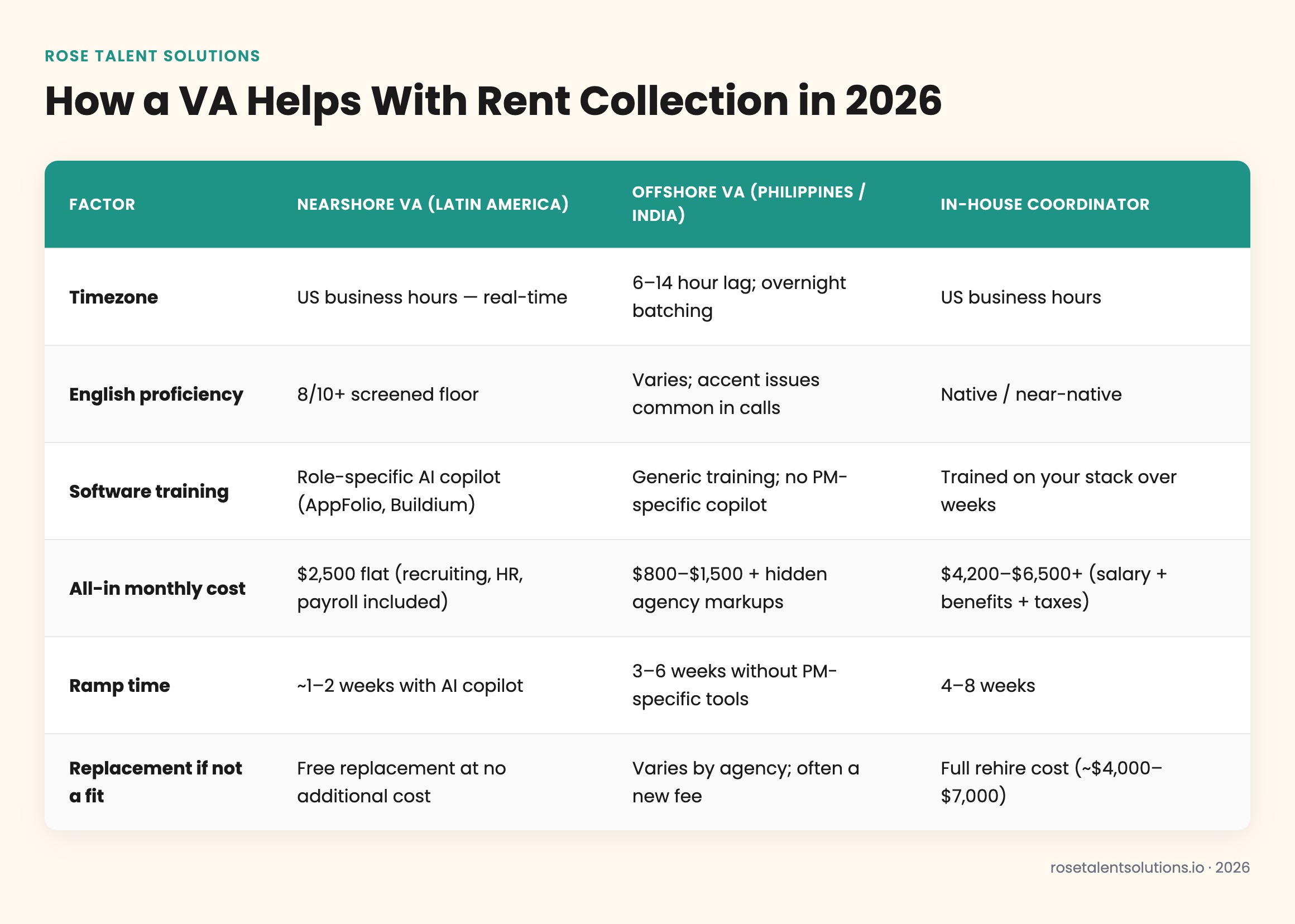
Nearshore VAs based in Latin America work your time zone — EST, CST, MST, or PST — without overlap gaps. They pick up the phone when the tenant calls. They post the late notice the same morning you send the approval. That real-time availability is the operational difference between a collections workflow that works and one that generates complaints. You can go deeper on exactly why timezone alignment matters in this nearshore virtual assistant property management comparison.
| Factor | Nearshore VA (Latin America) | Offshore VA (Philippines / India) | In-House Coordinator |
|---|---|---|---|
| Timezone | US business hours — real-time | 6–14 hour lag; overnight batching | US business hours |
| English proficiency | 8/10+ screened floor | Varies; accent issues common in calls | Native / near-native |
| Software training | Role-specific AI copilot (AppFolio, Buildium) | Generic training; no PM-specific copilot | Trained on your stack over weeks |
| All-in monthly cost | $2,500 flat (recruiting, HR, payroll included) | $800–$1,500 + hidden agency markups | $4,200–$6,500+ (salary + benefits + taxes) |
| Ramp time | ~1–2 weeks with AI copilot | 3–6 weeks without PM-specific tools | 4–8 weeks |
| Replacement if not a fit | Free replacement at no additional cost | Varies by agency; often a new fee | Full rehire cost (~$4,000–$7,000) |
"Rent collection follow-up is one of the highest-volume, lowest-complexity tasks in property management — which makes it exactly the kind of work that should be delegated first. Operators who do this well free up their licensed staff for leasing and asset decisions." — Tony Julianelle, CEO at Atlas Real Estate (2023)
How a Virtual Assistant Helps With Rent Collection Using AI Copilot Tools in 2026
Every Rose team member ships with a role-specific AI copilot trained on the software they will use daily — AppFolio, Buildium, QuickBooks, or whichever platform your portfolio runs on. For rent collection specifically, that means the VA arrives knowing how to run delinquency reports, post charges, log communications, and generate notices inside your system — without a three-week shadow period. You can read more about how this works on Rose's AI advantage page.
The practical impact: a VA without software training spends the first month asking "where do I find X?" A VA with an AI copilot spends that time actually working the delinquency list. This is a core reason why how does a virtual assistant help with rent collection has a different answer at Rose than at a generic staffing agency — the software fluency is built in before day one. According to AppFolio's 2024 Property Management Industry Pulse, property management companies that leverage automation and trained staff on PM software report 30% faster rent collection cycle times compared to those relying on manual workflows alone.
If your portfolio runs on Buildium, there is a full breakdown of what a VA trained specifically on that platform can do in Rose's Buildium virtual assistant guide. If you run AppFolio, the same depth of coverage exists in Rose's AppFolio virtual assistant hiring guide — both are worth reading before you scope a VA role.
The hidden cost of an offshore VA isn't the lower hourly rate — it's the 6–14 hour timezone gap that turns a 5-minute tenant call into a 3-day email chain. For rent collection, where timing is everything, that delay compounds directly into higher delinquency rates and slower eviction timelines.
The U.S. Bureau of Labor Statistics (2024) reports that property and community association managers spend a significant portion of their time on administrative tasks — the exact category where a trained VA delivers the clearest ROI, freeing licensed staff for decisions that require judgment and local knowledge.
How to Onboard a Rent Collection VA Without Losing a Month to Setup
The most common onboarding mistake is handing a new VA a login and a list of delinquent tenants and expecting results in week one. The fastest ramps happen when you give the VA three specific things: your collections policy in writing, your escalation thresholds (e.g., "call on day 3, email supervisor on day 7"), and access to your PM platform with a defined role and permissions. With those three inputs and an AI copilot, a trained Rose VA is typically running the delinquency workflow independently within 10 business days — which is precisely how a virtual assistant helps with rent collection at the operational level from the very first month-end cycle.
Scope the role
List every rent-collection task you currently do or avoid doing — reminders, logging, calls, notices. That list becomes the VA's job description. Visit Rose's property management staffing page to see standard role templates.
Match and vet
Rose recruits, screens, and presents a pre-vetted candidate — typically within 7 days. English proficiency is screened at 8/10 or higher before any candidate reaches you.
Provide your three onboarding inputs
Share your collections policy, escalation thresholds, and PM platform access with defined permissions. Your VA's AI copilot handles the software learning curve from day one.
Run a supervised first cycle
Have the VA shadow your current collections workflow for the first month-end cycle, then hand off ownership of the delinquency list for the second cycle with daily check-ins.
Review and expand
After 30 days, review delinquency rates and call-log quality. Most operators expand the VA's scope to include lease renewals, maintenance coordination, or bookkeeping support — all within the same flat $2,500/month rate.
Month-to-month terms mean you are never locked in. If the placement is not the right fit, Rose replaces the team member at no additional cost — that is the only risk reversal you need. There is no long-term contract required to get started; you can get your first VA placed and cancel with 30 days written notice if the model does not work for your portfolio.
Rent collection is rarely the only workflow a property management VA can absorb. HOA communities have nearly identical delinquency workflows — monthly assessments, late fees, lien notices — and a VA trained on PM software handles those just as effectively. Rose has a dedicated guide on whether a virtual assistant can handle HOA management if that applies to your portfolio.
What a Rent Collection VA Frees Up
- Licensed PMs focus on leasing and asset decisions
- On-site staff handle inspections and maintenance — not phones
- Month-end close happens faster with daily payment reconciliation
- Eviction timelines shorten when notices go out the same day approval is given
What a VA Cannot Replace
- Signing legal notices (must be a licensed PM in most states)
- In-person conversations with tenants in distress
- Court appearances or attorney coordination decisions
- Judgment calls on partial-payment acceptance where local law is ambiguous
According to SHRM's 2024 Employee Benefits Survey, the total cost of employing a full-time in-house administrative coordinator — including salary, benefits, payroll taxes, and turnover costs — runs 1.25 to 1.4 times the base salary. At the national median for a property management coordinator, that puts the all-in annual cost between $52,000 and $65,000. A nearshore VA at $2,500/month is $30,000 annually, all-in, with recruiting, HR, and management included — and no long-term contract. When you factor in how a virtual assistant helps with rent collection across 12 months of consistent, systematized follow-up, the ROI case is straightforward. You can also explore how that same VA handles the financial side of your portfolio on Rose's bookkeeping and accounting staffing page.