
Nearshore virtual bookkeepers are quietly becoming the go-to solution for US business owners who operate more than one legal entity and need their books to actually reflect that complexity. If you own three LLCs, two S-corps, or a mix of holding and operating companies, you already know the problem: standard bookkeeping advice assumes a single set of books, and most freelance bookkeepers aren't equipped to handle the intercompany transactions, entity-level P&Ls, and consolidated reporting that multi-entity structures demand. This guide explains exactly how virtual bookkeepers trained on platforms like QuickBooks Online, Xero, and NetSuite approach the challenge — and what you should look for before you hire one.
What Is Multi-Entity Bookkeeping — and Why Is It Different?
Multi-entity bookkeeping is the practice of maintaining a separate, legally distinct general ledger for each business entity you own, while also producing consolidated financial statements that roll all entities up into a single view. It is distinct from single-entity bookkeeping because it requires intercompany transaction tracking, elimination entries, and entity-level segmentation — three tasks that most general bookkeepers have never touched.
A holding company that loans cash to an operating subsidiary, for example, creates a receivable on one set of books and a payable on another. When you consolidate, that intercompany balance must be eliminated so it doesn't inflate your total assets. Miss that step, and your banker or CPA is looking at overstated numbers. According to the Financial Accounting Standards Board (FASB) (2024), intercompany eliminations are a required step under US GAAP for any consolidated financial reporting — there is no optional shortcut.
The good news: modern cloud accounting platforms have made multi-entity bookkeeping dramatically more accessible. QuickBooks Online Advanced, Xero, and NetSuite all support multiple company files or native entity consolidation — and a virtual bookkeeper who is fluent in these tools can manage your entire portfolio without you needing to hire a $90,000-a-year controller.
How Virtual Bookkeepers Structure Multi-Entity Work in 2026
The workflow a competent virtual bookkeeper uses for multi-entity clients follows a consistent architecture, regardless of which platform you're on. Understanding this architecture helps you ask the right questions when you're evaluating candidates.
Separate Company Files, One Bookkeeper
Each entity gets its own QuickBooks Online or Xero file. The bookkeeper is granted accountant-level access to all files under a single login, so they can move between entities without logging in and out repeatedly.
Standardized Chart of Accounts Across Entities
The bookkeeper builds a master chart of accounts template and replicates it across all entities. Consistent account numbers mean consolidation is a mapping exercise, not a research project, every month-end.
Intercompany Transaction Ledger
Every loan, management fee, shared expense, or cost allocation between entities is logged in a dedicated intercompany clearing account on both sides of the transaction simultaneously.
Monthly Elimination Entries
At close, the bookkeeper runs elimination journal entries to zero out intercompany receivables and payables before rolling the numbers into the consolidated P&L and balance sheet.
Consolidated Reporting Package
The final deliverable is a reporting package: entity-level P&Ls, a consolidated income statement, a consolidated balance sheet, and a cash position summary — typically delivered by the 10th of each month.
If you want to understand how this same discipline applies to day-to-day cash outflows, our post on how virtual bookkeepers handle accounts payable walks through the payment workflow that sits underneath every entity's ledger.
Which Platforms Support Multi-Entity Bookkeeping Best in 2026?
Platform choice matters more in a multi-entity context than in single-entity bookkeeping. Not every plan or tool handles consolidation natively — and a bookkeeper working in the wrong tier of software will spend hours on manual workarounds that a proper setup would automate.
| Platform | Multi-Entity Support | Intercompany Eliminations | Consolidated Reporting | Best For |
|---|---|---|---|---|
| QuickBooks Online Advanced | Multiple company files; accountant access across all | Manual journal entries (no automation) | Via third-party consolidation add-ons (e.g., Fathom, Syft) | SMBs with 2–5 entities |
| Xero | Separate orgs per entity; advisor multi-org login | Manual; Xero HQ provides portfolio-level overview | Native group reporting in select plans; Fathom integration | Service businesses, property portfolios |
| NetSuite | Native multi-subsidiary architecture | Automated intercompany elimination module | Native consolidated P&L and balance sheet | 6+ entities, complex ownership structures |
| QuickBooks Desktop Enterprise | Multiple files; manual switching | Manual only | Limited; requires external reporting tools | Legacy users; not recommended for new setups |
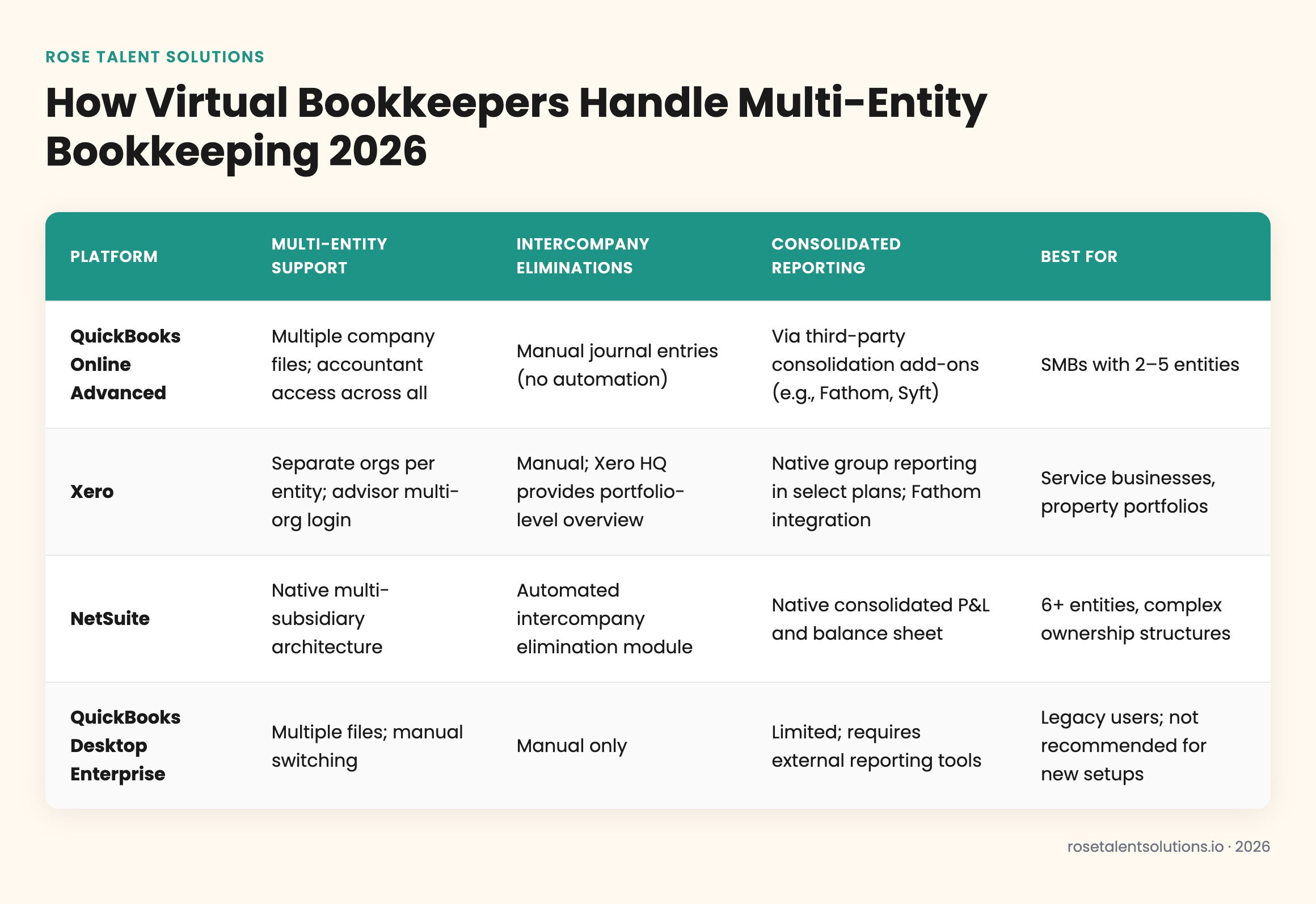
For most business owners in the 2–8 entity range, QuickBooks Online Advanced paired with a consolidation reporting tool is the sweet spot — affordable, widely understood, and compatible with most CPAs. If you're already in Xero, a skilled virtual bookkeeper can manage the multi-org workflow just as effectively; our deep-dive on hiring a Xero virtual bookkeeper covers what to look for in that context specifically.
"The firms that struggle with multi-entity books aren't struggling because of software — they're struggling because no one owns the intercompany reconciliation. Once you assign that to one person with the right access and a documented process, it becomes the most predictable close step you have." — Randy Johnston, Executive Vice President at K2 Enterprises (2024)
How Nearshore VAs Compare to Offshore and Onshore Bookkeepers for Multi-Entity Work
Not all virtual bookkeepers are built the same. For multi-entity bookkeeping specifically, three factors separate nearshore Latin American bookkeepers from offshore (Philippines, India) and onshore (US-based) alternatives: timezone alignment, English fluency, and software depth.
Multi-entity close requires real-time collaboration — your bookkeeper needs to reach your CPA, your property manager, or your ops team on the same business day to resolve a posting question. A bookkeeper operating on a 10-12 hour time difference batches those questions overnight. At month-end, that delay can push your close by 3–5 days. According to SHRM's research on remote team productivity (2023), timezone misalignment is the single most-cited friction point in cross-border accounting workflows.
Multi-entity close is a collaboration-heavy process — intercompany queries, CPA reviews, and entity-level reconciliations all require same-day responses. Offshore bookkeepers operating 10-12 hours out of sync routinely push close dates by 3-5 days simply because of communication lag, not skill deficits.
Nearshore bookkeepers in Latin America work your business hours — EST, CST, PST — and communicate in fluent English. Rose's published proficiency floor is 8/10 on structured English screens, which means your bookkeeper can draft emails to your lender, respond to your CPA's questions in plain language, and flag a discrepancy in a Slack message without you needing to decipher it. That language clarity becomes critical when you're reviewing an elimination entry that involves four entities and two holding structures.
| Factor | Onshore (US) | Offshore (Philippines/India) | Nearshore (Latin America) |
|---|---|---|---|
| Typical Monthly Cost | $5,500–$8,000+ | $800–$1,500 | $2,500 flat |
| Timezone Alignment (US) | ✅ Perfect | ❌ 10-13 hr gap | ✅ Same hours |
| English Proficiency | ✅ Native | ⚠️ Variable | ✅ 8/10+ screened |
| Multi-Entity QBO/Xero Depth | ✅ Strong (if specialized) | ⚠️ Inconsistent | ✅ AI copilot trained on platform |
| Replacement if Not a Fit | ❌ Rehire cost | ⚠️ Agency-dependent | ✅ Free replacement included |
For a detailed cost comparison between QuickBooks-specialized virtual bookkeepers, see our breakdown of QuickBooks virtual bookkeeper costs — it breaks down where the pricing gaps come from and what you actually get at each tier.
What Does Rose's AI Copilot Add to Multi-Entity Bookkeeping in 2026?
Every bookkeeper placed through Rose ships with a role-specific AI copilot trained on the exact software stack your entities run — QuickBooks Online, Xero, NetSuite, or others. For multi-entity work, this matters in three specific ways.
First, the AI copilot surfaces intercompany balance mismatches automatically. Instead of your bookkeeper manually cross-referencing two company files to find a $3,400 discrepancy, the copilot flags it during the reconciliation pass. Second, it generates elimination journal entry templates based on the intercompany transaction history, reducing close time on complex structures by hours per month. Third, it produces a first-draft consolidated report that the bookkeeper reviews, adjusts, and delivers — cutting the reporting cycle without cutting corners on accuracy.
The McKinsey Global Institute's State of AI report (2024) found that finance and accounting functions adopting AI-assisted workflows reduced manual reconciliation time by an average of 40% — a number that compounds significantly when you're running reconciliations across multiple entities simultaneously.
You can read more about how this AI layer works across all of Rose's placements on the AI Advantage page — it explains the copilot architecture, what platforms are currently supported, and how the training model is updated when software vendors push major releases.
How to Vet a Virtual Bookkeeper for Multi-Entity Capability
Most bookkeepers list "multi-entity experience" on their profiles. Very few can describe what an intercompany elimination entry looks like or explain the difference between a consolidated and combined financial statement. Here's how to cut through the noise.
Green Flags to Look For
- Can explain the intercompany elimination process step-by-step without prompting
- Has accountant-level access experience in QBO, Xero, or NetSuite across 3+ company files simultaneously
- Understands the difference between consolidated (eliminations applied) and combined (no eliminations) financials
- Has worked with a CPA on a year-end audit involving multiple entities
- Uses a standardized close checklist they can share
Red Flags to Screen Out
- Describes "multi-entity" as simply keeping two separate QuickBooks files
- Cannot define intercompany receivables and payables clearly
- Has never produced a consolidated balance sheet
- Works a timezone 8+ hours removed from your office
- No documented process for month-end close — improvises each cycle
Rose's vetting process screens for all of these competencies before a bookkeeper is presented to you. The bookkeeping and accounting service page details exactly what the technical screen covers, including platform proficiency scores and the multi-entity case study exercise every candidate completes during evaluation.
When you're ready to explore a placement, the getting started page walks through the intake process — typically a 20-minute call where you describe your entity structure, software stack, and current close timeline, after which Rose matches you with a shortlisted candidate within days. Pricing is $2,500 per month flat, month-to-month with no long-term contract, and includes free replacement if the bookkeeper isn't the right fit for your operation.
For business owners who have already priced out QuickBooks-specialized bookkeeping in the market, our 2026 guide to QuickBooks virtual bookkeeper pricing shows how the $2,500 flat rate stacks up against hourly freelancers and domestic bookkeeping firms across a range of entity counts.
According to the U.S. Bureau of Labor Statistics (2024), the median annual salary for a bookkeeping clerk in the United States is $47,440 — and that figure doesn't include benefits, payroll taxes, or the recruiting cost to find someone with multi-entity experience specifically. A nearshore bookkeeper at $2,500 per month ($30,000 per year all-in) delivers full-time dedicated coverage at roughly 63% of what a mid-market domestic hire costs before a single benefit is added.