
Nearshore virtual assistants have quietly become the backbone of maintenance coordination for US property management companies — and the numbers explain why. The average property manager spends over 30% of their workweek on maintenance-related communication alone, according to Buildium's State of the Property Management Industry Report (2024). That's time that doesn't scale. When you understand how property managers use virtual assistants for maintenance coordination — and hand those workflows to a trained VA working your business hours from Latin America — you get the responsiveness of an in-house hire at a fraction of the fully-loaded cost, without the timezone nightmare of traditional offshore staffing.
This guide breaks down exactly how property managers use virtual assistants for maintenance coordination in 2026: what tasks they own, which software they operate in, how the handoff works, and what to look for when you're ready to hire.
What Does a Maintenance Coordination VA Actually Do in 2026?
A maintenance coordination virtual assistant owns the full administrative lifecycle of a repair request — from the moment a tenant submits a ticket to the moment the work order is closed and documented. This is the core of how property managers use virtual assistants for maintenance coordination: not as a dispatcher in the old-school sense, but as a system operator who lives inside your property management software and keeps every moving part documented and on schedule.
A well-trained VA in this role typically handles:
- Intake and triage — logging inbound maintenance requests from tenants via phone, email, or portal; categorizing by urgency (emergency vs. routine vs. cosmetic)
- Vendor dispatch — contacting approved vendors, confirming availability, scheduling access windows, and sending confirmation to both the tenant and the owner
- Work order management — creating, updating, and closing work orders in AppFolio, Buildium, Yardi, or Rent Manager in real time
- Tenant communication — sending status updates at each stage of the repair so tenants aren't calling your office asking "where's my plumber?"
- Invoice processing — receiving vendor invoices, matching them to work orders, flagging discrepancies, and routing to accounting
- Follow-up and quality checks — confirming repairs are complete, collecting tenant satisfaction responses, and flagging recurring issues for owner review
That's a complete operational role, not an assistant. The distinction matters because it affects how you write the job description, how you train the person, and what software access they need on day one.
How Nearshore VAs Outperform Offshore for Maintenance Coordination in 2026
Maintenance coordination is time-sensitive by nature. A leaking pipe at 8am needs a vendor confirmed by 9am — not batched into an overnight queue and answered at 3am local time. That single constraint eliminates most traditional offshore VA arrangements for this specific role. It also explains why so many property managers use virtual assistants for maintenance coordination specifically through a nearshore model rather than a generic offshore platform.
Nearshore VAs based in Latin America work your business hours in real time. A team member in Bogotá or Mexico City operates on Eastern or Central time, picks up the phone when your tenant calls, and dispatches your plumber before lunch. There's no lag. That's the fundamental operational difference — and it's why the nearshore model exists as a distinct category from offshore staffing. If you want a deeper breakdown of how these two models compare across cost, communication, and turnover, our post on nearshore virtual assistant property management covers exactly that.
"Timezone alignment is the single biggest predictor of VA success in property management. When your coordinator is 10 hours ahead of your tenants, you're essentially running a delayed-response model — and tenants notice." — Matthew Whitaker, Founder at Evernest (2023)
English fluency is the second variable that separates nearshore from offshore for this role. Maintenance coordinators are tenant-facing. They're on the phone with a frustrated renter who has no hot water. Rose's English proficiency floor of 8/10+ on standardized screens means your VA can handle that call without the tenant asking to speak to someone else — which happens more often than offshore agencies will admit.
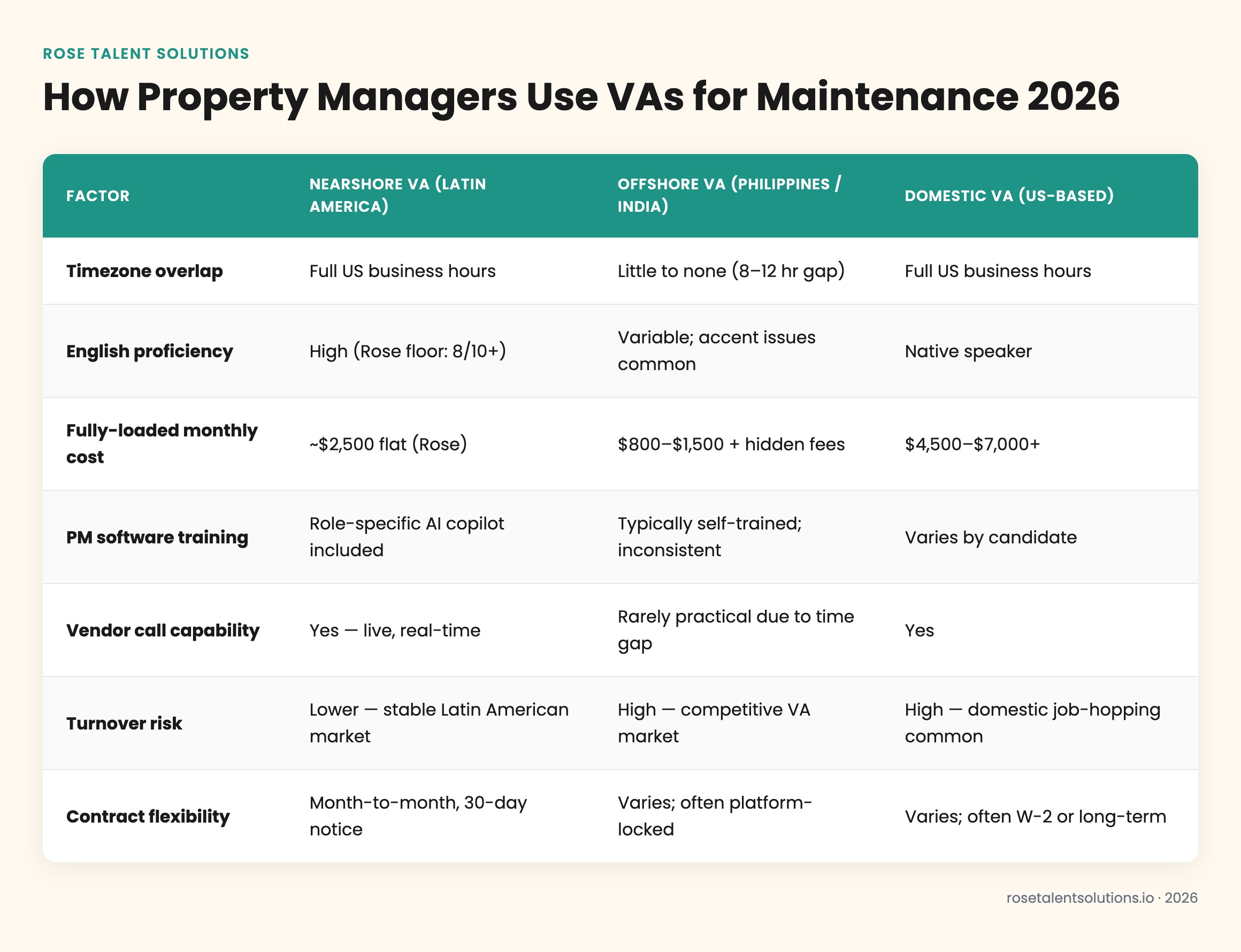
| Factor | Nearshore VA (Latin America) | Offshore VA (Philippines / India) | Domestic VA (US-based) |
|---|---|---|---|
| Timezone overlap | Full US business hours | Little to none (8–12 hr gap) | Full US business hours |
| English proficiency | High (Rose floor: 8/10+) | Variable; accent issues common | Native speaker |
| Fully-loaded monthly cost | ~$2,500 flat (Rose) | $800–$1,500 + hidden fees | $4,500–$7,000+ |
| PM software training | Role-specific AI copilot included | Typically self-trained; inconsistent | Varies by candidate |
| Vendor call capability | Yes — live, real-time | Rarely practical due to time gap | Yes |
| Turnover risk | Lower — stable Latin American market | High — competitive VA market | High — domestic job-hopping common |
| Contract flexibility | Month-to-month, 30-day notice | Varies; often platform-locked | Varies; often W-2 or long-term |
How Property Management Software Shapes the VA's Role in 2026
The software your company runs determines what your VA can actually do on day one. A coordinator who has never touched AppFolio will spend their first two weeks learning the interface instead of closing work orders. This is exactly why Rose equips every placed team member with a role-specific AI copilot trained on the platform they'll operate in — whether that's AppFolio, Buildium, Yardi, or Rent Manager. Learn more about how this works on the AI advantage page.
AppFolio users benefit from the platform's built-in maintenance request portal and automated tenant communication triggers. An AppFolio virtual assistant can manage the full maintenance queue from the Maintenance tab, update work order statuses, attach vendor invoices directly to the record, and send templated tenant updates — all without leaving the platform. That's the operational leverage that makes a single VA capable of handling a 300-unit portfolio's maintenance load.
Buildium users get similar depth. Buildium's Maintenance Requests module allows the VA to create requests, assign vendors from the vendor network, track open items, and pull reports on recurring issues by property. A Buildium virtual assistant can also cross-reference maintenance history against lease terms to flag owner-responsibility vs. tenant-responsibility repairs before a vendor is ever dispatched — which reduces billing disputes and owner calls significantly.
According to AppFolio's Property Management Industry Pulse (2024), 67% of property management companies say maintenance coordination is the operational area where technology adoption has the highest ROI — yet most still assign it to licensed property managers rather than trained support staff.
Software-trained VAs reduce work order resolution time not because they work faster — but because they never leave the platform to figure out where things live. Every action is documented in real time, which means your property managers always have a current view of the maintenance queue without asking anyone for a status update.
How the Onboarding Process Works When You Hire a Maintenance VA in 2026
One of the most common objections property managers raise is: "Training a VA will take longer than just doing it myself." That's true of a generic hire. It's not true of a role-specific nearshore VA placed by a staffing partner who has already pre-screened for PM software experience. Here's how the Rose onboarding sequence works for property managers who use virtual assistants for maintenance coordination:
Role scoping call
Rose's team maps your maintenance workflow — software stack, vendor list, escalation paths, and communication templates — before a single candidate is presented. The job description is built around your actual process, not a generic one.
Candidate matching
Rose surfaces 2–3 pre-vetted candidates with documented AppFolio or Buildium experience and a proven maintenance coordination background. You interview and select. Typical placement happens within 7 business days.
AI copilot activation
The placed VA receives a role-specific AI copilot trained on your software — covering work order workflows, vendor communication scripts, and escalation triggers. This cuts the ramp period from weeks to days.
Live coordination begins
The VA joins your team's Slack or Teams, gets software access, and starts handling maintenance intake on day one — supervised closely for the first two weeks with your PM team available for escalations.
Ongoing management included
Rose handles HR, payroll, performance reviews, and replacement if the team member isn't a fit — at no additional cost. You manage the work; Rose manages the employment.
This structured process is why the Rose property management staffing model produces faster ramp times than hiring through a generic VA marketplace. The pre-work done before the VA's first day eliminates the first two weeks of "figuring out where things are."
According to the U.S. Bureau of Labor Statistics (2024), the median annual wage for property, real estate, and community association managers is $60,670. When a licensed PM is spending 30% of their time on maintenance administration, that's nearly $18,000 per year in salary cost allocated to work a trained VA can handle at a fraction of that rate — freeing the PM to focus on owner retention, leasing, and portfolio growth.
How Short-Term Rental Operators Use Maintenance VAs Differently in 2026
The maintenance coordination challenge for short-term rental (STR) operators is compressed. Where a traditional property manager might have a 24–48 hour window to schedule a repair, an STR operator might have a 4-hour turnaround between checkout and the next guest check-in. When STR operators think about how property managers use virtual assistants for maintenance coordination, the VA's role shifts from scheduling repairs to triaging urgency in real time and coordinating cleaners, handymen, and property inspectors in a tightly sequenced window.
STR-focused VAs also monitor guest communication channels — Airbnb, Vrbo, direct booking sites — and flag maintenance issues reported in guest messages before they become reviews. A guest message that says "the shower drain is slow" at 10pm is an opportunity to schedule a fix for the next morning's turnover if someone is watching. That kind of proactive coordination is only possible when your VA is working your timezone. Our guide on best virtual assistants for short-term rental hosts covers the full role breakdown for STR operators specifically.
According to the National Multifamily Housing Council (NMHC) (2024), maintenance and repair costs represent one of the largest controllable operating expense categories for rental housing operators — making coordination efficiency a direct driver of NOI, not just a convenience factor.
Why Maintenance VAs Work for Property Managers
- Full-time coverage of intake, dispatch, and follow-up without a full-time in-office hire
- Real-time documentation in AppFolio or Buildium — no missed work orders or manual data entry backlogs
- Timezone-aligned communication means tenants and vendors reach a live person during business hours
- Flat $2,500/month rate is predictable — no overtime, no benefits, no payroll tax overhead for you
- Free replacement if the team member isn't a fit — zero-risk staffing decision
Where Maintenance VAs Have Limits
- Cannot perform physical inspections or be on-site for access coordination without a local contact
- Emergency after-hours coverage requires a separate on-call protocol — VAs work standard business hours
- Initial access to your vendor database and preferred contractors must be set up by your team first
- Complex owner disputes over repair responsibility still need a licensed PM's judgment call
The bottom line: a maintenance coordination VA handles roughly 80% of the administrative volume in a typical PM workflow. The remaining 20% — judgment calls, owner negotiations, emergency escalations — stays with your licensed staff. That's the right division of labor. Your PMs should be spending their hours on the work that requires a license and relationship equity, not on logging work orders and chasing vendor confirmations.
If your team also handles bookkeeping tasks alongside maintenance administration, Rose's bookkeeping and accounting VA service covers the financial side of the operation — invoice reconciliation, owner disbursements, and expense categorization — using the same nearshore model and software-trained approach.
According to SHRM's 2024 Employee Benefits Survey, the total cost of a single full-time employee in the United States — including benefits, payroll taxes, and overhead — runs 1.25 to 1.4× their base salary. For a $45,000/year maintenance coordinator, that's $56,000–$63,000 in real annual cost. At $2,500/month, a Rose nearshore VA costs $30,000/year all-in — with recruiting, HR, and management included. That's a $26,000–$33,000 annual difference before you factor in the time your team doesn't spend interviewing, onboarding, and replacing staff.
Ready to see how the model works for your portfolio? You can get started with Rose and have a maintenance coordinator placed and active within a week.