
What Does It Actually Cost to Hire a Sales Development Representative in 2026?
Nearshore sales development representatives are reshaping how US and Canadian businesses scale their outbound pipelines — and the cost gap between hiring in-house versus going nearshore has never been wider. Before you post a job on LinkedIn or sign a six-figure employment contract, you need to understand the full picture: base salary, benefits, payroll taxes, recruiting fees, ramp time, and the hidden costs that don't show up in any job description. This guide breaks every number down so you can make the decision with confidence.
A sales development representative (SDR) is a specialized sales role focused on outbound prospecting, cold outreach, and booking qualified meetings for account executives. SDRs don't close deals — they fill the top of the funnel. Because the role is measurable and process-driven, it's one of the most cost-effective positions to staff via a nearshore model, where team members work your US business hours from Latin America at a fraction of the domestic cost.
What follows is a complete cost model — built line by line — so you're comparing real numbers, not ballpark estimates. Whether you're a founder making your first SDR hire or a VP of Sales evaluating your headcount budget for Q3, these figures will help you build a defensible business case for any path you choose.
That $81,000 figure from the U.S. Bureau of Labor Statistics (2024) doesn't include recruiting costs, manager time, onboarding, software seats, or the very real risk of turnover — which runs high in SDR roles. The average SDR tenure is just 14 months, according to SHRM (2023), meaning you're often restarting that entire cost cycle before the rep even reaches full productivity.
That turnover reality is what makes the true cost of an in-house SDR so much higher than the base salary number suggests. Every time an SDR churns, you absorb the recruiting fee again, the onboarding time again, and the 60–90 day ramp period again. Multiply that across a team of three or four SDRs and the compounding effect on your pipeline — and your budget — becomes significant. Understanding how to accurately model the full cost of hiring sales development reps before you make the decision is one of the highest-leverage things a sales leader can do going into a new fiscal year.
How In-House SDR Hiring Costs Stack Up in 2026
Let's build the real number. A typical in-house SDR hire at a US company carries these line items annually:
- Base salary: $50,000–$65,000 depending on market and experience
- Commission/bonus: $10,000–$20,000 at quota
- Employer payroll taxes (FICA, FUTA, SUTA): ~8–10% of base, roughly $4,500–$6,500
- Health, dental, and vision benefits: $6,000–$9,000/year employer contribution
- Recruiting (agency fee or internal recruiter time): $5,000–$15,000 per hire
- Onboarding and ramp time (60–90 days at reduced output): $5,000–$10,000 in lost productivity value
- Software seats (Outreach, Salesloft, LinkedIn Sales Navigator, CRM): $2,000–$6,000/year
- Manager overhead (10–15% of manager salary allocated to SDR oversight): $8,000–$12,000
Total realistic cost: $90,000–$143,000 per SDR per year when you account for all-in overhead. That range aligns with findings from Gartner's Sales Development research (2023), which notes that companies consistently underestimate true SDR cost by 40–60% when looking at base salary alone.
Most finance teams budget for base salary plus a standard benefits load and call it done. The items that blow budgets are the ones in the middle of that list — the recruiting retainer when your first hire doesn't work out, the Outreach and Sales Navigator seats that renew annually regardless of headcount changes, and the manager time that quietly disappears into pipeline reviews and 1:1s. If you want a deeper look at how these numbers compound over a 12-month period versus outsourced alternatives, the full breakdown of SDR hiring costs on the Rose blog walks through each cost bucket with a side-by-side annual model.

How the 4 Main SDR Hiring Models Compare in 2026
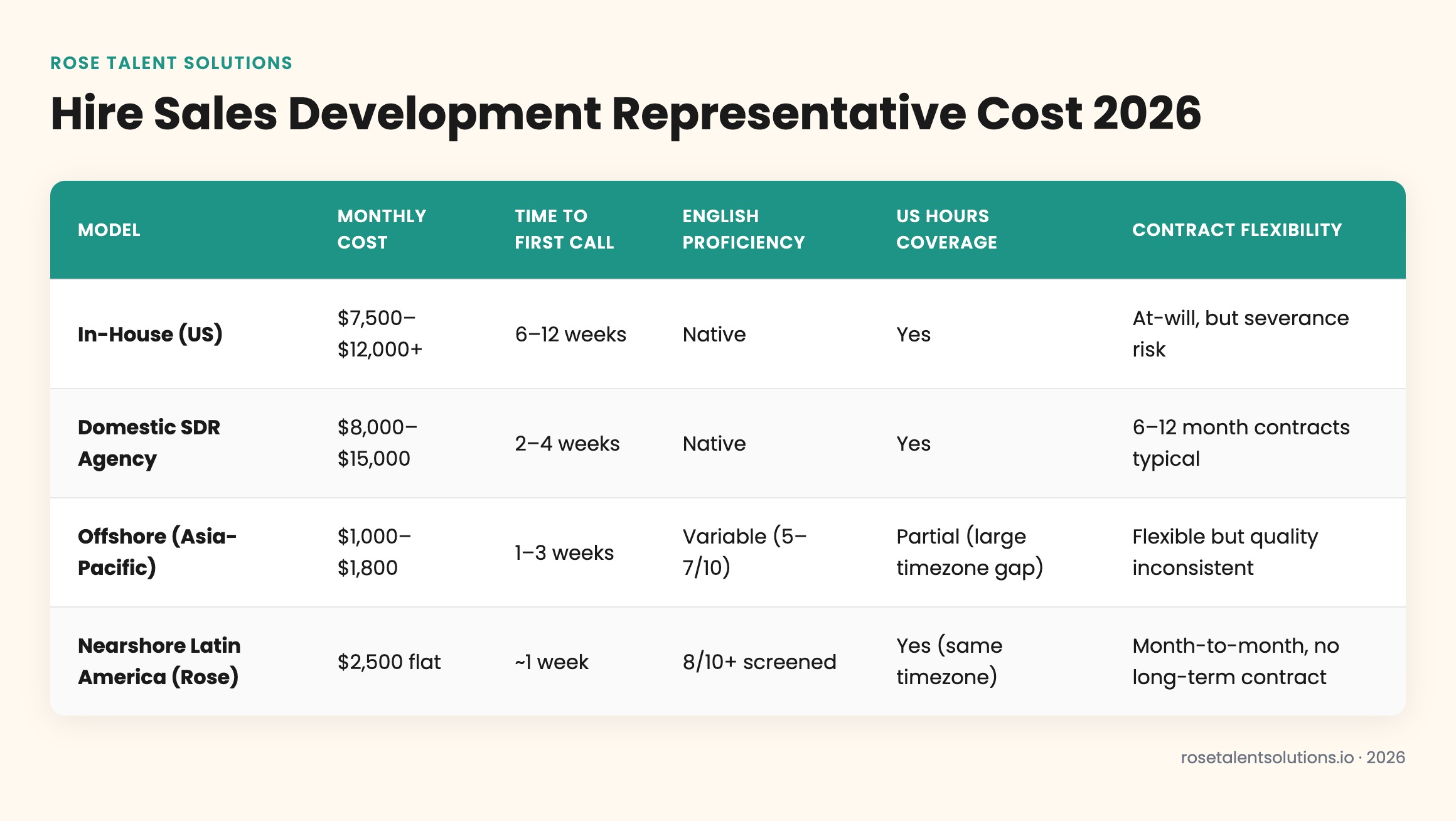
Not every business has the same budget, timeline, or risk tolerance. Here's how the four most common SDR staffing models stack up on the metrics that actually matter to growth-stage operators. The differences in monthly cost are significant, but timezone coverage and contract flexibility are the factors that most often drive regret in the wrong direction after the fact.
| Model | Monthly Cost | Time to First Call | English Proficiency | US Hours Coverage | Contract Flexibility |
|---|---|---|---|---|---|
| In-House (US) | $7,500–$12,000+ | 6–12 weeks | Native | Yes | At-will, but severance risk |
| Domestic SDR Agency | $8,000–$15,000 | 2–4 weeks | Native | Yes | 6–12 month contracts typical |
| Offshore (Asia-Pacific) | $1,000–$1,800 | 1–3 weeks | Variable (5–7/10) | Partial (large timezone gap) | Flexible but quality inconsistent |
| Nearshore Latin America (Rose) | $2,500 flat | ~1 week | 8/10+ screened | Yes (same timezone) | Month-to-month, no long-term contract |
"The most expensive SDR hire isn't the one with the highest salary — it's the one who ramps for 90 days and then churns. Companies that shift to outcome-focused staffing models cut that risk by removing the fixed overhead entirely." — Kyle Coleman, Chief Marketing Officer at Copy.ai (2024)
What Does "Nearshore" Mean for an SDR Role?
A nearshore SDR is a sales development professional based in Latin America — countries like Colombia, Mexico, Argentina, or Costa Rica — who works your US or Canadian business hours in real time. Nearshore team members operate in the same or closely adjacent timezone as their clients, which is what separates this model from offshore alternatives that carry a 10–14 hour time difference. Rose Talent Solutions screens all team members to an 8/10 or higher English proficiency standard before placement, ensuring every SDR can hold a fluent discovery call without friction.
The timezone alignment is what makes nearshore SDRs actually workable for outbound. If your prospect picks up a cold call at 10am EST, your SDR needs to be there — not asleep or working an overnight shift. According to McKinsey's Sales Automation research (2023), same-timezone responsiveness is one of the top three factors in SDR-to-meeting conversion rates, outperforming script quality and cadence length in their analysis of over 1,000 outbound programs.
For SaaS companies specifically, where the sales cycle is shorter and pipeline velocity is everything, timezone gaps compound faster than in enterprise or field sales. If you're evaluating nearshore SDR options for a software business, the guide to outsourced SDR services for SaaS companies covers the specific tech stack requirements, qualification criteria, and onboarding questions you should ask every vendor before signing.
The hidden cost of large-timezone-gap SDRs isn't the hourly rate — it's the 10–14 hour gap that means your prospects are being called at odd hours or receiving follow-up emails a full business day late. Nearshore Latin America eliminates this problem entirely because your SDR is live and available during the same window your prospects are in the office.
According to Gallup's State of the Global Workplace report (2023), employees who work fully aligned to their manager's and team's operating hours report significantly higher engagement scores than those who work asynchronously — a finding that applies directly to SDR performance, where collaboration with AEs and managers during live selling hours directly impacts quota attainment.
How Rose Talent Solutions Prices Nearshore SDR Hiring in 2026
Rose charges a single flat rate: $2,500 per month for a full-time, dedicated SDR working 40 hours per week. That price is all-in — recruiting, vetting, payroll, HR, and ongoing management are included. There are no setup fees, no per-seat software charges from Rose, and no long-term contract. You operate month-to-month and can cancel with 30 days written notice.
Every Rose SDR ships with a role-specific AI copilot trained on the tools your team actually uses — whether that's HubSpot, Salesforce, Apollo, Outreach, or any combination. This isn't a chatbot add-on; it's a workflow layer that lets your SDR research prospects faster, generate personalized first-touch emails, and log activities without switching tabs. According to Salesforce's State of Sales report (2024), SDRs who use AI assistance spend 27% more time on actual selling activities versus administrative tasks — directly impacting pipeline output per rep per month.
The only risk reversal Rose offers: if your SDR isn't the right fit, they replace the team member at no additional cost. That guarantee removes the biggest financial risk of any staffing decision — paying for a bad hire while you restart the search from zero. You can review the full AI tooling stack on the Rose AI Advantage page and start a placement through the get started form.
For businesses that need dedicated property management staffing or bookkeeping and accounting support alongside their sales function, Rose staffs those roles at the same $2,500/month flat rate — making it possible to build a multi-function nearshore team without multiplying overhead per headcount.
How Rose Onboards a Nearshore SDR: The 2026 Placement Process
One of the most common concerns growth-stage operators raise about outsourced staffing is onboarding complexity — the fear that getting a remote SDR productive will take longer than hiring in-house. In practice, the Rose placement process is structured specifically to compress that timeline. Here's how it works from first call to first prospect outreach:
Discovery Call
Rose's team learns your ICP, tech stack, and outbound workflow in a 30-minute call. This conversation also determines whether a traditional SDR or a virtual appointment setter is the better fit for your pipeline stage and volume.
Candidate Matching
Rose surfaces 1–3 pre-vetted nearshore SDR candidates with English proficiency scores, relevant industry experience, and tool familiarity. Most placements happen within approximately 7 days of the discovery call.
Interview and Select
You interview the shortlisted candidates and choose your SDR. Rose handles all offer logistics, contracts with the team member, and payroll setup — you never touch the employment paperwork.
Onboarding and AI Copilot Setup
Your SDR starts on your preferred tools with a role-specific AI copilot already configured for your stack. Rose's onboarding team stays actively involved for the first 30 days to make sure ramp-up stays on track.
Ongoing Management
Rose handles HR, performance check-ins, and compliance on an ongoing basis. You manage the day-to-day pipeline direction. If anything isn't working, the replacement guarantee means you're never stuck with a bad fit.
Outsourced vs In-House SDR: How Do the ROI Paths Actually Differ in 2026?
The ROI calculation between in-house and outsourced nearshore SDRs comes down to three variables: cost per meeting booked, ramp time to productivity, and turnover cost. In-house SDRs typically take 60–90 days to reach full productivity, according to Gartner (2023). During that window, you're paying full salary and benefits for partial output. Nearshore SDRs through an agency model arrive pre-vetted with relevant experience and AI tools already configured — ramp time compresses to 2–3 weeks in most cases.
The financial math over 12 months is stark. An in-house SDR at the midpoint of the cost range — say $116,000 all-in — costs roughly $9,700/month. A nearshore SDR through Rose costs $2,500/month. The $7,200/month delta, compounded over a full year, is $86,400 in savings per SDR headcount. That's capital that can go back into paid acquisition, product, or additional pipeline capacity. For a full model comparing 12-month ROI across both approaches, the outsourced vs in-house SDR ROI comparison is the most detailed public breakdown available on this specific question.
According to McKinsey's talent research (2022), companies that shift variable-cost staffing models to fixed-cost outsourced equivalents report 30–40% improvements in budget predictability — a benefit that compounds as you scale headcount beyond your first SDR.
Nearshore SDR Pros
- $2,500/month all-in vs. $7,500–$12,000+ for in-house total cost
- US timezone alignment — real-time calls, standups, and Slack
- No long-term contract — month-to-month with 30-day cancellation
- AI copilot included, configured for your stack from day one
- Free replacement guarantee if not the right fit
- No payroll taxes, benefits, or HR overhead on your plate
Nearshore SDR Cons
- You manage the daily pipeline direction — Rose handles HR, not quota
- Not a fit if your product requires heavy security clearance or mandatory on-site presence
- Onboarding still requires 1–2 weeks of your team's time to transfer process knowledge
The bottom line is this: for the overwhelming majority of US and Canadian businesses running outbound sales programs, the nearshore model delivers equivalent pipeline output at 65–75% lower cost, with significantly less administrative overhead and no long-term staffing commitment. If you want to evaluate whether it fits your specific motion, the Rose get started page is the fastest way to get a candidate match in front of you.