
What Does It Actually Cost to Hire a Sales Development Rep in 2026?
Nearshore staffing has quietly become the default answer for growth-stage companies that need pipeline without the full-time headcount bill — and once you see the complete cost of an in-house SDR, it's easy to understand why. The number most founders quote is the base salary. The number that actually hits the P&L is two to three times that.
A sales development representative (SDR) is an outbound or inbound sales role focused exclusively on prospecting, qualifying leads, and booking meetings for account executives — they don't close deals, they fill the calendar. Because SDRs are high-activity, high-churn roles, the embedded costs of hiring, onboarding, and replacing them compound fast.
According to the U.S. Bureau of Labor Statistics (2024), median annual wages for sales representatives in the US sit at $63,230 — and that's before a single dollar of employer-side cost. SDR roles in SaaS markets in major metros routinely command $55,000–$75,000 in base alone, with on-target earnings pushing total cash compensation past $90,000.
How Do You Build the Full Cost of an In-House SDR in 2026?
Most hiring managers anchor to base salary and stop there. That's a mistake. Here's every line item that belongs in the honest cost model:
Base salary: $55,000–$75,000 depending on market and experience level. Expect the higher end for SaaS, fintech, or any competitive metro. Employer payroll taxes (FICA, FUTA, SUTA): Add roughly 7.65% in federal payroll taxes alone, according to the IRS Employment Tax guidance (2024). On a $65,000 base, that's approximately $5,000 per year before state taxes.
Benefits: Health, dental, and vision insurance for a single employee averaged $8,435 per year for employer-sponsored coverage, according to SHRM's Employee Benefits Survey (2023). Add 401(k) match, PTO accrual, and any equity component and the benefits load climbs to 20–30% of base salary for most companies.
Recruiting and hiring costs: SHRM benchmarks average cost-per-hire at $4,700 across all US roles. For specialized sales roles, agency fees of 15–20% of first-year salary are common — that's $9,750–$13,000 on a $65,000 base hire.
Sales tools and software: A typical SDR stack includes a CRM (Salesforce or HubSpot), a sequencing tool (Outreach, Salesloft, or Apollo), a data provider (ZoomInfo or Clay), and LinkedIn Sales Navigator. That stack runs $500–$1,200 per seat per month depending on tier and contract, or $6,000–$14,400 per year.
Ramp time: SDRs are rarely fully productive before month three. Quota attainment in the first 90 days typically runs 30–50% of target, according to Gartner Sales Research (2023). That lost productivity has a real dollar value — often $15,000–$25,000 in deferred pipeline when you factor in the AE time spent covering gaps.

How Does SDR Turnover Multiply the Real Cost in 2026?
Turnover is the multiplier nobody puts in the spreadsheet. SDR roles have some of the highest churn in any department — annual turnover rates of 30–40% are common in the industry. When an SDR leaves after 12 months, you've absorbed the full recruiting, onboarding, and ramp cost all over again.
"The fully-loaded cost of replacing a single sales rep is typically 1.5 to 2 times their annual salary once you account for lost productivity, recruiting, and onboarding time." — Tiffani Bova, Chief Growth Evangelist at Salesforce, Growth IQ (2019)
On a $65,000 SDR, that's a replacement cost of $97,500–$130,000 — every cycle. If you're running a team of three SDRs and one turns over per year (conservative at a 33% rate), the replacement drag alone equals a meaningful chunk of your GTM budget.
This is one reason so many growth-stage companies are now doing a more rigorous outsourced vs in-house SDR ROI comparison before committing to another W-2 hire. The math changes quickly when you put replacement risk on the table.
In-House vs. SDR Agency vs. Nearshore: 2026 Cost Comparison
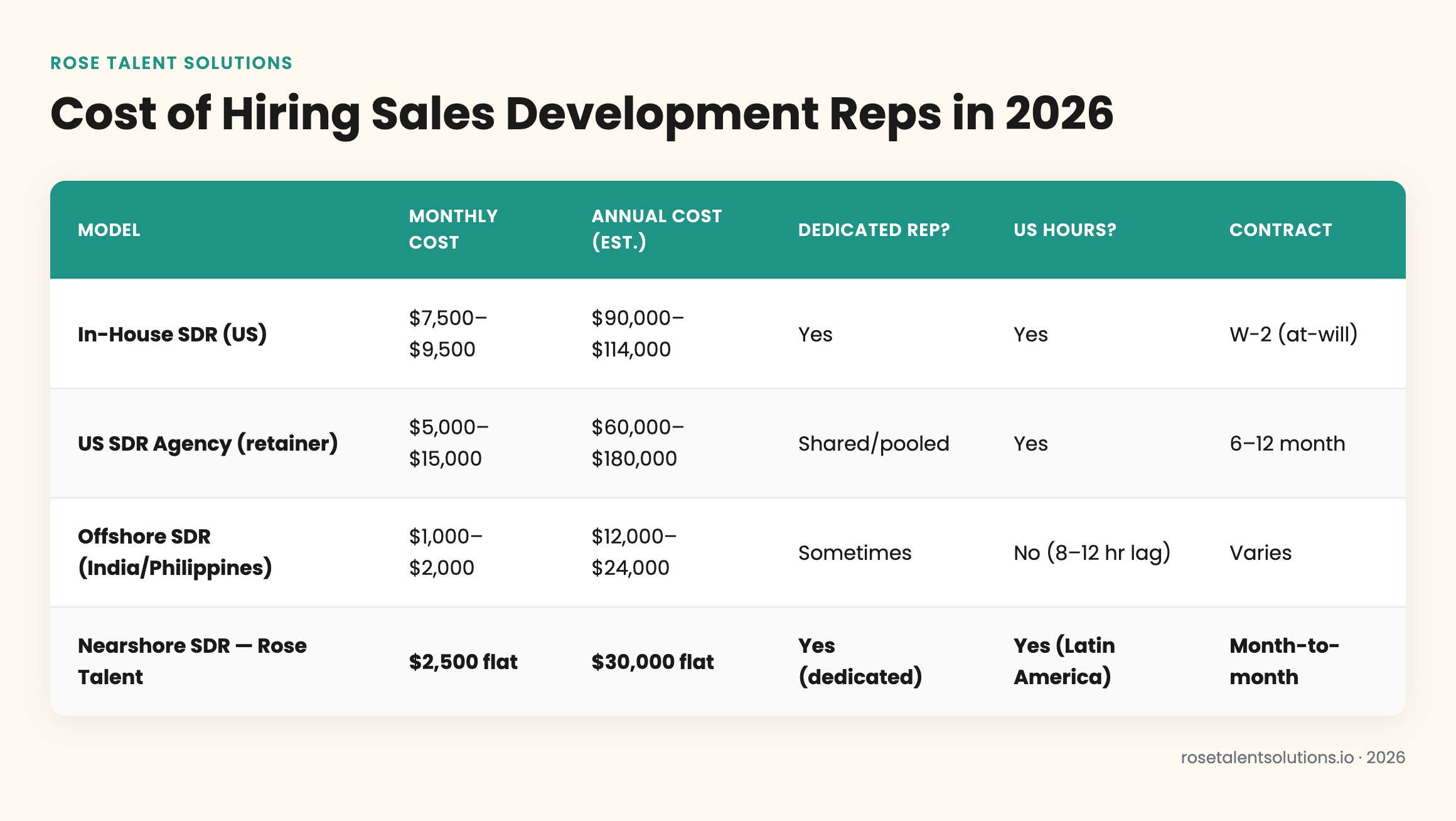
Not all SDR alternatives are equal. A US-based SDR agency charges a performance or retainer fee on top of your tech stack and often doesn't give you a dedicated rep. An offshore provider gives you low cost but often at the expense of timezone alignment and language fluency. Nearshore hits a different point on the curve.
| Model | Monthly Cost | Annual Cost (est.) | Dedicated Rep? | US Hours? | Contract |
|---|---|---|---|---|---|
| In-House SDR (US) | $7,500–$9,500 | $90,000–$114,000 | Yes | Yes | W-2 (at-will) |
| US SDR Agency (retainer) | $5,000–$15,000 | $60,000–$180,000 | Shared/pooled | Yes | 6–12 month |
| Offshore SDR (India/Philippines) | $1,000–$2,000 | $12,000–$24,000 | Sometimes | No (8–12 hr lag) | Varies |
| Nearshore SDR — Rose Talent | $2,500 flat | $30,000 flat | Yes (dedicated) | Yes (Latin America) | Month-to-month |
For a deeper look at how the numbers shake out across different business models, our breakdown of how much an outsourced sales development rep actually costs walks through each pricing tier with real examples.
What Does a Nearshore SDR Actually Do — and How Are They Different?
A nearshore SDR is a full-time, dedicated sales development representative based in Latin America who works your US business hours in your time zone. They prospect, qualify, send sequences, make outbound calls, and book meetings — the same scope as a US-based hire, at a fraction of the all-in cost.
The distinction from offshore (India, Philippines) is meaningful: timezone overlap is the single biggest operational variable in outbound sales. A rep who is available when your prospects are available — during EST or PST business hours — books more meetings, period. Latin American countries like Colombia, Mexico, and Argentina operate in EST or CST naturally, with no shift work required.
Rose's published English proficiency floor is 8/10 or above on screening assessments. Every team member also ships with a role-specific AI copilot trained on the tools in your stack — whether that's Salesforce, HubSpot, Apollo, or Outreach. That AI layer means your rep isn't spending hour one of day one figuring out your CRM; they're prospecting. Learn more about that at our AI advantage page.
If you're specifically scaling pipeline for a SaaS product, our guide on how to hire outsourced SDR services for SaaS covers the exact criteria to vet for — including sequencing tool proficiency and ICP alignment.

The hidden cost of an offshore SDR isn't the hourly rate — it's the 8–12 hour timezone gap that means every prospect callback, every same-day follow-up, and every hot lead that goes cold overnight. Nearshore eliminates that gap entirely.
How Does the Rose Talent Hiring Process Work for SDRs in 2026?
One objection that comes up: "Won't I spend weeks recruiting even for an outsourced role?" Not with a managed staffing model. Rose handles recruiting, vetting, and placement so the only thing you're choosing is whether the candidate fits your workflow.
Intake call
You walk through your ICP, tools, quota targets, and communication style. This takes 30 minutes and replaces the job description writing, job board posting, and resume screening you'd normally do yourself.
Candidate matching
Rose's team screens and presents qualified nearshore SDR candidates — already vetted on English proficiency (8/10+ floor), outbound sales experience, and tool familiarity. You interview the finalists.
Placement and AI onboarding
Your SDR starts within approximately 7 days of match. Their role-specific AI copilot is configured to your stack before day one — your rep hits the ground prospecting, not learning software.
Ongoing HR and management
Payroll, HR, compliance, and performance monitoring are handled by Rose. You direct the work; Rose handles the employment infrastructure. If the placement isn't a fit, you get a free replacement — no additional cost.
The flat rate is $2,500/month, all-in. That means recruiting, vetting, payroll, HR, and ongoing management are all included — not billed as add-ons. The arrangement is month-to-month with no long-term contract; you cancel with 30 days written notice. Ready to see who's available? Start your search here.
Who Is a Nearshore SDR the Right Fit For in 2026?
Nearshore SDRs through a managed staffing model work best for companies that have a defined ICP and sales process but can't justify — or don't want to absorb — the full W-2 cost of a US hire. According to McKinsey's B2B Growth research (2022), 65% of B2B companies now use a hybrid human-plus-digital sales model, and outsourced SDR capacity is a natural fit in that structure.
They are not a fit if you have zero sales process documented. An SDR — nearshore or otherwise — needs a script, an ICP, an email sequence, and access to a prospect list or data tool. If those don't exist, you need a fractional sales leader before you need an SDR.
Small businesses specifically often find nearshore SDRs more accessible than enterprise-grade US agencies. If you're in that category, our resource on B2B lead generation services for companies under 20 employees is worth reading before you decide on a model.
Good fit for nearshore SDR
- Defined ICP and documented sales process
- Need full-time dedicated coverage, not a shared pool
- Want US timezone availability without a US salary
- Budget is $2,500–$5,000/month for sales development
- Growth-stage or SMB that can't absorb W-2 turnover risk
Not the right fit (yet)
- No sales process or messaging documented
- Requires in-person presence or on-site demos
- Needs someone who closes, not just qualifies
- Looking for a part-time or project-based arrangement
For businesses that need pipeline support alongside back-office functions, Rose also places nearshore staff across bookkeeping and accounting roles — useful context if you're thinking about building a broader nearshore team rather than a single SDR hire.