
Why Nearshore Bookkeeping Is Winning in 2026
Nearshore bookkeeping from Latin America has quietly become the most practical staffing decision a US or Canadian business owner can make in 2026. Unlike offshore alternatives in Asia-Pacific, a nearshore bookkeeper works inside — or right next to — your timezone, speaks fluent English, and already knows the accounting software your business runs on. You get a dedicated full-time professional without the six-figure salary, the benefits overhead, or the communication lag that turns a simple reconciliation question into a 48-hour email chain.
The math is hard to ignore. The median annual salary for a staff accountant in the United States hit $54,000 in 2024, according to the U.S. Bureau of Labor Statistics (2024). Add benefits, payroll taxes, recruiting, and onboarding, and the all-in cost easily clears $70,000 per year. A full-time nearshore bookkeeper through Rose Talent Solutions runs $2,500 per month — all-in, flat rate, no surprises.
This guide walks you through exactly what to look for, what to pay, how to vet candidates, and why Latin America specifically — not Southeast Asia, not Eastern Europe — is the right region for English-speaking North American businesses that want real-time collaboration.
What Is a Nearshore Bookkeeper? (And How Is It Different From Offshore?)
A nearshore bookkeeper is a remote accounting professional based in a country geographically and culturally close to your own — in this context, Latin America relative to the US and Canada. They work the same business hours as your team, communicate in fluent English, and operate in a regulatory and business environment shaped by close economic ties to North America. This is meaningfully different from offshore outsourcing, which typically involves countries 8–12 time zones away where real-time collaboration is structurally difficult.
The nearshore model matters most for bookkeeping because accounting isn't a batch job. Your bookkeeper needs to answer a bank reconciliation question at 10 a.m., catch a duplicate vendor payment before payroll runs, and jump on a 15-minute Zoom with your CPA at short notice. A professional in Medellín, Mexico City, or Buenos Aires can do all of that. A professional in Manila or Bangalore structurally cannot — not without someone working a graveyard shift.
Rose Talent Solutions places team members exclusively in Latin America. Every candidate clears an 8/10 or higher English proficiency screen before a client ever sees their profile. If you want to dig deeper into how this compares across software platforms, our guide to top Latin America bookkeeping outsourcing companies breaks down the major players and their vetting standards.

How Nearshore Compares to Offshore and Onshore Bookkeeping in 2026
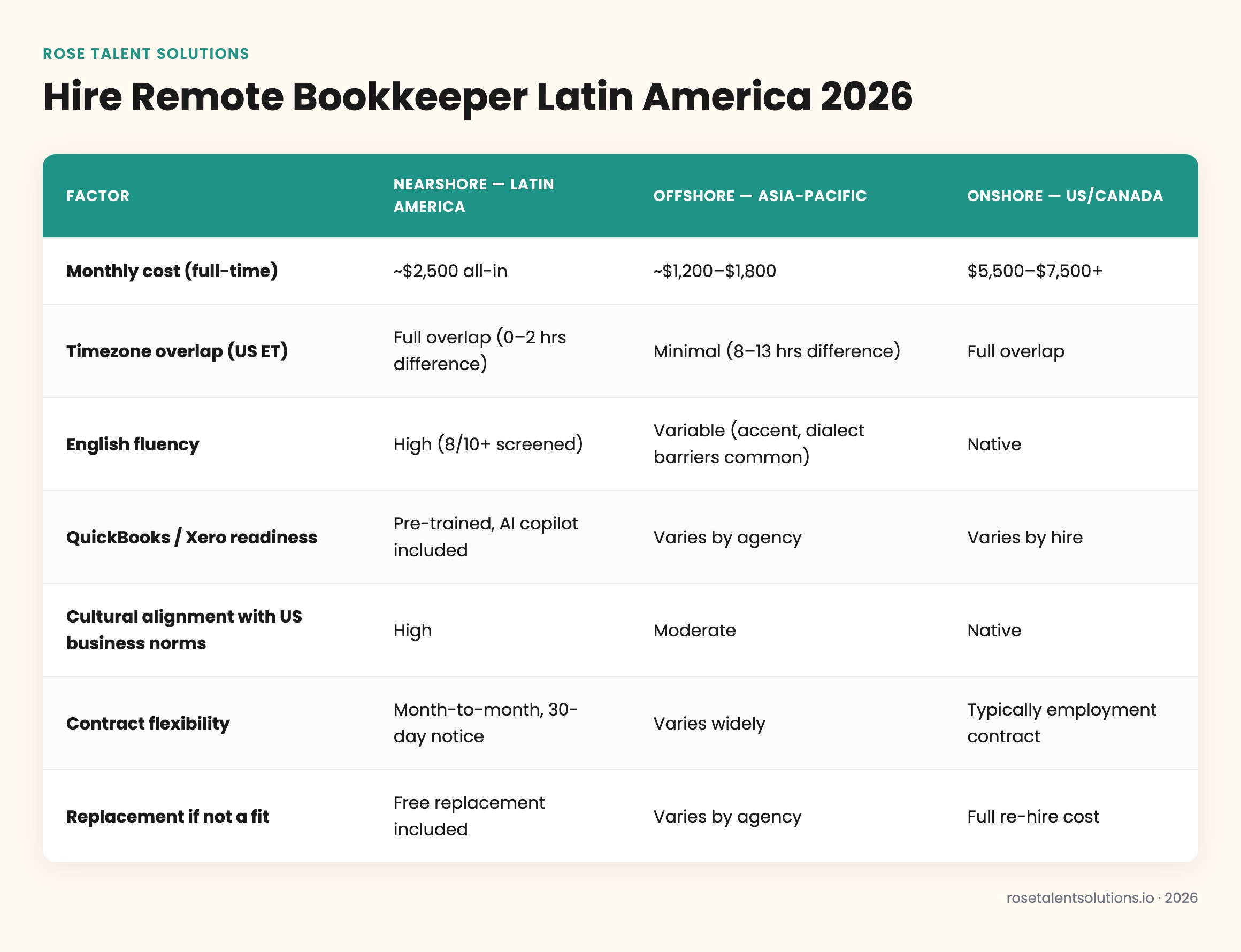
When business owners research remote bookkeeping, they typically consider three options: hire domestically, go offshore (Philippines, India), or go nearshore (Latin America). Each has a different cost structure, communication profile, and risk profile. The table below puts them side by side on the factors that actually affect day-to-day operations.
| Factor | Nearshore — Latin America | Offshore — Asia-Pacific | Onshore — US/Canada |
|---|---|---|---|
| Monthly cost (full-time) | ~$2,500 all-in | ~$1,200–$1,800 | $5,500–$7,500+ |
| Timezone overlap (US ET) | Full overlap (0–2 hrs difference) | Minimal (8–13 hrs difference) | Full overlap |
| English fluency | High (8/10+ screened) | Variable (accent, dialect barriers common) | Native |
| QuickBooks / Xero readiness | Pre-trained, AI copilot included | Varies by agency | Varies by hire |
| Cultural alignment with US business norms | High | Moderate | Native |
| Contract flexibility | Month-to-month, 30-day notice | Varies widely | Typically employment contract |
| Replacement if not a fit | Free replacement included | Varies by agency | Full re-hire cost |
What Tasks Can a Remote Latin America Bookkeeper Handle in 2026?
One of the most common misconceptions is that a remote bookkeeper is only useful for data entry. In reality, a well-vetted nearshore bookkeeper can own the entire financial back office of a small or mid-size business. Here is what a typical Rose Talent Solutions bookkeeper handles from day one:
- Accounts payable and receivable — processing invoices, tracking outstanding balances, managing vendor payments
- Bank and credit card reconciliation — daily or weekly, depending on transaction volume
- Payroll processing — coordinating with payroll platforms like Gusto or ADP
- Expense categorization — keeping the chart of accounts clean for your CPA
- Financial reporting — monthly P&L, balance sheet, and cash flow statements
- Software management — QuickBooks Online, Xero, FreshBooks, Wave, and others
- Tax prep support — organizing documentation and liaising with your external CPA
Every Rose team member arrives with a role-specific AI copilot trained on the software they'll be using in your business. If you're running QuickBooks, your bookkeeper's AI copilot is trained on QuickBooks workflows. This dramatically cuts ramp time — most Rose bookkeepers are fully operational within their first week. You can read more about how this works on our AI advantage page.
For businesses specifically comparing platform costs before hiring, our breakdown of QuickBooks virtual bookkeeper costs in 2026 is worth a read before you make a decision.
"Outsourcing accounting functions — especially to professionals with strong software fluency — can reduce the cost of the finance function by 40 to 60 percent without sacrificing quality or control." — Deloitte, Global Outsourcing Survey (Deloitte, 2022)
The hidden cost of offshore bookkeeping isn't the hourly rate — it's the 8–12 hour timezone gap that means every urgent question sits unanswered until the next business day. For finance functions that touch cash flow and vendor relationships daily, that lag has a real dollar cost.
How Rose Talent Solutions Vets and Places Remote Bookkeepers
Finding a qualified remote bookkeeper in Latin America on your own is possible — but the vetting process is where most businesses underestimate the effort. You need to screen for English fluency, accounting software proficiency, professional reliability, and cultural fit. Rose Talent Solutions handles all of that before you speak to a single candidate.
Role Discovery
Rose's team learns exactly what software you use, what your transaction volume looks like, and what a successful first 30 days looks like for your business.
Candidate Sourcing & Screening
Every candidate is sourced from Rose's Latin America talent network and screened for English proficiency (8/10+ floor), accounting credentials, and software fluency before being shortlisted.
Client Interview
You interview the top 1–2 matched candidates. You choose the person you want — no one is assigned to you without your sign-off.
Onboarding & AI Copilot Activation
Your bookkeeper starts with a role-specific AI copilot already configured for your software stack. Rose handles payroll, HR, and ongoing management.
Ongoing Support & Free Replacement
If the team member isn't the right fit at any point, Rose replaces them at no additional cost. Month-to-month terms, 30 days written notice to cancel.
The entire process is built around the fact that bookkeeping is a trust role. You're giving someone access to your financial data. Rose's vetting process is designed to surface professionals who are not just technically capable, but operationally trustworthy. According to SHRM (2023), the average cost to replace an employee is between 50% and 200% of annual salary — a figure that makes the free replacement guarantee at Rose far more valuable than it might initially appear.

How Much Does It Cost to Hire a Remote Bookkeeper in Latin America in 2026?
Pricing in the nearshore staffing space varies more than most buyers expect — because what you're paying for differs dramatically by provider. Some agencies charge per task, some per hour, some for a "part-time" allocation that's really three clients sharing one bookkeeper's attention. Rose Talent Solutions keeps it simple: $2,500 per month, flat. That covers full-time (40 hours per week), dedicated to your business only, with recruiting, vetting, payroll, HR, and ongoing management all included.
For context on how the hourly math breaks down across different platforms and arrangements, our detailed post on QuickBooks bookkeeper costs is worth reviewing — it covers what you can realistically expect to pay when software specificity is a factor. And if your business uses Xero rather than QuickBooks, our guide on hiring a Xero virtual bookkeeper covers the specific skills and certifications to look for.
According to a 2023 report by Statista (2023), the global outsourcing market reached $731 billion, with finance and accounting functions representing one of the fastest-growing segments. That growth is being driven by exactly the dynamic described here — businesses discovering that they can access senior talent at junior-hire prices without sacrificing quality, communication, or control.
The no-long-term-contract structure matters here too. You're not locked in. If your business shrinks, pivots, or you simply want to pause, 30 days written notice is all it takes. That flexibility is structurally impossible with a W-2 hire and difficult even with most staffing agencies that use annual retainer models.
Is a Nearshore Bookkeeper Right for Your Business? Pros and Cons
Nearshore bookkeeping from Latin America is the right move for most US small and mid-size businesses — but it's worth being clear-eyed about both sides. Here is an honest breakdown:
Pros
- Full timezone overlap with US/Canada business hours — real-time collaboration, no lag
- 60%+ cost savings vs. a comparable US hire, without sacrificing skill level
- English fluency screened to 8/10+ — clear communication, no interpretation risk
- Pre-trained on QuickBooks, Xero, and other common platforms with AI copilot support
- Month-to-month terms — no long-term contract commitment
- Free replacement if the team member isn't a fit — zero re-hiring cost to you
- HR, payroll, and management handled by Rose — no employer-of-record complexity
Cons
- Not ideal if your business requires a CPA license for work that legally requires one (a bookkeeper handles books — a CPA handles tax filings and audits)
- Requires you to share software access and financial data — onboarding security protocols matter
- Best results come when you have defined processes to hand off, not when you're building them from scratch
For most businesses that have outgrown DIY bookkeeping and don't yet need a full-time in-house controller, the nearshore model hits a sweet spot that no other staffing structure currently matches. If you're ready to move forward, the getting started page walks you through exactly what happens in the first 72 hours after you reach out. And if your operations include property management or real estate, the bookkeeping and accounting services page covers the specific tasks Rose bookkeepers handle for that industry vertical.
The McKinsey Global Institute has documented that generative AI tools can automate 60–70% of time spent on data processing tasks in finance functions (McKinsey, 2023). Rose's AI copilot is built on exactly this insight — your nearshore bookkeeper is not competing with AI; they are augmented by it, which means faster turnaround, fewer errors, and more senior-level judgment applied to the work that actually matters.