
Nearshore bookkeeping outsourcing from Latin America has moved from a cost-cutting experiment to a mainstream staffing strategy for US and Canadian businesses in 2026. The combination of overlapping time zones, strong English fluency, and deep familiarity with US accounting software makes Latin America the most practical region to source remote bookkeeping talent — not just the cheapest. This post breaks down how the top providers stack up, what you should expect to pay, and which model actually works for a growing business.
Before diving in, one term worth defining clearly: a nearshore bookkeeper is a finance professional based in a country geographically and culturally close to the client — in this context, Latin America serving the US, Canada, or UK. Unlike offshore bookkeepers in the Philippines or India, nearshore hires work your actual business hours, join your Slack, and answer your calls in real time. That distinction has real operational consequences, especially for cash-flow-sensitive businesses that need same-day answers on vendor payments, reconciliations, or payroll runs.
Bookkeeping errors aren't just annoying — they're expensive. According to SCORE (2024), 60% of small business owners reported that financial reporting problems directly delayed a key business decision in the past 12 months. The fix isn't more software. It's a dedicated, trained human who owns your books every single day — and who's reachable when you need them.
How the Top Latin America Bookkeeping Outsourcing Companies Compare in 2026
The market has consolidated around a few distinct models. You'll find full-service staffing agencies (which recruit, vet, and manage the bookkeeper for you), freelance marketplaces (where you do the sourcing yourself), and accounting firm outsourcing (where a firm in Mexico City or Medellín handles your books as a managed service). Each has tradeoffs on control, cost, and quality consistency.
Staffing agencies like Rose Talent Solutions' bookkeeping practice price at a flat monthly rate that bundles recruiting, vetting, payroll administration, HR, and ongoing performance management. The bookkeeper is yours full-time — not shared across five other clients the way accounting firm outsourcing models work. For businesses that need a consistent person inside their systems every day, the dedicated staffing model consistently outperforms the managed-service alternative on responsiveness and institutional knowledge retention.
Freelance marketplaces (Workana, Upwork Latin America filters) look cheaper on paper but require you to handle vetting, contracts, payment compliance across borders, and replacement sourcing yourself. The hidden labor cost of running a bad hire out and replacing them frequently erases the rate savings within a quarter.

Nearshore vs. Offshore vs. Onshore Bookkeeping: 2026 Side-by-Side
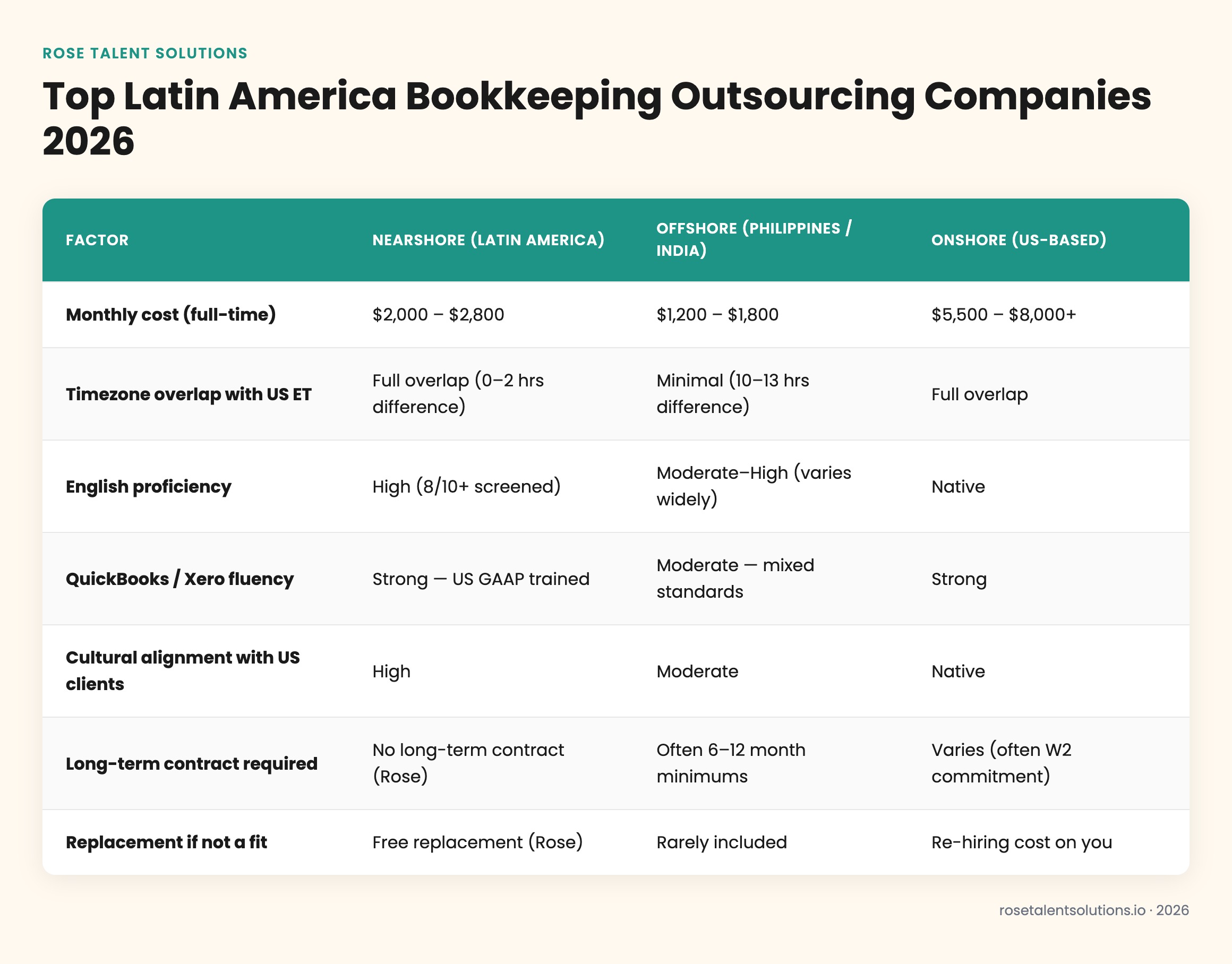
The table below is the clearest way to see why the top Latin America bookkeeping outsourcing companies have taken market share from both Philippine offshore providers and US onshore accounting staff. The deciding factors are almost never just rate — they're timezone, communication quality, and how fast a new hire gets productive inside your specific software stack.
| Factor | Nearshore (Latin America) | Offshore (Philippines / India) | Onshore (US-based) |
|---|---|---|---|
| Monthly cost (full-time) | $2,000 – $2,800 | $1,200 – $1,800 | $5,500 – $8,000+ |
| Timezone overlap with US ET | Full overlap (0–2 hrs difference) | Minimal (10–13 hrs difference) | Full overlap |
| English proficiency | High (8/10+ screened) | Moderate–High (varies widely) | Native |
| QuickBooks / Xero fluency | Strong — US GAAP trained | Moderate — mixed standards | Strong |
| Cultural alignment with US clients | High | Moderate | Native |
| Long-term contract required | No long-term contract (Rose) | Often 6–12 month minimums | Varies (often W2 commitment) |
| Replacement if not a fit | Free replacement (Rose) | Rarely included | Re-hiring cost on you |
The data supports the shift. The U.S. Bureau of Labor Statistics (2024) puts the median US bookkeeper salary at $47,440 annually — roughly $3,953/month before benefits, payroll taxes, and overhead. A nearshore equivalent at $2,500/month flat, fully managed, represents a 37% savings with zero employer-side compliance burden. If you want to explore exactly what those savings look like broken down by software platform, our QuickBooks virtual bookkeeper cost breakdown for 2026 runs the full numbers.
"Outsourcing bookkeeping to Latin America isn't offshoring — it's a different category entirely. You get real-time collaboration, US GAAP familiarity, and cultural context that makes the relationship feel like an in-house hire." — Lupe Flores, Director of Finance Operations at Escalon Services (2024)
What Does a Top-Tier Latin America Bookkeeping Outsourcing Company Actually Provide in 2026?
Not all providers in this space deliver the same scope. When evaluating companies, the deliverables that separate strong providers from commodity ones come down to five things: software depth, vetting rigor, day-one productivity, replacement protection, and ongoing management support.
Software fluency is the single biggest predictor of ramp time. A bookkeeper who has logged 1,000+ hours in QuickBooks Online is productive by day three. A bookkeeper who's "familiar" with it is still asking you basic navigation questions in week two. The best Latin America providers pre-screen for platform-specific experience and, increasingly, layer in AI copilots trained on the client's exact software environment. Rose's AI advantage program assigns every bookkeeper a role-specific AI copilot trained on their tools — QuickBooks, Xero, or whichever platform the client runs — before the first day of work.
The hidden cost of a slow-ramp bookkeeper isn't their salary — it's the 4–6 weeks of your own time spent answering their questions, correcting their entries, and re-explaining your chart of accounts. Providers who invest in pre-onboarding software training cut that burden by roughly half.
Accounts payable is a particularly high-stakes bookkeeping function. Missed due dates, duplicate payments, and vendor disputes all trace back to poor AP management. If this is a pain point for your business, our breakdown of the best accounts payable virtual assistant services covers exactly what to look for when the bookkeeper's primary role involves vendor payment cycles.
According to SHRM (2024), the average cost to replace a professional employee in the US is 50–200% of their annual salary. That's why replacement protection matters: if a nearshore provider places someone who isn't working out, absorbing the re-recruiting cost themselves is the structural difference between a vendor relationship and a staffing partnership. Rose replaces any team member at no additional cost if they're not a fit — that's the risk reversal that makes month-to-month terms viable for both sides.

How Rose Talent Solutions' Bookkeeping Placement Process Works in 2026
For context on what a high-quality onboarding experience looks like, here's the process Rose uses — it's a useful benchmark against which to evaluate any Latin America bookkeeping outsourcing company you're considering.
Intake & Role Scoping
You complete a 20-minute intake call where Rose maps your software stack, transaction volume, reporting cadence, and any industry-specific needs (e.g., job costing, property management, e-commerce COGS). The scoping call drives the candidate brief — generic briefs produce generic placements.
Candidate Matching & Vetting
Rose screens for platform-specific experience (QuickBooks, Xero, Wave, etc.), runs English proficiency assessments to a minimum 8/10 bar, and conducts live scenario tests using your actual software. Only candidates who pass all three gates go to the shortlist.
Client Interview & Selection
You interview the shortlisted candidates — typically 2 to 3 — and make the final selection. You're choosing your bookkeeper, not accepting whoever the agency assigns.
AI Copilot Activation
Before day one, the selected bookkeeper is set up with a role-specific AI copilot calibrated to your software environment. This compresses the ramp from weeks to days on routine tasks like transaction categorization and reconciliation prep.
Ongoing Management & Monthly Check-ins
Rose handles payroll, HR administration, and performance oversight. You get a monthly check-in with a Rose account manager — so you're never managing the employment relationship yourself while also running a business.
If your books run on Xero specifically, the platform has nuances in bank rule logic and reporting that generalist bookkeepers routinely fumble. Our guide to hiring a Xero virtual bookkeeper covers the certification flags and task-specific experience markers that actually predict performance — separate from general bookkeeping competence.
The QuickBooks Intuit resource center (2024) notes that businesses with a dedicated bookkeeper reconcile accounts an average of 3× faster than those relying on part-time or shared bookkeeping resources — a meaningful operational difference for any business managing weekly cash flow decisions.
What Should You Actually Pay for Latin America Bookkeeping Outsourcing in 2026?
Pricing in this market ranges from $1,200/month (freelance marketplace, no vetting, no support) to $3,200/month (boutique agency with specialized CPA-adjacent staff). The $2,000–$2,800 band is where you find full-time dedicated bookkeepers with agency support, software vetting, and some form of replacement protection. That's the segment worth evaluating seriously.
Watch out for per-hour pricing models that look attractive at $12–$18/hour but cap your bookkeeper's availability or share them across other clients. A bookkeeper who owns 40 hours of your week knows your chart of accounts, your vendor relationships, your revenue patterns. One who's splitting time across four accounts knows none of them deeply.
Why Latin America Bookkeeping Outsourcing Works
- Full US business hours — no overnight batching of questions or urgent requests
- US GAAP training standard; familiar with IRS reporting requirements and 1099 workflows
- Flat-rate monthly pricing with no employer-side payroll tax, benefits, or HR overhead
- Month-to-month terms available — no long-term contract required at leading providers
- English fluency screened to a documented bar (8/10+ at Rose), not self-reported
Where to Watch Out
- Freelance platforms require you to self-manage vetting, contracts, and replacement
- Not all providers screen for software-specific experience — "QuickBooks" on a resume ≠ QuickBooks proficiency
- Managed accounting firm models often share your bookkeeper across multiple clients, reducing responsiveness
- Some agencies charge setup or placement fees on top of the monthly rate — always confirm the all-in number
According to McKinsey & Company's outsourcing research (2023), businesses that outsource finance functions to nearshore partners report a 28% reduction in finance-related operational overhead compared to fully in-house teams — and a faster monthly close cycle as the secondary benefit. The savings are real; the key is choosing a provider structured to deliver them consistently.
For businesses ready to move, the fastest path is a direct intake conversation where your software, volume, and reporting needs get matched to a pre-vetted candidate pool. You can start that process with Rose here — the intake takes under 30 minutes and typically produces a shortlist within 5–7 business days.
If you want to compare specific QuickBooks-focused providers before committing, the QuickBooks virtual bookkeeper services comparison walks through the top options side by side, including how their vetting, pricing, and replacement policies differ in practice.