
What Does It Mean to Hire a Dedicated Nearshore Developer?
Nearshore developers are software engineers based in countries geographically close to your own — for US and Canadian companies, that means Latin America: Colombia, Mexico, Argentina, Brazil, Costa Rica, and similar markets. "Dedicated" means the developer works exclusively on your product, on your schedule, for a fixed monthly cost. They are not shared across multiple clients, not rotated between projects, and not billing you by the hour.
This is fundamentally different from a freelancer marketplace or an offshore staff-aug firm. When you hire dedicated nearshore developers, you get someone who shows up on your Slack at 9 a.m. Eastern, attends your sprint standup, and still has four hours of overlap left when your San Francisco team logs on. That real-time collaboration is the single biggest operational advantage nearshore has over traditional offshore models.
The Latin America tech talent pool has grown dramatically. According to Coursera's Global Skills Report (2023), Latin American countries rank among the fastest-growing regions for technology skill proficiency, with software development topping the list. That growth — combined with salaries 40–60% below US market rates — is why companies like Google, IBM, and hundreds of mid-market SaaS firms have planted engineering teams across the region.
It is also worth defining the staffing model itself. A dedicated nearshore staffing engagement means one provider handles recruiting, vetting, payroll, compliance, HR, and ongoing performance management — all for a single flat monthly fee. You do not manage an overseas payroll entity. You do not negotiate local labor law. You show up on Monday morning with a developer already in your tools, your repo, and your standup invite. That operational simplicity is why the model is accelerating among US product teams in 2026.

How Nearshore Compares to Offshore and Onshore in 2026
Before you commit to any hiring model, it is worth seeing the full picture side by side. The table below cuts through the marketing noise and shows you what each model actually delivers across the dimensions that matter most for a dedicated software development role.
| Criteria | Nearshore (Latin America) | Offshore (India / Philippines) | Onshore (US / Canada) |
|---|---|---|---|
| Typical monthly cost (dedicated, full-time) | $2,000–$4,000 | $1,200–$2,500 | $8,000–$14,000+ |
| Timezone overlap with US East Coast | 6–8 hours/day | 0–3 hours/day | Full workday |
| English proficiency (avg. EF EPI score) | High (Colombia: 58.9, Argentina: 56.6) | Moderate–High (Philippines: 61.6, India: 49.9) | Native |
| Cultural alignment with US business norms | Strong | Moderate | Native |
| Average ramp time to productive contribution | 1–2 weeks | 3–5 weeks | 1–2 weeks |
| AI copilot / tool pre-training available | Yes (role-specific) | Varies by firm | Varies by firm |
| Contract flexibility | Month-to-month | Often 6–12 month lock-in | Often full-time employment |
The cost gap between nearshore and onshore is significant, but the real story is what you lose by choosing the cheapest offshore option. A developer in a timezone 9–12 hours away might save you $800/month on paper, but a single blocked pull request that sits overnight for three days in a row costs your team far more than that in delayed shipping cycles. Timezone overlap is engineering velocity — and nearshore delivers it at a fraction of the onshore price.
English proficiency data reinforces this. The EF English Proficiency Index (2023) shows Argentina ranked 25th globally and Colombia 57th — both comfortably in the "high" or "moderate-high" band. When you combine that language baseline with US business-hour availability, the communication gap that plagues many offshore engagements largely disappears with a well-vetted nearshore hire.
What Skills Can You Cover When You Hire Dedicated Nearshore Developers in 2026?
The Latin America talent market in 2026 is not a single-stack region. You can source across virtually every modern technology stack. Full-stack roles — React, Node.js, Python, Django — are the most common placements, but mobile, DevOps, and data engineering talent is abundant too.
If you need a nearshore full-stack developer who can own a product from front-end to API layer, Latin America has deep benches in React/Next.js, Vue, Laravel, and Ruby on Rails. Mobile is equally strong — dedicated nearshore iOS and Android developers are regularly placed into product teams building consumer-facing apps for US markets. Backend-specific roles, like a dedicated nearshore Node.js developer, are also in strong supply — particularly in Colombia and Argentina, where bootcamp and university CS output has grown sharply since 2020.
According to the U.S. Bureau of Labor Statistics (2024), the median annual wage for a US software developer is $132,270 — roughly $11,000/month. A dedicated nearshore developer through Rose Talent Solutions runs $2,500/month, all-in. That single data point is why the model is accelerating among founders and engineering leaders who need full-time capacity without full-time US overhead.
The regional developer output supports that scale. According to the Inter-American Development Bank (2023), Latin America's technology sector has grown at more than twice the global average over the past five years, with software development, fintech, and cloud engineering roles leading the expansion. Countries like Colombia, Argentina, and Mexico now produce tens of thousands of credentialed software engineers annually — and that pipeline is still growing.
"Latin America has quietly become one of the most competitive technology talent markets in the world. The combination of strong university STEM programs, US cultural familiarity, and real-time timezone alignment makes it a strategically superior choice to traditional offshore markets for many product teams." — Andrés Bilbao, Co-founder of Nequi at Bancolombia (2023)
How the Rose Talent Matching Process Works in 2026
Hiring a dedicated nearshore developer through Rose Talent Solutions is not a job board experience. It is a managed staffing process — recruiting, vetting, payroll, HR, and ongoing performance management are all handled for you. Here is exactly how it works:
Intake Call & Role Scoping
Rose's team maps your stack, your workflow, your tooling, and your communication style. This is not a form — it's a 30-minute conversation that drives a precise candidate brief.
Candidate Sourcing & Technical Vetting
Candidates are sourced exclusively from Rose's Latin America network, then screened for technical skills, English proficiency (8/10+ floor), and timezone availability. Only the top 1–3 candidates reach you.
AI Copilot Onboarding
Every placed developer ships with a role-specific AI copilot trained on your team's tooling — whether that's GitHub workflows, Jira, Linear, or your internal docs. Learn more on the AI advantage page.
First Day Integration
Rose handles onboarding logistics so your new developer is in your Slack, on your repo, and attending your standup from day one — not week three.
Ongoing HR & Management Support
Payroll, compliance, performance check-ins, and replacement coverage if needed — all included in the flat $2,500/month. No surprise invoices, no hidden fees.
The entire model runs month-to-month with no long-term contract. Cancel with 30 days written notice. If the developer isn't the right fit for your team at any point, Rose replaces them at no additional cost — that is the only risk reversal we offer, and it is the right one.
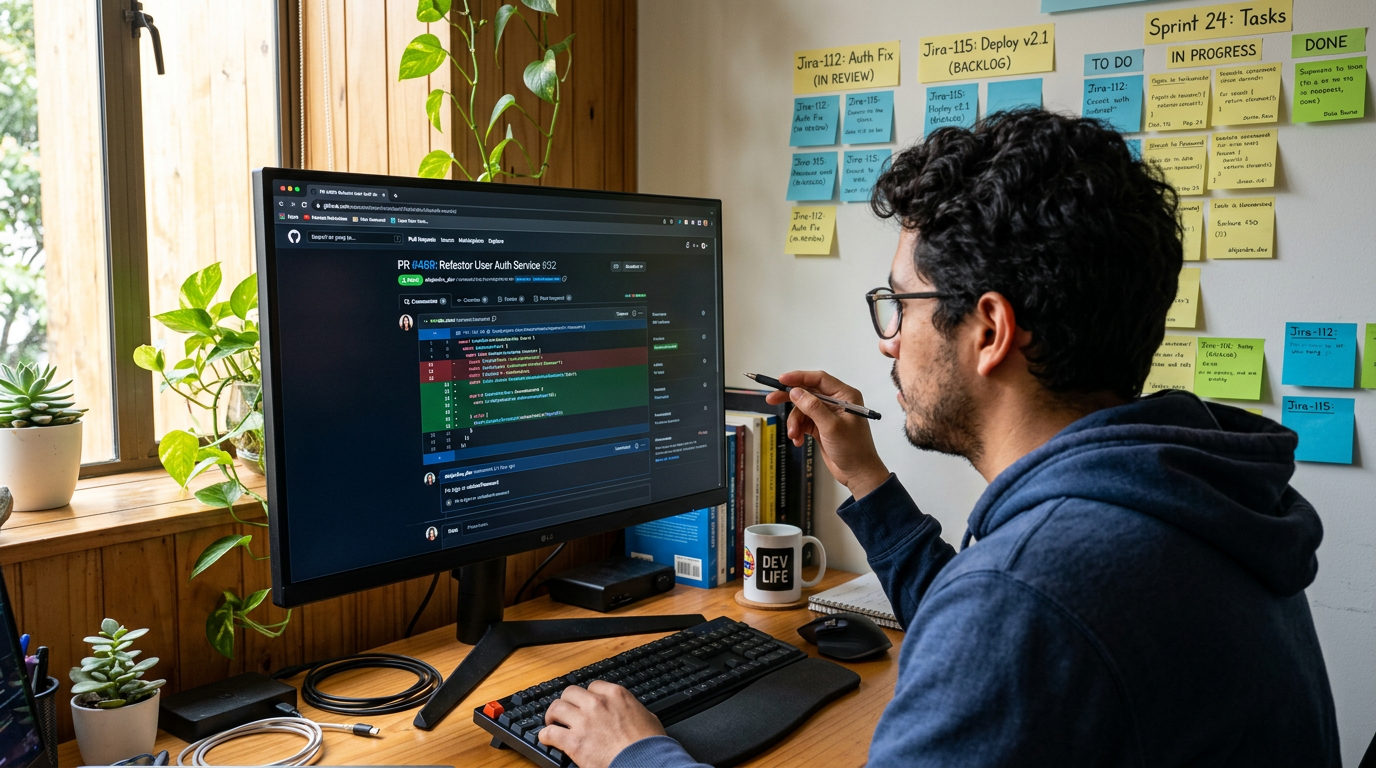
How AI-Trained Developers Ramp Faster Than Traditional Hires in 2026
Every Rose team member arrives with a role-specific AI copilot — a layer of tooling trained on the software and workflows relevant to their function. For developers, that means pre-configured context around your stack, your documentation patterns, and your code review conventions. This is not a chatbot bolted on as an afterthought. It is a structured knowledge asset built before the developer's first day.
The hidden ramp cost of a new technical hire isn't salary — it's the first 3–6 weeks of reduced team velocity while they find their footing. AI copilots cut that window by giving developers structured context from day one, not week six.
According to McKinsey's analysis of generative AI (2023), developer productivity gains from AI-assisted coding tools range from 20–45% for routine tasks like code completion, documentation, and test writing. When a nearshore developer arrives already fluent in those tools and trained on your specific codebase context, that productivity gain starts on day one — not after a 60-day learning curve.
The retention picture matters here too. According to Gallup's State of the Global Workplace report (2023), employees who feel their work tools support their productivity are 17% more likely to stay with their employer through the 12-month mark. For nearshore developers, that translates directly into lower churn and fewer replacement cycles — which matters when you're building a product on a tight roadmap.
If you're scaling a product team and considering whether a single dedicated hire or a small team makes more sense, the post on building a dedicated nearshore developer team walks through the staffing structure decisions in detail. For individual contributor roles, a single dedicated hire at $2,500/month is typically the right starting point before layering in additional team members.
Is Hiring Dedicated Nearshore Developers Right for Your Business in 2026?
The nearshore model works best for companies that have a defined product or technical function they need covered full-time, but can't justify — or don't want to manage — a full US-based engineering hire. That includes early-stage startups extending their founding team, growth-stage companies scaling a specific function, and established businesses backfilling roles or adding capacity without headcount complexity.
Who Nearshore Works Best For
- Startups needing full-time dedicated engineers without US employment overhead
- Product teams that rely on real-time collaboration (daily standups, async PR reviews)
- Companies scaling specific stacks fast — Node.js, React, mobile, Python
- Operators who want month-to-month flexibility with no long-term contract commitment
- Businesses where English communication and cultural fit directly affect code quality and teamwork
When Nearshore May Not Be the Fit
- Projects requiring on-site presence or hardware-dependent development environments
- Roles with extreme US security clearance requirements (government contracts)
- Teams that are entirely async with no overlap preference (pure offshore economics may win)
- One-off projects better suited to freelance platforms than a dedicated model
According to SHRM's talent acquisition research (2023), the average cost to hire a full-time software developer in the US — including recruiting fees, onboarding time, and lost productivity — exceeds $28,000 per hire. The nearshore dedicated model eliminates most of that overhead. Recruiting, vetting, payroll, HR, and replacement coverage are all included in the flat monthly fee.
The math is not just about base salary either. A fully-loaded US engineering hire — salary, benefits, payroll taxes, equity, recruiting fees, and the inevitable 60-day ramp period — frequently pushes the real first-year cost of a single developer above $180,000, according to BLS Employer Costs for Employee Compensation data (2024). At $2,500/month, a dedicated nearshore developer through Rose costs $30,000 per year — all-in. That delta is not a rounding error. It is the difference between funding one engineering hire and funding six.
The nearshore model is not about cutting corners on talent — it is about accessing the same caliber of developer your US competitors are hiring, at a price point that lets you scale without burning your runway. Rose screens for technical ability first, English fluency second, and timezone compatibility third. Every hire clears all three bars before you meet them. You can start the process at rosetalentsolutions.io/start — the intake conversation takes under 20 minutes.