
Nearshore mobile developers for iOS and Android have quietly become the most practical staffing move US tech companies are making in 2026. While Silicon Valley salaries for senior iOS engineers routinely clear $180,000 annually and offshore teams in Southeast Asia introduce 12-hour lag into every code review cycle, Latin America has emerged as the high-quality middle ground — same time zone, strong English, and deep native mobile expertise at a sustainable cost structure. If you're evaluating whether this model is right for your product team, this guide gives you the full picture: what to look for, how the economics work, and how Rose Talent Solutions makes the match.
What Is a Nearshore Mobile Developer, Exactly?
A nearshore mobile developer is a software engineer based in a geographically proximate country — in the US context, that means Latin America — who specializes in building native or cross-platform mobile applications for iOS, Android, or both. Unlike offshore developers in India or the Philippines who operate 8–13 hours ahead of US time, nearshore engineers in countries like Colombia, Mexico, Argentina, and Brazil overlap with Eastern, Central, and Pacific time zones by 5–8 hours, enabling real-time collaboration during the full US workday.
The distinction matters more than most hiring managers realize. Timezone alignment is not a soft perk — it's the difference between a bug fix that ships by 4pm and one that gets picked up the next morning after your standup has already started. When you're in active sprint cycles, that lag compounds into missed deadlines and frustrated stakeholders.
Rose Talent Solutions places nearshore mobile developers who work full US business hours — 40 hours per week, dedicated to your team. Every engineer we place has passed an 8/10 or higher English proficiency screen, meaning standups, PR reviews, and Slack threads don't require a translator or a follow-up email chain to interpret.
How the iOS and Android Skill Stack Breaks Down in 2026
Mobile development in 2026 is not a monolith. Before you post a job or brief a staffing partner, you need clarity on which technical path your product actually needs — because the wrong hire will cost you three to six months of rework. Here's how the landscape divides:
Native iOS engineers write in Swift (and sometimes legacy Objective-C). They work natively with Xcode, UIKit, SwiftUI, and Apple's ecosystem of frameworks including CoreData, AVFoundation, and ARKit. Senior iOS developers command the highest premiums domestically because supply is thin relative to demand — according to the U.S. Bureau of Labor Statistics (2024), software developer employment is projected to grow 25% through 2032, with mobile specializations among the most in-demand niches.
Native Android engineers write in Kotlin (and sometimes Java). They're fluent with Android Studio, Jetpack Compose, Room, and the Google Play Services stack. The Android developer pool in Latin America is notably deep — Brazil and Argentina in particular produce large cohorts of Kotlin-proficient engineers through both university programs and Google-certified Android developer tracks.
Cross-platform engineers work in React Native or Flutter and can ship to both App Store and Google Play from a single codebase. This is the right call for early-stage products where speed to market matters more than platform-specific performance optimization. For enterprise-grade apps with heavy native integrations (camera, Bluetooth, biometrics), native is usually the better long-term investment.

If your product roadmap requires both platforms and you're not sure which path fits, that's exactly the kind of conversation to have before you staff — not after you've onboarded someone and discovered their Flutter experience is more tutorial than production. Rose's technical vetting process is designed to surface that distinction before you ever see a candidate profile. You can also read our deeper breakdown on hiring a nearshore full-stack developer if your team needs someone who can span backend and mobile simultaneously.
Nearshore vs. Offshore vs. Onshore: How Does the Model Actually Compare in 2026?
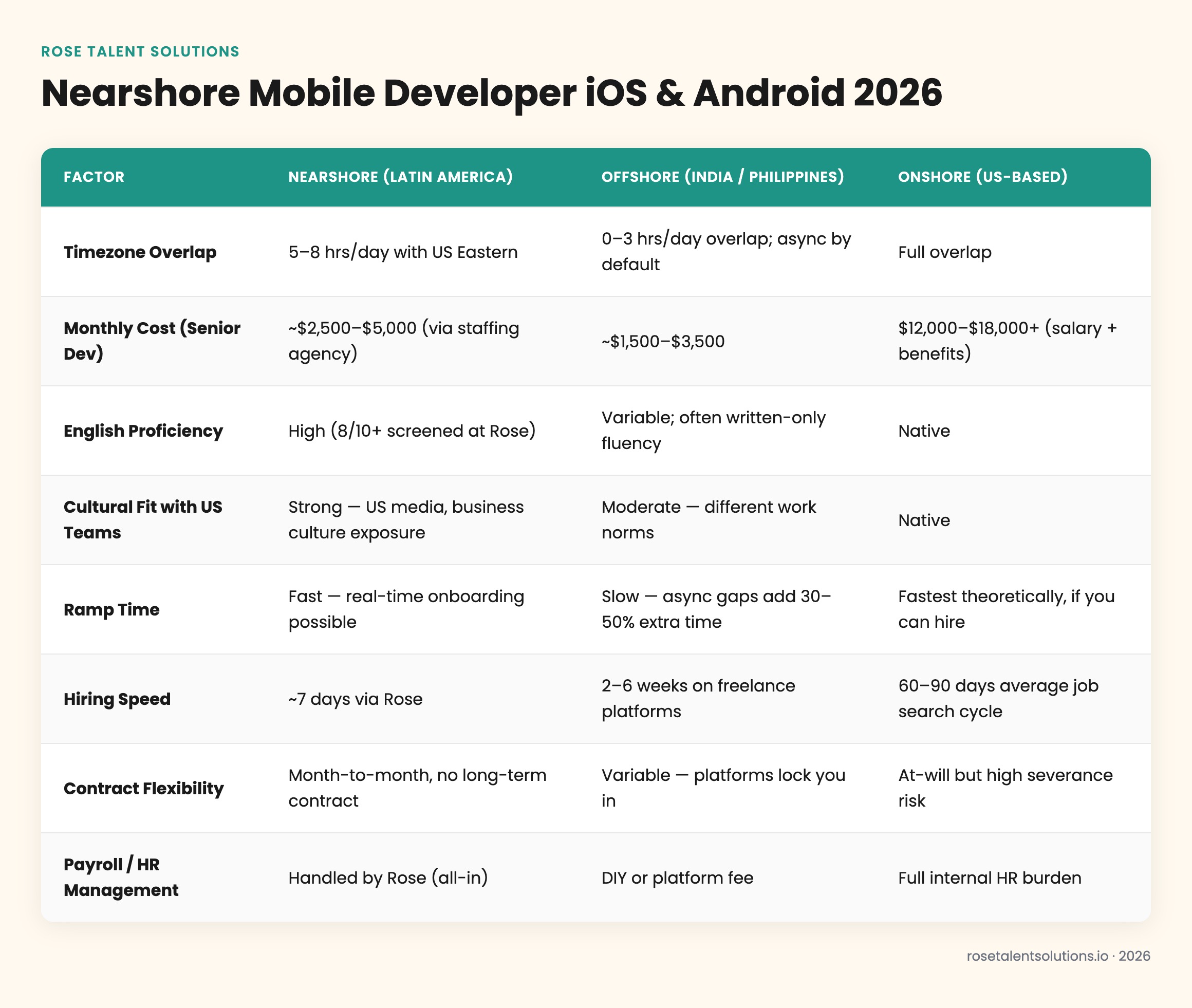
The staffing conversation almost always comes down to a three-way comparison. Here's an honest, structured look at each model across the dimensions that actually move the needle for a product team:
| Factor | Nearshore (Latin America) | Offshore (India / Philippines) | Onshore (US-Based) |
|---|---|---|---|
| Timezone Overlap | 5–8 hrs/day with US Eastern | 0–3 hrs/day overlap; async by default | Full overlap |
| Monthly Cost (Senior Dev) | ~$2,500–$5,000 (via staffing agency) | ~$1,500–$3,500 | $12,000–$18,000+ (salary + benefits) |
| English Proficiency | High (8/10+ screened at Rose) | Variable; often written-only fluency | Native |
| Cultural Fit with US Teams | Strong — US media, business culture exposure | Moderate — different work norms | Native |
| Ramp Time | Fast — real-time onboarding possible | Slow — async gaps add 30–50% extra time | Fastest theoretically, if you can hire |
| Hiring Speed | ~7 days via Rose | 2–6 weeks on freelance platforms | 60–90 days average job search cycle |
| Contract Flexibility | Month-to-month, no long-term contract | Variable — platforms lock you in | At-will but high severance risk |
| Payroll / HR Management | Handled by Rose (all-in) | DIY or platform fee | Full internal HR burden |
"Latin America has produced a generation of mobile engineers who are technically competitive with US peers, work American hours, and communicate in English — there's genuinely no reason to default to offshore anymore if timezone and communication matter to you." — Matías Hernández, Head of Engineering Talent at Globant (2024)
The offshore model's apparent cost advantage dissolves quickly when you price in the async tax. Every back-and-forth that takes 15 minutes in a Slack thread with a nearshore dev takes 24 hours with an offshore team. Multiply that by daily standups, PR reviews, QA loops, and stakeholder demos, and you're looking at a hidden productivity loss of 20–30% on a typical two-week sprint, according to McKinsey Digital (2023).
For a deeper side-by-side on platform-based alternatives, see our analysis of the nearshore developer model versus Toptal — specifically how vetting depth and ongoing management compare.
How Rose Talent Solutions Matches and Places Nearshore Mobile Developers in 2026
Most staffing firms send you a resume stack and disappear. Rose's model is different: we handle recruiting, technical vetting, payroll, HR, and ongoing performance management — all included in the $2,500/month flat rate. There are no hidden markups, no per-placement fees, and no long-term contract. You pay month-to-month and cancel with 30 days' written notice if the engagement isn't working.
Role Brief
You tell us your stack (Swift, Kotlin, Flutter, React Native), your team structure, and your timeline. We clarify technical requirements and your communication expectations before we start sourcing.
Technical Vetting
Candidates go through code assessments and architecture reviews specific to mobile. English proficiency is screened to an 8/10 floor. We don't send you anyone we wouldn't hire ourselves.
Candidate Shortlist
You receive 2–3 matched profiles within approximately 7 days. You interview, you choose — no pressure to accept anyone who isn't the right fit.
Placement and Onboarding
Once you greenlight a candidate, Rose handles payroll, HR paperwork, and onboarding logistics. Your developer shows up to their first standup ready to work.
Ongoing Management + AI Copilot
Every Rose team member ships with a role-specific AI copilot trained on the tools they'll use daily. If the placement isn't the right fit, we replace at no additional cost.
The replacement guarantee is the only risk reversal we offer — and we mean it specifically. If the developer we place isn't working for your team, we find a replacement at no additional cost to you. That's the backstop: a commitment that our vetting is rigorous enough that we'll stand behind it.
Every Rose developer also arrives with access to our AI copilot advantage — a role-specific AI layer trained on the tools and workflows relevant to their specialty. For mobile developers, that means AI assistance tuned for the documentation, debugging patterns, and release workflows specific to the App Store and Google Play ecosystems.

What Questions Should You Ask Before Hiring a Nearshore Mobile Developer in 2026?
Not all nearshore staffing is equal. The model is sound — but execution varies significantly between providers. Here are the questions that separate a high-quality placement from one that costs you six months of productivity:
- What does the technical vetting process include? A resume review is not a vetting process. Ask specifically about code assessments, system design interviews, and mobile-specific architecture challenges.
- How is English proficiency measured? "Conversational English" means different things to different firms. Rose uses a standardized 10-point proficiency screen and requires 8/10 or above.
- Who manages payroll and HR compliance? Latin American labor law varies by country. Make sure your staffing partner owns that complexity, not you.
- What happens if the placement isn't a fit? The answer should be a specific process, not a vague reassurance. Rose replaces at no additional cost — that's the commitment in writing.
- Is the developer dedicated to my team or shared? Shared developers are a cost-saving measure that will cost you more in ramp time and context-switching than you save on the rate. Rose placements are full-time and dedicated.
The hidden cost of an under-vetted nearshore hire isn't the monthly rate — it's the 90 days of sprint capacity you burn discovering that "5 years of iOS experience" means 5 years of maintaining a single legacy app. Technical vetting specificity is the most important variable in nearshore mobile developer ROI.
According to SHRM's Talent Acquisition Research (2024), the average cost of a bad technical hire is 1.5–2× the employee's annual salary when you factor in lost productivity, re-recruitment, and onboarding time for a replacement. That math applies whether the hire is domestic or nearshore — the variable is vetting quality, not geography.
If you're also considering whether a dedicated team structure is right for you versus a single placement, our guide on building a dedicated nearshore developer team covers how to sequence those hires as your product scales.
How the Nearshore Mobile Model Stacks Up Against Platform Alternatives in 2026
Platforms like Toptal, Turing, and Upwork position themselves as the self-serve alternative to a staffing partner. For some use cases — a one-week audit, a single component build — they're fine. For a sustained mobile development engagement where you need someone embedded in your product team, the platform model has structural limitations that compound over time.
Nearshore via Rose (Pros)
- Full-time, dedicated — no competing client projects
- All-in rate covers payroll, HR, and ongoing management
- AI copilot included for mobile-specific workflows
- Technical and English vetting done before you see the profile
- No long-term contract — month-to-month with 30 days' notice
- Replacement at no additional cost if the placement isn't a fit
Freelance Platforms (Cons)
- Developer typically manages multiple clients simultaneously
- You own recruiting, vetting, contracts, and payments
- No ongoing performance management or HR support
- Vetting is self-service — you're reading portfolios, not assessing architecture skills
- Platform lock-in fees and usage markups accumulate
- No replacement guarantee — bad hire means starting over
The platform model's flexibility is real — but it's flexibility you pay for in management overhead. A Gallup Workplace Research (2023) study found that employees who have a dedicated manager with structured check-ins are 21% more productive than those working in low-oversight arrangements. The staffing model isn't just about recruiting — it's about the ongoing management infrastructure that keeps a placed developer performing at their ceiling.
For more context on how Rose's model compares to another major platform, see our breakdown of the nearshore developer versus Turing comparison — specifically around vetting depth, developer exclusivity, and what happens when performance drops.
According to Statista's Global Developer Survey (2024), React Native and Flutter now account for over 40% of new mobile app development starts globally, while native Swift and Kotlin retain dominance in enterprise and high-performance consumer apps. Knowing which segment your product sits in is the first real decision — and it shapes every sourcing decision that follows.
Ready to move? Start your search here and tell us what you're building. Most placements are matched within 7 days.