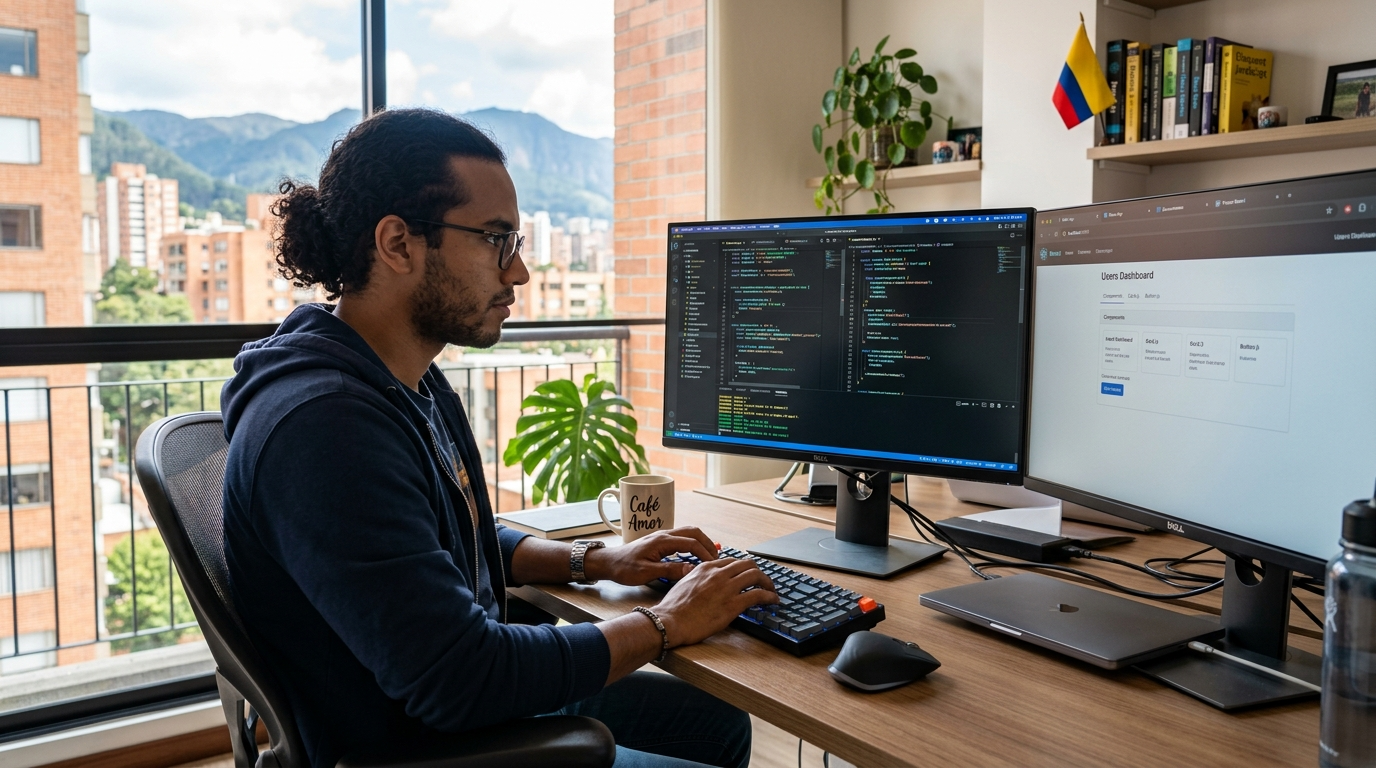
Nearshore full-stack developers — engineers based in Latin America who work US business hours — have become the dominant hiring choice for US and Canadian tech teams that need real output without the overhead of a domestic engineering hire. The math is simple: you get a senior-capable developer who overlaps your entire workday, communicates in fluent English, and integrates into your existing stack (React, Node.js, Python, you name it) for a flat monthly rate that is 50–70% below a comparable W-2 hire. In 2026, that combination is hard to argue with, and the agencies that can deliver it reliably are becoming the backbone of lean tech teams across North America.
This guide breaks down exactly what to look for when hiring a nearshore full-stack developer, how the cost and quality math stacks up against other hiring models, and how Rose Talent Solutions structures its placements so you are not rolling the dice on a stranger from a job board.
According to SHRM's State of the Workplace research (2024), talent scarcity in software engineering roles is the single most commonly cited barrier to product growth among US companies with under 200 employees. The nearshore model exists precisely to close that gap — without the 6-to-18-month recruiting cycles that in-house hiring demands.
What Is a Nearshore Full-Stack Developer, Exactly?
A nearshore full-stack developer is a software engineer based in a geographically close, lower-cost country — in the US context, that means Latin America — who works synchronously with your team during your business hours. "Full-stack" means they handle both the client-facing frontend layer (React, Vue, Angular) and the server-side backend layer (Node.js, Python, Django, REST APIs, databases). They are not contractors who batch work overnight and send you a pull request at 3am. They are present, communicating, and building alongside your team in real time.
The nearshore model is distinct from every other remote hiring model in one critical way: timezone alignment. A developer in Medellín, Buenos Aires, or Mexico City sits in a time zone that overlaps 6–8 hours with US Eastern time. That full-day overlap is what makes real-time standups, live code reviews, and same-day blocker resolution possible — none of which are reliably achievable when your developer is separated from your team by a double-digit hour gap.

How Nearshore Compares to Every Other Hiring Model in 2026
Before you commit to any hiring path, you need to see the true cost picture. Most teams undercount the total cost of an onshore hire (benefits, payroll taxes, recruiter fees, equity dilution) and overcount the risk of nearshore (assuming a quality or communication gap that, with a rigorous vetting process, does not exist). The table below puts all four models side by side on the variables that actually matter.
| Hiring Model | Monthly All-In Cost | Timezone Overlap (US ET) | English Proficiency | Avg. Ramp Time | Commitment |
|---|---|---|---|---|---|
| Nearshore (Latin America) | $2,500 flat (Rose) | 6–8 hrs | 8/10+ screened | 1–2 weeks | Month-to-month |
| Distant offshore (outside Americas) | $800–$1,800 | 0–2 hrs | Varies widely | 3–6 weeks | Often 3–6 mo min |
| US Onshore (W-2) | $12,000–$18,000+ | Full overlap | Native | 4–8 weeks | Indefinite / at-will |
| Freelance (Upwork / Toptal) | $4,000–$10,000 (hourly) | Unpredictable | Varies | 1–4 weeks | Project-by-project |
The low-cost distant offshore price point looks attractive until you factor in what McKinsey's digital talent research (2024) describes as "coordination drag" — the compounding productivity loss that occurs when a team cannot resolve a blocker in real time. For a full-stack developer who needs to align constantly with your product manager, designer, and QA team, a double-digit hour time gap is not a minor inconvenience. It is a structural cap on your sprint velocity.
What Skills Does a Nearshore Full-Stack Developer Bring in 2026?
The Latin American developer talent pool has matured significantly over the last five years. Universities in Brazil, Colombia, Mexico, and Argentina are producing graduates with strong computer science fundamentals, and the developer communities in those countries have rallied around the same open-source ecosystems US teams use: React, TypeScript, Node.js, Python, PostgreSQL, Docker, AWS. If your stack is JavaScript end-to-end — which describes most SaaS and product teams in 2026 — you will find deep talent in the nearshore pool. For teams that lean on Python for their backend or data layer, Rose's nearshore Python developer placements cover that specialization specifically.
Full-stack, by definition, means your developer can move fluidly between frontend and backend work without handing off to a second person. That is valuable on a lean team where you cannot afford to hire a React specialist and a Node specialist separately. Rose vets for genuine full-stack capability — not just developers who list both on a resume but freeze when you ask them to refactor an Express middleware or build a custom React hook from scratch.
AI fluency is now table-stakes for any developer Rose places. Every team member ships with a role-specific AI copilot trained on the tools in your stack — whether that is GitHub Copilot integration, custom prompt workflows for your framework, or automated testing pipelines. According to GitHub's 2024 developer survey, developers using AI coding assistants complete tasks up to 55% faster than those who do not — meaning your nearshore developer is not just cheaper than a domestic hire, they are also faster than an unassisted one. You can read more about how Rose structures that tooling on the AI advantage page.
How Rose Talent Solutions Vets and Places Full-Stack Developers in 2026
Most staffing agencies send you a resume and wish you luck. Rose's process is different because the vetting happens before you see a single candidate — and the placement is backed by a free replacement guarantee if the developer is not a fit. Here is exactly how the process works from first contact to a developer shipping code on your team.
Stack and role scoping call
Rose's team maps your actual technical requirements — frontend framework, backend language, database, CI/CD setup — so the search is scoped to developers who have shipped in your specific environment, not just developers who generically claim full-stack experience.
Multi-stage technical screening
Every candidate completes a live coding assessment, an architecture discussion, and an English fluency screen (minimum 8/10). Developers who pass are added to the active talent pool; most do not.
Curated shortlist delivered to you
You receive 2–3 pre-vetted profiles with recorded technical assessments, not a stack of raw resumes. You interview your shortlist and choose your developer — Rose does not choose for you.
Placement, onboarding, and AI copilot setup
Once you select your developer, Rose handles payroll, HR, and compliance. The developer's role-specific AI copilot is configured for your stack before day one, so they are productive immediately.
Ongoing management and replacement guarantee
Rose stays involved post-placement. If the developer is not meeting your expectations, Rose replaces them at no additional cost — no re-negotiation, no additional placement fee.
The $2,500/month flat rate covers everything in that process: recruiting, vetting, payroll, HR administration, ongoing management, and the replacement guarantee. There are no add-on fees for the AI copilot, no separate payroll processing charges, and no long-term contract. You can cancel with 30 days written notice. Compare that to a staffing agency that charges a 20–25% annual salary markup on a full-time domestic hire — on a $120,000 developer, that is $24,000–$30,000 in placement fees alone, before you pay a single dollar of salary.
"The cost arbitrage in Latin American tech talent is real, but the more durable advantage is cultural and operational alignment — these developers grew up watching the same content, using the same tools, and building for the same end users as your US team." — Ariel Camus, CEO at Microverse (2023)

How Frontend and Backend Specialization Fits Inside a Full-Stack Role
Full-stack is a spectrum, not a binary. Some developers are frontend-dominant — they live in React, care deeply about component architecture, and can build a Node.js API but are not architecting distributed systems. Others are backend-dominant — they optimize PostgreSQL queries in their sleep but will need a design system to produce clean UI. When you are hiring a full-stack developer, you need to be honest about which end of the spectrum your work actually lives on, and hire accordingly.
If your team's bottleneck is the UI layer — building out a design system, optimizing core web vitals, managing complex state — then a developer who skews frontend-heavy is the right hire. Rose has a dedicated resource on hiring a nearshore frontend developer that goes deeper on that specific profile. If your bottleneck is the API and infrastructure layer, the complementary piece on nearshore backend developers covers that side of the stack in detail.
The hidden cost of hiring a "full-stack" developer who is actually 90% frontend is not the salary — it is the six months you spend waiting for backend features that never ship because your developer is out of their depth. Vetting for genuine balance across the stack is the single most important thing Rose's technical screen does.
For teams running JavaScript end-to-end, Node.js proficiency is the hinge skill that makes a full-stack developer genuinely full-stack. A developer who can write React components and also build and maintain a Node.js API with proper middleware, error handling, and authentication is a force multiplier on a lean team. Rose's resource on hiring a nearshore Node.js developer is worth reading if that is central to your stack.
The broader workforce data reinforces how critical specialization clarity is. According to the US Bureau of Labor Statistics (2024), software developer employment is projected to grow 25% through 2032 — more than four times the average for all occupations. That growth is driving up domestic salaries faster than most startup budgets can absorb, making the nearshore Latin American talent pool not just a cost play but a strategic necessity for teams that need to grow their engineering capacity in 2026.
What Does the Nearshore Model Look Like Day to Day?
The question hiring managers ask most often is not about cost or vetting — it is "will this actually feel like they are on my team?" The answer, with a well-matched nearshore developer from Latin America, is yes — because the conditions that make remote work feel disconnected (timezone gaps, language friction, tool mismatch) are all addressed in the nearshore model before the developer starts.
What works exceptionally well
- Standups, sprint planning, and code reviews happen live — no async delays
- Slack and Jira communication in natural, fluent English with no translation lag
- Cultural alignment with US product thinking and user expectations
- AI copilot configured to your stack accelerates ramp dramatically
- Month-to-month terms mean you can scale a second developer as workload grows
What to manage proactively
- Local holidays in Mexico, Colombia, or Argentina differ from US federal holidays — plan sprint calendars accordingly
- Internet reliability varies by city and home setup — Rose screens for this, but confirm backup connectivity
- A genuinely full-stack developer costs more than a junior specialist — $2,500/mo is the right level, not a bargain bin
The day-to-day reality for most teams is that a nearshore full-stack developer from Latin America behaves operationally identically to a remote US developer — with the exception that their fully-loaded cost to you is $2,500/month instead of $12,000–$18,000. For companies that want to explore what that looks like across broader operational functions beyond development, Rose also covers the full onboarding process on the start page.
According to Gallup's remote work research (2024), fully remote employees who have real-time access to their manager and teammates report engagement levels statistically indistinguishable from co-located workers. Nearshore — not distant offshore — is the model that makes real-time access possible across an international team, because the entire business day is shared rather than separated by half a planet.