
Why Nearshore Ecommerce Accounting Support Is Outpacing Traditional Offshore in 2026
Nearshore ecommerce accounting support — meaning bookkeepers and accounting specialists based in Latin America serving US, Canadian, and UK businesses — has quietly become the default choice for ecommerce operators who've been burned by the classic offshore model. The difference isn't just cost. It's time zones, communication cadence, and the ability to get your reconciliations done before you wake up, not after midnight on the other side of the planet.
Ecommerce accounting is uniquely messy. You're juggling Shopify payouts, Amazon settlement files, PayPal and Stripe fee reconciliations, sales tax nexus across 20+ states, COGS tracking per SKU, and inventory adjustments — all of which have to land in QuickBooks or Xero with zero error. According to Accounting Today (2024), more than 75% of small accounting firms report a shortage of experienced staff. That talent gap is pushing ecommerce brands toward virtual staffing at an accelerating rate.
This guide breaks down exactly what to look for when hiring offshore or nearshore ecommerce accounting support in 2026, what the real cost looks like, and why the geography of your bookkeeper matters more than most founders realize.
What Is Ecommerce Accounting Support — and What Does "Offshore" Actually Mean in 2026?
Ecommerce accounting support refers to a dedicated bookkeeper or accounting specialist who manages the financial back-end of an online retail business. That includes transaction categorization, payment gateway reconciliation, sales tax filings, monthly close, profit-and-loss reporting, and inventory cost accounting. Unlike a general bookkeeper, an ecommerce-focused specialist understands the specific data exports from Shopify, WooCommerce, Amazon Seller Central, and similar platforms.
"Offshore" in the staffing industry has historically meant the Philippines or India — countries 9 to 13 hours ahead of US Eastern time. Nearshore, by contrast, refers specifically to Latin America: Colombia, Mexico, Costa Rica, Argentina, and similar countries that sit in the same or adjacent time zones as the US. When you hire nearshore ecommerce accounting support, your bookkeeper is online at 9 AM EST when you are — not sending you a Slack message at 3 AM your time asking a clarifying question that stalls your close by 24 hours.
The distinction matters operationally. According to SHRM (2023), time zone misalignment is consistently cited as the top operational friction in cross-border remote work arrangements. For ecommerce businesses that need to reconcile daily transactions and answer urgent tax questions in real time, that friction isn't minor — it compounds every single day.

How Nearshore Compares to Offshore and Onshore Ecommerce Accounting Support in 2026
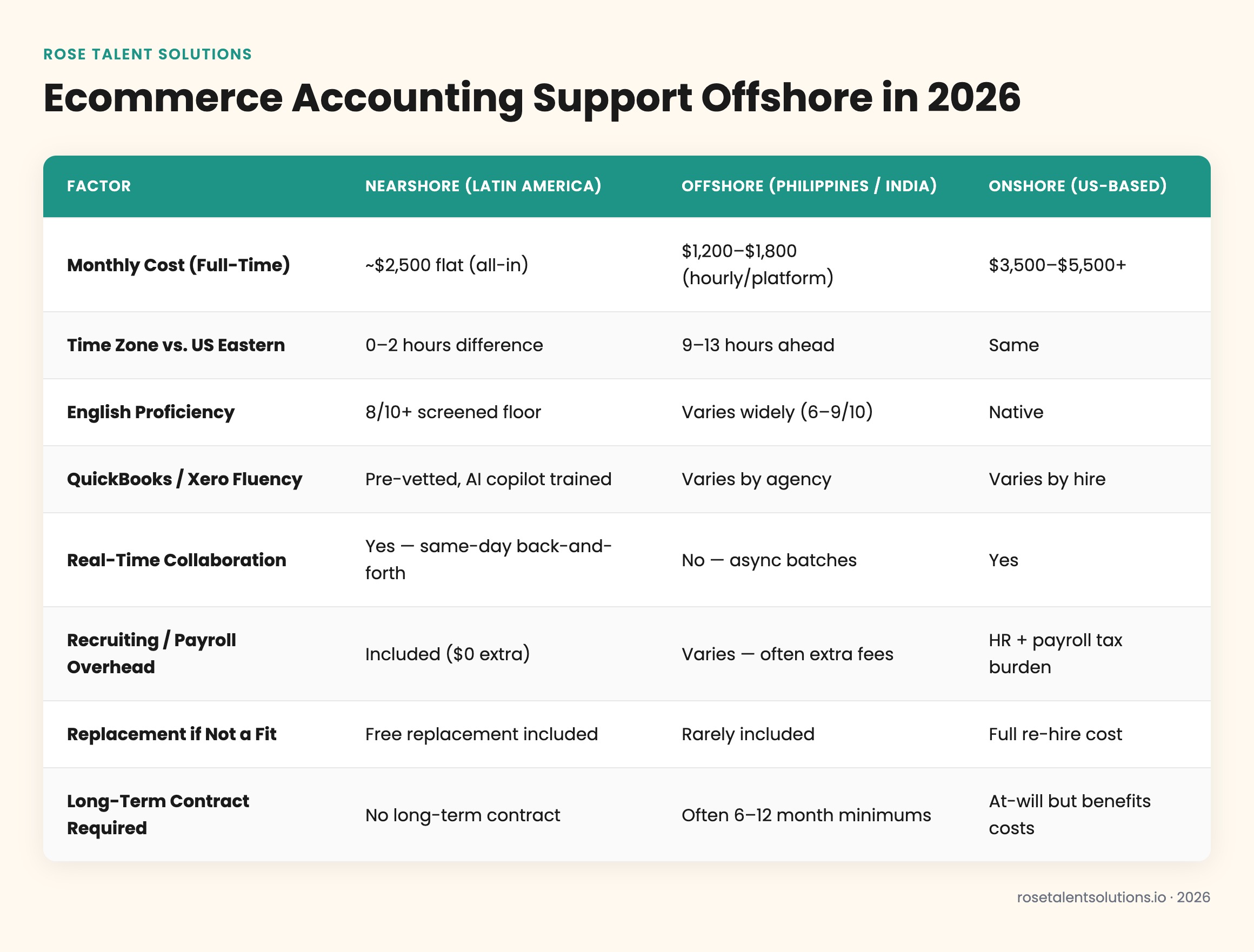
The comparison below is the one most ecommerce founders wish they'd seen before signing a 12-month offshore contract. The sticker price on a Philippines-based bookkeeper looks attractive at first — until you account for the revision cycles, the delayed closes, and the training cost every time someone churns. The Bureau of Labor Statistics puts the median US bookkeeper salary at over $47,000 per year ($45,860 precisely, per BLS 2023) — or roughly $3,800/month fully loaded. Nearshore undercuts that by a third while delivering overlap-hours coverage that pure offshore can't match.
| Factor | Nearshore (Latin America) | Offshore (Philippines / India) | Onshore (US-based) |
|---|---|---|---|
| Monthly Cost (Full-Time) | ~$2,500 flat (all-in) | $1,200–$1,800 (hourly/platform) | $3,500–$5,500+ |
| Time Zone vs. US Eastern | 0–2 hours difference | 9–13 hours ahead | Same |
| English Proficiency | 8/10+ screened floor | Varies widely (6–9/10) | Native |
| QuickBooks / Xero Fluency | Pre-vetted, AI copilot trained | Varies by agency | Varies by hire |
| Real-Time Collaboration | Yes — same-day back-and-forth | No — async batches | Yes |
| Recruiting / Payroll Overhead | Included ($0 extra) | Varies — often extra fees | HR + payroll tax burden |
| Replacement if Not a Fit | Free replacement included | Rarely included | Full re-hire cost |
| Long-Term Contract Required | No long-term contract | Often 6–12 month minimums | At-will but benefits costs |
How Rose Talent's AI Copilot Advantage Changes Ecommerce Bookkeeping in 2026
Every Rose Talent team member ships with a role-specific AI copilot trained on the software they'll actually use — QuickBooks, Xero, Shopify, Amazon Seller Central, and more. This isn't a generic ChatGPT wrapper. It's a tool tuned to the specific workflows your bookkeeper runs daily: categorizing transactions from Stripe exports, reconciling Amazon fee structures, flagging duplicate entries across payment gateways, and preparing month-end close checklists automatically.
The practical result is faster ramp time. Traditional offshore bookkeepers often take 4–8 weeks to get productive on a new ecommerce client's stack. A nearshore specialist with an AI copilot already trained on their software can be processing your transactions meaningfully in the first week. If you want to understand exactly what this looks like in practice, the Rose AI advantage page walks through the copilot system in detail.
"AI tools are reshaping how bookkeeping gets done — but the human in the loop still determines whether you get accurate financials or just fast ones. The combination of trained talent and AI assistance is where quality actually compounds." — Intuit Finance Team, QuickBooks Bookkeeping Trends Report (2024)
If you're already comparing the real cost of virtual bookkeeping, the Rose blog has a detailed breakdown of what a QuickBooks bookkeeper actually costs when you factor in recruiting, benefits, and turnover — numbers that make the $2,500 flat rate look even more compelling on a spreadsheet.
The hidden cost of traditional offshore ecommerce accounting isn't the hourly rate — it's the 9–13 hour timezone gap that turns every clarifying question into a 24-hour delay, stretching a 3-day monthly close into 7 days and pushing your reporting cycle past investor or lender deadlines.
What Tasks Can an Offshore Ecommerce Accounting VA Actually Handle in 2026?
This is the question most founders ask second — right after price. Here's what a properly vetted, software-trained nearshore ecommerce accounting specialist can own from day one, without hand-holding:
- Daily transaction categorization — importing and coding Shopify, Amazon, Etsy, or WooCommerce payouts in QuickBooks or Xero
- Payment gateway reconciliation — matching Stripe, PayPal, Square, and Afterpay deposits to bank statements
- Amazon settlement reconciliation — breaking down Amazon's notoriously complex bi-weekly settlement files into clean P&L line items
- Sales tax tracking — monitoring nexus thresholds and preparing data for your CPA or filing through Avalara/TaxJar
- COGS and inventory accounting — updating landed cost, managing purchase orders, and adjusting inventory values in sync with your 3PL
- Monthly close and financial reporting — producing P&L, balance sheet, and cash flow statements on a defined monthly cadence
- Accounts payable management — processing supplier invoices and scheduling payments
- Expense report processing — categorizing team card spend and coding it to the right departments
For brands running on Xero rather than QuickBooks, the workflow is nearly identical — and Rose's specialists are vetted on both platforms. If you're evaluating Xero specifically, the Rose blog's guide on hiring a Xero virtual bookkeeper covers exactly what to look for in a screening process.
According to McKinsey's 2023 report on generative AI and the workforce, up to 60% of routine finance and accounting tasks are automatable or augmentable with AI — but the judgment layer (categorization decisions, exception handling, vendor dispute resolution) still requires a skilled human. That's precisely where a trained nearshore specialist delivers ROI that a pure software solution can't.
How the Rose Talent Hiring Process Works for Ecommerce Accounting Roles in 2026
One of the most common objections to hiring virtual accounting support is the fear of a long, painful onboarding process. Rose Talent's model is built specifically to compress that timeline. Here's how the matching and onboarding sequence works for an ecommerce bookkeeping role:
Role Brief
You complete a short intake form describing your ecommerce stack (Shopify, Amazon, QuickBooks, etc.), transaction volume, and reporting needs. This takes under 20 minutes.
Candidate Matching
Rose's recruiting team identifies 2–3 pre-vetted candidates from its Latin America network, each screened for English proficiency (8/10+ floor), software fluency, and ecommerce-specific accounting experience.
Interview & Selection
You interview your shortlisted candidates and select the one who fits your working style. Rose handles all the scheduling logistics.
AI Copilot Setup
Your team member's role-specific AI copilot is configured for your software stack before day one — so they arrive already oriented to your tools, not learning them on your clock.
Ongoing HR & Management
Payroll, HR, compliance, and ongoing performance management are handled by Rose — you manage the work, Rose manages the employment relationship. Month-to-month, cancel with 30 days written notice.
The entire model is designed around one principle: you should spend your time reviewing clean financials, not managing a hiring process. If something isn't working, Rose replaces your team member at no additional cost — that's the replacement guarantee. You can explore the full service model on the Rose bookkeeping and accounting support page, or get matched directly through the start page.
What Does Ecommerce Accounting Support Actually Cost Offshore vs. Nearshore in 2026?
Let's run the real numbers, because "offshore is cheaper" is one of the most repeated — and most incomplete — claims in the virtual staffing industry.
A Philippines-based bookkeeper through a typical offshore platform might run $8–$12/hour. At 40 hours a week, that's $1,280–$1,920/month in direct labor. But then add platform fees (typically 15–25%), your own time recruiting and managing the relationship, re-hiring costs when someone churns (industry average tenure on offshore platforms is under 11 months, per Statista's outsourcing research (2023)), and the cost of errors during a slow ramp period — and the real monthly cost frequently lands above $2,500 before you account for timezone-driven delays on your close cycle.
Rose's $2,500/month flat rate includes recruiting, vetting, payroll, HR, and ongoing management. There are no surprise fees and no long-term contract. For small ecommerce businesses specifically, the Rose blog post on bookkeeping and accounting support for small businesses walks through exactly which tasks you should be delegating first to maximize ROI from a virtual bookkeeper.
If you want a line-by-line cost comparison for QuickBooks-specific roles, the Rose post on QuickBooks virtual bookkeeper cost in 2026 gives you the full breakdown with real market numbers.
Nearshore Ecommerce Accounting: Pros
- Same-day responses during US business hours
- 0–2 hour time zone difference — no async bottlenecks
- Pre-vetted English proficiency (8/10+ floor)
- AI copilot accelerates ramp and reduces errors
- All-in flat pricing — no hidden platform or HR fees
- Free replacement if the fit isn't right
- No long-term contract required
Traditional Offshore Ecommerce Accounting: Cons
- 9–13 hour time zone gaps create 24-hour delay loops
- Variable English proficiency with no guaranteed floor
- Platform fees often add 15–25% on top of hourly rate
- No replacement guarantee — re-hire cost falls on you
- Ramp time typically 4–8 weeks without AI tooling
- Churn rates higher — average tenure under 11 months
The choice isn't actually about saving money at all costs — it's about finding the model that delivers accurate, on-time financials without creating a second job for you. For most ecommerce operators running $500K to $10M in annual revenue, nearshore support at $2,500/month is the decision that pays for itself within the first quarter of clean books.