
Why Boutique Property Managers Are Asking This Question in 2026
Nearshore virtual assistants have gone from a curiosity to a competitive necessity for small property management operators — and the firms asking "does this actually work for us?" are usually the ones closest to burning out. You're managing 80 to 300 doors, handling maintenance calls yourself, chasing rent manually, and doing leasing follow-ups between owner reports. You don't need a theory. You need a real answer.
Here it is: nearshore VAs built specifically for property management do work — measurably, repeatably, and at a price point that makes sense for a boutique shop. The remainder of this post breaks down exactly how, with numbers attached to every claim.
Boutique PM firms — typically defined as independent operators managing fewer than 500 units without institutional backing — face a staffing paradox. They need specialized labor (someone who actually knows AppFolio or Buildium), but they can't justify a $55,000-per-year W-2 coordinator. According to the U.S. Bureau of Labor Statistics (2024), the median annual wage for a property, real estate, and community association manager in the US is over $60,000 — a number most boutique operators can't sustainably absorb for an admin-heavy role.
That gap is exactly where a well-matched nearshore VA steps in. The question isn't whether VAs can handle PM work — it's whether the right VA, in the right time zone, trained on the right software, can integrate with your operation without creating more management overhead than they save. For boutique firms especially, the answer depends on how the VA was sourced, vetted, and onboarded.
What Is a Nearshore VA — and How Does It Differ From Offshore?
A nearshore virtual assistant is a remote team member based in a geographically proximate region that shares or closely overlaps your time zone and cultural context. For US and Canadian property management firms, "nearshore" means Latin America — countries like Colombia, Mexico, Argentina, Costa Rica, and Peru. This distinguishes nearshore staffing from offshore staffing, which typically refers to the Philippines or India, where time zones can lag US Eastern by 12 to 13 hours.
The time zone distinction is not a minor operational detail for property management. Tenant emergencies, leasing inquiries, and maintenance dispatch don't pause until 9am Manila time. Real-time responsiveness is a core service promise in PM, and a nearshore VA working 9am–6pm EST can deliver it; an offshore VA batching responses overnight cannot.
If you want a deep comparison of how these models perform specifically in property management contexts, our post on nearshore virtual assistant property management covers the tradeoffs in detail — including response-time data and owner satisfaction scores.
"The number one complaint we hear from property managers who tried offshore VAs is that nothing could be resolved same-day. The 12-hour gap turned every routine issue into a 24-hour ticket." — Jordan Muela, CEO at LeadSimple (2023)
How Nearshore VAs Perform Across Core PM Tasks in 2026
Let's get specific about what boutique PM firms actually delegate to nearshore VAs — and how well those tasks transfer remotely.
The tasks that transfer best are high-volume, repeatable, and software-mediated. In property management, that's most of your operation. Maintenance coordination — logging work orders, following up with vendors, updating tenants on status — maps almost perfectly to what a trained remote coordinator handles. Leasing administration — fielding inquiries, scheduling showings, sending applications, screening follow-ups — is entirely phone-and-software work that a fluent, time-zone-aligned VA executes without friction.
Rent collection workflows inside AppFolio or Buildium are another natural fit. A VA can monitor arrears dashboards, send templated notices, log late fees, and escalate to you only when a tenant hits a threshold you define. This alone reclaims 6 to 10 hours a week for most boutique operators. If you're running AppFolio, our AppFolio virtual assistant hiring guide walks through exactly how to structure those workflows so the VA operates with minimal hand-holding.
Owner reporting is more nuanced but absolutely achievable. A VA who has been briefed on your reporting template can pull data from your PM software, assemble the monthly owner statement narrative, and have a draft in your inbox for review. According to Buildium's State of the Property Management Industry Report (2024), owner communication quality is the single strongest driver of owner retention — which means this task carries outsized business value when delegated correctly.
What doesn't transfer to a VA (nearshore or otherwise): in-person inspections, physical key handoffs, and showing units that require on-site presence. Everything else in your operation is on the table.
Nearshore vs. Offshore vs. US-Based VA: The 2026 Comparison
Before committing to any staffing model, boutique PM operators deserve a side-by-side. Here's how the three main options compare across the dimensions that actually matter for day-to-day operations.
| Dimension | Nearshore VA (Latin America) | Offshore VA (Philippines/India) | US-Based VA / Employee |
|---|---|---|---|
| Monthly Cost (Full-Time) | ~$2,500 all-in | $800–$1,500 (variable; add mgmt overhead) | $4,500–$6,500+ (wages + taxes + benefits) |
| Time Zone Overlap (EST) | Full overlap (0–2 hr diff) | Minimal (10–13 hr gap) | Full overlap |
| English Proficiency | 8/10+ screened fluency | Varies; accent can create friction | Native |
| PM Software Training | Role-specific AI copilot included | Rarely pre-trained; self-taught | Must train from scratch or hire experienced |
| Recruiting / HR Overhead | Handled by agency | You manage it or use marketplace | You manage it fully |
| Contract Flexibility | Month-to-month, 30-day notice | Varies by platform | At-will but high severance risk |
| Risk Reversal | Free replacement if not a fit | Rarely offered | None — rehiring cost is yours |
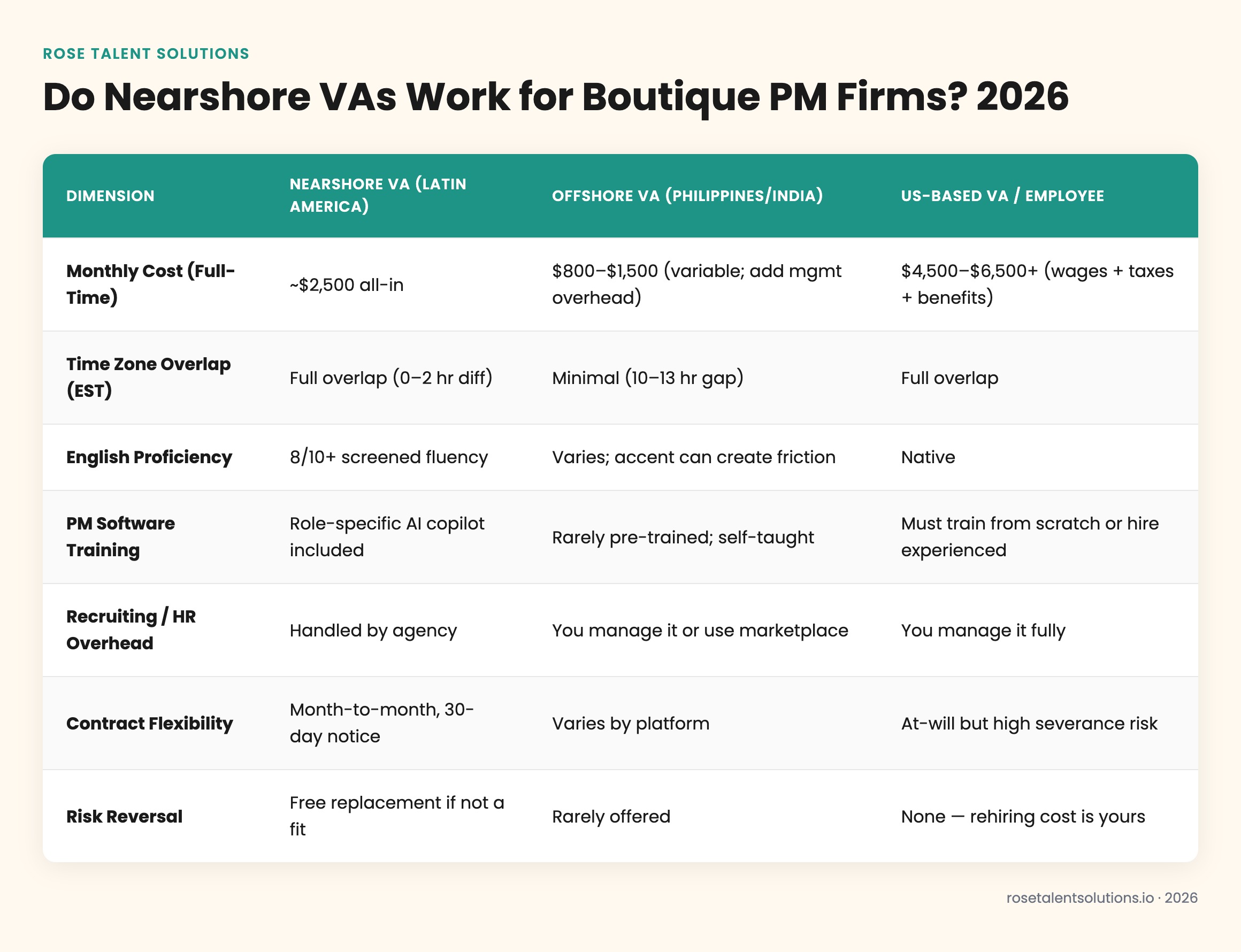
The offshore price looks attractive until you account for hidden costs: coordination overhead created by a 12-hour gap, re-work from miscommunication, and the management time you spend compensating for availability mismatches. According to the National Multifamily Housing Council's 2024 Apartment Industry Outlook, operational efficiency — not acquisition — is now the primary focus for independent rental housing operators under 500 units. A boutique operator with 150 units and one employee cannot afford to lose 2 hours a day to lag-driven coordination debt.
How the AI Copilot Advantage Changes the Equation for Small PM Firms in 2026
One of the most concrete differentiators in 2026 is what a properly placed nearshore VA arrives with. Every Rose team member ships with a role-specific AI copilot trained on the software stack relevant to their placement — AppFolio, Buildium, QuickBooks, or whatever your shop runs. This isn't a generic chatbot; it's a knowledge layer specific to that software's workflows, shortcut keys, report structures, and common error states.
For a boutique PM firm, this matters enormously. You don't have a training department. You don't have an operations manual 80 pages deep. You have tribal knowledge, a login, and a hope that the new hire figures it out. A VA arriving with an AI copilot pre-loaded on Buildium — already knowing how to generate owner statements, configure late fee automations, and pull vacancy reports — cuts your ramp time dramatically. You can learn more about how that copilot model works across PM software on the Rose AI advantage page.
The hidden cost of a nearshore VA who isn't software-trained isn't the hourly rate — it's the 3 to 6 weeks of ramp time where you're doing their job and yours simultaneously. Software-specific AI copilots eliminate most of that ramp, which is especially critical for a 2-to-3-person boutique firm where there's no spare bandwidth to absorb a slow start.
According to SHRM's Human Capital Benchmarking Report (2022), the average cost to replace an employee is between 50% and 200% of their annual salary — a figure that balloons for small operators who have to absorb productivity loss personally. Reducing ramp time and getting replacement guarantees built into the engagement model directly attacks that cost risk.
Remote work adoption has also permanently lowered the friction of integrating distributed team members. According to Pew Research Center's 2023 study on remote work, workers who collaborate remotely across time zones report faster tool adoption when provided structured digital onboarding resources — exactly the role an AI copilot plays for a freshly placed VA. If your firm uses Buildium specifically, the Buildium virtual assistant guide covers the specific task workflows and AI copilot configurations that work best for independent PM operators on that platform.
How Rose's Placement Process Works for Boutique PM Operators
The concern most boutique operators raise isn't "does this work in theory" — it's "how much work is it for me to get this running?" Here's the actual sequence for a Rose placement.
Intake & Role Definition
Rose's team works with you to define the exact tasks, software stack, and hours for your placement. This typically takes a single 30-minute call — you don't need a job description written in advance.
Recruiting & Vetting
Rose recruits from Latin America, screens for 8/10+ English proficiency, and vets PM-specific software experience. You receive a shortlist — usually within a week — with video intros and skill assessments attached.
Match & Onboarding
You select your team member, they receive their role-specific AI copilot configuration, and Rose handles all payroll, HR compliance, and ongoing management. Your job is to give them access and context — not manage their employment.
Ongoing Support & Replacement Guarantee
If the placement isn't the right fit, Rose replaces them at no additional cost. The engagement is month-to-month with 30 days written notice to cancel — no long-term contract required.
The flat $2,500/month rate covers recruiting, vetting, payroll, HR, and ongoing management — everything. No markup on hours, no surprise fees when you need to replace someone. For a boutique operator already managing tight margins across 100 to 300 units, this predictability matters as much as the cost level itself.
You can see the full service scope on the Rose property management staffing page, or go straight to start your placement if you already know what you need.
Is a Nearshore VA Right for Your Boutique PM Firm? 2026 Checklist
Not every PM operator is ready to delegate effectively. A nearshore VA amplifies an operator who has at least minimal process documentation — even a checklist of daily tasks is enough. They're less effective for operators who haven't yet defined what "done well" looks like for the tasks they're delegating.
Strong fit if you…
- Manage 75+ units and are personally handling admin tasks
- Use AppFolio, Buildium, or another cloud-based PM platform
- Have at least a rough checklist of repeatable daily tasks
- Want to add leasing or maintenance capacity without a W-2 hire
- Need a dedicated 40-hour-a-week resource, not occasional gig help
Not yet ready if you…
- Can't articulate what the VA would do in their first week
- Need someone physically on-site daily
- Are managing fewer than 40 units with minimal admin volume
- Haven't yet adopted a cloud-based PM software platform
According to the National Association of Realtors' Profile of Real Estate Firms (2023), the majority of independent property management operations in the US are small, owner-operated businesses — exactly the profile where a $2,500/month nearshore coordinator generates the highest leverage per dollar spent.
If you're handling leasing follow-up personally, our post on hiring a remote leasing agent for property management shows what that role looks like when it's properly scoped and handed off — including what scripts, tools, and handoff protocols work best. And if you have a bookkeeping backlog alongside your PM admin burden, the Rose bookkeeping and accounting staffing page covers how nearshore bookkeepers integrate with PM-specific chart-of-accounts structures.
The bottom line for 2026: boutique property management firms are not too small for nearshore VAs — they're exactly the right size. The leverage is highest when one well-placed, software-trained, time-zone-aligned coordinator can double your operational capacity without doubling your payroll. That's not a pitch. That's the math.