What Is a Remote Leasing Agent for Property Management in 2026?
A remote leasing agent for property management is a dedicated team member who manages the entire tenant acquisition cycle — lead response, virtual showings, application processing, lease execution, and move-in coordination — without ever setting foot in your office or your properties. In 2026, the most cost-effective way to staff this role is with a nearshore virtual assistant from Latin America: someone who works your US business hours, speaks fluent English, and already knows your software — at a flat rate that is roughly half what a local hire costs.
A nearshore virtual assistant is a remote professional based in a Latin American country (Mexico, Colombia, Argentina, Costa Rica, and similar) who works within one to two time zones of the US, communicates at a professional English level of 8/10 or higher, and is placed, vetted, and managed by a staffing partner like Rose Talent Solutions' property management division. Nearshore staffing is categorically different from offshore outsourcing, which typically carries a 10–14 hour timezone gap and inconsistent availability during US business hours.
Property managers searching for this role today face a fork in the road: hire a local W-2 employee, post on a job board and hope, or staff the position with a nearshore virtual assistant who is productive in days, not weeks. This guide covers all three paths — salary data, tools, daily workflows, career progression, and honest pros and cons — so you can make a fully informed decision.
Can Leasing Agents Work Remotely? What the 2026 Market Says
Yes — and the transition is now nearly complete for mid-market property management companies. Virtual tour platforms, AI-assisted screening tools, e-signature software, and cloud-based property management platforms (AppFolio, Buildium, Yardi) have removed every technical barrier that once required physical presence. The leasing function is now one of the easiest PM roles to run fully remote.
The remaining hesitation from operators is almost always about lead response time — the fear that a remote agent won't answer a prospect's inquiry fast enough to compete. That concern is valid when there is a 12-hour timezone gap, but it disappears entirely with nearshore staff from Latin America who start their shift at 8 or 9 AM your time and answer live chat, calls, and emails in real-time.
Properties that respond to an inquiry within five minutes are 100x more likely to qualify that lead than those that respond within 30 minutes, according to the National Association of Realtors (2024). A nearshore agent working your timezone answers within five minutes. A team member working overnight batches responses — and you lose the lease.

Remote Leasing Agent Salary in 2026: What Does This Role Actually Cost?
If you are asking about remote leasing agent salary from the perspective of hiring the role, here is the honest range. A US-based remote leasing coordinator earns between $38,000 and $52,000 per year in base salary, according to the US Bureau of Labor Statistics (2024). Add benefits, payroll taxes, recruiting fees, and churn replacement costs, and you are realistically looking at $55,000–$70,000 total annual cost for a single W-2 leasing employee.
A nearshore virtual leasing agent through Rose Talent Solutions costs $2,500/month flat — $30,000 per year, all-in. That rate includes recruiting, multi-stage vetting, payroll administration, HR oversight, and ongoing performance management. There is no separate recruiter invoice, no benefits overhead, and no long-term contract. If the team member is not a fit, Rose replaces them at no additional cost.
If you are a leasing professional researching your own earning potential, remote-first leasing roles posted in 2025–2026 carry a median advertised salary of $42,000/year, with top performers in commission-bearing roles earning $55,000–$65,000, per ZipRecruiter's 2025 salary data. Remote leasing agents who specialize in Class A multifamily or student housing portfolios command the upper end of that range.
How Nearshore VAs Compare to Other Remote Leasing Options in 2026
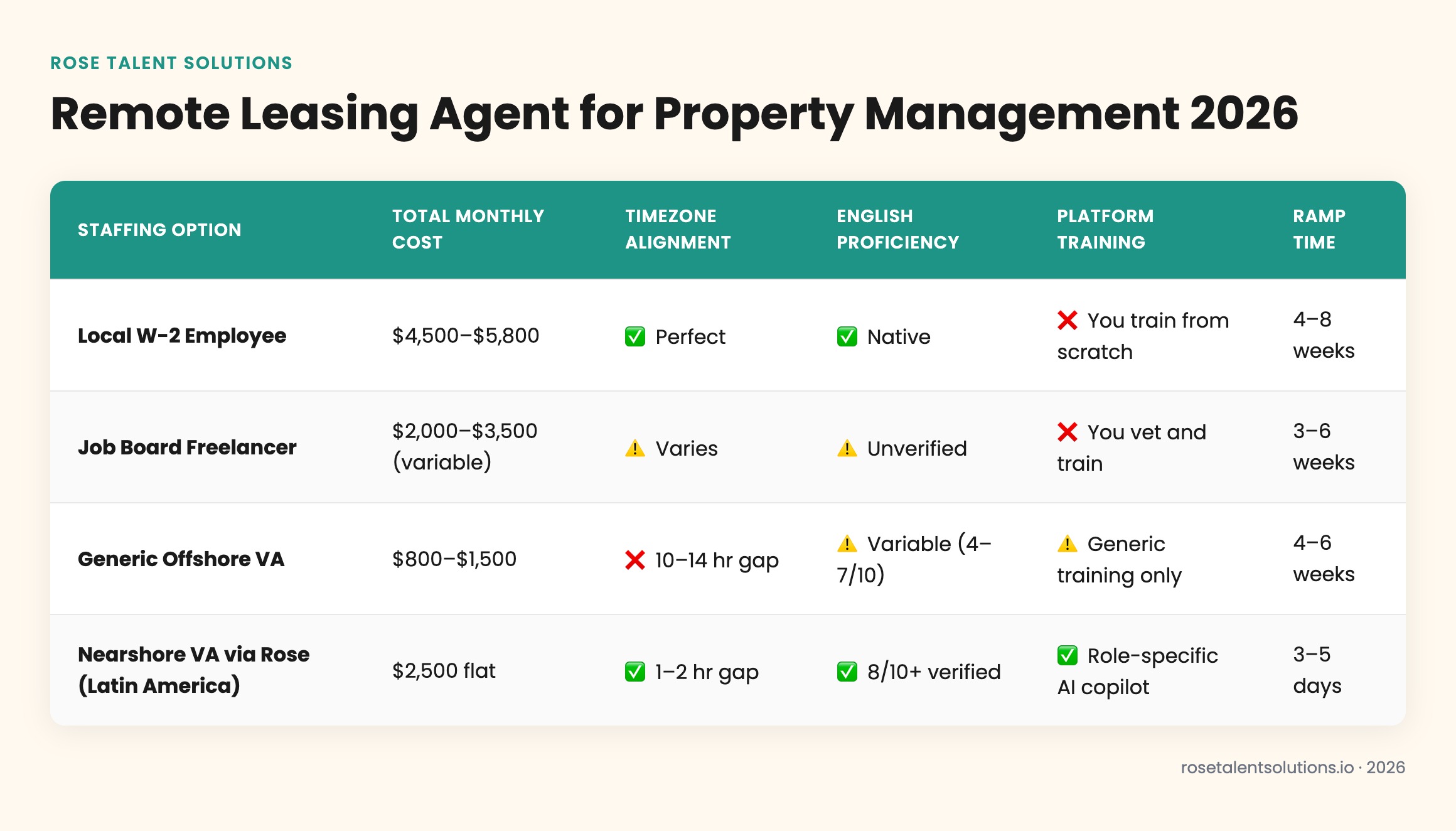
Not all remote leasing coverage is created equal. The table below breaks down the four most common staffing approaches property managers use to fill this role — a local W-2 employee, a freelance hire from a job board, a generic offshore VA, and a nearshore VA through a staffing partner. Evaluate them on the factors that actually determine lease conversion: availability, response time, platform fluency, and total cost.
| Staffing Option | Total Monthly Cost | Timezone Alignment | English Proficiency | Platform Training | Ramp Time |
|---|---|---|---|---|---|
| Local W-2 Employee | $4,500–$5,800 | ✅ Perfect | ✅ Native | ❌ You train from scratch | 4–8 weeks |
| Job Board Freelancer | $2,000–$3,500 (variable) | ⚠️ Varies | ⚠️ Unverified | ❌ You vet and train | 3–6 weeks |
| Generic Offshore VA | $800–$1,500 | ❌ 10–14 hr gap | ⚠️ Variable (4–7/10) | ⚠️ Generic training only | 4–6 weeks |
| Nearshore VA via Rose (Latin America) | $2,500 flat | ✅ 1–2 hr gap | ✅ 8/10+ verified | ✅ Role-specific AI copilot | 3–5 days |
What Tools Does a Remote Leasing Agent Use Day-to-Day?
One of the biggest gaps in competitor coverage on this topic is the actual tech stack. Here is what a competent remote leasing agent operates in 2026, and why platform fluency matters more than raw leasing experience.
Property management platforms: AppFolio, Buildium, Yardi Breeze, and Rent Manager handle the core lease lifecycle — prospect tracking, application processing, lease generation, and move-in documentation. A leasing agent who has never opened AppFolio requires 2–4 weeks of platform training before they are productive. Rose's team members arrive with an AI copilot pre-trained on their assigned platform, cutting that ramp to under a week.
Virtual tour tools: Matterport, Zillow 3D Home, and iGUIDE generate self-guided 3D tours that remote leasing agents share with prospects via link. Live video tours run over Zoom, Google Meet, or FaceTime. The leasing agent narrates, answers questions, and captures intent — all without a lockbox.
Lead and CRM tools: Knock, Rent Dynamics, and Funnel CRM are purpose-built for multifamily leasing. General CRMs like HubSpot and Follow Up Boss work for smaller portfolios. The agent's job is rapid follow-up: 50% of renters sign with the first property that follows up within 24 hours, according to NMHC research (2024).
E-signature and document platforms: DocuSign and HelloSign handle lease execution. Blue Moon Software and Clauses.com provide lease template libraries compliant by state. Document turnaround is where remote leasing agents either win or lose the applicant — delays beyond 24 hours after approval dramatically increase prospect drop-off.
The hidden cost of an untrained remote leasing agent is not the hourly rate — it is the three to four weeks of platform onboarding while your leads go cold. Nearshore VAs from Latin America, placed by Rose with role-specific AI copilots trained on AppFolio or Buildium, are productive in days, not weeks.
A Day-in-the-Life: What Does Remote Leasing Agent Work Actually Look Like?
Competitors describe the role in broad strokes. Here is what a full-time nearshore remote leasing agent for a 200-unit portfolio actually does, hour by hour, on a typical Tuesday.

8:00–9:30 AM — Lead Triage and Response
Reviews overnight inquiry forms from Zillow, Apartments.com, and the property website. Sends personalized follow-up emails and texts within the first hour of shift. Updates AppFolio prospect records with contact status.
9:30–11:30 AM — Virtual Tours and Live Calls
Runs scheduled Zoom or FaceTime tours for 2–4 prospects. Narrates unit features, answers objections, and captures live interest levels. Logs tour outcomes and sets follow-up tasks in CRM.
11:30 AM–1:00 PM — Application Processing
Reviews submitted applications for completeness, orders background and credit checks through integrated screening tools, and flags any conditions for the property manager to review. Sends applicants status updates proactively.
1:00–3:00 PM — Lease Preparation and Execution
Prepares lease documents for approved applicants using Blue Moon or the platform's native lease builder. Sends via DocuSign, tracks signature completion, and follows up on outstanding signatures same-day.
3:00–5:00 PM — Move-In Coordination and Pipeline Review
Confirms move-in logistics, sends welcome packages, and coordinates key or access code delivery with the on-site team. Ends the day with a pipeline report pushed to the property manager — occupancy rate, leads in queue, leases pending signature.
Can You Work as a Property Manager Remotely — and What Is the Career Path in 2026?
Remote leasing is frequently the entry point into a full remote property management career. The progression is well-defined: leasing coordinator → leasing manager → assistant property manager → remote property manager. Each step adds scope — from single-family leasing to multifamily portfolios to mixed-use assets — and corresponding pay.
For professionals looking to break into this field with no prior experience, remote leasing is one of the more accessible entry points in real estate operations. No state license is required for leasing coordination in most states (though some states require a salesperson license for agents who show property in person — verify your state with ARELLO's licensing database). Remote roles focused on administrative leasing tasks — application intake, lease prep, CRM management — typically require zero licensure.
The National Apartment Leasing Professional (NALP) credential from the National Apartment Association is the most recognized entry-level qualifier for multifamily leasing roles. It is achievable in 3–6 months and signals platform fluency and professional commitment to hiring managers — a meaningful differentiator for candidates with no prior experience.
For property management companies, this career progression means a well-trained remote leasing agent can grow into a full remote property management role — handling maintenance coordination, vendor oversight, and owner reporting — without ever requiring a physical office presence. The same nearshore model scales with them.
Pros of Nearshore Remote Leasing Agents
- Eliminates $25,000–$35,000/year in local hiring overhead vs. W-2 staff
- Latin America-based agents respond to leads in real-time during US business hours
- Platform-trained agents with AI copilots are productive in days, not weeks
- Scales instantly — add a second agent for a second portfolio with no office space required
- Month-to-month terms mean no long-term contract lock-in
Cons to Plan Around
- Physical showings still require a local on-site contact or lockbox system for self-guided tours
- Initial SOP documentation falls on you — the agent executes your process, not a generic one
- Non-nearshore remote agents introduce timezone lag that hurts lead conversion
- Some states require a real estate license even for remote lease execution — confirm your jurisdiction
How to Hire a Remote Leasing Agent for Property Management in 2026 Without Getting Burned
The most common hiring mistake property managers make is treating a remote leasing agent search like a job posting. They write a generic description, collect 40 applications, interview five people, hire the most articulate one, and then spend four weeks discovering the person has never opened AppFolio. That process costs time, leads, and occupancy.
The faster path: define your exact workflow first (which software, which tour platforms, which screening tools, what hours you need covered), then match the hire to that spec. Rose's placement process does this matching before you ever meet a candidate. The property management virtual assistant process starts with a workflow audit, not a resume stack.
If you are hiring independently, evaluate candidates on these five criteria: AppFolio or Buildium proficiency (ask for a live screen-share demo, not a self-reported skill level), written English quality (send a real prospect email scenario and grade the response), response time discipline (did they follow up with you promptly during the hiring process?), familiarity with your state's lease requirements, and comfort with video tour delivery.
Pair your leasing agent with a remote bookkeeping and accounting assistant and you have covered the two most time-intensive back-office functions in property management for under $5,000/month combined — with no long-term contract and a free replacement on both roles if either is not a fit.
Replacing a bad hire costs an average of 50–60% of that employee's annual salary, according to SHRM's hiring cost research (2023). For a $42,000 leasing agent, that is a $21,000–$25,200 replacement cost. Rose's free replacement guarantee eliminates that risk entirely.