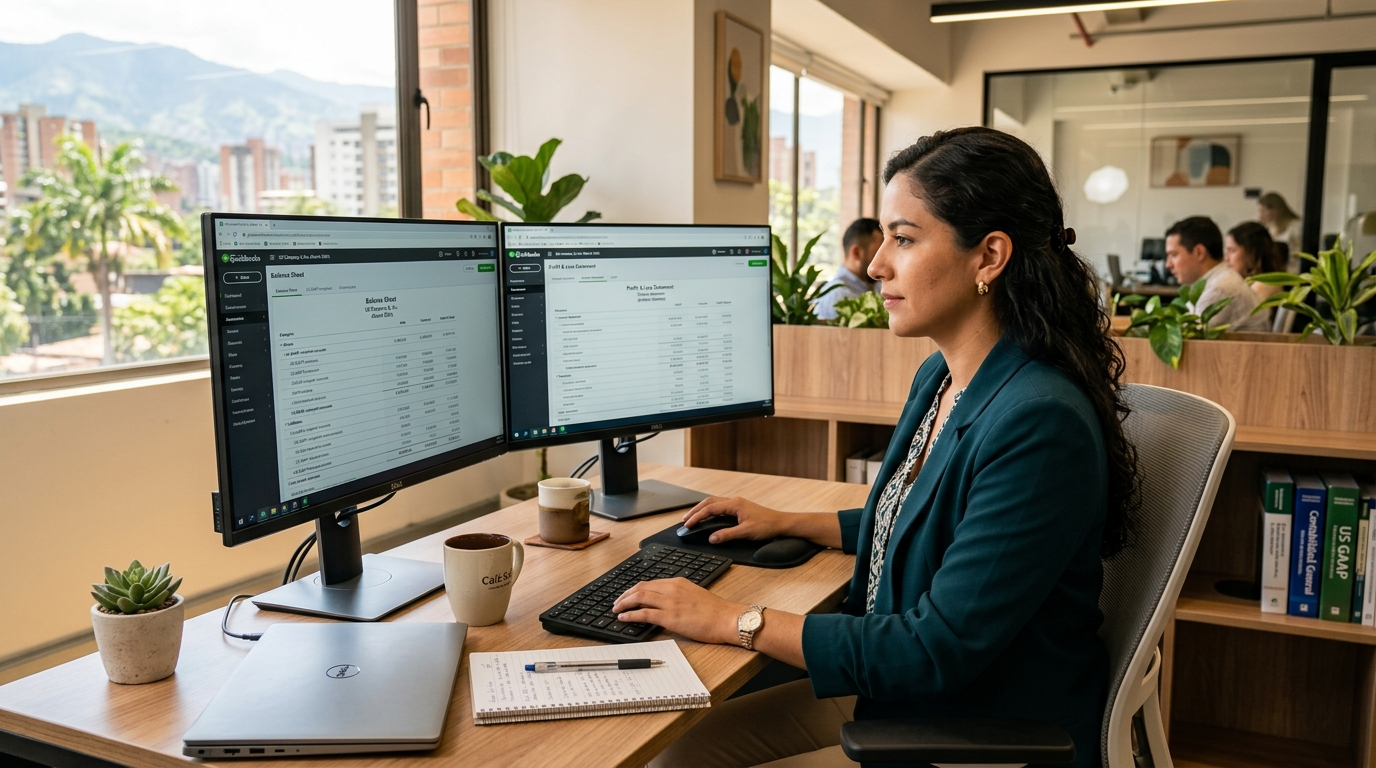
Nearshore bookkeepers — based in Latin America and working US business hours — are fully capable of operating under US Generally Accepted Accounting Principles. That's not a marketing claim; it reflects where accounting education in countries like Colombia, Mexico, Argentina, and Costa Rica has landed over the past decade. Universities in these countries teach GAAP-aligned curricula, and many graduates pursue US CPA firm clients precisely because the frameworks are familiar. If you've been wondering whether a nearshore hire can handle your accruals, bank reconciliations, or period-end close, the short answer is yes — with the right vetting process behind the placement.
This post breaks down exactly what US GAAP competency looks like in a nearshore bookkeeper, how to verify it before you hire, and where nearshore compares to offshore and onshore alternatives on the metrics that actually matter to a US business owner.
What Is US GAAP — and Why Does It Matter for Outsourced Bookkeeping?
US GAAP (Generally Accepted Accounting Principles) is the standardized framework of accounting rules, standards, and procedures issued primarily by the Financial Accounting Standards Board (FASB) and required for financial reporting by US businesses. GAAP governs how revenue is recognized, how expenses are matched to the periods they relate to, how assets are valued, and how financial statements are presented. Any bookkeeper handling your books for a US entity — whether in-house or outsourced — needs to understand these rules to produce financials that are audit-ready and tax-compliant.
For small and mid-size businesses, the most relevant GAAP concepts a bookkeeper touches daily include: the accrual basis of accounting, the matching principle, chart-of-accounts structure, revenue recognition timing, and correct treatment of prepaid expenses and deferred revenue. A bookkeeper who only understands cash-basis entries and has no exposure to accruals will create cleanup headaches for your CPA at tax time — regardless of where they're located.
According to the Financial Accounting Standards Board (FASB), GAAP consists of more than 160 active standards — which is why ongoing training and software familiarity matter as much as foundational education.
How Nearshore Bookkeepers Develop US GAAP Fluency in 2026
Latin American accounting programs are not a second-tier alternative to US education — they're architecturally similar to it. Countries like Colombia and Mexico follow local GAAP frameworks that share roots with IFRS, and many private universities in the region have added explicit US GAAP and QuickBooks certification tracks specifically to serve the export-services market. Graduates entering virtual bookkeeping roles in 2026 frequently arrive with QuickBooks ProAdvisor certification, Xero Advisor Certification, or both.
If you're evaluating a nearshore bookkeeper for your business, the right questions to ask during vetting include: Can they explain the difference between cash and accrual accounting? Have they prepared or reviewed a balance sheet under US GAAP? Do they understand deferred revenue and how to record it? Have they reconciled accounts in QuickBooks or Xero for a US-based client? Rose's vetting process includes a skills screen specifically designed to surface these competencies before a candidate ever reaches your desk.
The combined effect of formal education, US-platform certification, and structured vetting means that a well-placed nearshore bookkeeper is not a junior data-entry hire — they're a working accountant who can own your month-end close. Rose pairs every placement with a role-specific AI copilot trained on the software your bookkeeper actually uses — QuickBooks, Xero, or whichever platform your business runs on — which accelerates ramp time and reduces errors during the first 30 days.
Nearshore vs. Offshore vs. Onshore Bookkeepers: 2026 Comparison
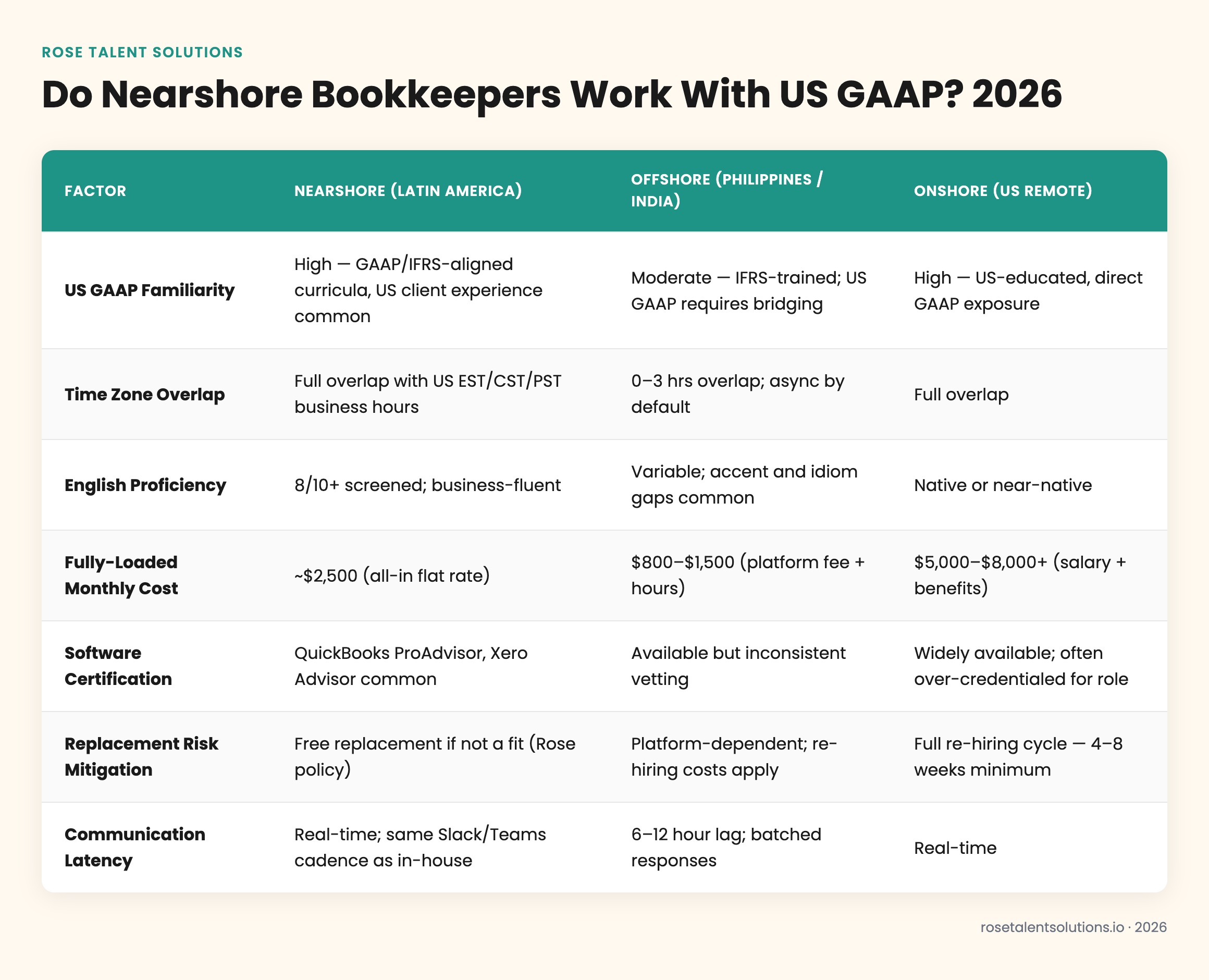
The three most common models US businesses evaluate when outsourcing bookkeeping are nearshore (Latin America), offshore (Philippines, India), and onshore (US-based remote). Each has real trade-offs. The table below compares them across the dimensions that matter most for a GAAP-compliant bookkeeping engagement.
| Factor | Nearshore (Latin America) | Offshore (Philippines / India) | Onshore (US Remote) |
|---|---|---|---|
| US GAAP Familiarity | High — GAAP/IFRS-aligned curricula, US client experience common | Moderate — IFRS-trained; US GAAP requires bridging | High — US-educated, direct GAAP exposure |
| Time Zone Overlap | Full overlap with US EST/CST/PST business hours | 0–3 hrs overlap; async by default | Full overlap |
| English Proficiency | 8/10+ screened; business-fluent | Variable; accent and idiom gaps common | Native or near-native |
| Fully-Loaded Monthly Cost | ~$2,500 (all-in flat rate) | $800–$1,500 (platform fee + hours) | $5,000–$8,000+ (salary + benefits) |
| Software Certification | QuickBooks ProAdvisor, Xero Advisor common | Available but inconsistent vetting | Widely available; often over-credentialed for role |
| Replacement Risk Mitigation | Free replacement if not a fit (Rose policy) | Platform-dependent; re-hiring costs apply | Full re-hiring cycle — 4–8 weeks minimum |
| Communication Latency | Real-time; same Slack/Teams cadence as in-house | 6–12 hour lag; batched responses | Real-time |
"The biggest misconception about Latin American accounting talent is that it's a cost play. It's actually a quality play — the time-zone alignment and GAAP literacy together are something you simply cannot replicate with an overnight offshore team." — Jeff Phillips, CEO at Padgett Business Services (2024)
What US GAAP Tasks Can a Nearshore Bookkeeper Own Day-to-Day?
A competent nearshore bookkeeper can take full ownership of the following US GAAP-aligned workflows without requiring CPA-level oversight on each transaction. This is the functional scope that most small and mid-size US businesses need covered:
- Accrual entries: Recording revenue when earned and expenses when incurred — not just when cash moves.
- Bank and credit card reconciliation: Monthly tie-out across all accounts, flagging discrepancies before close.
- Accounts payable and receivable: Invoice coding, vendor payments, aging reports, customer follow-up.
- Payroll journal entries: Recording payroll liabilities, employer taxes, and wage expense correctly under accrual GAAP.
- Fixed asset tracking: Maintaining a depreciation schedule and posting monthly depreciation entries.
- Deferred revenue / prepaid expense schedules: Amortizing prepaid insurance, subscriptions, and retainers over the correct periods.
- Period-end close support: Preparing a trial balance and financial statement package (P&L, balance sheet, cash flow) for CPA or CFO review.
- Multi-entity consolidation support: Intercompany eliminations and consolidated reporting for businesses with multiple legal entities.
If you're already using QuickBooks, our post on QuickBooks virtual bookkeeper costs in 2026 breaks down exactly what you should expect to pay and what deliverables to benchmark. And if your business runs Xero, the same principles apply — see our breakdown of what a Xero virtual bookkeeper handles and how to vet platform fluency before you hire.
The hidden cost of an under-qualified bookkeeper isn't their hourly rate — it's the CPA cleanup bill at year-end when accruals are missing, prepaid expenses were expensed immediately, and deferred revenue was recorded as income. Nearshore bookkeepers with US GAAP training prevent that bill from ever arriving.
How to Verify US GAAP Competency Before You Hire in 2026
Not every bookkeeper who lists "US GAAP" on a resume can explain the matching principle under pressure. Here's a practical vetting sequence that surfaces real competency versus credential padding:
Software certification check
Ask for their QuickBooks ProAdvisor or Xero Advisor certification number. Both are publicly verifiable. A certified bookkeeper has passed platform-specific exams that include GAAP-aligned accounting workflows.
Live scenario questions
Give them a real scenario: "A client pays 12 months of rent upfront in January. How do you record that?" A GAAP-trained bookkeeper says: debit cash, credit deferred revenue, then recognize 1/12 monthly. A cash-basis-only hire just debits cash and credits rent income.
Sample work product review
Ask for an anonymized trial balance or reconciliation they've prepared for a US client. Review the chart of accounts structure and whether accrual entries are present. A clean, GAAP-structured chart of accounts is a strong signal.
Reference check on US client work
Ask for a reference from a US-based client or CPA firm. Specifically ask: "Did this bookkeeper require significant cleanup by your CPA at year-end?" The answer tells you more than any certification.
Rose's recruiting and vetting process runs all four of these checks before a candidate reaches your inbox. According to SHRM's hiring research (2024), structured pre-hire skills assessments reduce mis-hires by up to 50% compared to resume-only screening. That's the gap Rose's process is designed to close.
The U.S. Bureau of Labor Statistics (BLS) reports that demand for bookkeeping and accounting roles remains strong through 2032, even as automation handles more transactional tasks — meaning the premium is increasingly on judgment-level accounting work, which is exactly where a GAAP-trained nearshore bookkeeper earns their rate.
For small businesses specifically, outsourcing bookkeeping to a qualified nearshore professional is one of the highest-leverage financial decisions available. Our guide on outsourcing bookkeeping for small businesses walks through the full decision framework, including when to outsource versus hire in-house and what deliverables to require from day one.
Why Nearshore Works for US GAAP Bookkeeping
- Full US business-hours availability — no async lag on urgent close items
- University-trained in GAAP-adjacent frameworks with US platform certification
- English proficiency screened to 8/10+ — clear communication with your CPA
- Flat $2,500/month covers recruiting, HR, payroll, and ongoing management
- Free replacement if the placement isn't the right fit — zero re-hiring cost
Where to Set Realistic Expectations
- Not a licensed CPA — strategic tax advice still requires your accountant
- Ramp time of 2–4 weeks to internalize your specific chart of accounts
- Multi-entity consolidation above 5 entities may need fractional CFO oversight
According to Pew Research Center (2024), 62% of workers in financial and accounting roles now report using AI tools weekly — which is why Rose's AI copilot integration for every placement isn't a bonus feature, it's a baseline expectation. A nearshore bookkeeper paired with an AI tool trained on your software closes faster, makes fewer coding errors, and surfaces anomalies your in-house team would miss. You can see the full picture of how that works on the Rose AI advantage page.
If you're ready to scope a bookkeeping placement, the fastest path is the Rose start page — it walks you through the role scoping process in under five minutes. Pricing is $2,500/month flat, month-to-month, with no long-term contract required. If the placement isn't a fit, Rose replaces them at no additional cost.
The McKinsey Global Institute (2023) estimates that up to 30% of hours worked in finance and accounting functions globally could be automated or shifted to lower-cost talent pools by 2030 — but the window for getting ahead of that shift with trained, GAAP-literate nearshore talent is now, while quality candidates are still available at today's rates. And if you want to explore the full bookkeeping and accounting service scope Rose offers, that page covers every deliverable in detail.