
How the Offshore Model Broke Down — and Why US Companies Are Switching to Nearshore Virtual Assistants in 2026
Nearshore virtual assistants — staffed from Latin America and working in US time zones — have moved from a niche alternative to the default choice for growth-focused US businesses in 2026. The question of why US companies are switching from offshore to nearshore virtual assistants in 2026 has a structural answer, not a trend-driven one. The shift is driven by the compounding frustration operators felt when offshore VAs in the Philippines or India delivered work that arrived overnight, required three rounds of revision, and still missed the cultural context that makes client communication feel human. Something had to change, and for tens of thousands of businesses this year, something did.
The core problem with traditional offshore hiring was never the talent itself — it was the structure. A 10-to-12-hour timezone gap turns every question into a 24-hour delay. Real-time collaboration becomes physically impossible when your team member is asleep while you're handling a tenant emergency, closing a sales call, or reconciling end-of-month books. According to Gallup's State of the American Workplace (2023), employees who can collaborate in real time are 21% more productive than those who rely on asynchronous communication alone — a finding that translates directly to VA performance.
Nearshore staffing solves this structurally. Team members in Colombia, Mexico, or Costa Rica are 0 to 3 hours off Eastern Time. They pick up Slack messages before your morning standup. They join your Zoom calls without anyone scheduling around a 10pm slot. That alignment alone is worth more than any hourly-rate discount offshore agencies advertise. It's why so many US companies switching from offshore to nearshore virtual assistants in 2026 report the decision as one they wish they had made sooner.
If you're evaluating your options carefully, the full nearshore vs. offshore vs. onshore comparison breaks down every variable — cost, fluency, timezone, and legal exposure — in one place. But the short version is this: offshore wins on paper price; nearshore wins on actual output.
What Is a Nearshore Virtual Assistant? A 2026 Definition
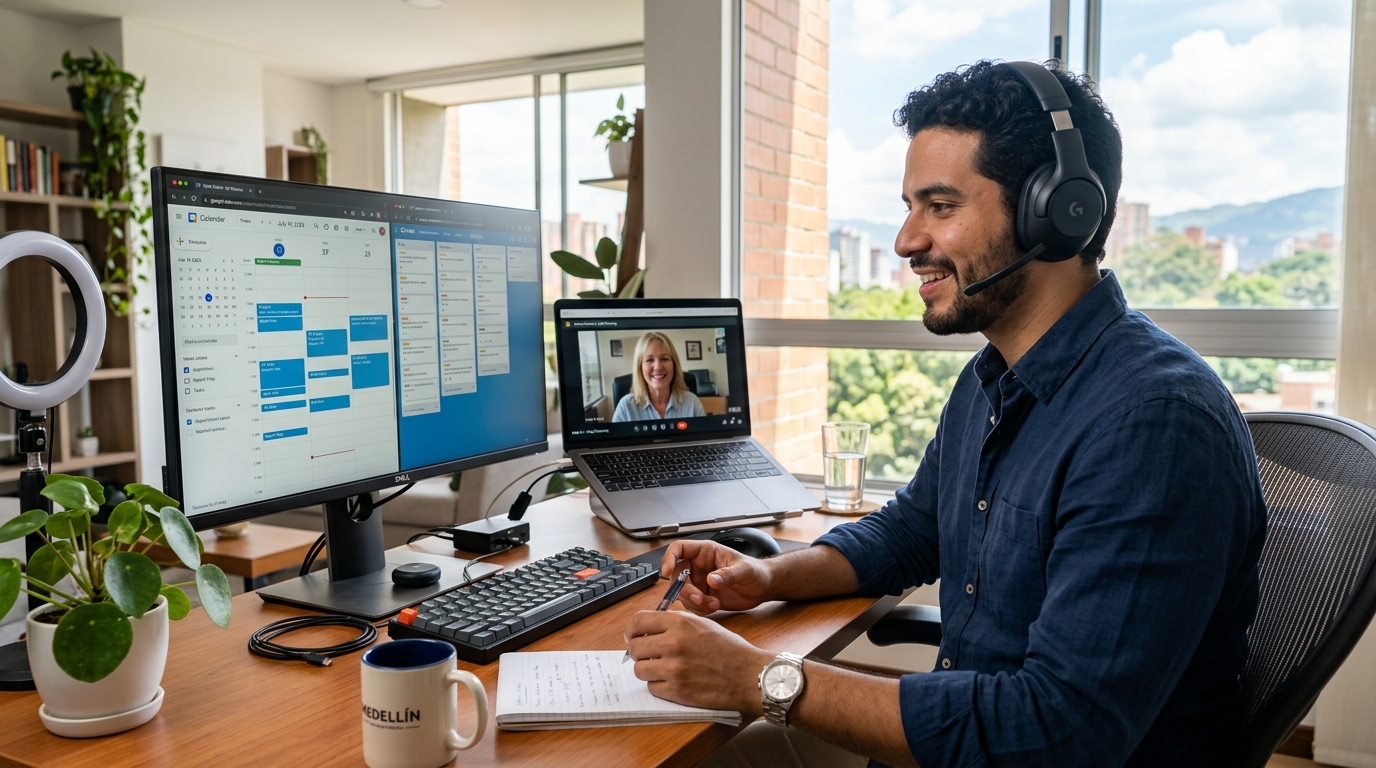
A nearshore virtual assistant is a full-time remote professional based in a country geographically close to the client's home market — for US and Canadian businesses, that means Latin America. Unlike offshore VAs in Southeast Asia or South Asia, nearshore VAs share similar or overlapping time zones with their US employers, enabling same-day communication, real-time task completion, and far fewer handoff delays. The "nearshore" designation specifically refers to geographic and temporal proximity, not just talent quality.
At Rose Talent Solutions, every nearshore team member is fluent in English at an 8/10 or higher proficiency level — a bar set and tested before any candidate reaches a client interview. They work a dedicated 40-hour week on your schedule, on your tools, inside your workflows. They are not shared resources bouncing between accounts. They are your hire, managed by Rose so you don't have to build an HR department to support them.
The distinction matters for AI-powered work too. Rose's AI advantage means every team member ships with a role-specific AI copilot pre-trained on the software they'll actually use — AppFolio, Buildium, QuickBooks, and more. This isn't a chatbot bolted on after hiring. It's a workflow tool tuned to the exact tasks your VA handles daily, so they ramp faster and deliver higher-quality work from week one.
How Nearshore VAs Compare to Offshore and Onshore in 2026
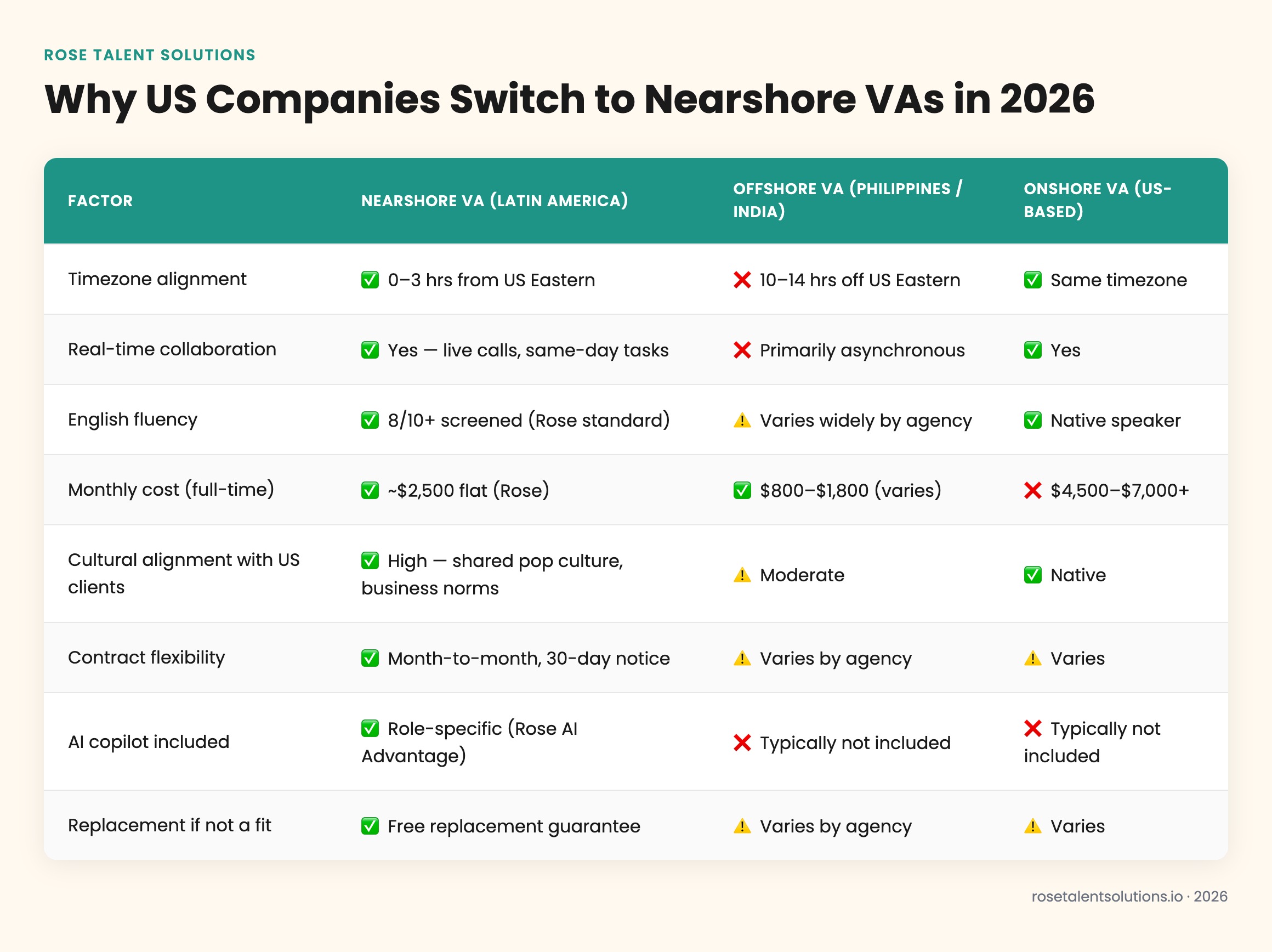
The table below captures the real-world performance differences that operators experience after three months with each model — not the sales pitch, but the operational reality. Most US companies switching from offshore to nearshore virtual assistants in 2026 do so after one painful offshore engagement, not before. The comparison shows why the switch sticks once it's made.
| Factor | Nearshore VA (Latin America) | Offshore VA (Philippines / India) | Onshore VA (US-based) |
|---|---|---|---|
| Timezone alignment | ✅ 0–3 hrs from US Eastern | ❌ 10–14 hrs off US Eastern | ✅ Same timezone |
| Real-time collaboration | ✅ Yes — live calls, same-day tasks | ❌ Primarily asynchronous | ✅ Yes |
| English fluency | ✅ 8/10+ screened (Rose standard) | ⚠️ Varies widely by agency | ✅ Native speaker |
| Monthly cost (full-time) | ✅ ~$2,500 flat (Rose) | ✅ $800–$1,800 (varies) | ❌ $4,500–$7,000+ |
| Cultural alignment with US clients | ✅ High — shared pop culture, business norms | ⚠️ Moderate | ✅ Native |
| Contract flexibility | ✅ Month-to-month, 30-day notice | ⚠️ Varies by agency | ⚠️ Varies |
| AI copilot included | ✅ Role-specific (Rose AI Advantage) | ❌ Typically not included | ❌ Typically not included |
| Replacement if not a fit | ✅ Free replacement guarantee | ⚠️ Varies by agency | ⚠️ Varies |
For a deeper look at what the cost difference actually translates to in day-to-day output, the nearshore virtual assistant cost guide for 2026 walks through what's included at each price point and where offshore "savings" evaporate on revision time and management overhead.
Why 2026 Is the Tipping Point — Three Forces Driving the Switch from Offshore to Nearshore
Three forces converged this year to accelerate the shift as US companies switch from offshore to nearshore virtual assistants in 2026 — and each one makes the decision easier to justify to a CFO or business partner.
First: AI raised the floor on English quality requirements. When VAs are paired with AI copilots that generate first-draft emails, client responses, and reports, the quality of the output is only as good as the human reviewing and editing it. A fluent English speaker catches a wrong tone or a factual error in a generated email. A VA with marginal English passes it through. The cost of that mistake — a misread client, a lost lease, a compliance error — can dwarf months of "savings" from cheaper offshore labor. According to McKinsey's Economic Potential of Generative AI report (2023), AI tools amplify individual worker output by 20–40% — but only when the worker has sufficient language and domain fluency to use them effectively.
The hidden cost of offshore VAs isn't the hourly rate — it's the 6-to-12-hour timezone gap that delays every decision, the language friction that doubles revision cycles, and the cultural misalignment that makes client-facing communication feel impersonal. Nearshore eliminates all three in one hire.
Second: US businesses are operating leaner. Headcount decisions are under more scrutiny than they were in 2021. When you add a full-time hire, you need them producing on day five, not day forty-five. Nearshore VAs, particularly those paired with role-specific AI tools, ramp significantly faster because they're already operating in your business hours, in your communication style, on software they've been pre-trained on. According to SHRM's HR Benchmarking data (2024), the average cost to replace a failed hire is 50–200% of that position's annual salary — a risk that Rose's free replacement guarantee directly offsets.
Third: The Latin American talent pool expanded dramatically. Remote work infrastructure — fast internet, co-working spaces, professional development programs — matured across Mexico, Colombia, Argentina, and Costa Rica between 2020 and 2025. The professionals available today are not the same pool that existed five years ago. Many have worked directly for US companies, hold US-adjacent certifications, and understand American business culture natively. This is why evaluating the best nearshore virtual assistant companies in 2026 matters — the quality gap between agencies has widened as demand has grown.

How the Rose Nearshore Hiring Process Works in 2026
One of the most common objections to switching from offshore to nearshore is the fear of a complicated transition. Understanding why US companies are making this switch from offshore to nearshore virtual assistants in 2026 is one thing — executing it efficiently is another. The process at Rose is deliberately short. You describe the role; Rose handles everything else — recruiting, vetting, AI copilot setup, payroll, HR compliance, and ongoing management.
Role Intake Call
You spend 30 minutes with the Rose team describing the role, the software stack, and the personality traits that matter for your team culture. This shapes the recruiting brief — not a generic job post.
Vetting and Matching
Rose screens candidates on English fluency (8/10+ floor), role-specific software knowledge, and cultural fit. You receive 1–3 matched candidates with video introductions — no sifting through 200 resumes.
AI Copilot Configuration
Before day one, the team member's role-specific AI copilot is configured for your software — whether that's AppFolio, Buildium, QuickBooks, or another platform — so they arrive ready to work, not ready to learn the basics.
First Week Live
Your VA begins working your hours, on your tools, integrated into your existing workflows. Rose stays in the background managing HR, payroll, and compliance so you stay focused on your business.
Ongoing Support and Replacement Guarantee
If at any point the team member isn't the right fit, Rose replaces them at no additional cost. Month-to-month terms mean you cancel with 30 days written notice — no long-term contract locking you in.
The flat rate is $2,500 per month — full-time, all-in. Recruiting, vetting, payroll, HR, and ongoing management are included. There is no per-task billing, no surprise fees, and no long-term contract. If you manage properties, the property management VA page details exactly what tasks these team members handle day-to-day. If your bottleneck is financial operations, the bookkeeping and accounting VA page covers the QuickBooks and reconciliation workflows Rose VAs are trained on.
The fastest way to see if nearshore staffing fits your operation is to start with a role intake call — it takes 30 minutes and gives you a clear picture of who you'd get, how fast, and at what cost. For a direct breakdown of what the pricing includes versus what comparable models charge, the 2026 VA cost breakdown by model is worth reading before you make any hiring decision.
Nearshore vs. Offshore: The Honest Pros and Cons for US Companies in 2026
No staffing model is perfect for every business. Here is an honest accounting of where nearshore VAs outperform — and the one area where offshore still has a surface-level edge. This is the comparison that matters most when US companies are evaluating the switch from offshore to nearshore virtual assistants in 2026.
Nearshore VA — Pros
- Same-day, real-time collaboration in US business hours
- English fluency screened to a measurable standard (8/10+)
- Cultural alignment reduces client-facing miscommunication
- AI copilot included — faster ramp, higher output quality
- Flat predictable pricing with no long-term contract
- Free replacement if the hire isn't a fit
- Latin American talent pool now deep across PM, finance, and ops roles
Offshore VA — Pros
- Lower sticker price ($800–$1,800/month in some markets)
- Large talent volume in some categories (data entry, bulk processing)
- May suit purely asynchronous tasks where timezone doesn't matter
According to the US Bureau of Labor Statistics Job Openings and Labor Turnover data (2024), the average time to fill a skilled administrative role in the US is 36 days — and the average cost of a bad hire compounds quickly when client relationships are involved. Nearshore staffing compresses that timeline and reduces replacement risk through a structured vetting process that offshore marketplaces rarely match.
"The future of work isn't about finding the cheapest labor market — it's about finding the closest aligned talent market. For US businesses, that's Latin America, full stop." — Liam Martin, Co-founder of Time Doctor and Running Remote Conference (2024)
The data from Statista's Global Outsourcing Market report (2024) shows the nearshore outsourcing segment growing at 2.3× the rate of traditional offshore outsourcing, driven specifically by demand from North American SMBs who prioritize communication quality over cost minimization. That growth rate reflects a genuine shift in buyer behavior — and it directly explains why US companies switching from offshore to nearshore virtual assistants in 2026 is no longer a fringe decision but a mainstream operational upgrade.