
Nearshore staffing has quietly become one of the sharpest tools in a growth-stage company's hiring toolkit — especially when the role you need filled is a product marketing manager (PMM). Team members are based in Latin America, work your actual US business hours, and cost a fraction of a domestic hire. Hiring domestically can cost you $90,000–$130,000 per year in base salary alone, and the average time-to-fill for a marketing manager role in the US stretches to 45 days or longer, according to SHRM's Talent Acquisition Benchmarking Report (2024). Before you post on LinkedIn and wait, it's worth understanding every option available to you in 2026.
What Does a Product Marketing Manager Actually Do in 2026?
A product marketing manager sits at the intersection of product, sales, and marketing. They own go-to-market strategy, craft positioning and messaging, build competitive intelligence, and create the sales enablement materials your revenue team relies on every quarter. The role has evolved significantly — in 2026, most PMMs are expected to work fluently inside tools like HubSpot, Notion, Figma, and AI-assisted research platforms. According to the U.S. Bureau of Labor Statistics (2024), employment in marketing management is projected to grow 6% through 2032, outpacing the average for all occupations.
Understanding the scope of the role matters before you choose a hiring channel. A PMM who only does content is not a PMM — they're a content marketer with a fancier title. You want someone who can run a win/loss analysis, interview customers, and translate findings into a sales pitch deck, all in the same week. Clarity on scope determines which hiring channel is actually right for you.

How the 2026 Hiring Landscape Compares: Your Four Main Options
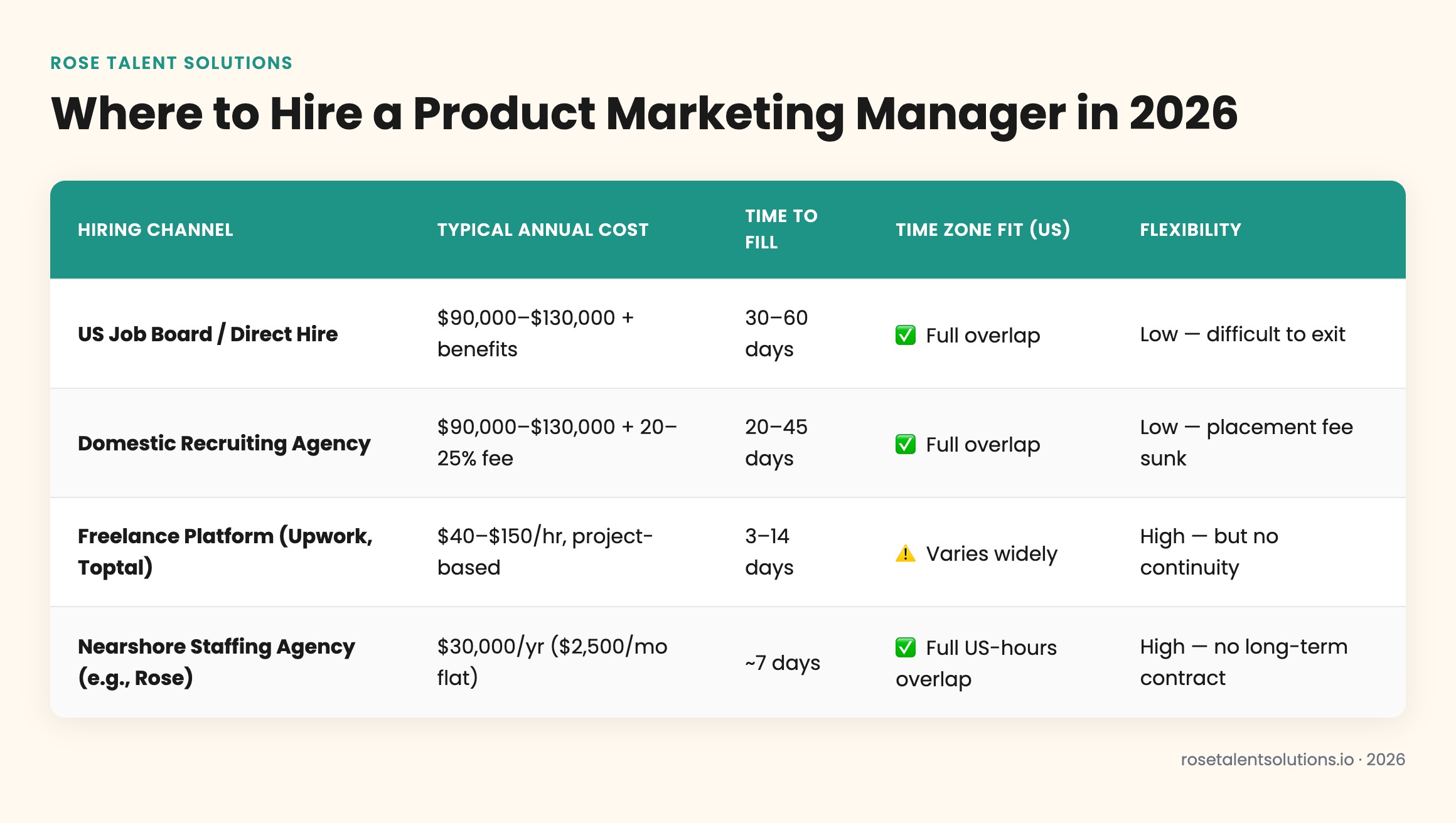
Most companies land on one of four paths when hiring a product marketing manager: a traditional job board hire, a domestic recruiting agency, a freelance platform, or a nearshore staffing agency. Each has a distinct cost profile, ramp time, and risk level. The table below breaks down what you're actually signing up for with each option.
| Hiring Channel | Typical Annual Cost | Time to Fill | Time Zone Fit (US) | Flexibility |
|---|---|---|---|---|
| US Job Board / Direct Hire | $90,000–$130,000 + benefits | 30–60 days | ✅ Full overlap | Low — difficult to exit |
| Domestic Recruiting Agency | $90,000–$130,000 + 20–25% fee | 20–45 days | ✅ Full overlap | Low — placement fee sunk |
| Freelance Platform (Upwork, Toptal) | $40–$150/hr, project-based | 3–14 days | ⚠️ Varies widely | High — but no continuity |
| Nearshore Staffing Agency (e.g., Rose) | $30,000/yr ($2,500/mo flat) | ~7 days | ✅ Full US-hours overlap | High — no long-term contract |
April Dunford's point cuts to the core of the hiring decision. If you need strategic positioning leadership, a senior domestic hire may be warranted. But if you need someone who can execute competitive research, update your sales deck, and manage your messaging calendar — a well-vetted nearshore PMM from Latin America does all of that at a fraction of the cost, starting week one.
Where to Post a Job for a Product Marketing Manager in 2026
If you're going the direct-hire route, channel selection matters more than budget. LinkedIn remains the dominant sourcing platform for PMM roles — LinkedIn Talent Solutions (2024) reports that marketing manager roles receive 3–5× more applications per posting than engineering roles, which sounds great until you realize 80% of applicants won't meet your baseline criteria. Volume is not the same as quality.
Specialized job boards like Demand Curve's job board, Product Marketing Alliance's jobs page, and Lenny's Job Board attract candidates who have specifically chosen product marketing as a career — not just marketers who added "product" to their resume. If you have time to screen carefully, these communities surface better-fit candidates than a broad LinkedIn post.
Boutique recruiting firms that specialize in B2B SaaS marketing can compress your search timeline but add 20–25% of first-year salary to your cost. That's $18,000–$32,500 in recruiter fees on top of a senior PMM salary — a significant outlay for a company that hasn't yet validated the role's ROI. If you want to understand the full cost comparison before committing to a recruiting agency, our breakdown of why nearshore virtual staffing outperforms in-house hiring on a cost-per-output basis lays out the math in detail.
How Nearshore Hiring in Latin America Works for a PMM Role in 2026
Nearshore staffing places your team member in Latin America — countries like Colombia, Mexico, Argentina, and Costa Rica — which means they work your actual business hours, live in your time zone (or one to three hours off), and have no asynchronous lag. If your product launch is blowing up in Slack at 10am EST, your nearshore PMM is right there with you. This is the core operational difference that sets Latin American nearshore talent apart from offshore models based on the other side of the globe, and it's worth understanding in full if you haven't already read the complete nearshore vs offshore vs onshore comparison.
"Geographic and time zone proximity is not a soft benefit — it's a hard productivity multiplier. Teams with full-overlap collaboration cycles complete cross-functional projects 35% faster than distributed teams operating across a 6+ hour gap." — McKinsey Global Institute, The Future of Work After COVID-19 (2021)
At Rose Talent Solutions, a nearshore PMM hire follows a specific, repeatable process. Every candidate clears an 8/10 or higher English proficiency screen, a role-specific skills assessment, and a structured interview before you ever speak with them. The typical placement timeline from intake to first day is around seven days — compared to 45+ days for a domestic search.
Intake Call
Rose's team learns your product, your stack, your team culture, and what "great" looks like for this specific PMM role — not a generic job description intake.
Candidate Matching
Rose surfaces 1–3 pre-vetted candidates from Latin America who have already cleared English fluency screens, skills assessments, and background checks.
You Interview and Select
You run your own interview. You make the final call. Rose handles offer, contracts, and onboarding paperwork on the back end.
Day One with AI Copilot
Your nearshore PMM arrives with a role-specific AI copilot trained on the tools your team actually uses — HubSpot, Notion, Figma, and others — so ramp time shrinks dramatically.
Ongoing HR and Management Support
Rose handles payroll, HR, compliance, and ongoing performance support. If it's not a fit, Rose replaces the team member at no additional cost.

What Does a Nearshore Product Marketing Manager Cost in 2026?
Rose Talent Solutions prices nearshore hires at a flat $2,500 per month — that's full-time (40 hours per week), all-in. Recruiting, vetting, payroll, HR, and ongoing management are included. There is no long-term contract, and if the team member isn't the right fit, Rose replaces them at no additional cost. Compare that to the loaded cost of a US-based PMM: $90,000–$130,000 base salary, plus 20–30% in benefits and payroll taxes, plus office overhead if applicable. The annual savings frequently exceed $70,000 — capital that goes back into paid acquisition, product development, or your next hire.
One important nuance: the $2,500 flat rate covers a highly skilled generalist PMM — someone who can own your messaging, manage competitive research, build enablement assets, and coordinate launches. If you need a C-suite-level Chief Marketing Officer or a deep-specialist with 15 years of Fortune 500 positioning experience, a domestic senior hire is probably the right call. But for the vast majority of growth-stage companies, the nearshore PMM profile delivers 90% of the output at 25% of the cost. You can learn more about how Latin America's talent ecosystem has matured to support exactly this kind of role in our overview of virtual assistant companies operating across Latin America.
The hidden cost of a delayed PMM hire isn't just the open salary slot — it's the product launches that slip, the sales decks that don't get updated, and the competitive positioning work that never happens. A nearshore PMM in seat within seven days eliminates that opportunity cost entirely.
Nearshore vs Offshore vs Onshore: Which Is Right for a PMM Role in 2026?
The distinction between nearshore Latin American talent and far-offshore hiring is not just geographic — it's operational. Far-offshore teams operating in Southeast Asia or South Asia work on a 10–14 hour time difference from US Eastern time. For a PMM role — which requires constant collaboration with product managers, sales leaders, and executives — that time gap creates a broken feedback loop. You ask a question at 3pm; you get an answer at 3am. Multiply that delay across a product launch cycle and you've lost days of iteration. According to Gallup's State of the Global Workplace (2023), employees who experience collaboration friction due to time zone gaps report 23% lower engagement scores — and disengaged remote workers produce measurably less output. For a deeper breakdown of how these three staffing models compare across cost, communication, and quality, the onshore vs offshore virtual assistant guide covers every dimension in detail.
Nearshore PMM: Pros
- Full US business-hours overlap — joins live calls, standups, and launches
- English fluency at 8/10+ — no communication friction on messaging or copy work
- Flat $2,500/mo rate — no benefits, payroll tax, or recruiter fee overhead
- No long-term contract — exit with 30 days written notice
- AI copilot included — faster ramp on your existing martech stack
Nearshore PMM: Cons
- Not the right fit for C-suite strategic leadership requiring 15+ years of experience
- Requires a clear scope doc from you — ambiguous roles are harder to match
- Remote-only — no option for in-office collaboration
The AI copilot advantage deserves its own mention. Every Rose team member ships with a role-specific AI assistant trained on the tools they'll actually use. For a PMM, that means your hire arrives already oriented inside HubSpot workflows, Notion templates, and competitive research frameworks — not spending their first two weeks figuring out where things live. You can read more about how this works on the Rose AI Advantage page. McKinsey's analysis of generative AI in the workplace (2023) found that AI-assisted knowledge workers complete complex tasks 25–40% faster than peers working without AI augmentation.
If you're ready to stop waiting on a 45-day recruiting cycle and put a vetted PMM in seat inside a week, the fastest path is to start your search with Rose — the intake call takes 20 minutes and matching begins the same day.