
What Is a Nearshore Virtual Assistant — and Why Does It Matter in 2026?
Nearshore virtual assistants are remote professionals based in Latin America who work for US, Canadian, or UK businesses during standard North American business hours. Unlike offshore staffing from the Philippines or India — where a 10–14 hour time zone gap creates overnight delays on every back-and-forth — nearshore VAs sit in the same or adjacent time zones as your team. They join your morning standups, respond to clients in real time, and hand off work without a 24-hour lag baked into every task cycle.
When business owners ask why hire a nearshore virtual assistant instead of in-house staff, the answer comes down to three things: cost, flexibility, and speed. The median annual salary for an administrative professional in the US hit $47,290 in 2024, according to the U.S. Bureau of Labor Statistics (2024). Stack benefits, payroll taxes, office space, equipment, and recruiting fees on top of that, and you're easily at $65,000–$75,000 fully loaded for one mid-level hire. That math is forcing business owners to ask a harder question: does this role actually need to be in-house?
For the majority of administrative, operational, and support roles — the honest answer is no.
How the True Cost of In-House Hiring Compares to a Nearshore VA in 2026
Most business owners budget for salary. Very few budget for the full employment cost — and that gap is where the real financial case for choosing a nearshore virtual assistant instead of in-house hiring lives. The Society for Human Resource Management (SHRM) estimates that employee benefits add 30–40% on top of base salary for the average US employer. That means a $47,000 administrative hire costs closer to $62,000–$66,000 before you've touched recruiting fees, onboarding time, or office overhead.
Then there's turnover. The average cost to replace an employee is 50–200% of their annual salary, according to Gallup (2019). For a $50,000 role, that's $25,000–$100,000 in lost productivity, recruiting, and training costs every time someone walks out. Administrative roles see some of the highest voluntary turnover rates in the labor market — making in-house hiring a recurring expense, not a one-time investment.
Compare that to Rose Talent Solutions' flat $2,500/month — which covers recruiting, vetting, payroll, HR administration, and ongoing management. That's $30,000 per year, all-in, for a dedicated full-time team member working 40 hours per week. No hidden fees. No benefits administration. No workers' comp filings. To understand what you're actually paying for at the market level, this breakdown of Latin American VA compensation covers country-by-country benchmarks and what skilled roles cost at market rate.

Nearshore vs. Offshore vs. In-House: 2026 Head-to-Head Comparison
The three staffing options most business owners seriously consider each have a fundamentally different risk and cost profile. The table below strips out the marketing language and puts the real variables side by side. Understanding why you'd hire a nearshore virtual assistant instead of in-house — or instead of offshore — requires looking at the full picture, not just the line-item rate.
| Factor | Nearshore VA (Latin America) | Offshore VA (Philippines/India) | US In-House Employee |
|---|---|---|---|
| Annual fully loaded cost | ~$30,000 | ~$18,000–$24,000 | ~$62,000–$75,000 |
| Time zone alignment | Same or ±1–2 hrs (US EST/CST/PST) | 10–14 hrs behind US ET | Perfect (local) |
| English proficiency | High (8/10+ screened) | Moderate–High (varies) | Native |
| Real-time collaboration | Yes — live calls, standups, Slack | No — async only or night shifts | Yes |
| Recruiting/HR overhead | Handled by Rose (included) | Varies — often DIY | High — internal HR or agency fees |
| Contract flexibility | Month-to-month, 30-day notice | Varies by platform | At-will, but severance risk |
| Replacement if not a fit | Free replacement included | Re-hire from scratch | Full recruiting cycle, ~45 days avg |
| AI copilot / software training | Included (role-specific) | Rarely included | You train them yourself |
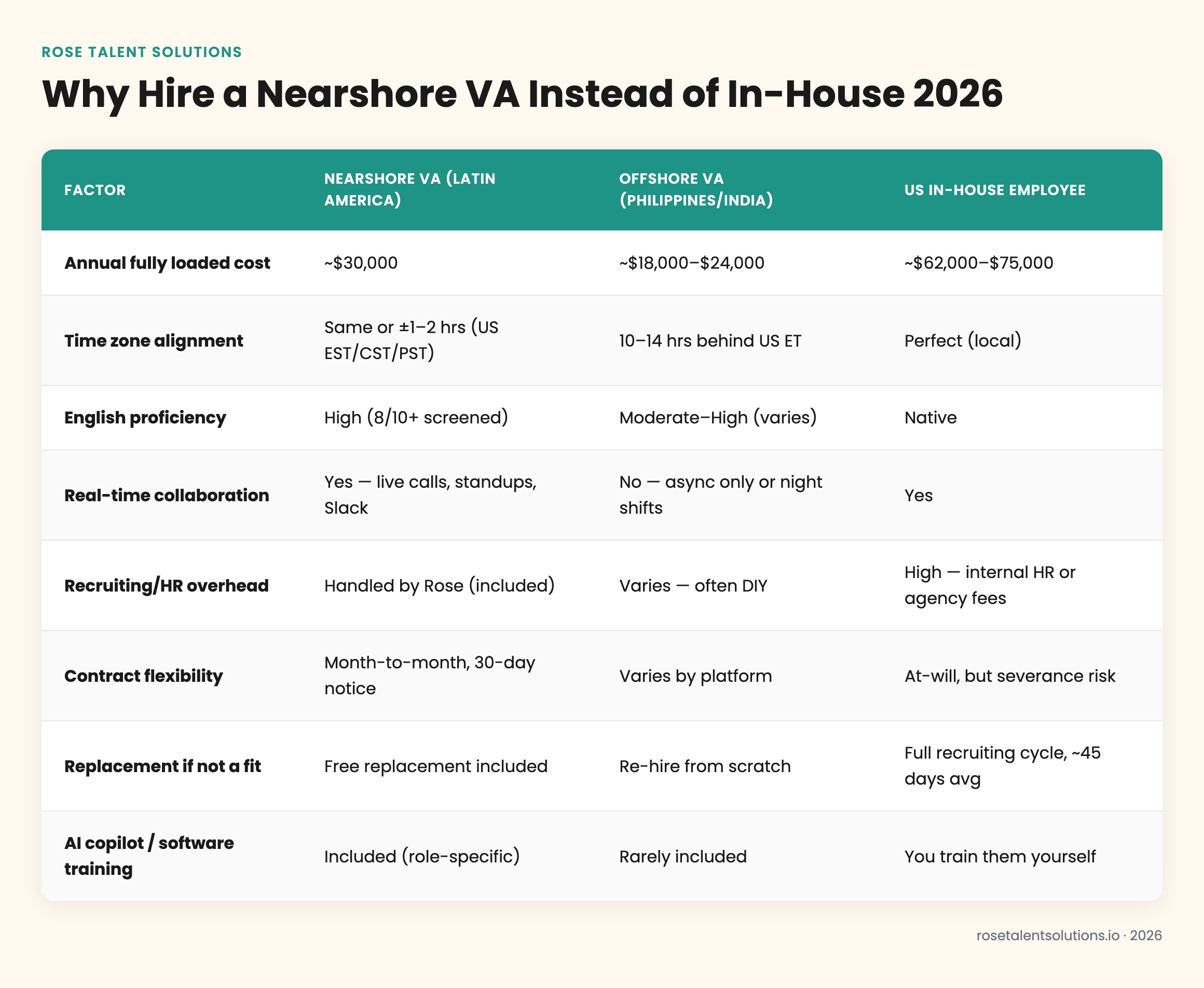
For a fuller breakdown of how these three models compare across even more dimensions — including communication quality scores and task completion latency data — see this complete nearshore vs. offshore vs. onshore comparison.
How Nearshore VAs Outperform In-House Hires on Operational Flexibility in 2026
In-house employees come with structural rigidity most small and mid-sized businesses can't afford. You're legally obligated to manage payroll taxes, file W-2s, comply with state-specific employment law, and navigate FMLA, ADA, and local leave requirements — even for a single admin hire. 42% of small business owners report spending more than 5 hours per week on HR and compliance tasks, according to the National Federation of Independent Business (2023). That's time you don't spend on revenue-generating work.
A nearshore virtual assistant through Rose eliminates the entire compliance stack. Rose handles payroll, HR, benefits administration, and ongoing performance management. You get a dedicated team member who shows up every morning at your time zone, knows your software, and has a role-specific AI copilot trained on the tools they'll actually use — whether that's QuickBooks for bookkeeping tasks, AppFolio for property management operations, or a CRM for sales support. You can learn more about how that AI layer works at Rose's AI advantage page.
"Remote work has permanently shifted employer expectations. The question is no longer whether distributed teams can perform — it's whether your hiring structure lets you access the best talent at the right cost." — Johnny C. Taylor Jr., President & CEO at SHRM (2023)
Flexibility also means scalability. Hiring in-house to handle a seasonal surge — tax season, a property acquisition wave, a product launch — means you're carrying that fixed cost long after the surge passes. A nearshore VA engagement runs month-to-month with 30 days written notice to cancel. You scale up when business demands it and adjust when it doesn't, without severance risk or a protracted exit process.
The flexibility advantage isn't just financial — it's operational. In-house employees require 45–90 days to hire, onboard, and reach full productivity. A Rose nearshore VA is placed, onboarded, and working in your systems within days, with the AI copilot compressing ramp time from weeks to hours on core software tasks.

How to Identify Which Roles Should Be Nearshore vs. Kept In-House
Not every role belongs outside your four walls. Physical presence, licensed professional requirements, and highly sensitive in-person client interactions are legitimate reasons to keep someone local. But the majority of operational and administrative functions — the ones eating 30–40% of a founder or manager's week — translate cleanly to a nearshore model. McKinsey estimates that 60% of all occupations have at least 30% of activities that could be performed remotely, according to McKinsey Global Institute (2021). For administrative and data-processing roles, that number skews even higher.
Roles that work especially well as nearshore engagements include: executive and administrative assistance, bookkeeping and accounts payable (Rose's bookkeeping VAs are trained on QuickBooks and Xero from day one), property management coordination, customer support and intake, lead follow-up and CRM management, and data entry or reporting work. These are roles where the output is digital, the tools are cloud-based, and real-time communication is possible — but physical proximity is irrelevant.
The trend toward choosing a nearshore virtual assistant instead of in-house staff is accelerating across industries. US companies switching from offshore to nearshore models cite real-time collaboration, higher English proficiency, and cultural alignment as the three primary drivers — not cost alone.
Why Nearshore Wins Over In-House
- $30,000–$40,000+ in annual savings on fully loaded employment costs
- Zero HR, payroll tax, or compliance overhead for you
- Month-to-month terms — no long-term contract, 30-day cancel notice
- AI copilot included, pre-trained on your software stack
- Free replacement if the team member isn't a fit
- Operational within days, not months
When In-House Still Makes Sense
- Role requires physical presence or licensed local credentials
- Highly sensitive in-person client relationships are central to the job
- Role involves managing other on-site staff daily
How Rose's Nearshore Placement Process Works in 2026
One of the most common hesitations business owners raise is the fear of a slow, complex onboarding process. The reality is the opposite — Rose's placement model is built specifically to compress time-to-productivity. Here's how it works from first call to first day:
Discovery Call
Rose scopes the role with you — software stack, hours, responsibilities, communication style preferences — so the match is built around your actual operation, not a generic job description.
Candidate Matching
Rose sources from a pre-vetted Latin America talent pool, screens for English proficiency (8/10+ minimum), software experience, and role fit — and presents you with matched candidates, typically within days.
Interview & Selection
You interview the shortlist and choose your person. No guesswork — you make the final call.
Onboarding & AI Copilot Activation
Your team member starts, with a role-specific AI copilot trained on your software stack already activated — so ramp time on tools like AppFolio, Buildium, or QuickBooks is measured in hours, not weeks.
Ongoing Management
Rose handles HR, payroll, and performance oversight. You manage the day-to-day work. If it's not the right fit, Rose replaces the team member at no additional cost.
If you're ready to see what this looks like for your specific business, the fastest path forward is starting your placement request here — the discovery call is the first step, and it typically takes under 30 minutes.