
Why Nearshore Fractional Bookkeeping Is the 2026 Default for Startups
Nearshore fractional bookkeepers — professionals based in Latin America, working your US business hours — have become the default finance solution for lean startups in 2026. Understanding when should a startup hire a fractional bookkeeper is one of the highest-leverage decisions a founder makes in the early stages. These professionals cost a fraction of a full-time hire, arrive already trained on the tools you use (QuickBooks, Xero, FreshBooks), and are reachable the moment you need them. That last point matters more than founders realize until they've lived the alternative: an offshore bookkeeper 10 time zones away who answers your urgent tax question the next morning.
The question isn't whether your startup eventually needs a fractional bookkeeper — it does. The real question is when the cost of not having one exceeds the cost of hiring one. For most startups, that crossover happens earlier than expected. According to SCORE (2023), 82% of small business failures are caused by cash flow problems — the exact category a competent bookkeeper prevents.
If you're still doing your own books past the $10K/month revenue mark, you're almost certainly paying more in founder time and financial errors than a bookkeeper would cost. This guide maps out the exact signals that tell a startup when to hire a fractional bookkeeper, what it costs in 2026, and how to get someone productive in days — not months.
What Is a Fractional Bookkeeper? (A 2026 Definition)
A fractional bookkeeper is a trained finance professional who works for your business on a part-time or shared basis — handling the day-to-day transaction recording, reconciliation, payables, receivables, and reporting that your business generates, without the overhead of a full-time salary and benefits package. Unlike a CPA, a fractional bookkeeper focuses on the operational layer of your finances: keeping the books clean so that your accountant or CFO has accurate data to work from.
The term "fractional" signals that you're purchasing a share of their time and capacity. In practice, many startups need 10–20 hours of bookkeeping work per week — enough for a dedicated part-time engagement but not a full 40-hour role. A nearshore fractional bookkeeper based in Latin America can cover that range at a predictable monthly flat rate. For a deeper breakdown of how this role differs from a CPA or a fractional CFO, see Rose's guide on virtual bookkeeper vs. CPA vs. fractional CFO — which do you actually need.
How to Know When Your Startup Should Hire a Fractional Bookkeeper in 2026
There's no single revenue threshold that automatically triggers the hire. Instead, watch for this cluster of signals — any two of them appearing together is your cue to move. Founders who understand when a startup should hire a fractional bookkeeper typically act on these indicators before a financial mistake forces the decision:
- You're over $10K/month in revenue and still reconciling your own bank statements. At this volume, errors compound fast and the IRS expects cleaner documentation.
- You spend more than 5 hours a week on financial tasks. At a $150/hr founder opportunity cost, that's $3,000/month in time you're burning — more than a fractional bookkeeper costs.
- You've missed a tax deadline, a vendor payment, or a payroll run. One missed payment can cost more in penalties than a year of bookkeeping fees.
- You're preparing for a fundraise or due diligence. Investors will ask for clean financials going back 12–24 months. Retroactive cleanup is expensive and embarrassing.
- You don't know your gross margin off the top of your head. A bookkeeper ensures your P&L is current enough that this number is always at your fingertips.
- You're adding headcount or opening a second revenue stream. Complexity scales faster than most founders expect. Add a fractional bookkeeper before the mess, not after.
According to the U.S. Bureau of Labor Statistics (2024), the median annual wage for a full-time bookkeeper in the US is $47,440 — that's before benefits, taxes, and recruiting costs. A nearshore fractional engagement at $2,500/month all-in runs $30,000/year and comes fully managed.

How Fractional Bookkeepers Compare to Other Finance Hires in 2026
One of the most common mistakes startup founders make is assuming they need a CPA when they actually need a bookkeeper, or hiring an expensive fractional CFO before the books are even clean enough to make CFO-level decisions meaningful. Understanding which role fits your stage is the most important decision in this process — and it starts with knowing when your startup should hire a fractional bookkeeper versus something else entirely.
"Most founders don't have a strategy problem with their finances — they have a data problem. The books are a mess, so every financial decision is made on bad information. Fix the books first." — Ben Richmond, US Country Manager at Xero (2023)
| Hire Type | Monthly Cost (US) | Weekly Hours | Best For | Software Depth |
|---|---|---|---|---|
| In-House Bookkeeper (US) | $3,800–$5,500 | 40 hrs | High-volume, complex ops | Varies — you train them |
| CPA Firm (outsourced) | $1,500–$4,000+ | As-needed / hourly | Tax filing, audits | Compliance-focused, not daily ops |
| Fractional CFO | $5,000–$15,000 | 10–20 hrs | Series A+, fundraising strategy | High-level, not transactional |
| Nearshore Fractional Bookkeeper (Rose) | $2,500 flat | 40 hrs | Seed–Series A startups | QuickBooks, Xero, FreshBooks — pre-trained |
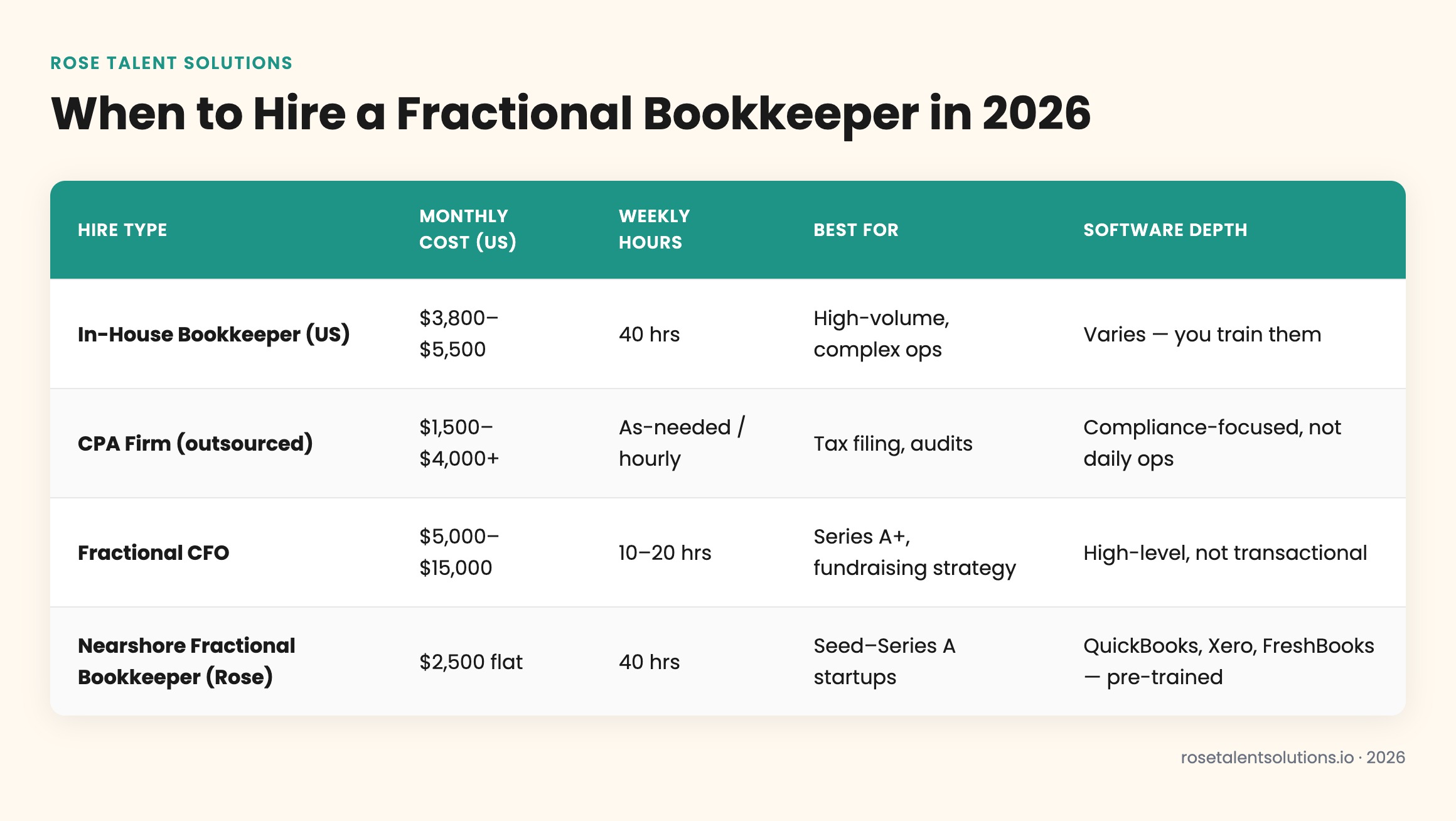
The nearshore model wins on the overlap of cost, dedicated hours, and pre-built software fluency. If you want to understand what a tool-specific engagement looks like in practice, Rose's post on QuickBooks virtual bookkeeper costs in 2026 breaks down exactly what you get at each price point.
What Does a Nearshore Fractional Bookkeeper Actually Do Day-to-Day?
Founders sometimes confuse bookkeeping with accounting. Bookkeeping is the daily operational layer — recording every transaction, reconciling bank and credit card statements, managing accounts payable and receivable, running payroll inputs, and generating weekly or monthly financial reports. Accounting sits on top of that clean data to produce tax returns, financial strategy, and compliance filings.
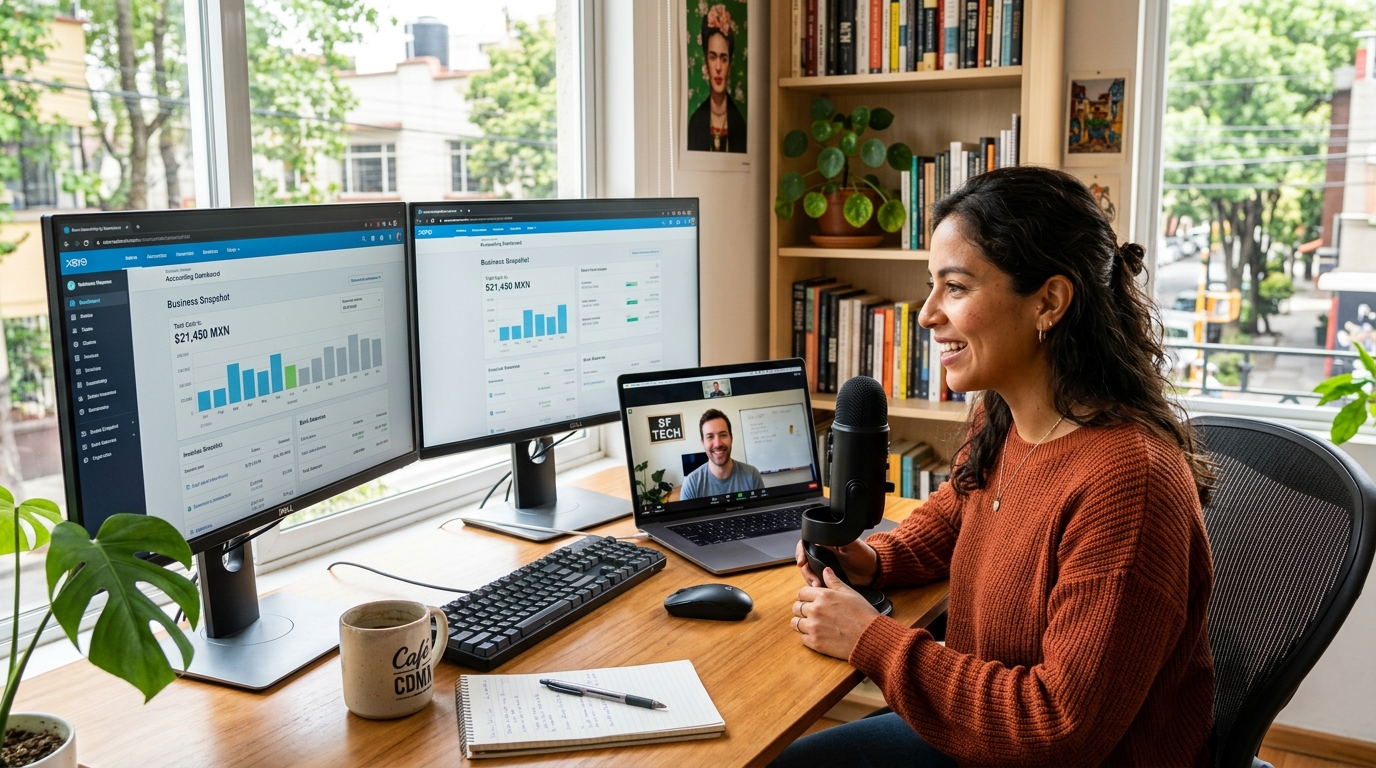
A nearshore fractional bookkeeper from Latin America working US hours covers the full operational layer. Because they're in your timezone (or within 1–2 hours of it), they can answer a QuickBooks question at 10am, catch a duplicate charge before it hits your cash position, and have your month-end close ready by the second business day of the next month. That real-time availability is what separates the nearshore model from traditional offshore arrangements. For businesses exploring Xero specifically, see how a dedicated Xero virtual bookkeeper manages the same day-to-day workflow inside that platform.
According to QuickBooks / Intuit (2024), small businesses that maintain up-to-date books are 40% more likely to secure financing when they need it — because lenders and investors require current, accurate financials before committing capital.
The hidden cost of doing your own books past $10K/month isn't just the 5+ hours per week. It's the decisions you make on stale or inaccurate data — and the cleanup bill you pay your CPA every April to sort out a year's worth of uncategorized transactions. This is precisely when a startup should hire a fractional bookkeeper — before that April reckoning arrives.
How Rose Talent Solutions Places a Fractional Bookkeeper in 2026
Getting a nearshore fractional bookkeeper placed through Rose is a five-step process designed to compress the typical 4–8 week hiring cycle into under two weeks. Every placement includes recruiting, vetting, payroll, HR, and ongoing management — all at the flat $2,500/month rate. There is no long-term contract, and if the team member isn't a fit, Rose replaces them at no additional cost.
Intake Call
Rose's team maps your software stack (QuickBooks, Xero, FreshBooks), transaction volume, and reporting cadence to define the exact role profile needed.
Candidate Matching
Rose pre-screens candidates against your profile — 8/10+ English proficiency, verified software certifications, and bookkeeping experience at comparable company stages.
AI Copilot Assignment
Each bookkeeper ships with a role-specific AI copilot pre-trained on their primary software platform, so they arrive ready to work — not learning on the job at your expense.
First Week Onboarding
Your bookkeeper integrates into your accounts, gets read/write access to your financial systems, and produces a baseline reconciliation within the first five business days.
Ongoing Management
Rose handles HR, payroll, performance check-ins, and any replacement needs — you manage the work, Rose manages the employment relationship.
Rose's bookkeeping and accounting service page covers the full scope of tasks included in each engagement. And if you want to understand the broader nearshore staffing model before committing, the nearshore bookkeeper overview explains how Latin American professionals compare to both US-based and offshore alternatives on cost, English fluency, and timezone fit.
Nearshore vs. Offshore Fractional Bookkeepers: The 2026 Honest Comparison
The offshore bookkeeping market — dominated by providers in India and the Philippines — competes primarily on hourly rate. On the surface, $8–$12/hr looks attractive against $2,500/month flat. But the real cost calculation includes ramp time, error correction, communication overhead, and the timezone penalty that compounds every day. Any startup evaluating when to hire a fractional bookkeeper should weigh these total costs, not just the sticker rate.
According to SHRM (2024), teams operating across time zone gaps of 6+ hours report 34% longer project cycle times due to async communication delays. For bookkeeping — where a founder might need a quick AP question answered at 2pm Eastern — that delay isn't a minor inconvenience. It's a decision bottleneck that compounds weekly.
Nearshore (Latin America)
- Same or 1–2 hr time zone overlap with US East/Central
- 8/10+ English proficiency standard
- Cultural alignment with US business norms
- Pre-trained on US GAAP bookkeeping workflows
- Real-time availability for calls and questions
Offshore (India / Philippines)
- 6–12 hour time zone gap with US East Coast
- Variable English proficiency (no standard floor)
- Async-only communication in practice
- Higher error correction overhead on US-specific tax codes
- Churn rates historically higher in high-volume outsourcing hubs
Month-to-month terms with no long-term contract mean you're never locked in — but in practice, startups that hire a well-matched nearshore fractional bookkeeper rarely need to invoke the exit clause. The model works because the timezone alignment creates a genuine working relationship, not just a task queue. If you're ready to see what the engagement looks like for your specific situation, the intake process starts here.
According to Gallup (2023), engaged employees — those with real-time collaboration and clear communication with their managers — are 23% more productive than disengaged counterparts. Timezone alignment is the single biggest driver of engagement for remote finance staff, and it's one of the strongest reasons a startup should hire a nearshore fractional bookkeeper over a traditional offshore alternative.