
Nearshore outsourced SDRs do not show up to their first day empty-handed. The best ones arrive with a battle-tested prospecting stack — CRM credentials loaded, sequences drafted, data lists pulled — and they are live in your pipeline within a week. If you have ever wondered exactly what tools outsourced SDRs use for prospecting, this breakdown covers the full 2026 stack: what each tool does, why it matters, how nearshore reps use it differently than offshore teams, and what to demand from any SDR partner before you sign on.
Understanding the tool stack is not just a technical exercise. The tools an SDR uses determine your pipeline's speed, accuracy, and scalability more than almost any other hiring decision you will make. A rep running Apollo.io with a clean Clay-enriched list and an AI writing layer books 2–3× more meetings than one cold-dialing from a spreadsheet, according to independent benchmarks published by McKinsey & Company on B2B sales productivity (2024).
How the Core 2026 SDR Prospecting Stack Is Structured
Every effective outsourced SDR setup in 2026 runs on five layers. Think of it as a pipeline assembly line: data in, messaging crafted, outreach sent, calls made, results logged. Each layer has a category leader, and knowing which tool fills which slot tells you a lot about how seriously an SDR provider takes their craft.
The five layers are: data sourcing (where prospects come from), CRM (where they live), sales engagement (how outreach is sequenced), dialing (how calls are made at scale), and AI writing (how personalization happens without burning hours). If a prospective SDR partner cannot name a specific tool in each category — and show you how their reps are trained on it — that is a red flag worth acting on before you commit budget.
Rose's nearshore SDRs ship with a role-specific AI copilot trained on whichever platform stack your business already runs, whether that is HubSpot, Salesforce, or a niche CRM. That pre-trained layer is what compresses ramp time from the industry average of 90 days down to closer to 2–3 weeks.
What Data Sourcing Tools Do Outsourced SDRs Use in 2026?
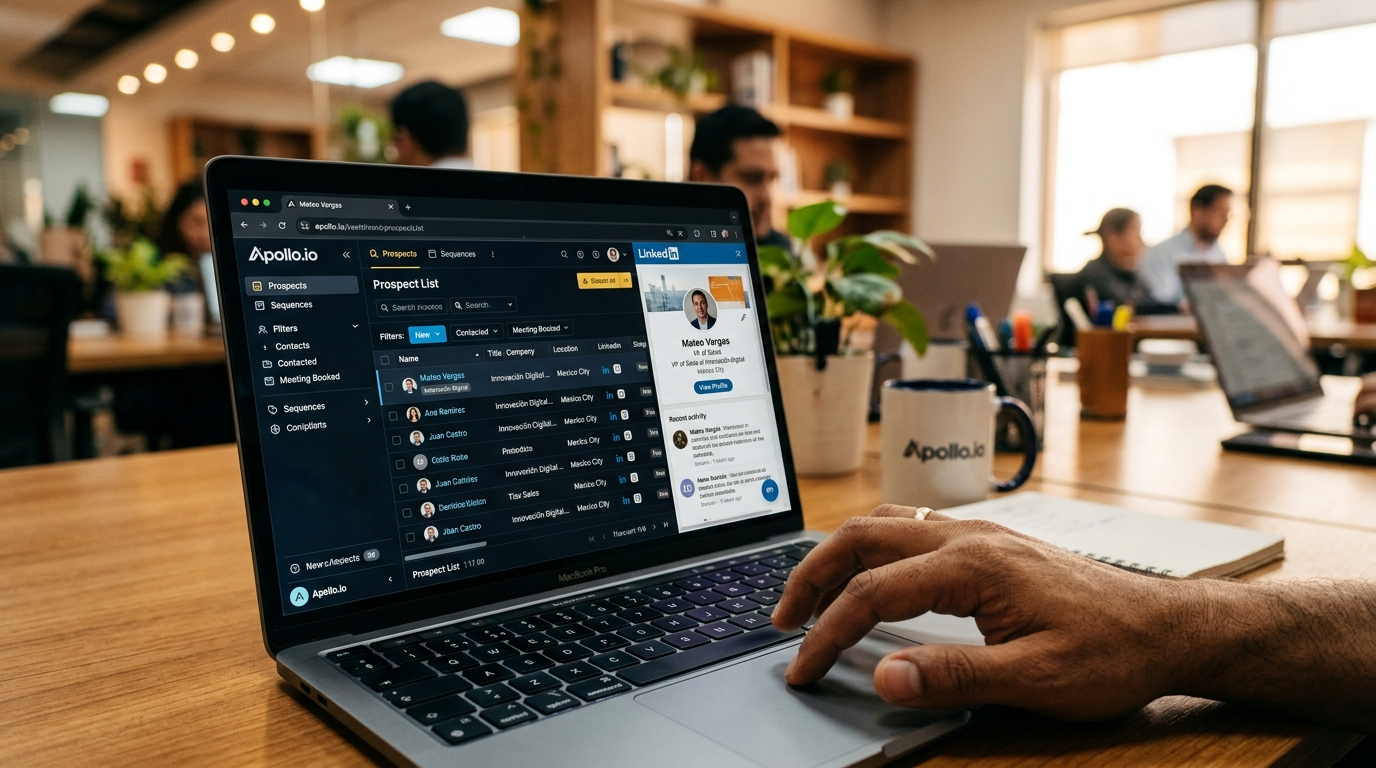
Data is the raw material of prospecting. Without accurate contact data — verified emails, direct dials, firmographic filters — even the best sequence dies in spam folders. The two dominant platforms in 2026 are Apollo.io and ZoomInfo, with Clay emerging as the enrichment and waterfall-routing layer that sits on top of both.
Apollo.io gives SDRs a searchable database of over 275 million contacts with built-in sequencing, making it a two-in-one tool for smaller teams. It is particularly strong for SMB and mid-market prospecting where list volumes are high and budget is tight. ZoomInfo runs deeper on enterprise firmographics — company tech stack, intent signals, org charts — and is the default at larger revenue orgs. Clay is the 2024–2026 breakout: it pulls data from 75+ providers simultaneously, routes each field through whichever source returns the highest-confidence result, and hands a clean, enriched row back to your CRM. According to Salesforce's State of Sales Report (2024), 81% of sales teams now use AI-powered data tools to prioritize leads — up from 54% in 2022.
If you are exploring how outsourced SDRs handle the full cold email workflow end-to-end, our deep-dive on how outsourced SDRs handle cold email at scale walks through list hygiene, deliverability setup, and sequence architecture in detail.
How CRM and Sales Engagement Platforms Power Outsourced SDR Pipelines
Once data is sourced, it needs a home and a workflow. The CRM is that home; the sales engagement platform is the workflow engine. In 2026, the dominant pairing for outsourced SDR teams is HubSpot Sales Hub (CRM) with Outreach.io or Salesloft (engagement), or Salesforce with Apollo sequences for cost-conscious teams.
Sales engagement platforms automate the multi-touch cadence — email on day one, LinkedIn connection on day three, call on day five — while logging every touchpoint back to the CRM without manual data entry. That automation matters enormously for outsourced SDRs because it means their output is measurable, auditable, and improvable in real time. You can see exactly which sequence step is converting and which is dropping off, and adjust without a single meeting.
"The biggest mistake companies make with outsourced SDRs is treating the tool stack as an afterthought. The rep's skill ceiling is set by the infrastructure you give them. A great SDR on a bad stack will underperform a mediocre SDR on a great stack every time." — Becc Holland, Founder & CEO at Flip the Script (2024)
According to Gartner's Sales Engagement Market Guide (2024), organizations using a dedicated sales engagement platform see an average 20% lift in SDR-generated pipeline within 90 days of deployment. That number climbs further when reps are trained on the platform before their first dial — which is exactly the model Rose's nearshore SDRs follow.
| Tool | Category | Monthly Cost (per seat) | AI Features (2026) | Best For |
|---|---|---|---|---|
| Apollo.io | Data + Engagement | $49–$99 | AI email writer, intent signals, sequence scoring | SMB/Mid-market teams, all-in-one budget stack |
| ZoomInfo + Outreach | Data + Engagement | $250–$500+ | Buying intent, persona scoring, AI call summaries | Enterprise teams with dedicated ops support |
| HubSpot Sales Hub | CRM + Light Sequencing | $90–$150 | AI deal scoring, email optimization, ChatSpot | Inbound-heavy orgs already on HubSpot CRM |
| Clay + Smartlead | Enrichment + Cold Email | $149–$299 | Waterfall enrichment, AI personalization rows, deliverability AI | Volume outbound, agency-style SDR teams |
How Dialers and AI Writing Tools Complete the 2026 SDR Stack
Two final tool categories separate high-output SDR teams from average ones in 2026: parallel dialers and AI writing assistants. Each solves a specific bottleneck that drags down prospecting velocity.
Parallel dialers — led by Orum, Nooks, and Aircall — allow an SDR to dial 5–10 lines simultaneously and connect only when a human picks up, discarding voicemail and busy signals automatically. According to U.S. Bureau of Labor Statistics data on sales rep productivity benchmarks (2024), the average SDR makes 45–60 dial attempts per day on a single-line dialer. Parallel dialers push that to 200–300 dial attempts with the same time investment, tripling live conversation rates without adding headcount.
The hidden cost of offshore SDRs is not the hourly rate — it is the 8–12 hour timezone gap that forces them to cold-call US prospects at the wrong time of day, cratering connect rates and burning your data. Nearshore SDRs work US business hours, so every dial hits during the 8am–6pm window when decision-makers actually pick up.
AI writing tools — primarily Lavender, ChatGPT with custom prompts, and Amplemarket's AI layer — solve the personalization-at-scale problem. Writing a genuinely personalized first line for 200 prospects per day used to take hours. In 2026, a trained SDR uses Clay to pull a prospect's recent LinkedIn post or company news, feeds it through a Lavender-optimized prompt, and generates a credible, specific opener in seconds. SHRM's Workforce Skills Research (2024) notes that AI tool proficiency is now among the top five skills hiring managers screen for in sales roles — a direct signal that the market has priced this capability in.
If you are weighing whether to build this infrastructure in-house or outsource it entirely, the outsourced vs. in-house SDR ROI comparison we published breaks down the full cost of each path — tool licenses, salary, benefits, ramp time, and management overhead — so you can make the call with real numbers.

How Rose Nearshore SDRs Are Onboarded to Your Stack in 2026
Knowing the tools is one thing. Being operational in your specific instance of those tools — with your ICP filters, your sequence templates, your CRM stages — is another. Here is how Rose's onboarding process gets a nearshore SDR from signed agreement to active prospecting in under two weeks.
Stack Audit & Role Brief
Rose's team maps your existing CRM, engagement platform, and data provider in the intake call. If gaps exist, we recommend the lightest-cost fill before placement begins.
Rep Matching & Vetting
Candidates are screened specifically for proficiency in your named tools — not generic "sales experience." English proficiency is verified at 8/10 or higher on Rose's standardized screen.
AI Copilot Activation
Each placed SDR's role-specific AI copilot is trained on your stack, your ICP, and your messaging before day one. This is what cuts ramp time in half versus a standard hire.
Week-One Calibration
The SDR runs live sequences under a structured 5-day calibration sprint — daily activity reviews, A/B subject line tests, and connect-rate tracking — so you have real performance data by end of week one, not week twelve.
Ongoing Management & Replacement Guarantee
Rose handles HR, payroll, and performance management. If the team member is not the right fit at any point, we replace them at no additional cost — no long-term contract required.
The entire engagement runs month-to-month at $2,500/month flat — recruiting, vetting, payroll, HR, and ongoing management included. You can learn more about the full SDR placement process on our get started page, or explore how this model applies specifically to software companies on our post about how to hire outsourced SDR services for SaaS businesses.
Nearshore vs. Offshore SDR Teams: How the Tool Stack Changes the Equation in 2026
The tools are largely the same whether your SDR is based in Bogotá or Bangalore. What differs is when those tools are being used and how fluently the rep can communicate when a prospect actually picks up the phone.
Nearshore SDRs (Latin America)
- Work US business hours — dials land during decision-maker availability windows
- English fluency at 8/10+ — real conversations, not scripted responses
- Same-day communication with your US sales team for rapid ICP adjustments
- Cultural alignment with North American B2B norms (follow-up cadence, directness)
- No timezone-driven reply lag on email responses or LinkedIn messages
Offshore SDRs (South/Southeast Asia)
- 8–12 hour timezone gap means cold calls happen outside prospect availability
- English proficiency varies widely — accent and fluency complaints common on connected calls
- Overnight batch processing of replies slows pipeline velocity significantly
- Cultural calibration for US buying behavior requires longer ramp time
- Management overhead increases due to async-only communication windows
For smaller teams — especially those under 20 employees — the timezone and fluency gap is not a minor inconvenience. It is the difference between a booked meeting and a ghosted sequence. Our guide on best B2B lead generation services for under-20-employee companies covers how team size should influence your outsourcing model and which tool stacks make the most sense at that scale.
According to Gallup's State of the Global Workplace Report (2024), employee engagement and timezone alignment consistently rank among the top drivers of remote worker productivity — a finding that maps directly onto SDR connect rate performance when nearshore and offshore teams are compared on identical sequences.