
What Is an Outsourced SDR in 2026?
Nearshore outsourced SDRs are the fastest-growing alternative to in-house sales development hiring — and for good reason. An outsourced SDR (Sales Development Representative) is a dedicated prospecting professional placed by a staffing partner, working full-time on your pipeline under your direction, without sitting on your payroll. They cold-call, sequence emails, qualify inbound leads, and book meetings for your account executives — the same work an internal SDR does, without the six-figure recruiting cost or the 90-day ramp gamble.
The SDR role itself is straightforward to define: an SDR focuses exclusively on top-of-funnel activity — identifying ideal prospects, initiating contact through calls, emails, and LinkedIn, and handing off sales-qualified leads (SQLs) to closing reps. They do not close deals. That separation of prospecting from closing is what makes the model scalable. When you outsource the SDR function, you extend that logic one step further: you also separate the hiring, HR, payroll, and management overhead from your internal team entirely.
The demand signal is clear. Sales development outsourcing has grown faster than any other GTM function over the past three years, driven by rising SDR salaries, high turnover, and the explosion of AI-augmented outreach tools that skilled nearshore reps can operate from day one. According to the U.S. Bureau of Labor Statistics (2024), the median annual wage for sales representatives now exceeds $67,000 — and that's before benefits, equity, or recruiting fees.
For a company with under 20 employees trying to build pipeline without blowing headcount budget, that number stings. If you're evaluating whether the math actually works, our outsourced vs. in-house SDR hiring ROI comparison breaks down the full cost difference with real numbers.
How an Outsourced SDR Model Actually Works in 2026
The mechanics are simpler than most people expect. You engage a staffing partner — like Rose Talent Solutions — who recruits, vets, and places a dedicated SDR with your company. That person works your hours, uses your tools (HubSpot, Salesforce, Apollo, Outreach, whatever your stack is), and reports to your sales manager or founder daily. The staffing partner handles payroll, HR compliance, and ongoing performance management. You get the output without the overhead.

Rose's model is built specifically for this workflow. Every SDR ships with a role-specific AI copilot trained on the tools they'll actually use — so if your stack is HubSpot + Apollo + LinkedIn Sales Navigator, your SDR arrives knowing those platforms, not learning them on your dime. The AI copilot handles tasks like sequence drafting, prospect research summarization, and CRM data hygiene, which means your SDR spends more time on live conversations and less time on admin. For a full walkthrough of how this scales in a SaaS context, see our guide on how to hire outsourced SDR services for SaaS companies.
The $2,500/month flat rate covers recruiting, vetting, payroll, HR, and ongoing management. There are no hidden add-ons for performance management, no separate recruiting invoice, and no long-term contract. If the SDR isn't a fit, Rose replaces them at no additional cost. That's the entirety of the risk reversal — a free replacement, not a refund, because the goal is to get you the right person, not to walk away from the engagement.
"The number one mistake early-stage sales leaders make is treating SDR hiring like AE hiring — they optimize for domain expertise instead of coachability and process discipline. That's why outsourced SDR models that include ongoing management tend to outperform self-managed offshore hires within the first 90 days." — Kyle Coleman, CMO at Copy.ai and former VP of Revenue Growth at Clari (2024)
Nearshore vs. Offshore vs. In-House SDRs: How Do They Compare in 2026?
Not all outsourced SDR options are the same. The three most common models — nearshore Latin America, offshore Asia/Philippines, and in-house U.S. — differ significantly in cost, timezone alignment, language quality, and ramp speed. The table below maps the key variables so you can make a direct comparison.
| Factor | Nearshore (Latin America) | Offshore (Philippines / India) | In-House (U.S.) |
|---|---|---|---|
| Monthly cost (all-in) | ~$2,500 flat | $1,200–$2,000 (variable) | $6,500–$9,000+ (salary + benefits) |
| Timezone alignment (US hours) | ✅ Same or 0–2 hr overlap | ❌ 10–14 hr gap (async only) | ✅ Perfect |
| English proficiency | 8/10+ screened floor | Variable (4–7/10 typical) | Native |
| Ramp time to first qualified meeting | 5–10 business days | 15–30 business days | 30–60 business days |
| AI copilot included | ✅ Role-trained at placement | ❌ Rarely | ❌ Rarely |
| HR / payroll managed | ✅ Fully handled | Partial (depends on agency) | ❌ Your burden |
| Contract flexibility | Month-to-month, 30-day notice | Often 3–6 month minimums | At-will but severance risk |
| Replacement if not a fit | ✅ Free replacement | Varies by agency | Restart full hiring cycle |
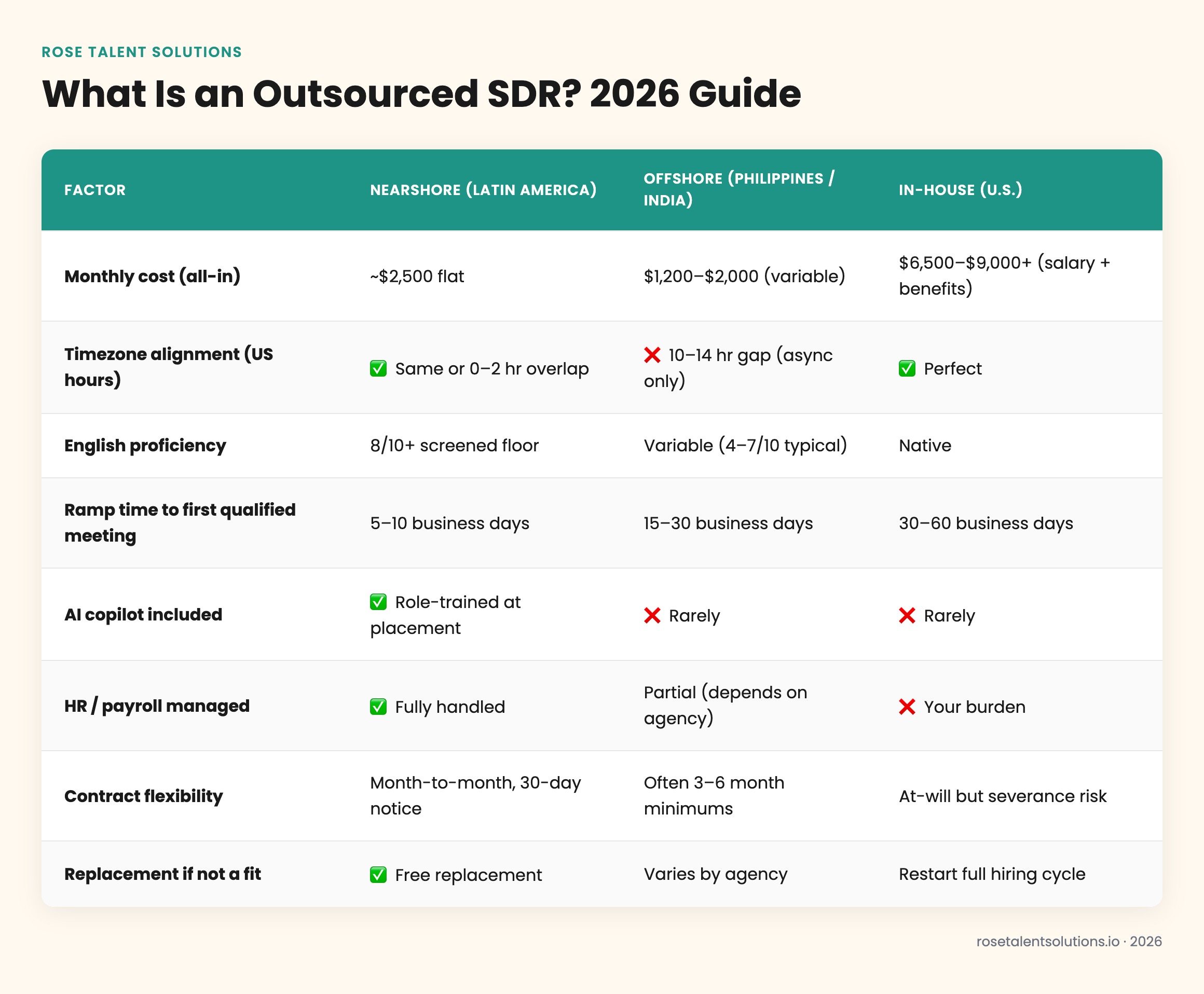
Table: Nearshore, offshore, and in-house SDR models compared across eight operational variables for 2026.
The hidden cost of offshore SDRs is rarely the hourly rate — it's the communication lag. When a prospect replies at 10 a.m. Eastern and your SDR responds at 10 p.m. Eastern, the window to convert that reply into a booked call has closed. Nearshore Latin American SDRs work in real time with your U.S. prospects, which is why pipeline velocity tends to be significantly higher than what offshore-only teams produce. According to McKinsey's State of Customer Care research (2022), response speed is the single largest driver of conversion rate in outbound-initiated sales interactions.
What Tasks Does an Outsourced SDR Handle Day-to-Day?
A common misconception is that outsourced SDRs only handle cold email blasts. In practice, a well-placed nearshore SDR covers the entire top-of-funnel workflow — from initial prospecting research to booked-meeting handoff. Here's what that looks like operationally:
Prospect List Building
Your SDR uses tools like Apollo, ZoomInfo, or LinkedIn Sales Navigator to build targeted lists based on your ICP (ideal customer profile) — filtering by industry, company size, title, and intent signals.
Outbound Sequencing
They launch multi-touch sequences — typically 6–10 touchpoints across email, phone, and LinkedIn — using your preferred cadence platform (Outreach, Salesloft, HubSpot Sequences, etc.).
Live Call Coverage
Because nearshore SDRs work your business hours, they make and receive calls in real time — handling inbound inquiry calls, follow-up dials, and voicemail strategies during your peak prospect availability windows.
Lead Qualification
Replies and inbound leads get screened against your qualification criteria (BANT, MEDDIC, or a custom framework) so only genuine SQLs land on your AE's calendar.
CRM Hygiene & Reporting
Every touchpoint, reply, and outcome gets logged in your CRM. Your SDR delivers a daily or weekly activity report so you always know exactly what pipeline activity happened and what's pending follow-up.
For teams that rely heavily on outbound email at volume, the workflows get more sophisticated. If you're curious about how nearshore SDRs manage cold email at scale — including deliverability management, A/B testing subject lines, and reply handling — our post on how outsourced SDRs handle cold email at scale covers the full operational picture.

The biggest ROI unlock from outsourcing your SDR function isn't the cost savings — it's the speed. A nearshore SDR placed through Rose can be running sequences in your CRM within the first week, while an in-house hire is still completing onboarding paperwork 30 days in. According to SHRM (2024), the average time-to-hire for a sales role in the U.S. is 44 days — before a single prospecting email is sent.
Is an Outsourced SDR Right for Your Business in 2026?
Outsourced SDRs work best for companies with a defined ICP, a working sales process, and at least one person internally who can review meeting quality and provide feedback on what's converting. They are not a magic pipeline machine you point at a market with no direction — they are skilled professionals who execute your outbound strategy with more speed and less overhead than an internal hire.
The model fits particularly well for:
- SaaS companies scaling outbound without adding headcount to payroll
- B2B service businesses — agencies, consultancies, staffing firms — that need consistent top-of-funnel activity without a full-time sales team
- Companies under 20 employees where every dollar of hiring budget carries outsized risk — for a curated list of the best-fit options at that size, see our roundup of the best B2B lead generation services for companies under 20 employees
- Founders doing their own sales who need to transition pipeline generation off their plate without a six-figure internal hire
According to Gallup's State of the American Workplace research (2023), employee turnover costs companies 50–200% of an employee's annual salary to replace — and SDR roles sit at some of the highest turnover rates in sales organizations. Outsourcing that function shifts turnover risk to your staffing partner, not to you. If a placement doesn't work out, your partner handles the replacement.
Why Outsourced SDRs Work
- Lower all-in cost than U.S. in-house hire (often 60–70% less)
- No recruiting lag — placements in days, not months
- Timezone-aligned nearshore talent works your hours live
- HR, payroll, and compliance handled by your staffing partner
- Free replacement if the SDR isn't performing — no sunk cost
- AI-augmented tools mean faster ramp and higher output per rep
When It's Not the Right Fit
- No defined ICP or sales process yet — SDRs need a playbook to run
- Product requires deep technical knowledge only an insider can convey
- Founder wants to stay personally in every first conversation
- Company lacks any CRM or sequencing tool infrastructure
If the fit criteria match your situation, the operational path is clear. Rose's onboarding process is built to get you from inquiry to active SDR in under two weeks, with no long-term contract required. Month-to-month terms mean you can scale up, pause, or redirect the engagement with 30 days' written notice — no penalties, no locked-in annual commitments.
For companies that need more than just pipeline generation — bookkeeping, admin, customer support — Rose also places property management specialists and bookkeeping and accounting staff under the same flat-rate, month-to-month model. The same nearshore advantage — timezone alignment, English proficiency, AI copilot — applies across every role.
According to Statista's global outsourcing industry data (2024), the global outsourcing market is projected to exceed $700 billion by 2026, with sales and marketing functions representing one of the fastest-growing outsourced verticals. The companies winning in this environment are not the ones with the largest internal headcount — they're the ones who figured out earlier how to pair internal leadership with nearshore execution talent.