
Nearshore bookkeeping services are quietly becoming the default choice for ecommerce businesses that have outgrown spreadsheets but can't justify a $70,000 in-house accountant. If you've been Googling "what bookkeeping companies work with ecommerce businesses," you already know the answer isn't obvious — the market ranges from solo freelancers on Upwork to Big Four advisory arms, and most options in between weren't built with ecommerce in mind. This guide cuts through that noise and tells you exactly what to look for, what to avoid, and what the smartest operators are actually doing in 2026.
Why Ecommerce Bookkeeping Is a Specialty (Not a Commodity) in 2026
Standard bookkeeping is about recording transactions. Ecommerce bookkeeping is about reconciling dozens of overlapping data streams — Shopify payouts, Stripe fees, Amazon settlements, sales tax nexus across 40+ states, COGS for SKUs that change weekly, and returns that hit your books 30 days after the original sale. A generalist bookkeeper who has never touched an ecommerce chart of accounts will cost you more in cleanup fees than they save you in wages.
The complexity compounds fast. Sales tax alone is a minefield — after the 2018 South Dakota v. Wayfair decision, every state can require you to collect and remit sales tax once you cross economic nexus thresholds, according to IRS.gov (2024). An ecommerce-fluent bookkeeper will flag nexus exposure before it becomes a $50,000 audit. A generalist might not even know the term.
That statistic explains why so many store owners are looking beyond local CPA firms. Cash flow visibility isn't a tax problem — it's a real-time data problem. And solving it requires someone who lives inside your ecommerce stack daily, not someone who reviews your books quarterly.
If you want a deeper look at how outsourced accounting functions map to ecommerce business needs, our overview of outsourced accounting services for ecommerce companies covers the full scope of roles and responsibilities worth delegating.

What Types of Bookkeeping Companies Work With Ecommerce Businesses in 2026?
There are four main categories of bookkeeping companies that serve ecommerce businesses. Understanding the difference between them is the fastest way to stop wasting time on demos with firms that can't actually solve your problems.
1. Ecommerce-specialist CPA firms. These are full-service accounting firms whose entire client base is online sellers. They typically offer bookkeeping, tax prep, sales tax filing (via TaxJar or Avalara integrations), and sometimes CFO-lite advisory. They're excellent — and priced accordingly, often $3,000–$8,000/month depending on volume. Best fit for 8-figure stores with genuine complexity.
2. Nearshore virtual staffing firms. Companies like Rose Talent Solutions place dedicated, full-time bookkeepers based in Latin America who work your US business hours. These aren't generalists — they're vetted specifically for ecommerce stacks (Shopify, WooCommerce, Amazon Seller Central, QuickBooks Online, Xero, A2X) and come with a role-specific AI copilot trained on your software. At $2,500/month flat with no long-term contract, this is the highest ROI option for 6- and 7-figure stores. You can learn more about what this looks like in practice on the Rose bookkeeping and accounting staffing page.
3. Latin America-based freelance bookkeepers. Individual contractors sourced through platforms like LinkedIn or Contra increasingly offer ecommerce-specific expertise at competitive rates. The upside is flexibility; the downside is that you absorb all HR, payroll, and continuity risk yourself — and if they leave, your books pause until you rehire.
4. DIY/freelance platforms. Upwork and Fiverr have ecommerce bookkeepers, but you're handling recruiting, vetting, payroll, HR, and continuity yourself. One bad hire or unexpected departure can set your books back months.
How to Compare Bookkeeping Options for Ecommerce: 2026 Decision Table
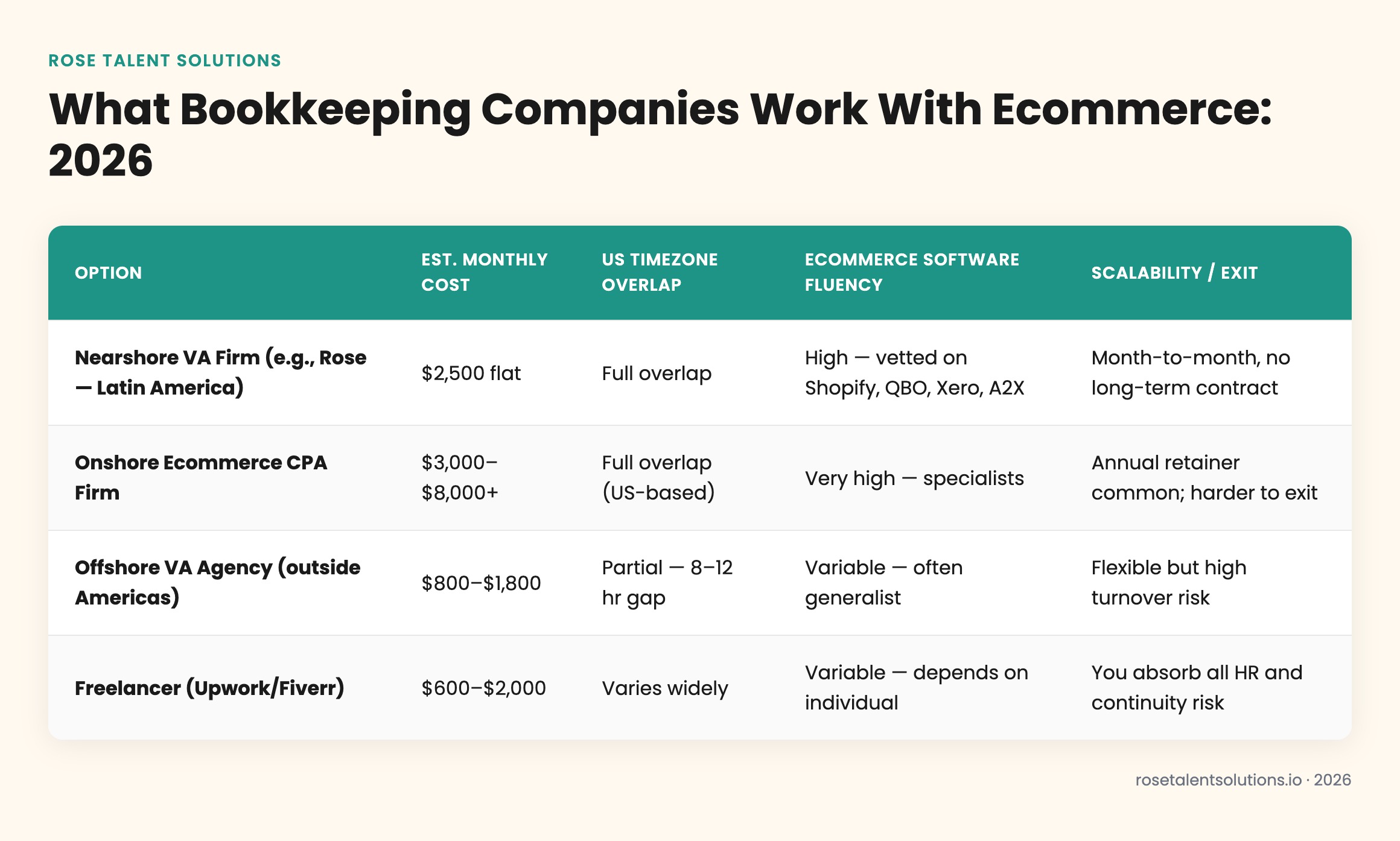
The table below compares four options across the dimensions that actually matter for an ecommerce operator: all-in monthly cost, timezone alignment with US hours, software fluency, and your ability to scale up or exit without pain.
| Option | Est. Monthly Cost | US Timezone Overlap | Ecommerce Software Fluency | Scalability / Exit |
|---|---|---|---|---|
| Nearshore VA Firm (e.g., Rose — Latin America) | $2,500 flat | Full overlap | High — vetted on Shopify, QBO, Xero, A2X | Month-to-month, no long-term contract |
| Onshore Ecommerce CPA Firm | $3,000–$8,000+ | Full overlap (US-based) | Very high — specialists | Annual retainer common; harder to exit |
| Offshore VA Agency (outside Americas) | $800–$1,800 | Partial — 8–12 hr gap | Variable — often generalist | Flexible but high turnover risk |
| Freelancer (Upwork/Fiverr) | $600–$2,000 | Varies widely | Variable — depends on individual | You absorb all HR and continuity risk |
"The biggest mistake ecommerce founders make is hiring a bookkeeper who's great with QuickBooks Desktop but has never reconciled a Shopify payout or set up A2X. The tool gap alone can take three months to bridge." — Liz Scott, Accounting Technology Advisor and Host of the Accounting Insiders Podcast (2024)
What Software Should an Ecommerce Bookkeeper Know in 2026?
This is the most practical filter you can apply when evaluating any bookkeeping company. Ask specifically about their team's proficiency with the tools in your stack. The non-negotiables for most Shopify or WooCommerce stores are QuickBooks Online or Xero for the general ledger, A2X for automated ecommerce settlement mapping, and either TaxJar or Avalara for sales tax. Amazon sellers add Seller Central reporting and sometimes InventoryLab to the mix.
Rose's AI advantage is worth understanding here. Every team member placed through Rose ships with a role-specific AI copilot trained on their assigned software stack. That means a bookkeeper placed for your Shopify + Xero business arrives with an AI assistant already tuned to Xero's reconciliation flows and Shopify's payout structure — not a generic chatbot. It cuts ramp time measurably.
If your business runs on Xero specifically, our dedicated resource on hiring a Xero virtual bookkeeper walks through exactly what skills to screen for and what a competent Xero setup looks like for ecommerce.
Don't ask a bookkeeping company "do you work with ecommerce?" — every firm will say yes. Ask instead: "Show me how your team reconciles a Shopify payout in A2X and maps it to the correct income and fee accounts in QuickBooks Online." The answer will tell you everything about their actual fluency versus their sales pitch.
According to QuickBooks / Intuit (2024), ecommerce businesses generate on average 3–5× more individual transactions per month than comparable brick-and-mortar businesses, which is why automation tools like A2X are not optional extras — they're the baseline for keeping books clean at any meaningful volume.
The growth trajectory of ecommerce itself makes this urgency clear. According to the U.S. Census Bureau (2024), US ecommerce sales exceeded $1.1 trillion in 2023 — a figure that underscores how much financial complexity is flowing through online stores that may still be running on ad hoc bookkeeping setups. The volume of transactions at even a mid-sized store now demands systematic, software-native reconciliation — not manual entry.

How Nearshore Ecommerce Bookkeepers Outperform Offshore Alternatives in 2026
The timezone argument is the one most business owners underestimate until they've lived it. When your bookkeeper operates across an 8–12 hour time gap, a simple question about a mismatched payout turns into a 24-hour back-and-forth. When your bookkeeper is in Bogotá or Mexico City, you ask at 10am and have an answer by 10:45am. That difference compounds across hundreds of interactions per month.
According to U.S. Bureau of Labor Statistics (2024), the median annual wage for a bookkeeping clerk in the United States is $47,440 — which translates to roughly $4,500/month when you include payroll taxes and benefits. A nearshore placement at $2,500/month all-in represents a direct $24,000/year saving on a like-for-like role, before you factor in recruiting fees, onboarding time, or HR overhead.
Rose's English proficiency floor of 8/10+ on standardized screens is another differentiator. Fluent written and spoken English matters in ecommerce bookkeeping because your team member will be communicating with your 3PL, your payment processor's support team, and potentially your accountant or CFO. Miscommunication on a dispute or a chargeback can cost real money.
Latin America's growing pool of finance professionals is well-documented. According to Gallup (2023), teams with high engagement and clear communication structures — characteristics far easier to maintain with same-timezone collaboration — show 21% higher profitability than disengaged equivalents. Real-time availability is not a soft perk; it's a measurable performance driver.
Nearshore Bookkeeping (Latin America)
- Full US business hours overlap — real-time collaboration
- English fluency screened at 8/10+ minimum
- Cultural alignment with US business norms
- All-in pricing covers HR, payroll, and management
- Free replacement if the team member isn't a fit
Offshore Bookkeeping (large time-zone gap)
- 8–12 hour timezone gap slows every back-and-forth
- English fluency varies — inconsistently screened
- High turnover means you restart onboarding frequently
- You often absorb HR and payroll administration yourself
- Ecommerce platform fluency frequently overstated in interviews
Ecommerce accounting outsourcing has matured significantly in the last three years. If you're evaluating the broader landscape of what functions make sense to delegate, our post on ecommerce accounting outsourcing for US businesses is a practical complement to what you're reading here — it breaks down which tasks to keep in-house versus which ones to hand off immediately.
How Rose Talent Solutions Places an Ecommerce Bookkeeper in 2026
The process is faster than most operators expect. From the intake call to your bookkeeper's first day is typically under two weeks. Here's what that looks like:
Role Scoping Call (Day 1)
Rose's team maps your ecommerce stack, transaction volume, current pain points, and the software your bookkeeper needs to be proficient in — Shopify, QuickBooks, Xero, A2X, Amazon Seller Central, or others.
Candidate Matching (Days 2–5)
Rose's recruiting team screens candidates from its Latin America talent pool against your specific requirements, including English proficiency, software fluency, and ecommerce transaction volume experience.
Your Interview (Days 5–7)
You meet your top 1–2 matched candidates. Rose handles the shortlisting — you're not reviewing 40 resumes. Most clients make a hire after a single round of interviews.
Onboarding & AI Copilot Activation (Days 7–14)
Rose handles payroll setup, HR paperwork, and activates the role-specific AI copilot for your bookkeeper. They start their first week with your software stack already loaded into their workflow assistant.
Ongoing Management
Rose manages HR, payroll, performance check-ins, and replaces your team member at no additional cost if they ever aren't a fit — you stay focused on your business.
If you're also delegating accounts payable — one of the most time-consuming ecommerce back-office tasks — our guide to outsourcing accounts payable services for ecommerce covers which AP tasks translate best to a virtual team member and what handoff documentation you need to prepare.
According to SHRM (2024), the average cost to replace an employee is 50–200% of their annual salary. For an in-house bookkeeper earning $50,000/year, that's $25,000–$100,000 per turnover event. The free replacement guarantee Rose offers isn't just a nice-to-have — it's a material financial protection.
Ready to see what a dedicated ecommerce bookkeeper would actually do for your business? You can review the full service model and start the conversation with Rose here.