
Why Personal Injury Firms Are Turning to Nearshore Virtual Paralegals in 2026
Nearshore virtual paralegals are reshaping how personal injury law firms staff their caseloads — and the economics are hard to argue with. A full-time in-house paralegal in a major US metro now costs $55,000–$75,000 per year in salary alone, before you add benefits, office space, and turnover risk. According to the U.S. Bureau of Labor Statistics (2024), the median annual wage for paralegals and legal assistants in the United States is $59,200 — and that figure climbs sharply in litigation-heavy markets like Los Angeles, New York, and Chicago.
Personal injury is one of the most paperwork-intensive practice areas in law. Every open file demands continuous follow-up: chasing medical records, coordinating with adjusters, tracking statute of limitations deadlines, and drafting demand packages that can run hundreds of pages. If your paralegals are spending half their week on administrative throughput, you are leaving billable attorney time — and contingency fees — on the table.
The solution an increasing number of PI firms are reaching for is a nearshore virtual paralegal — a full-time, dedicated team member based in Latin America who works your business hours, communicates in fluent English, and operates inside your existing case management software from day one. This post breaks down exactly what a virtual paralegal does for personal injury practices, how nearshore compares to other staffing models, and what to look for when you hire one in 2026.

What Does a Virtual Paralegal for Personal Injury Law Firms Actually Do in 2026?
A virtual paralegal in a personal injury practice is not a general virtual assistant who answers emails. The role is substantive, case-specific, and deeply integrated into your workflow. Here is what a well-trained nearshore paralegal handles day-to-day in a PI firm:
- Client intake coordination — completing intake questionnaires, pulling accident reports, and opening new matter files in your case management system (Clio, MyCase, Filevine, or similar)
- Medical record requests — sending HIPAA-compliant authorizations, tracking provider responses, and organizing records into indexed PDF packages
- Demand letter support — compiling medical specials, lost wage documentation, and lien information for attorney review; formatting demand packages to insurer specifications
- Statute of limitations calendaring — maintaining deadline trackers and sending attorney alerts well ahead of critical dates
- Insurance adjuster follow-up — logging all adjuster communications, confirming coverage, and tracking settlement offers through negotiation stages
- Lien resolution coordination — communicating with Medicare, Medicaid, and health insurer lien holders to obtain conditional payment letters
- File closure and disbursement prep — calculating settlement distributions, preparing settlement statements, and coordinating with the trust account for disbursement
If your firm also handles legal transcription for recorded client statements or deposition summaries, a legal transcription virtual assistant can be paired alongside your paralegal to handle that specific throughput — keeping your paralegal focused on case-moving tasks rather than transcription queues.
What separates a nearshore paralegal from a generic offshore hire is real-time availability. When your attorney needs a demand packet updated before a 3 p.m. adjuster call, your nearshore paralegal is online, on Slack, and delivering — not sleeping nine time zones away.
Nearshore vs. Offshore vs. In-House: How the Models Compare in 2026
Not all virtual paralegal options are equal. The three models most PI firms evaluate are: nearshore (Latin America), offshore (Philippines or India), and in-house or domestic freelance. Each has a genuinely different risk-and-cost profile — and the wrong choice for a litigation practice shows up fast.
| Criteria | Nearshore (Latin America) | Offshore (Philippines / India) | In-House / Domestic |
|---|---|---|---|
| Monthly cost (full-time) | ~$2,500 flat, all-in | $1,200–$2,000 (management not included) | $4,500–$6,500+ (salary + benefits) |
| Timezone alignment | Works US business hours natively | 8–12 hour gap; overnight batching common | Perfect alignment |
| English proficiency | 8/10+ screened floor | Varies; accent and written quality inconsistent | Native; no screen needed |
| Ramp-up speed | Fast — AI copilot trained on your software | Moderate — depends heavily on agency quality | Slow — onboarding, notice periods, training |
| Recruiting, HR, payroll included | Yes — fully managed | Sometimes; often DIY | No — your HR team handles all of it |
| Replacement if not a fit | Yes — free replacement at no extra cost | Varies by agency | Full re-hire cycle, 4–8 weeks |
| Contract commitment | Month-to-month, 30-day notice | Often 3–6 month minimums | At-will, but severance risk applies |
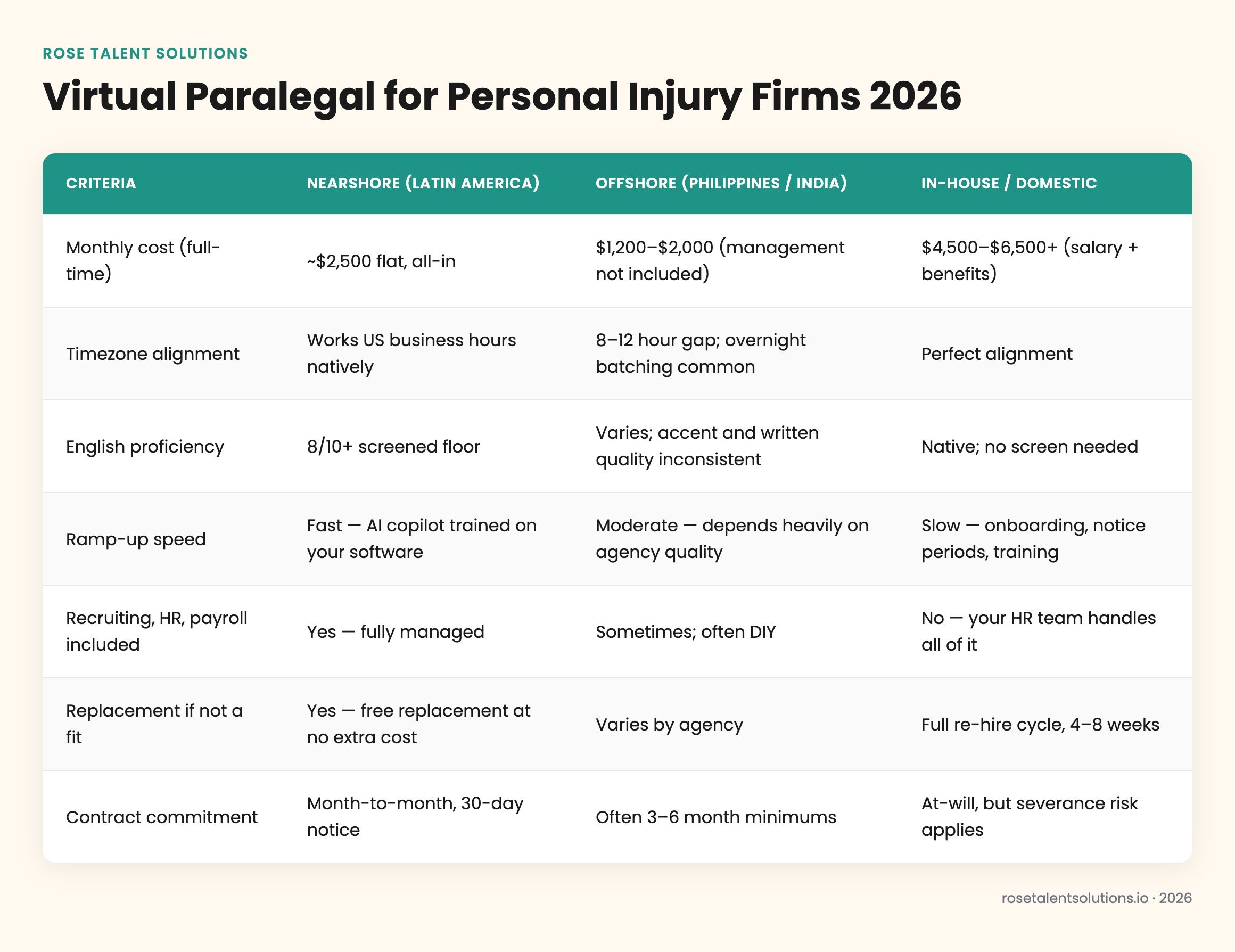
Personal injury timelines are unforgiving. Statutes of limitations, adjuster response windows, and court scheduling orders do not pause for overnight batching. Timezone alignment is not a preference — it is a case management requirement in PI practice. That is the single biggest structural advantage of the nearshore model for litigation firms specifically.
Legal staffing researchers at the American Bar Association's Legal Technology Survey (2023) consistently find that communication lag is the top complaint attorneys cite when offshore legal support arrangements fail — outranking skill gaps and software unfamiliarity combined.
For firms already exploring virtual legal staffing more broadly, understanding how to hire a virtual legal assistant for your law firm is a useful foundation — the vetting criteria, software requirements, and onboarding steps translate directly to the paralegal role.
How AI Copilots Make Nearshore Paralegals Ramp Faster in Personal Injury Cases
One of the most common objections PI attorneys raise about virtual paralegals is ramp-up time. "It'll take months to train someone on our intake process, our demand format, our software." That objection made sense in 2020. It does not hold in 2026.
Every team member placed through Rose ships with a role-specific AI copilot trained on the software stack your firm already uses — Clio, Filevine, MyCase, and similar PI-specific platforms. The copilot accelerates software navigation, surfaces procedure checklists during live tasks, and reduces the time-to-productivity curve dramatically. According to McKinsey & Company (2023), generative AI tools can reduce the time spent on legal document drafting and review tasks by up to 70% when properly configured for domain-specific workflows.
The AI copilot is not a chatbot your paralegal talks to — it is a workflow layer built into their daily task environment, trained on your specific software and your firm's document templates. It catches what new hires miss and surfaces the right procedure at the right moment in the case lifecycle.
This is especially high-value in PI because demand packages, medical chronologies, and HIPAA authorization sets follow repeatable structures. A paralegal who might spend 45 minutes assembling a demand package manually can do the same task in 20 minutes with an AI-assisted template pipeline — giving your firm more throughput from the same headcount. According to Gallup's State of the Global Workplace Report (2023), employees who have access to AI-assisted tools report 23% higher engagement and significantly faster task completion on repetitive documentation workflows.
PI firms that handle immigration crossover cases — undocumented clients injured in workplace accidents, for example — often need paralegal support that spans both practice areas. If your team already uses a virtual paralegal for immigration law work, the same nearshore staffing model applies, and in many cases one team member can be cross-trained to support both queues.
You can explore how Rose's AI advantage for virtual team members works across different software platforms — the same architecture that powers AppFolio coordinators for property managers powers Clio and Filevine users for law firms.

What Does It Cost to Hire a Virtual Paralegal for a Personal Injury Firm in 2026?
Pricing in the virtual paralegal market ranges widely depending on the model. Freelance platforms like Upwork quote hourly rates of $15–$35 for legal support, but that number excludes recruiting time, quality control, turnover replacement, and the management overhead your firm absorbs internally. According to SHRM (2023), the average cost to replace an employee is between 50% and 200% of their annual salary — a number that compounds painfully in a high-churn category like legal support staff.
Rose charges $2,500 per month, flat. That covers recruiting, vetting, payroll, HR compliance, ongoing management, and the AI copilot layer. There is no long-term contract — month-to-month terms with 30 days written notice. If the team member is not a fit for your firm, Rose replaces them at no additional cost. That is the risk reversal: free replacement if it is not working, no long-term contract locking you in.
"The firms winning on contingency volume in 2026 are the ones that figured out how to scale paralegal throughput without scaling headcount linearly. Virtual staffing is how they are doing it." — Jared Correia, Legal Technology Consultant and Host of Legal Toolkit Podcast (2024)
Compare that to the fully loaded cost of an in-house paralegal. The BLS median of $59,200 in salary, plus an estimated 30% in benefits and payroll taxes, puts the true annual cost at $77,000+ — or roughly $6,400 per month. The nearshore model at $2,500/month represents a potential savings of $3,900 per month, or nearly $47,000 annually, for a single full-time equivalent. According to Pew Research Center (2023), remote and distributed staffing arrangements are now considered a standard operational model rather than an exception — a shift that has normalized virtual paralegal engagements even among traditionally conservative law firm management committees.
Firms that also need bookkeeping support — trust account reconciliation, expense tracking, or IOLTA compliance — can layer in a nearshore bookkeeping and accounting specialist using the same staffing model, keeping financial and legal support functions under one managed relationship.
How Rose Matches and Onboards a Virtual Paralegal for Your PI Firm in 2026
The placement process is faster than most attorneys expect. Here is how it works from first contact to day one:
Intake call and role scoping
A Rose team member maps your caseload volume, software stack, and specific paralegal tasks — intake, demand drafting, records retrieval, or a mix. This call takes 30 minutes and determines candidate criteria.
Candidate matching and vetting
Rose screens for legal background, English proficiency (8/10+ floor), and software familiarity. You receive a shortlist of matched candidates within days, not weeks, along with recorded screening samples.
Interview and selection
You interview your top candidate(s) directly. Most PI firms select on the first or second interview. You make the final call — Rose handles the offer and contract.
AI copilot configuration
Before day one, Rose configures the role-specific AI copilot for your case management platform and imports your firm's document templates and standard operating procedures.
Day-one onboarding and ongoing support
Your paralegal starts on your schedule. Rose's ongoing management team monitors performance, handles HR issues, and remains accountable for quality — so you do not manage vendor relationships, you manage legal outcomes.
The full cycle from intake call to first day typically runs seven business days. Compare that to the average 36-day time-to-fill for in-house legal support roles, according to SHRM's Human Capital Benchmarking Report (2023). If you are ready to move, you can start the placement process for your firm here.
Pros and Cons of Hiring a Nearshore Virtual Paralegal for a Personal Injury Practice
Every staffing decision involves trade-offs. Here is an honest assessment of what the nearshore model delivers — and where it requires deliberate management on your part.
Pros
- Works US business hours — real-time availability for adjuster calls, attorney requests, and client follow-up
- $2,500/month all-in vs. $6,000+ for an in-house paralegal fully loaded
- 8/10+ English proficiency screen means written client communications and demand letter support are professional-grade
- AI copilot trained on your software reduces ramp-up time to days
- Free replacement guarantee eliminates the sunk cost of a bad hire
- No long-term contract — scales up or down with your caseload
- Recruiting, HR, payroll, and ongoing management all handled by Rose
Cons
- Cannot physically appear in court or notarize documents — in-person tasks still require local staff
- Initial SOP documentation requires effort from your team — the better your procedures are written, the faster the ramp
- Some state bar rules require supervision of paralegal work — you must ensure your supervising attorney is available for review
- Client-facing phone calls require clear communication protocols — accent coaching is available but not always needed
For family law firms evaluating the same model, the trade-offs look nearly identical — if you want a benchmark comparison from a different practice area, the breakdown of virtual paralegals for family law firms covers the same hiring criteria with family-court-specific context.
Personal injury firms with high settlement volume and lean attorney-to-paralegal ratios tend to see the fastest ROI. If your attorneys are doing tasks that a trained paralegal should own — medical records follow-up, adjuster status calls, demand assembly — the capacity unlocked by a dedicated virtual paralegal often translates directly to more cases closed per quarter. The U.S. Department of Labor notes that misclassification and improper staffing structures are among the top compliance risks for law firms adding remote workers — a managed staffing arrangement like Rose's, where payroll and HR compliance are handled for you, eliminates that exposure entirely.
Explore the full range of Rose's staffing specializations to see how the same managed model applies across industries — the legal vertical uses the same placement infrastructure that serves property management, accounting, and operations teams.