
Nearshore legal transcription virtual assistants are quietly becoming one of the highest-leverage hires a law firm can make in 2026. Instead of routing deposition recordings and attorney dictation through a slow domestic transcription service—or dumping the work on a paralegal who should be doing higher-value tasks—you hire one dedicated, fluent, full-time team member based in Latin America who works your hours, knows your software, and turns audio into formatted, court-ready documents the same day. The math is hard to argue with: a full-time nearshore VA at a flat $2,500/month versus a US-based legal transcriptionist at $25–$45 per hour.
This guide breaks down exactly what a legal transcription VA does, how to evaluate your options, what separates nearshore from offshore for legal work, and how to get one placed without friction. If you've already been exploring broader ways to hire a virtual legal assistant for your law firm, transcription is often the fastest ROI to unlock first—because the output is measurable and the time savings are immediate.
What Does a Legal Transcription Virtual Assistant Actually Do in 2026?
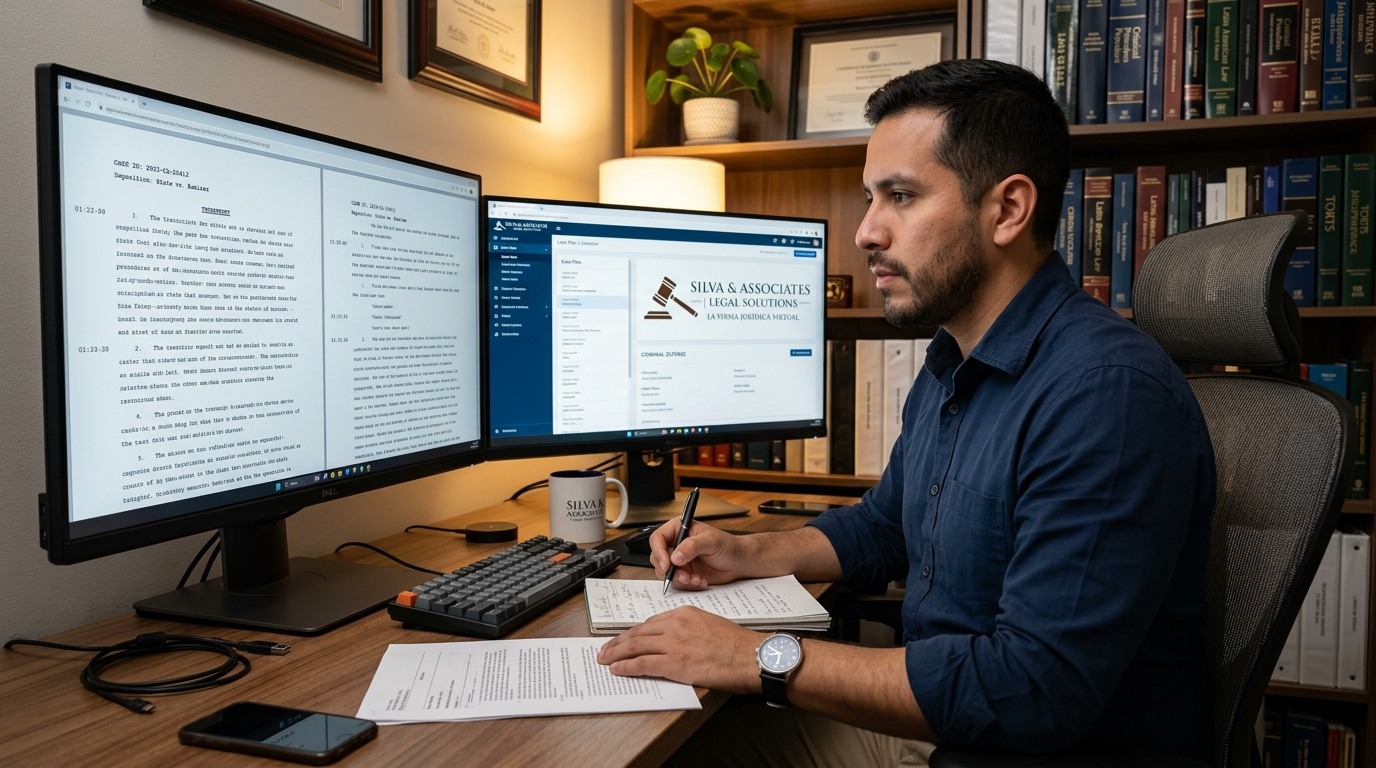
A legal transcription virtual assistant converts spoken audio into accurate written text across every format a law firm produces. That includes attorney dictation (notes, memos, demand letters), deposition recordings, client intake call recordings, court hearing audio, arbitration sessions, and internal team meeting summaries. Beyond raw transcription, a trained VA formats output into firm-standard templates, flags unclear audio timestamps for attorney review, and uploads finalized documents into your case management system.
The role has expanded significantly in 2026 because AI transcription tools—Otter.ai, Whisper, Descript—generate rough transcripts quickly but still produce errors that are unacceptable in legal documents. A skilled VA acts as the quality control layer: reviewing AI-generated output, correcting legal terminology, cleaning up speaker labels in multi-party depositions, and ensuring everything is formatted to jurisdiction-specific standards before it touches a file. The VA doesn't replace AI transcription tools—she makes them production-ready.
At Rose Talent Solutions, every transcription VA ships with a role-specific AI copilot trained on the tools your firm already uses—whether that's Clio, MyCase, PracticePanther, or a custom document management system. That means faster ramp time and fewer errors from day one.
How Nearshore Compares to Offshore and Onshore for Legal Transcription in 2026
Not all remote transcription support is equal, and for legal work the differences are material. Offshore VAs based in the Philippines or India often bring strong general transcription skills, but the 10–14 hour timezone gap means your Monday morning deposition recording doesn't get back to you until Tuesday. For litigation timelines, that gap creates real risk. Onshore US transcriptionists solve the timezone problem but cost three to four times more and rarely offer full-time dedicated support at a predictable flat rate.
Nearshore VAs based in Latin America sit in US-compatible timezones (EST to PST, depending on country), which means they attend your 9am Zoom, pick up your Slack messages in real time, and deliver transcripts within the same business day. English fluency is also materially different: Rose screens all candidates to an 8/10+ English proficiency floor, prioritizing candidates with legal vocabulary exposure. The result is fewer corrections, faster turnaround, and a team member who can actually sit in on a client call without an accent creating friction.
"Timezone alignment is the single most underrated factor in remote legal support. A one-day lag on document turnaround doesn't sound like much until you're on a filing deadline." — Brett Trembly, Co-Founder at Get Staffed Up (2024)
| Factor | Onshore (US) | Nearshore (Latin America) | Offshore (Philippines/India) |
|---|---|---|---|
| Monthly cost (full-time) | $6,000–$9,000+ | $2,500 flat | $1,200–$1,800 |
| Timezone overlap with US firms | Full (same TZ) | Full (US hours matched) | Minimal (10–14 hr gap) |
| English fluency for legal terminology | Native | High (8/10+ screened) | Variable (4–7/10 typical) |
| Same-day transcript turnaround | Yes | Yes | Rarely |
| Dedicated full-time (not shared) | Typically yes | Yes (Rose model) | Often shared/pooled |
| Long-term contract required | Often yes | No long-term contract (Rose) | Often 6–12 month commitments |
| HR, payroll, management included | Your cost | Yes (fully managed) | Varies |
How a Legal Transcription VA Integrates With Your Firm's Existing Workflow
One of the most common hesitations attorneys raise is workflow disruption: "How do I hand off audio files securely? How does the VA know our formatting standards? What happens when she encounters an unclear recording?" These are fair questions, and the answer is that a good nearshore VA is set up to slot into your existing systems, not to replace them.
Here's the typical integration sequence for a Rose transcription VA placement:
Audio Handoff Setup
Your VA gets access to your secure file-sharing or dictation platform (Dragon, Otter, a shared Dropbox, or a client portal in Clio). A simple naming convention and folder structure is agreed upon in the first week so nothing gets misrouted.
Template and Style Training
Your VA learns your firm's document templates—margins, fonts, caption formats, exhibit labeling, speaker identification conventions—during the onboarding week. Rose's AI copilot accelerates this by pre-loading common legal document structures.
Quality Review Loop
Completed transcripts are returned with timestamps flagging any inaudible sections. Your attorney or paralegal reviews flagged sections only—not the entire document—cutting review time by roughly 70% versus self-transcribing.
Case Management Upload
The VA uploads finalized documents directly into Clio, MyCase, or PracticePanther with correct matter numbers, document type tags, and billing notes if applicable. No paralegal time consumed.
Ongoing Refinement
After the first 30 days, most firms find their VA has internalized firm-specific terminology and attorney speech patterns well enough to produce near-zero-correction transcripts on routine matter types.
Legal transcription is rarely a standalone function. The same VA who handles your transcription can also support client intake processes the way a virtual paralegal would—collecting documents, sending retainer agreements, and logging matter details—so you're getting leverage across the full administrative pipeline, not just one task.
According to the U.S. Bureau of Labor Statistics (2024), paralegals and legal assistants earn a median annual wage of $60,400 in the US—roughly $5,000 per month for a single team member, before benefits, payroll taxes, or overhead. A nearshore transcription VA at $2,500/month covers 40 dedicated hours per week for less than half that cost, with recruiting, HR, and ongoing management handled for you.

What Skills Should You Screen for in a Legal Transcription VA in 2026?
Not every VA who lists "transcription" on a resume is prepared for the specific demands of legal transcription. The error tolerance in legal documents is essentially zero—a misheard word in a deposition can alter testimony meaning, and a formatting error in a court filing can trigger rejection. Here's what actually matters when evaluating candidates.
Legal vocabulary depth is the starting point. Your VA should know the difference between a complaint and a petition, understand standard deposition format, and recognize common Latin legal terms without needing to Google them. Ask candidates to transcribe a 2-minute sample deposition clip as part of vetting—errors in legal terminology are disqualifying.
Typing speed and accuracy matter more than most hiring managers test. A minimum of 70 words per minute with 98%+ accuracy is a reasonable floor for legal transcription work. Below that, turnaround times become a bottleneck, especially on multi-hour depositions.
Confidentiality awareness is non-negotiable. Your VA will handle privileged attorney-client communications. She should understand basic confidentiality obligations, be willing to sign an NDA, and operate in a secure home environment. Rose's vetting process includes background screening and confidentiality agreement execution before any placement goes live.
According to SHRM's benchmarking research (2023), the average cost of a bad hire is 50–60% of that employee's annual salary. In legal, a bad transcription hire costs more than money—it costs accuracy, privileged document integrity, and potentially client trust. Vetting rigorously upfront eliminates that risk. If you're weighing the broader tradeoffs, the comparison between a law firm virtual assistant and in-house staff covers the full cost picture in depth.
The most expensive transcription mistake isn't a missed word—it's a missed deadline. A nearshore VA working your exact business hours eliminates the overnight lag that turns a same-day request into a next-morning scramble, which is where filing deadlines get missed and malpractice exposure starts.
How Rose Talent Solutions Handles Legal Transcription VA Placement in 2026
Rose Talent Solutions is a nearshore staffing agency purpose-built for US, Canadian, and UK businesses that need dedicated, full-time remote team members from Latin America. The model is straightforward: one flat monthly rate of $2,500 covers recruiting, vetting, placement, payroll processing, HR compliance, and ongoing performance management. There's no long-term contract, and if the team member isn't a fit, Rose replaces them at no additional cost.
For law firms specifically, Rose sources candidates with prior legal administrative experience—not general VA backgrounds. Candidates go through English proficiency screening (8/10+ floor), a legal vocabulary assessment, a live transcription skills test, and a confidentiality orientation before they're presented to a firm. The average time from intake call to first placement is seven days.
Every legal transcription VA placed by Rose ships with an AI copilot trained on the firm's specific software stack. If your firm runs Clio Manage, the VA arrives knowing Clio's document upload conventions, matter number formats, and task assignment workflow. If you use Dragon for dictation, the VA is already familiar with Dragon audio file formats and playback conventions. This is part of the AI advantage Rose builds into every placement—not a generic VA who needs three weeks to learn your tools.
Law firms that also need front-of-house support alongside transcription often combine a transcription VA with a law firm virtual receptionist to handle inbound calls and intake—two distinct roles, both at $2,500/month, covering the full administrative surface area of a growing practice for less than the cost of one junior associate.
According to Gallup's State of the Global Workplace report (2023), employees who feel their strengths are used daily are 6× more likely to be engaged at work. Dedicating a VA exclusively to transcription and legal document support—rather than asking a paralegal to split attention—produces measurably better output and a more engaged team member. That's not a soft benefit; it shows up in turnaround time and error rates within the first 60 days.
Why Nearshore Legal Transcription VAs Work
- Same-day turnaround because they work your exact business hours
- 8/10+ English proficiency means legal vocabulary accuracy, not just fluency
- Flat $2,500/month is predictable—no per-page or per-hour billing surprises
- AI copilot pre-loaded on Clio, MyCase, or your dictation tool from day one
- Free replacement if the fit isn't right—zero placement risk
What to Plan For
- First-week onboarding investment: sharing templates, naming conventions, access credentials
- NDA and confidentiality agreements need to be executed before work begins
- Multi-speaker depositions with heavy crosstalk may require a brief style guide upfront
If you're ready to get a legal transcription VA placed, the fastest path is to start the intake process here—most firms have a candidate presented within a week of that first call.