
Nearshore virtual paralegals are quietly reshaping how family law firms operate in 2026. While the average in-office paralegal in the United States now costs $65,000–$80,000 per year in salary alone — before benefits, payroll taxes, and office overhead — Latin America-based virtual paralegals deliver the same document prep, client communication, and deadline tracking at a fraction of that cost, working your exact business hours without the timezone headache that plagues offshore hiring. If you run a family law practice and you're still paying for a full W-2 paralegal seat, this post will show you exactly what you're leaving on the table.
According to the Clio Legal Trends Report (2023), 68% of small law firms cite administrative overhead as their single biggest profitability barrier. Family law is especially hard-hit: divorce filings, custody modifications, asset discovery, and protective order paperwork are relentlessly document-heavy. Every hour an attorney spends chasing a missing financial affidavit is an hour not billed. A virtual paralegal absorbs that work — and when that paralegal is nearshore, they're on your Slack by 8:00 AM Eastern, not sending you a status update at midnight.
What Is a Virtual Paralegal for Family Law, Exactly?
A virtual paralegal is a credentialed or trained legal support professional who works remotely rather than in your physical office. In the family law context, their core responsibilities span drafting petitions for dissolution of marriage, preparing financial disclosure statements, organizing discovery documents, managing court deadline calendars, coordinating with opposing counsel's office, and handling initial client intake. They are not attorneys and do not provide legal advice — but they handle the procedural and administrative scaffolding that keeps cases moving.
The "nearshore" modifier matters. Nearshore means Latin America — countries like Colombia, Mexico, Costa Rica, and Argentina — where professionals work in overlapping US time zones (ET, CT, MT, PT), are immersed in American business culture, and are screened to an 8/10 or higher English proficiency standard. That is a fundamentally different hire than an offshore VA based in the Philippines or India, where a 10–13 hour time difference turns every quick question into a next-day email thread. If you want to understand the full scope of what remote legal support can look like before going deep on paralegals specifically, our guide on how to hire a virtual legal assistant for your law firm is a good starting point.
How a Nearshore Virtual Paralegal Outperforms Offshore in 2026
Time zone alignment is not a soft benefit — it is a hard operational requirement in family law. Emergency protective orders, last-minute continuance requests, and same-day client crises are a routine part of the practice area. When a client calls at 2:00 PM on a Tuesday because a hearing date just moved, you need a paralegal who can pull the file, draft the motion, and get it to you for signature within the hour — not one who is asleep on the other side of the world. Nearshore virtual paralegals work your business hours, full stop.

English fluency is the second axis. Rose Talent Solutions screens every candidate at an 8/10 or higher on English proficiency, which means your paralegal can draft a professionally worded letter to opposing counsel, handle a sensitive phone intake with a distressed client, and annotate a financial disclosure without you having to rewrite their work. The U.S. Bureau of Labor Statistics (2024) projects paralegal employment to grow 14% through 2032 — faster than average — meaning competition for domestic talent is only intensifying. Nearshore hiring sidesteps that supply crunch entirely.
It's also worth distinguishing the virtual paralegal role from adjacent positions before you hire. The decision between a virtual legal secretary versus a paralegal depends entirely on the complexity of work you need covered — secretaries handle scheduling and correspondence; paralegals own substantive legal document work. If your bottleneck is court filings and case prep, you want a paralegal, not a secretary.
Nearshore vs. Offshore vs. Onshore: How the Options Compare in 2026
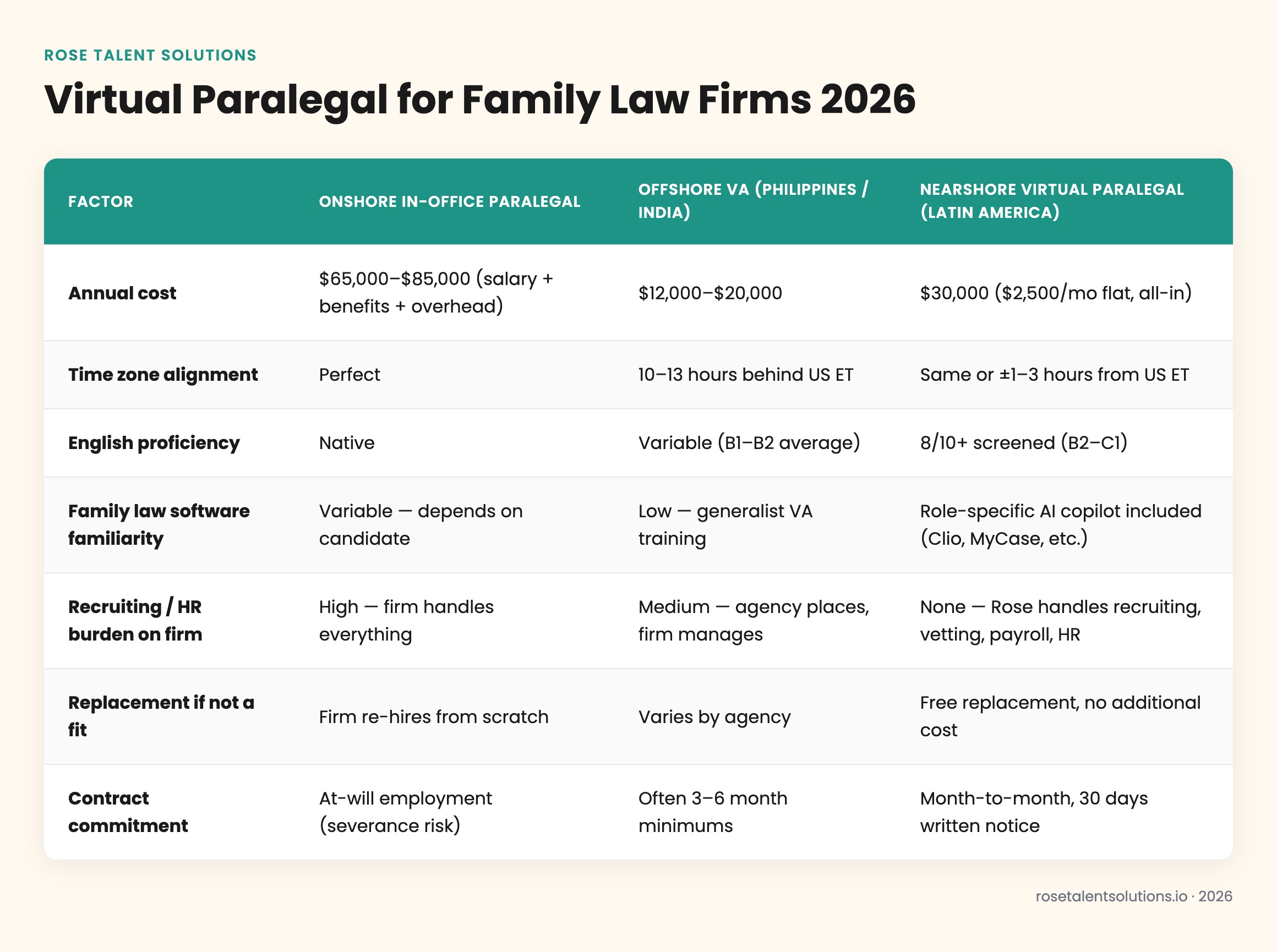
The table below cuts through the marketing noise and puts the three main virtual paralegal options side by side on the dimensions that actually matter for a family law practice.
| Factor | Onshore In-Office Paralegal | Offshore VA (Philippines / India) | Nearshore Virtual Paralegal (Latin America) |
|---|---|---|---|
| Annual cost | $65,000–$85,000 (salary + benefits + overhead) | $12,000–$20,000 | $30,000 ($2,500/mo flat, all-in) |
| Time zone alignment | Perfect | 10–13 hours behind US ET | Same or ±1–3 hours from US ET |
| English proficiency | Native | Variable (B1–B2 average) | 8/10+ screened (B2–C1) |
| Family law software familiarity | Variable — depends on candidate | Low — generalist VA training | Role-specific AI copilot included (Clio, MyCase, etc.) |
| Recruiting / HR burden on firm | High — firm handles everything | Medium — agency places, firm manages | None — Rose handles recruiting, vetting, payroll, HR |
| Replacement if not a fit | Firm re-hires from scratch | Varies by agency | Free replacement, no additional cost |
| Contract commitment | At-will employment (severance risk) | Often 3–6 month minimums | Month-to-month, 30 days written notice |
What Tasks Can a Virtual Paralegal Handle for Family Law in 2026?
Family law generates more recurring document types than almost any other practice area. Here is what a well-trained nearshore virtual paralegal can own from day one, without attorney hand-holding:
- Divorce and separation filings — Draft petitions for dissolution, responses, and supporting affidavits using your state's standard forms.
- Financial disclosure preparation — Organize bank statements, tax returns, and asset inventories into the disclosure format required by your jurisdiction.
- Child custody documentation — Prepare parenting plan drafts, modification petitions, and guardian ad litem coordination correspondence.
- Court deadline management — Maintain a master calendar in Clio or MyCase, flag upcoming deadlines 14 and 7 days in advance, and confirm filings.
- Client intake and onboarding — Run the initial intake call script, collect required documents, open the client file, and send engagement letters for attorney review.
- Discovery support — Draft interrogatories, organize production responses, and maintain the discovery log.
- Correspondence drafting — Write letters to opposing counsel, court clerks, and third-party agencies (banks, employers, pension administrators).
- Billing and time entry support — Log attorney time entries, prepare pre-bills, and flag missing time narratives before billing runs.
Every Rose virtual paralegal also ships with a role-specific AI copilot trained on the software your firm already uses — Clio, MyCase, PracticePanther, or whatever your case management platform is. This is not a generic ChatGPT wrapper. It is a purpose-built assistant that helps your paralegal draft documents faster, surface relevant case precedents, and catch missing fields in court forms. You can see how this works across all roles on our AI advantage page.
The hidden cost of an unvetted VA isn't the hourly rate — it's the attorney time spent fixing their work. A nearshore paralegal screened for legal document accuracy and English fluency at 8/10+ pays for itself the first time it stops a botched filing from hitting your client's docket.
How the Rose Talent Matching Process Works for Family Law Firms
Scoping Call
You walk Rose through your firm's practice areas, volume, software stack, and the specific tasks you need covered. This call takes 20–30 minutes and defines the candidate profile.
Candidate Matching
Rose surfaces 1–3 pre-vetted nearshore paralegals from its Latin America talent pool who have family law document experience and pass the 8/10+ English screen. You review profiles and interview your top choice.
Placement and Onboarding
Your paralegal starts within days, not weeks. Rose handles the employment contract, payroll, and HR compliance — you just add them to your Clio workspace and your Slack channel.
Ongoing Management Support
Rose stays involved post-placement. If the fit isn't right for any reason, the replacement is at no additional cost — no re-recruiting fee, no gap in coverage.
The flat $2,500/month covers everything: recruiting, vetting, payroll, HR, and ongoing management. There is no long-term contract — the arrangement is month-to-month with 30 days written notice if you ever need to exit. Ready to scope your first paralegal? Start the process here.

How Much Does a Virtual Paralegal for Family Law Cost in 2026?
The fully-loaded cost of a domestic W-2 paralegal — salary, employer payroll taxes (7.65% FICA), health insurance, PTO, and a share of office overhead — lands most family law firms in the $85,000–$110,000 per year range for a single mid-level hire, according to compensation data published by SHRM (2024). That math hits differently when you compare it to a $30,000 annual spend ($2,500/month) for a nearshore virtual paralegal who works 40 hours a week, needs zero office space, and carries no benefits liability on your firm's books.
Employee disengagement adds another layer of hidden cost to domestic hires. According to Gallup's Workplace Report (2023), disengaged employees cost US businesses an average of $3,400 per $10,000 in annual salary — a drag that nearshore contractors, vetted through a competitive selection process, consistently sidestep. Remote work adoption has also accelerated the viability of virtual legal teams: the McKinsey Global Institute (2023) found that legal and paralegal support roles rank among the highest in remote-work feasibility across all professional services sectors, given that the core work product — documents, research, and calendar management — is entirely digital.
When you also consider that many small family law firms handle transcription and audio-to-document work alongside standard paralegal tasks, it's worth knowing that your virtual paralegal can often handle basic transcript review — or you can layer in a dedicated legal transcription virtual assistant for high-volume deposition and hearing transcript work.
Some firms find that before they're ready for a full paralegal, getting their phones and intake covered is the first bottleneck to fix. Our overview of law firm virtual receptionist services walks through how that layer complements a paralegal hire — you do not have to choose between them.
Pros and Cons of Hiring a Virtual Paralegal for Your Family Law Firm
Pros
- Saves $50,000–$75,000 per year versus a domestic W-2 paralegal hire
- Works US business hours with real-time availability — no overnight batching
- Screened for English fluency (8/10+) and family law document familiarity
- AI copilot trained on Clio, MyCase, or your platform ships with the hire
- Month-to-month terms — no long-term contract exposure
- Free replacement if the fit isn't right — zero re-recruiting cost
- No office space, equipment, or benefits overhead
Cons
- Not physically present — requires clear digital workflows and SOPs
- Some state bar rules on paralegal supervision apply regardless of work location — confirm your jurisdiction's requirements
- Onboarding still requires 1–2 weeks of attorney time to transfer institutional knowledge
- Not a substitute for a licensed attorney — substantive legal advice stays with you
The supervision point deserves a direct note: every US state bar has rules governing paralegal supervision, and those rules apply to virtual paralegals exactly as they do to in-office staff. Your virtual paralegal works under your direction — Rose does not provide legal supervision. What Rose does provide is a vetted professional who understands that boundary and operates within it. The American Bar Association's paralegal resources (2024) confirm that remote paralegal arrangements are fully consistent with ABA model guidelines on supervision, provided the attorney maintains direct oversight of all substantive work product. If your firm also handles a volume of bookkeeping-adjacent tasks — client trust accounting, IOLTA reconciliation, billing — our bookkeeping and accounting VA services can cover that lane separately so your paralegal stays focused on legal work.
"Remote legal professionals — when properly screened and supervised — perform at parity with in-office paralegals on document accuracy and deadline adherence, with significantly lower total cost to the firm." — Niki Black, Legal Technology Evangelist at MyCase (2024)
The bottom line for family law firms in 2026: the question is no longer whether a virtual paralegal can do the work. The question is whether you want to keep paying a W-2 premium for a seat that doesn't need to be in your building. The math, the time zone alignment, and the AI-augmented toolset have all moved decisively in the nearshore direction. See how the placement process works and get a nearshore virtual paralegal scoped for your practice.