
Nearshore virtual paralegals are quietly transforming how immigration law firms operate in 2026. While your in-house team drowns in I-485 packets, RFE responses, and client status calls, a nearshore paralegal based in Latin America — working your exact business hours, in fluent English — can absorb that volume starting in under two weeks. Immigration caseloads are rising fast: USCIS reported over 3.7 million pending cases in its immigration court backlog as of late 2024, and that pressure lands directly on paralegal desks.
If you've looked at hiring a full-time in-house paralegal recently, you already know the pain. Salary, benefits, payroll taxes, and onboarding overhead can push the true annual cost past $75,000 — for a single mid-level hire, according to the U.S. Bureau of Labor Statistics (BLS) (2024). A nearshore virtual paralegal through Rose Talent Solutions costs $2,500 per month flat — that's $30,000 per year, all-in, including recruiting, vetting, payroll, HR, and ongoing management.
What Is a Virtual Paralegal for Immigration Law Firms?
A virtual paralegal for immigration law firms is a trained legal support professional who works remotely — handling the same case-load tasks as an in-house paralegal, but without the physical desk, benefits overhead, or geographic hiring constraints. In the immigration context specifically, that means managing USCIS form preparation, organizing supporting documentation, tracking petition deadlines, drafting cover letters, and coordinating client follow-ups across active case queues.
A nearshore virtual paralegal narrows that definition further: this is a paralegal based in Latin America who works US business hours (EST, CST, PST — your choice), communicates in fluent English at a level Rose screens at 8/10 or above, and operates inside a timezone that's 0–2 hours off New York. That's meaningfully different from offshore outsourcing to the Philippines or India, where a 10–12 hour gap means your paralegal is answering your 3pm Slack message at 3am their time — which isn't sustainable and slows down urgent immigration filings. For a deeper look at how virtual legal roles compare by scope, the breakdown between a virtual legal secretary and a virtual paralegal is worth reading before you decide which role you actually need.

What Immigration Tasks Can a Virtual Paralegal Handle in 2026?
The short answer: most of what your current in-house paralegal does. Immigration law is document-intensive and process-driven — which makes it particularly well-suited to remote delegation. A well-trained virtual paralegal can handle the following workstreams from day one:
- Case intake and client onboarding — collecting identity documents, employment records, and prior immigration history; entering data into your case management system (Clio, MyCase, LollyLaw, or similar)
- Form preparation — drafting I-130, I-485, I-765, I-131, I-140, DS-260, and N-400 packets; flagging incomplete fields for attorney review
- USCIS deadline and receipt tracking — monitoring NOA1/NOA2 timelines, biometrics scheduling, RFE response windows, and priority dates via the Visa Bulletin
- RFE drafting support — compiling supporting evidence, writing initial draft responses for attorney sign-off
- Client status updates — proactively communicating case milestones so attorneys aren't fielding "where is my case?" calls all day
- Document management — organizing client files in SharePoint, Google Drive, or NetDocuments; maintaining chain-of-custody logs
- Billing support — entering time entries, generating invoices, following up on outstanding balances
Every Rose Talent team member ships with a role-specific AI copilot trained on the software your firm already uses — whether that's Clio, LollyLaw, or another immigration-focused practice management platform. That means your new paralegal isn't learning your tools from scratch during week one.
"The paralegal shortage is real and it's getting worse — firms that don't adapt their staffing model will simply lose cases to firms that do." — Allison Johs, Practice Management Advisor at the American Bar Association Law Practice Division (2024)
Nearshore vs. Offshore vs. In-House: Which Is Right for Immigration Firms in 2026?
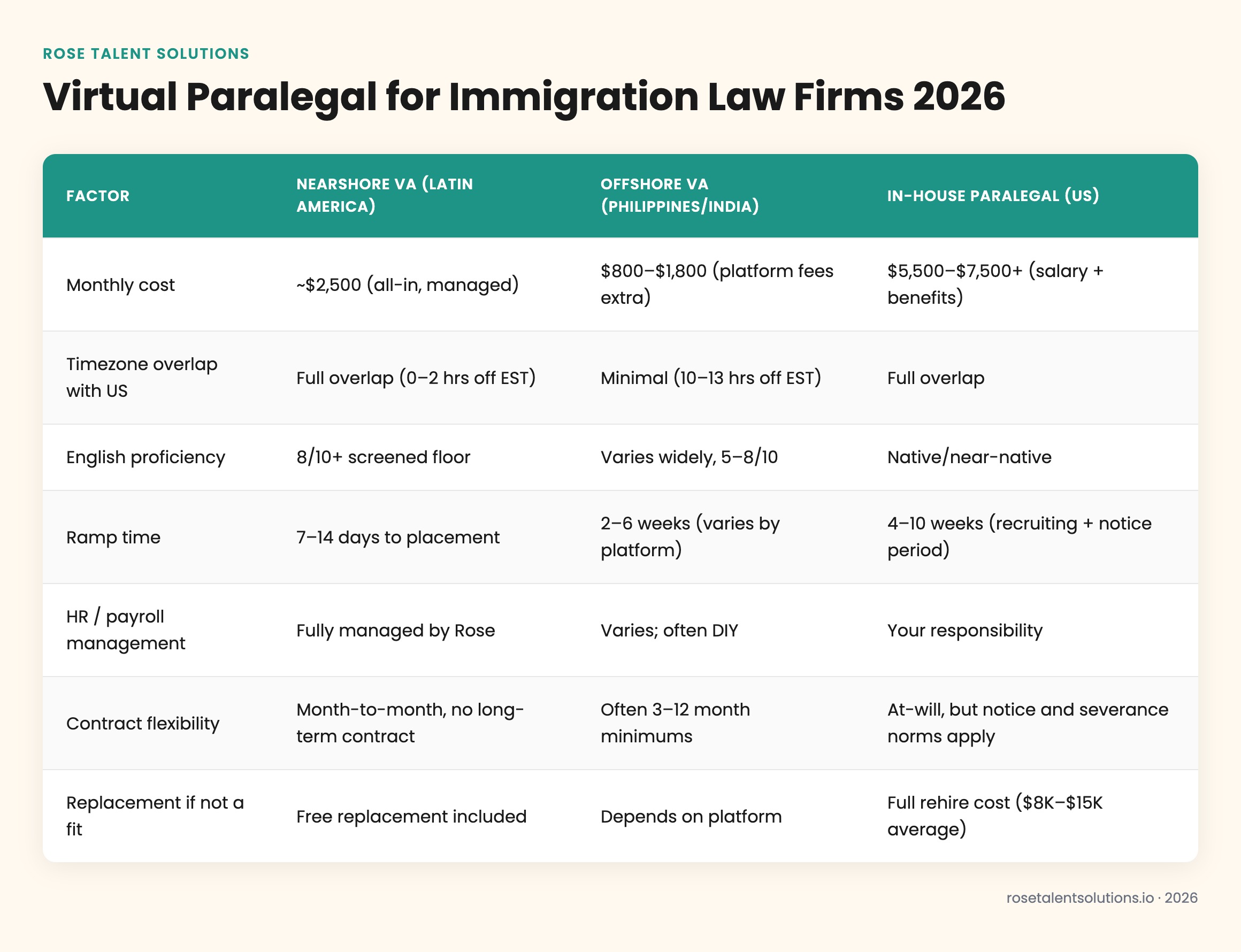
The staffing decision comes down to three variables immigration firms consistently cite: cost, communication quality, and real-time availability. The table below maps each option honestly across those dimensions. If you've ever read about what it actually takes to hire a virtual legal assistant for your law firm, you'll recognize why nearshore consistently wins on the communication axis.
| Factor | Nearshore VA (Latin America) | Offshore VA (Philippines/India) | In-House Paralegal (US) |
|---|---|---|---|
| Monthly cost | ~$2,500 (all-in, managed) | $800–$1,800 (platform fees extra) | $5,500–$7,500+ (salary + benefits) |
| Timezone overlap with US | Full overlap (0–2 hrs off EST) | Minimal (10–13 hrs off EST) | Full overlap |
| English proficiency | 8/10+ screened floor | Varies widely, 5–8/10 | Native/near-native |
| Ramp time | 7–14 days to placement | 2–6 weeks (varies by platform) | 4–10 weeks (recruiting + notice period) |
| HR / payroll management | Fully managed by Rose | Varies; often DIY | Your responsibility |
| Contract flexibility | Month-to-month, no long-term contract | Often 3–12 month minimums | At-will, but notice and severance norms apply |
| Replacement if not a fit | Free replacement included | Depends on platform | Full rehire cost ($8K–$15K average) |
How Rose Talent Places a Virtual Paralegal at Your Immigration Firm
The placement process is faster than most immigration attorneys expect. Rose handles every step — you never post a job, review 80 resumes, or coordinate a background check. According to SHRM's Human Capital Benchmarking Report (2024), the average time-to-fill for a paralegal role in the US is 36 days. Rose's median is under 14.
Intake call (30 min)
You describe your caseload, software stack, and communication style. Rose maps those requirements to candidates already in the talent pool.
Candidate shortlist (3–5 days)
Rose surfaces 2–3 pre-vetted candidates who've passed English proficiency, legal background, and software skills screens. You interview only the finalists.
Match confirmation (1 day)
You select your paralegal. Rose handles the offer, onboarding paperwork, payroll setup, and equipment check — nothing touches your HR department.
First week integration
Your paralegal joins your Slack/Teams, gets logins to Clio or LollyLaw, and begins live cases under your supervising attorney's direction by day three.
Ongoing management
Rose manages HR, payroll, performance check-ins, and any issues. If the fit isn't right, Rose replaces the team member at no additional cost.
This model works especially well for solo immigration attorneys and boutique firms (2–10 attorneys) who need paralegal-level support but can't justify a full-time in-house hire. Starting the process takes about 30 minutes — the intake call is where most firms realize they can cover two paralegal functions (intake + deadline tracking) for the price of one.

How AI-Augmented Virtual Paralegals Handle Immigration Caseload Surges in 2026
The AI component is not a chatbot bolted onto a job posting. Every Rose team member is equipped with a role-specific AI copilot trained on the software and workflows relevant to their placement. For immigration paralegals, that means the AI assists with form pre-population, deadline calculation, and document checklist generation — tasks that eat hours of manual time on high-volume caseloads.
This matters more than ever in 2026. McKinsey's report on the economic potential of generative AI (2023) found that legal functions — including document review and drafting support — represent one of the highest-value AI automation opportunities across professional services. A virtual paralegal who is already fluent in AI-assisted workflows doesn't just save you money; they process more cases per day than an equivalent unaugmented hire.
Immigration firms that combine nearshore paralegal support with AI-assisted form prep report handling 30–40% more petitions per attorney per month — without adding to their in-house headcount. The leverage isn't just cost reduction; it's throughput expansion at a fixed monthly rate.
If your firm also handles transcription of client interviews, asylum testimony, or USCIS hearing recordings, a dedicated legal transcription virtual assistant can be layered alongside your paralegal — or the same team member can be scoped to handle both functions depending on volume. For immigration firms managing family-based petitions alongside removal defense, the overlap with virtual paralegal support for family law practices is also worth reviewing, since many of the intake and document management workflows are nearly identical.
According to Gallup's State of the Global Workplace report (2024), remote workers who operate within the same timezone as their managers report 23% higher engagement scores than those spanning 8+ hour gaps. For an immigration firm where deadline sensitivity is non-negotiable, real-time engagement isn't a soft benefit — it's a compliance risk management tool.
Is a Nearshore Virtual Paralegal Right for Your Immigration Firm?
This model fits best when at least one of the following is true for your practice: your attorneys are spending more than 30% of their time on paralegal-level tasks; you have a growing caseload but can't justify a full-time in-house hire yet; you've tried offshore staffing and lost time to timezone gaps or communication friction; or your current paralegal is at capacity and you need overflow support without a second full-time salary.
Nearshore Virtual Paralegal — Best Fit
- Immigration boutiques (1–15 attorneys) with recurring petition volume
- Firms already using Clio, LollyLaw, or MyCase who want a fast ramp
- Solo attorneys handling both family and employment-based immigration
- Practices that need full-time hours at a part-time budget
- Firms burned by offshore timezone gaps who need real-time availability
Might Not Be the Right Fit
- Firms requiring in-person court appearances or notarization (virtual paralegals are remote-only)
- Practices needing a licensed attorney — a paralegal cannot provide legal advice
- Firms with no existing practice management software (some onboarding friction without it)
The pricing is straightforward: $2,500 per month, flat. That covers a full-time (40 hours/week) dedicated team member, all recruiting and vetting costs, payroll processing, HR management, and ongoing performance oversight by Rose. There's no long-term contract — you continue month-to-month and can cancel with 30 days written notice. If your paralegal isn't the right fit for your firm, Rose replaces them at no additional cost. That's the only risk reversal, and it's the right one to offer in a trust-sensitive professional services context.
To see how this fits inside a broader legal staffing strategy — including when to hire a paralegal versus a broader legal assistant — the guide on hiring a virtual legal assistant for your law firm covers the role distinction in depth. And if you're ready to move forward, starting the placement process takes about 30 minutes.