
Nearshore virtual legal secretaries are reshaping how lean law firms operate in 2026 — and the biggest mistake solo attorneys and small firm partners make is confusing this role with a paralegal. The two are not interchangeable. Hiring the wrong one costs you money, creates compliance exposure, and buries your highest-value staff in tasks they were never meant to do. This guide draws a hard line between the two roles, shows you exactly where each fits in a modern law firm, and explains why a nearshore legal VA — based in Latin America, working your business hours — is often the faster, more affordable path to operational leverage.
What Is a Virtual Legal Secretary in 2026?
A virtual legal secretary is a remote administrative professional who supports attorneys with non-substantive legal tasks. The word "non-substantive" matters: a legal secretary does not practice law, offer legal opinions, or independently prepare legal strategy. Instead, they manage the operational infrastructure that keeps a law firm running — calendar management, client correspondence, document formatting, court deadline tracking, billing entry, and intake coordination.
What makes the "virtual" version different from a traditional in-house secretary is location and cost structure. A virtual legal secretary works remotely, typically full-time, for a flat monthly fee rather than a salary-plus-benefits package. For firms exploring this model, hiring a virtual legal assistant for your law firm is often the entry point — covering the same administrative scope at a fraction of the in-house cost.
According to the U.S. Bureau of Labor Statistics (2024), the median annual wage for a legal secretary in the United States is $56,760 — and that's before payroll taxes, health benefits, PTO, and office overhead. A nearshore virtual legal secretary typically costs a fraction of that all-in.
What Is a Paralegal — and How Does the Role Differ in 2026?
A paralegal performs substantive legal work under attorney supervision. That includes drafting pleadings, conducting legal research, preparing discovery documents, summarizing depositions, and maintaining case files with strategic context. Paralegals are often degreed — ABA-approved paralegal certificates or bachelor's degrees are common — and in many states their work product feeds directly into billable hours.
The scope difference is not subtle. A legal secretary schedules the deposition. A paralegal prepares the outline the attorney uses inside that deposition. A legal secretary formats the motion. A paralegal drafts it. According to the Bureau of Labor Statistics (2024), median paralegal pay in the U.S. is $60,370 per year — and experienced litigation paralegals in major metros routinely exceed $80,000 before benefits.
Both roles are valuable. The question is sequencing: most small and mid-size firms are overdue on administrative relief long before they need another substantive-legal hire. If your attorneys are spending 30% of their day on scheduling, inbox triage, and document formatting, that's a legal secretary problem — not a paralegal gap. The American Bar Association's Legal Technology Survey Report (2023) found that attorneys at small firms spend a disproportionate share of non-billable time on administrative functions — a direct drag on firm profitability that a well-placed legal secretary VA can reverse.

Virtual Legal Secretary vs Paralegal vs Nearshore Legal VA: 2026 Comparison
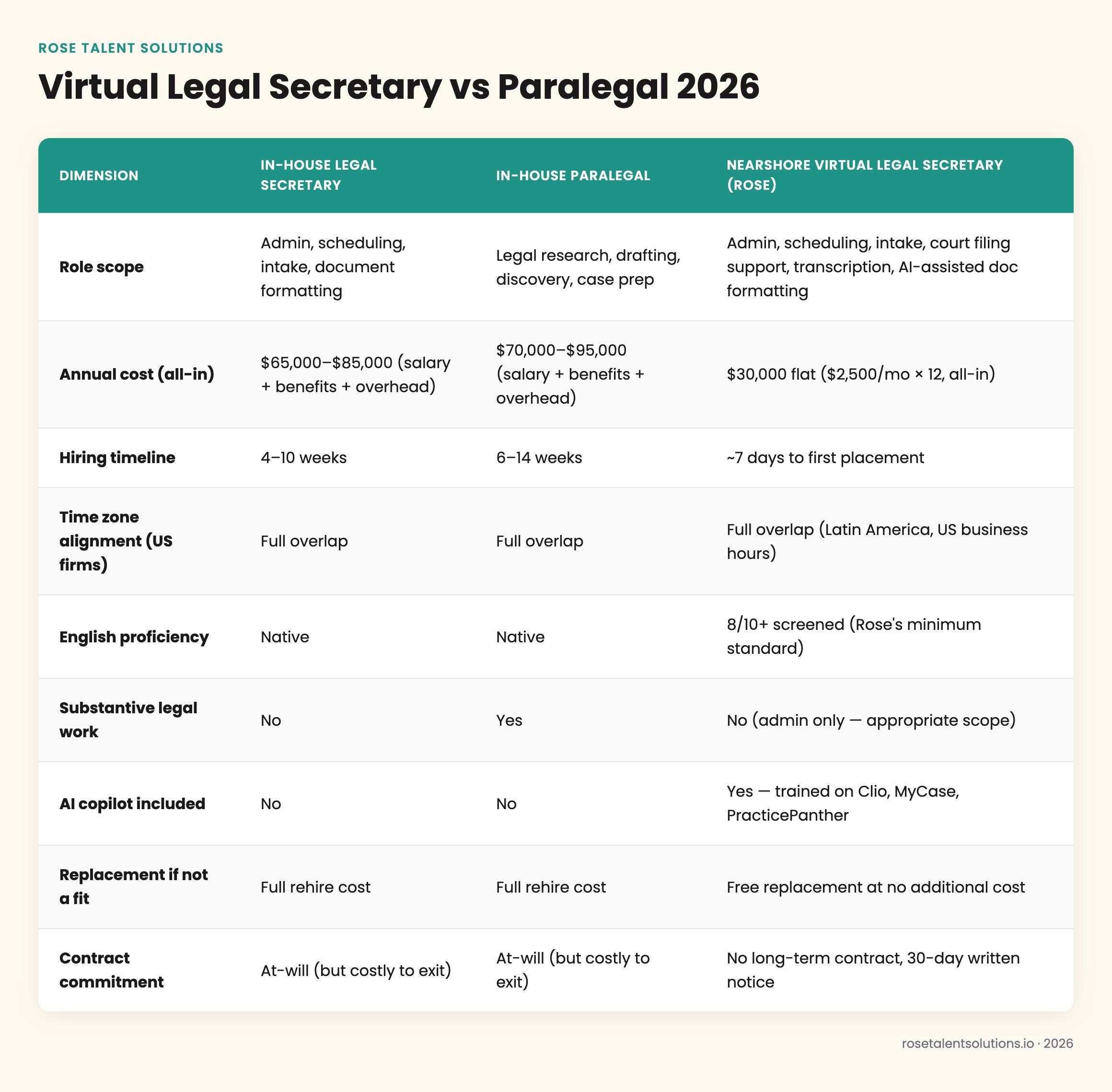
The comparison table below maps three staffing options across the dimensions that matter most for law firm operators: role scope, annual cost, ramp time, and direct impact on attorney billable hours. Use this to identify which role your firm is actually missing.
| Dimension | In-House Legal Secretary | In-House Paralegal | Nearshore Virtual Legal Secretary (Rose) |
|---|---|---|---|
| Role scope | Admin, scheduling, intake, document formatting | Legal research, drafting, discovery, case prep | Admin, scheduling, intake, court filing support, transcription, AI-assisted doc formatting |
| Annual cost (all-in) | $65,000–$85,000 (salary + benefits + overhead) | $70,000–$95,000 (salary + benefits + overhead) | $30,000 flat ($2,500/mo × 12, all-in) |
| Hiring timeline | 4–10 weeks | 6–14 weeks | ~7 days to first placement |
| Time zone alignment (US firms) | Full overlap | Full overlap | Full overlap (Latin America, US business hours) |
| English proficiency | Native | Native | 8/10+ screened (Rose's minimum standard) |
| Substantive legal work | No | Yes | No (admin only — appropriate scope) |
| AI copilot included | No | No | Yes — trained on Clio, MyCase, PracticePanther |
| Replacement if not a fit | Full rehire cost | Full rehire cost | Free replacement at no additional cost |
| Contract commitment | At-will (but costly to exit) | At-will (but costly to exit) | No long-term contract, 30-day written notice |
How Nearshore Legal VAs Handle Tasks That Traditional Hiring Can't Match in 2026
The nearshore model — staffing from Latin America for U.S. law firms — solves a problem that neither offshore nor domestic hiring fully addresses. Offshore virtual assistants (Philippines, India) often operate 12–14 hours out of sync with U.S. time zones. That gap means your 3:00 PM client callback request doesn't get actioned until 3:00 AM. For legal admin work that requires real-time responsiveness — answering intake calls, scheduling urgent hearings, coordinating with opposing counsel — that lag is operationally unacceptable.
The hidden cost of offshore legal admin isn't the hourly rate — it's the 12-hour timezone gap that turns a 10-minute scheduling task into a 24-hour back-and-forth chain, compressing your firm's response time and damaging client experience.
Nearshore legal VAs from Rose work your business hours, communicate in fluent English (screened at 8/10 or above), and arrive on day one with a role-specific AI copilot trained on the legal practice management software your firm already uses — Clio, MyCase, PracticePanther, or similar. That's a meaningful ramp-time advantage. According to SHRM (2024), the average cost to replace a single employee is 50–200% of their annual salary — making a bad hire in legal admin extraordinarily expensive before you factor in the disruption to client relationships.
Rose's nearshore legal VAs are particularly effective at the tasks that fall between paralegal work and pure reception — legal transcription support, court deadline tracking, e-filing coordination, and billing entry. These are the tasks that paralegals hate doing, attorneys shouldn't be doing, and in-house legal secretaries cost $65,000+ per year to do. A nearshore VA covers the same ground at $2,500/month, all-in.
Remote work adoption in professional services has accelerated the viability of this model significantly. According to Pew Research Center (2023), more than 35% of workers with jobs that can be done remotely now work from home full or part time — a structural shift that has normalized remote administrative support across every professional service vertical, including legal.

Which Tasks Should Go to a Virtual Legal Secretary vs a Paralegal?
The fastest way to decide which role your firm needs is to audit where your attorneys are bleeding time. Below is a practical task-routing framework based on scope of practice and cost-efficiency.
Route to a Virtual Legal Secretary
- Client intake forms and initial screening calls
- Calendar management and court deadline tracking
- Document formatting, template population, and filing prep
- Attorney inbox triage and correspondence drafting
- Billing time entry and invoice follow-up
- Court e-filing coordination and docket monitoring
- Meeting scheduling with clients and opposing counsel
- Legal transcription of recorded calls or dictation
Route to a Paralegal
- Legal research (case law, statutes, regulations)
- Drafting motions, briefs, and pleadings
- Discovery preparation and document review
- Deposition summaries and trial prep binders
- Contract analysis and redlining under supervision
- Case strategy research and memo preparation
Most solo and small firm attorneys discover that 70–80% of the tasks clogging their day sit squarely in the left column. That means hiring a paralegal first — while skipping the legal secretary role — creates a situation where a $75,000/year substantive-legal hire spends a third of their time on formatting, scheduling, and inbox work. That's a $25,000/year administrative task being performed by your most expensive non-attorney staff member.
The National Federation of Paralegal Associations consistently notes that paralegal underutilization — where credentialed professionals spend significant time on clerical work — is one of the most prevalent and preventable sources of firm overhead. Routing administrative tasks to a dedicated legal secretary VA is the fix, not a workaround.
"Law firms that invest in administrative infrastructure first — before adding more substantive legal headcount — consistently outperform peers on realization rates and attorney satisfaction scores." — Stephanie Everett, CEO at Lawyerist (2023)
For firms that also need someone answering the phones and creating a professional first impression for inbound callers, a law firm virtual receptionist can layer on top of or complement a legal secretary VA — handling live call answering while the secretary manages back-office admin in parallel.
How Rose's Onboarding Process Gets a Nearshore Legal VA Live in 7 Days
One of the most common objections law firms raise is ramp time: "We don't have weeks to train someone." Rose's matching and onboarding process is designed around that constraint. Here's how it works from inquiry to day-one productivity.
Intake Call (Day 1)
Rose maps your firm's specific software stack, practice area, and task list. The matching criteria are set here — not guessed at later.
Candidate Matching (Days 2–4)
Rose's recruiter team identifies pre-vetted legal admin candidates from Latin America with relevant experience in your practice area's software (Clio, MyCase, PracticePanther, etc.).
Interview & Selection (Day 5)
You interview the shortlisted candidate(s). You make the final call — Rose doesn't place anyone without your approval.
AI Copilot Activation (Day 6)
Your VA's role-specific AI copilot is activated and trained on your firm's software, templates, and workflow preferences before day one.
Day-One Live (Day 7)
Your nearshore legal secretary starts, works US business hours, and is covered by Rose's free replacement guarantee if the fit isn't right.
Rose handles recruiting, vetting, payroll, HR, and ongoing management. There is no long-term contract — you can cancel with 30 days written notice. And if the team member isn't the right fit, Rose replaces them at no additional cost. The flat rate is $2,500/month for a full-time (40 hours/week) dedicated team member.
For firms that also need court document management support, Rose's nearshore VAs are trained to assist with virtual court filing workflows — handling e-filing coordination, deadline calendaring, and docket monitoring tasks that routinely fall through the cracks in understaffed offices.
According to McKinsey & Company (2023), generative AI tools can automate up to 70% of tasks in legal and administrative support roles — which is exactly why Rose equips every VA with an AI copilot from day one, rather than leaving firms to configure it themselves. The combination of a trained human and role-specific AI produces output that neither could match alone.
The bottom line for 2026: if your law firm is still trying to decide between a virtual legal secretary and a paralegal, start by auditing where your attorneys are actually losing hours. In most small and mid-size firms, the answer points clearly to the administrative stack — and a nearshore legal VA is the most cost-efficient, fastest-to-deploy solution on the market. See how Rose matches your firm with a pre-vetted nearshore legal secretary in about a week.