
Nearshore virtual leasing assistants have quietly become one of the highest-leverage hires a property management company can make in 2026. While your in-house team is tied up with maintenance calls and owner reports, a dedicated remote leasing coordinator — working your exact business hours from Latin America — handles every inbound inquiry, schedules tours, pre-screens applicants, and keeps your vacancy clock ticking down. This guide breaks down exactly what a virtual leasing assistant does, what to pay, how to hire one, and why nearshore beats both offshore and domestic for this specific role.
What Is a Virtual Leasing Assistant?
A virtual leasing assistant is a remote employee who manages the front end of the rental process on behalf of a property management company or landlord. Their core job is to make sure no lead goes cold: they respond to inquiries within minutes, answer questions about units, coordinate showing schedules, collect and review applications, run background and credit pre-checks, and hand off qualified prospects to a leasing agent or property manager for final approval.
The role is distinct from a general virtual assistant. A virtual leasing assistant is trained specifically on leasing workflows — including the software your team uses, the fair housing rules your state enforces, and the tone your brand requires on prospect calls. Speed of response is the single biggest driver of lease conversion, and that is exactly what this role is built around.
That stat alone explains why property managers who staff a dedicated leasing coordinator — even a remote one — consistently outperform those who leave inquiry follow-up to a shared inbox. The question is no longer whether to hire for this role. It is where to hire from, and at what cost.
What Does a Virtual Leasing Assistant Do in 2026?
The scope of the role has expanded significantly as leasing platforms have matured. A well-trained virtual leasing assistant today handles far more than phone calls and email replies. Here is a realistic task list for a full-time (40 hours per week) nearshore leasing coordinator:
- Responding to inbound inquiries across Zillow, Apartments.com, Facebook Marketplace, and your own website within 5–10 minutes
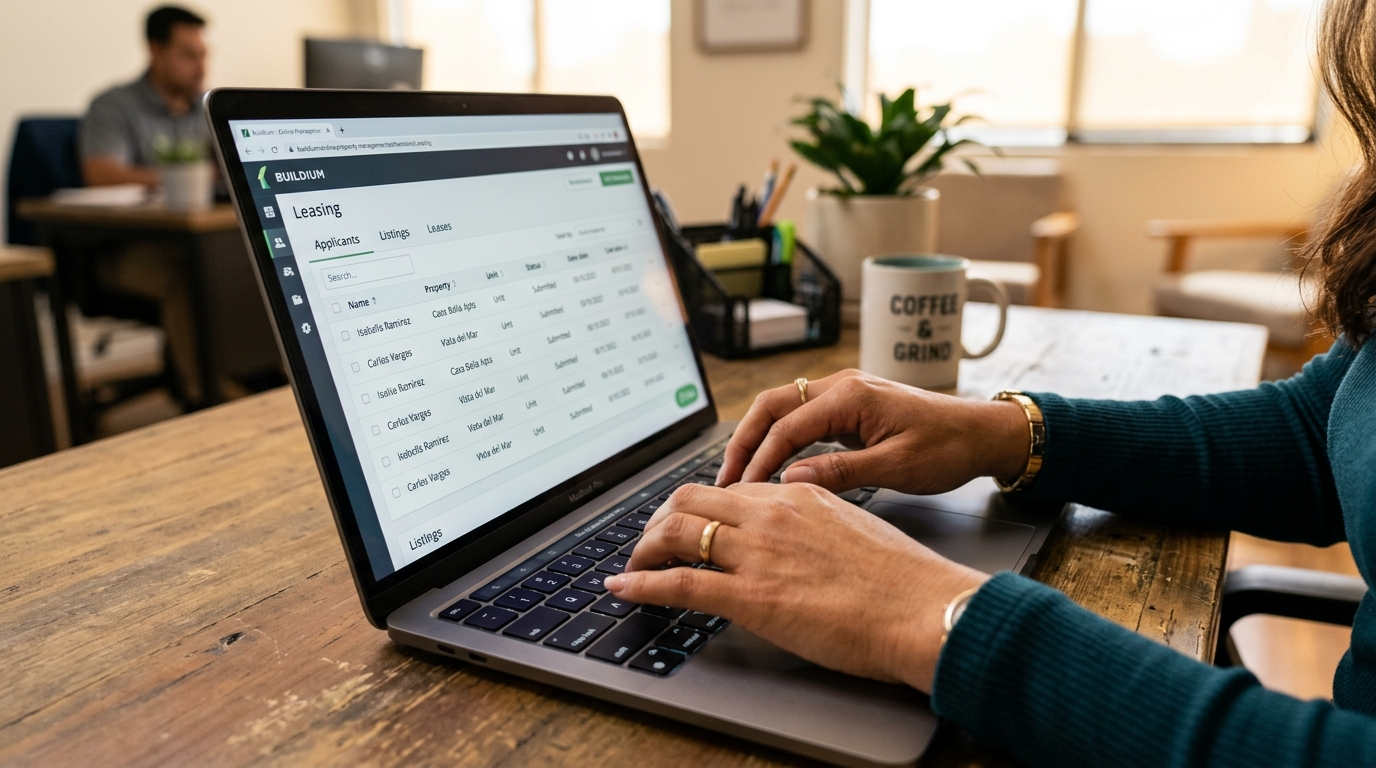
- Scheduling and confirming self-guided, virtual, or agent-accompanied tours via AppFolio, Buildium, or Yardi
- Following up with unresponsive prospects on a structured cadence (email, text, voicemail)
- Collecting rental applications and verifying completeness before pushing to screening
- Running income, credit, and background pre-screens using your criteria
- Answering FAQs about pet policies, parking, utilities, lease terms, and move-in costs
- Updating vacancy listings with accurate availability and pricing
- Coordinating move-in paperwork and lease execution through e-sign platforms
- Logging every touchpoint in your CRM so nothing falls through the cracks
If your team currently uses AppFolio as your primary leasing platform, a well-matched virtual leasing assistant can manage this entire list inside AppFolio without you having to rebuild any workflow. That software fluency is what separates a trained nearshore hire from a generalist freelancer.

Nearshore vs. Offshore vs. Onshore: 2026 Comparison
Not all virtual leasing assistants are equal. The three most common sourcing models — onshore (US-based), nearshore (Latin America), and offshore (Philippines or India) — differ significantly on the factors that matter most for a leasing role: timezone overlap, communication clarity, and cost.
For a deeper breakdown of why the timezone gap alone can tank your leasing conversion rate, see our full analysis of nearshore vs. offshore virtual assistants for property management. The short version: a 12-hour timezone gap means overnight batching of tenant communications — which is fatal for leasing velocity.
| Factor | Onshore (US-based) | Nearshore (Latin America) | Offshore (Philippines/India) |
|---|---|---|---|
| Typical monthly cost (full-time) | $4,500–$7,000+ | $2,500 flat | $800–$1,500 |
| US timezone overlap | Full overlap | Full overlap (same hours) | 0–4 hrs (night shift required) |
| English fluency | Native | 8/10+ screened fluency | Variable (4–8/10 range) |
| Software training (AppFolio, Buildium) | Self-sourced | Role-specific AI copilot included | Varies by agency |
| Cultural alignment with US renters | High | High | Moderate |
| Payroll/HR overhead | High (W-2, benefits) | Included in flat rate | Varies |
| Replacement if not a fit | Full rehire cost | Free replacement | Varies by agency |
"The biggest mistake property managers make with virtual staff is hiring offshore to save $500 a month and then losing $3,000 in vacancy because their leasing coordinator is asleep when a prospect calls at 2pm EST." — Jeremy Tallman, CEO at T&H Realty Services (2024)
How AI Copilots Make a Virtual Leasing Assistant More Effective in 2026
One of the clearest differentiators in the current market is whether your virtual leasing assistant works with or without AI-assisted tools. Every Rose team member ships with a role-specific AI copilot trained on the exact software they will use — AppFolio, Buildium, Yardi, or whatever platform your team runs on. This is not a generic chatbot. It is a purpose-built assistant that surfaces the right answers at the right moment: lease clauses, pet policy language, move-in checklist templates, screening criteria thresholds.
According to Buildium's State of the Property Management Industry Report (2024), 69% of property management companies that adopted AI-assisted workflows reported faster resident onboarding — with the biggest gains in the leasing inquiry-to-application stage. That is precisely the stage your virtual leasing assistant owns.
You can explore the full breakdown of how Rose's AI copilot advantage works — but the practical result is that a nearshore leasing assistant with an AI copilot ramps faster, makes fewer errors on your specific platform, and handles edge-case inquiries without escalating every unusual question to your in-house team.
The hidden cost of an untrained virtual leasing assistant is not their hourly rate — it is the 3–4 weeks of ramp time while they figure out your software, your screening criteria, and your brand voice. An AI copilot cuts that ramp to days, not weeks.
How Much Does a Virtual Leasing Assistant Cost in 2026?
Cost is usually the first question, so here is the direct answer: a full-time nearshore virtual leasing assistant through Rose Talent Solutions is $2,500 per month, flat. That includes recruiting, vetting, payroll, HR administration, and ongoing management. There is no long-term contract — you can cancel with 30 days written notice. If the placement is not a fit, Rose replaces them at no additional cost.
For context, the Bureau of Labor Statistics reports that the median annual wage for a leasing consultant in the United States is approximately $38,000–$44,000 per year, according to the U.S. Bureau of Labor Statistics (2024) — that is $3,100–$3,600/month before benefits, payroll taxes, PTO, or turnover costs. A nearshore virtual leasing assistant delivers comparable output at a lower all-in number, with none of the HR overhead.
The property management staffing page at Rose breaks down the full cost comparison if you want to model it against your current payroll. The $2,500 flat rate is the same whether your VA handles 20 units or 200 — because the role is full-time and dedicated, not task-based or hourly.
According to SHRM's benchmarking data (2024), the average cost to hire a single employee in the US is $4,700 — not counting the first few months of reduced productivity during onboarding. When you factor in turnover risk (leasing staff have high churn in a tight labor market), the case for a nearshore model with a free replacement guarantee becomes even clearer.
How to Hire a Virtual Leasing Assistant Through Rose in 2026
The hiring process at Rose is designed to get a leasing coordinator in front of your team fast — typically within about seven days of starting the intake call. Here is how it works:
Intake & Role Scoping
Rose's team conducts a 30-minute call to map your current leasing workflow, identify the software stack, and define the English fluency and availability requirements for your market.
Candidate Matching
Rose sources from its Latin America talent network, screening each candidate against your role spec, running an English proficiency screen (8/10 minimum), and verifying leasing software familiarity before presenting a shortlist.
Interview & Selection
You interview the top candidate(s) directly. Rose facilitates the process but you make the call — you're hiring a full-time team member, not renting an anonymous resource.
AI Copilot Onboarding
Before day one, Rose configures your VA's role-specific AI copilot for your software platform so they arrive trained on your tools, not learning from scratch on your time.
Day-One Start
Your virtual leasing assistant begins on your schedule, during your US business hours, with ongoing HR and management support from Rose in the background.
If you manage HOA communities in addition to rentals, the same nearshore staffing model applies — and the scope of work overlaps more than most operators expect. Our guide on what an HOA management virtual assistant handles covers the specific workflow differences. For community associations specifically, we also address the most common objection in detail: whether a virtual assistant can realistically handle HOA management end-to-end.
Is a Virtual Leasing Assistant Right for Your Portfolio in 2026?
A virtual leasing assistant is the right hire if any of the following are true: your team misses inbound inquiries after hours or during peak times, your average days-on-market is higher than your market benchmark, your in-house staff is spending more than 30% of their week on leasing admin instead of high-value work, or you are growing your portfolio and need leasing capacity without adding a full-time W-2 employee.
According to National Association of Realtors research (2024), rental vacancy rates in most US metros remain below 6%, meaning every day a unit sits vacant is real lost revenue — not just an abstract metric. A dedicated virtual leasing assistant whose only job is to convert inquiries into signed leases typically pays for itself with one or two fewer vacancy days per unit per month.
Good fit for a virtual leasing assistant
- Portfolio of 20+ units with active vacancy turnover
- Inquiry volume that overwhelms in-house staff
- Already using AppFolio, Buildium, or Yardi
- Leasing leads coming from multiple channels (Zillow, MLS, direct)
- Want to scale without adding W-2 headcount
May need a different approach
- Portfolio under 10 units with low turnover (part-time help may suffice)
- No leasing software in place yet (set up your platform first)
- Require in-person showings only with no self-guided or virtual option
- Owner-managed single-family with no growth plans
If you are ready to move, the fastest next step is the Rose intake form — it takes about three minutes and gets a matching conversation started within one business day. The flat rate is $2,500/month, no long-term contract, with a free replacement guarantee if the placement is not a fit.