
Nearshore virtual assistant services are having their breakout moment in 2026 — and the data backs it up. Remote work normalization, tighter hiring budgets, and the explosion of AI-ready workflows have pushed US, Canadian, and UK businesses to rethink where their administrative and operational horsepower comes from. The result? A measurable shift toward specialized, timezone-aligned virtual staff who can actually show up on a morning standup at 9am EST without anyone sacrificing sleep.
This post breaks down exactly which virtual assistant roles are seeing the sharpest demand this year, why nearshore Latin America is outpacing other sourcing models, and what you should look for when evaluating a staffing partner. Whether you run a property management company, an accounting firm, or a fast-growing e-commerce brand, the categories below represent real hiring decisions operators are making right now.
Which Virtual Assistant Services Are Most in Demand in 2026?
The demand landscape for virtual assistants has shifted hard toward specialized, software-literate roles rather than generalist admin support. Businesses aren't looking for someone to answer generic emails anymore — they want someone who can open AppFolio, triage maintenance tickets, code invoices in QuickBooks, and close a leasing inquiry before noon. Here are the five categories drawing the most hiring activity in 2026.
1. Property Management Coordination. Leasing inquiries, maintenance dispatch, tenant communication, and move-in/move-out coordination are all repeatable, high-volume tasks that eat a local manager's entire day. According to Buildium's 2025 Property Management Industry Report (2025), 58% of property management companies with fewer than 500 units cite administrative overload as their top operational challenge. A VA trained on Buildium or AppFolio solves that immediately. You can explore Rose's property management VA services to see exactly how that placement works.
2. Bookkeeping and Accounts Payable. QuickBooks-trained VAs handling invoice coding, bank reconciliation, and vendor payment tracking are in extreme demand — especially from real estate operators and professional services firms running lean back offices. The U.S. Bureau of Labor Statistics (2024) notes that bookkeeping and accounting clerk roles are increasingly being filled by remote staff as firms restructure for cost efficiency. Rose's bookkeeping and accounting VA service places full-time staff trained specifically on QuickBooks, Xero, and AppFolio's accounting module.
3. Customer Support and Inbox Management. High-volume inboxes — whether it's a property company getting 200 tenant emails a week or a DTC brand handling order inquiries — are the most common trigger for a first VA hire. Operators want real-time response, not overnight batching. That's why timezone alignment matters more than hourly rate for this role.
4. Executive and Calendar Management. Founders and operators wasting 10+ hours a week on scheduling, travel coordination, and CRM updates are a classic VA use case that's seeing renewed interest as AI tools amplify what a well-supported EA can accomplish.
5. Social Media and Content Operations. Scheduling, repurposing, community management, and reporting — not strategy — are where VA demand is strongest. Businesses want execution bandwidth, not another consultant.

How Nearshore VAs Outperform Offshore Models in 2026
The offshore VA model — Philippines, India, Pakistan — has one structural problem that no hourly rate can fix: time zones. A 10-12 hour gap means your VA is working while you sleep. Every question waits until tomorrow. Every escalation sits in a queue. For customer-facing or operations-heavy roles, that delay compounds fast.
Nearshore virtual assistants, based in Latin America, work US business hours by default. Someone in Bogotá, Mexico City, or Buenos Aires shares your timezone (or is within 1-3 hours of it). They're available for your morning standup, your 2pm Zoom, and your 4pm emergency without anyone pulling an overnight shift. That's not a small operational difference — it's the difference between a VA who integrates into your team and one who sends you batched updates you read at breakfast.
"Timezone alignment is consistently underweighted in the buy decision. Operators focus on rate, then six months later they're rebuilding workflows because the async gap destroyed their SLAs." — Matthew Stibbe, CEO at Articulate Marketing (2024)
English fluency is the other structural variable. Rose screens every candidate to an 8/10 or higher on English proficiency — a threshold that rules out most offshore pools. Latin American professionals, particularly in Colombia, Mexico, and Argentina, consistently test at higher written and spoken English fluency scores compared to equivalent-cost offshore markets, according to EF Education First's English Proficiency Index (2024).
If you want to go deeper on how these three sourcing models stack up across every variable, the complete nearshore vs offshore vs onshore comparison breaks it down head-to-head.
2026 VA Model Comparison: Nearshore vs. Offshore vs. Onshore
| Factor | Nearshore (Latin America) | Offshore (Philippines / India) | Onshore (US-Based) |
|---|---|---|---|
| Typical Monthly Cost (Full-Time) | $2,000–$3,000 | $800–$1,800 | $5,000–$8,000+ |
| Timezone Overlap with US | Full overlap (0–3 hrs) | Minimal (10–14 hrs difference) | Full overlap |
| English Proficiency | High (8/10+ screened) | Variable (6–9/10) | Native |
| AI Copilot / Software Training | Included (role-specific) | Varies by agency | Varies by hire |
| Recruiting + HR Management | Fully managed by agency | Often self-managed | Self-managed or staffing agency |
| Contract Flexibility | Month-to-month, no long-term contract | Varies widely | Often W-2 or long-term contract |
| Replacement Guarantee | Yes — at no additional cost | Rarely included | Rarely included |
For a deeper breakdown of just the onshore versus offshore tradeoffs, the onshore vs offshore VA comparison covers the total cost of ownership differences operators often miss when evaluating price alone.
How AI Copilots Are Changing What 2026 VAs Can Do
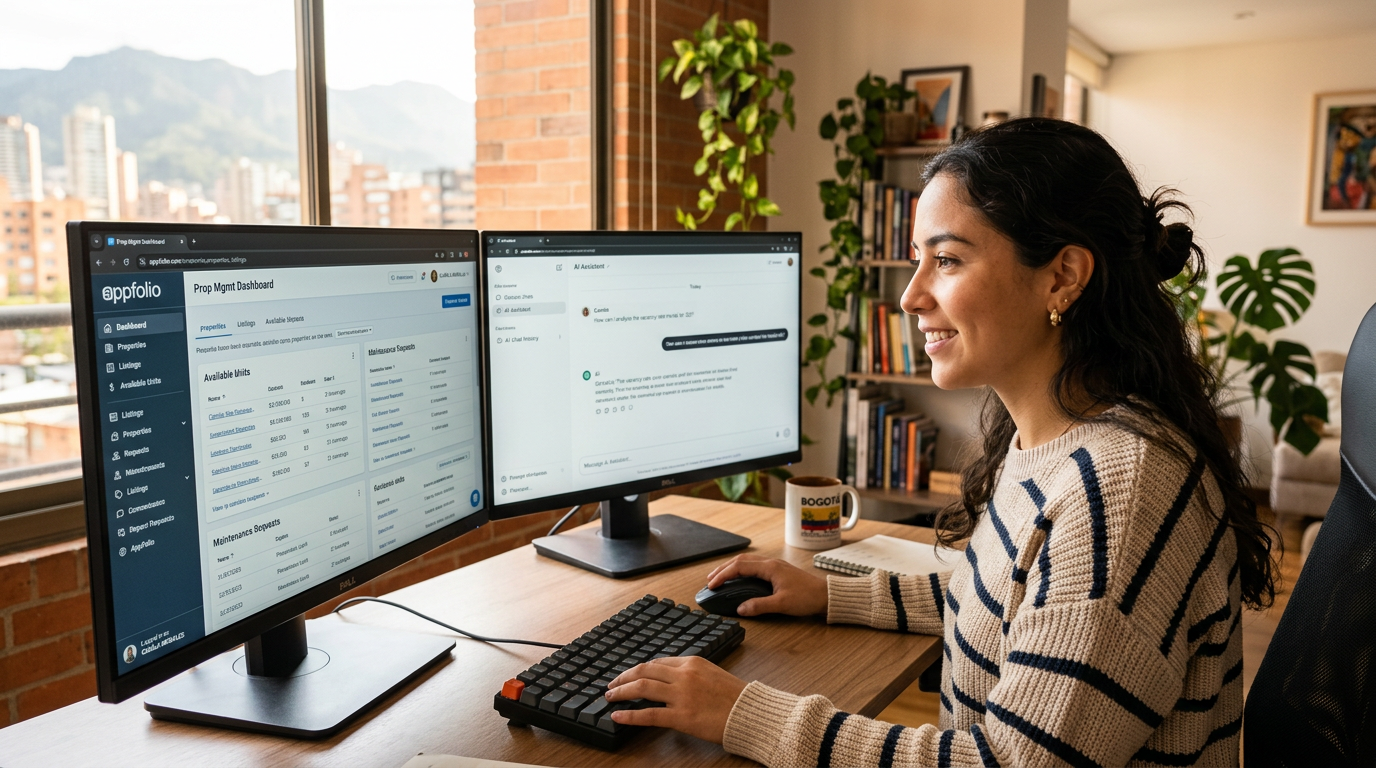
The most significant shift in virtual assistant services in 2026 isn't headcount — it's capability per head. AI-augmented VAs handle work that previously required a mid-level employee. A nearshore VA trained on AppFolio with an AI copilot can draft lease renewals, flag delinquencies, auto-categorize maintenance requests, and surface vendor invoices for approval — all within the same shift.
At Rose, every placed team member ships with a role-specific AI copilot trained on their primary software stack — whether that's AppFolio, Buildium, QuickBooks, or another tool central to your workflow. This isn't generic ChatGPT access. It's a purpose-built assistant that knows your software's data schema and your team's SOPs. The practical result is faster ramp time and higher output volume from day one.
An AI-augmented nearshore VA doesn't just save you money versus a local hire — they frequently outperform the local hire on throughput, because the AI copilot eliminates the lookup, formatting, and drafting time that consumes 30-40% of a traditional admin role. You can learn more about this on Rose's AI advantage page.
According to McKinsey's report on the economic potential of generative AI (2023), administrative and data-processing tasks have the highest automation augmentation potential of any work category — meaning the humans doing those tasks get the biggest productivity lift from AI tools. That's not a future trend. That's the baseline expectation for a well-hired VA in 2026.
What Does It Actually Cost to Hire a VA in 2026?
Pricing transparency in the VA market is notoriously poor. Platforms quote hourly rates that don't include recruiting, vetting, HR management, or replacement. You end up doing the math after the fact — and the number is always higher than the rate card suggested. If you want a realistic picture, the guide to the best affordable virtual assistant services in 2026 compares the all-in cost structures across major staffing models.
Rose's pricing is straightforward: $2,500/month, flat. That includes recruiting, vetting, placement, payroll administration, HR management, and ongoing oversight. Full-time, 40 hours a week, dedicated to your business. Month-to-month terms with 30 days written notice — no long-term contract required. If the team member isn't a fit, Rose replaces them at no additional cost. That's the complete risk profile.
For context, the fully-loaded cost of a US-based administrative employee — salary, benefits, payroll taxes, recruiting, and onboarding — runs $55,000 to $75,000 annually for a mid-market market, according to SHRM's cost-per-hire research (2024). At $2,500/month, a Rose VA costs $30,000/year all-in — with no benefits overhead, no payroll tax complexity, and no 90-day notice period if the role evolves.
Nearshore VA via Rose — What You Get
- Full-time, dedicated staff at $2,500/month flat
- Real-time US timezone overlap — no overnight batching
- 8/10+ English proficiency, screened and verified
- Role-specific AI copilot included from day one
- Recruiting, HR, payroll all managed by Rose
- Free replacement if the placement isn't a fit
- Month-to-month terms — no long-term contract
DIY Offshore Hiring — What You Deal With
- 10–14 hour timezone gap creates async-only workflows
- Variable English fluency — no screened floor
- You own recruiting, vetting, and replacement
- No AI copilot — software training on your dime
- Payroll and compliance complexity across borders
- No replacement guarantee — re-hire from scratch
- Platform fees often not included in quoted hourly rate
How to Get Started with a Nearshore VA in 2026
The hiring process matters as much as the pricing. A low-friction onboarding path means your VA is productive faster — and your team doesn't spend three weeks running a search process. Here's how Rose's placement flow works from first contact to active team member.
Role Scoping Call
You speak with a Rose placement specialist who maps your workflows, software stack, and availability requirements. This call typically runs 30 minutes and produces a candidate brief.
Candidate Matching
Rose surfaces 2–3 pre-vetted candidates from its Latin America talent pool — already screened for English fluency, software proficiency, and availability on US business hours. Average matching time is under 7 days.
Interview and Selection
You interview your shortlist, ask role-specific questions, and select your preferred candidate. Rose handles the offer, onboarding paperwork, and payroll setup.
AI Copilot Activation
Your new team member's role-specific AI copilot is activated and configured for your primary software — AppFolio, Buildium, QuickBooks, or another tool — before their first day.
Ongoing Management Support
Rose stays involved post-placement — handling HR, performance check-ins, and replacement coordination if needed. You manage the work; Rose manages the employment relationship.
If you're ready to scope your first role, the getting started page walks through what to expect and how to book your placement call. And if you want to compare Rose against other agencies before deciding, the ranking of the best nearshore virtual assistant companies in 2026 covers the field honestly, including how agencies differ on vetting standards, replacement policies, and pricing transparency.
Virtual assistant services in demand in 2026 are not a commodity category. The difference between a VA who integrates into your team on day three and one who's still being onboarded at week six comes down to three things: timezone fit, software fluency, and a staffing partner who owns the outcome. Those variables are worth optimizing before you sign anything.