
Why Virtual Assistant Pricing Is Confusing in 2026 — and How to Cut Through It
Nearshore virtual assistants have become a mainstream hiring strategy for small and mid-size businesses in the US, Canada, and the UK. But the pricing landscape is a mess. You'll find hourly platforms charging $8/hr, agencies charging $3,500/month, and everything in between — with wildly different definitions of what's actually included. Before you can compare prices, you need to understand that you're often comparing completely different products.
This guide breaks down every major virtual assistant pricing model, explains the hidden costs that don't show up on the rate card, and tells you exactly which model makes sense depending on how many hours you need and how much management bandwidth you have. The goal is a single reference you can bookmark and return to when a vendor's proposal lands in your inbox.
According to the Society for Human Resource Management (SHRM) (2025), hidden onboarding costs — background checks, equipment provisioning, payroll setup — add an average of $1,200–$2,400 to the effective first-month cost of a freelance hire. That figure rarely appears in any platform's advertised rate.

What Are the Four Main Virtual Assistant Pricing Models in 2026?
A virtual assistant pricing model is the billing structure that determines how you pay for remote support work — whether that's by the hour, by the task, through a prepaid block of hours, or as a flat monthly fee for a dedicated full-time person. Each model allocates cost risk differently between you and the provider, and each creates different incentive structures for the VA doing the work.
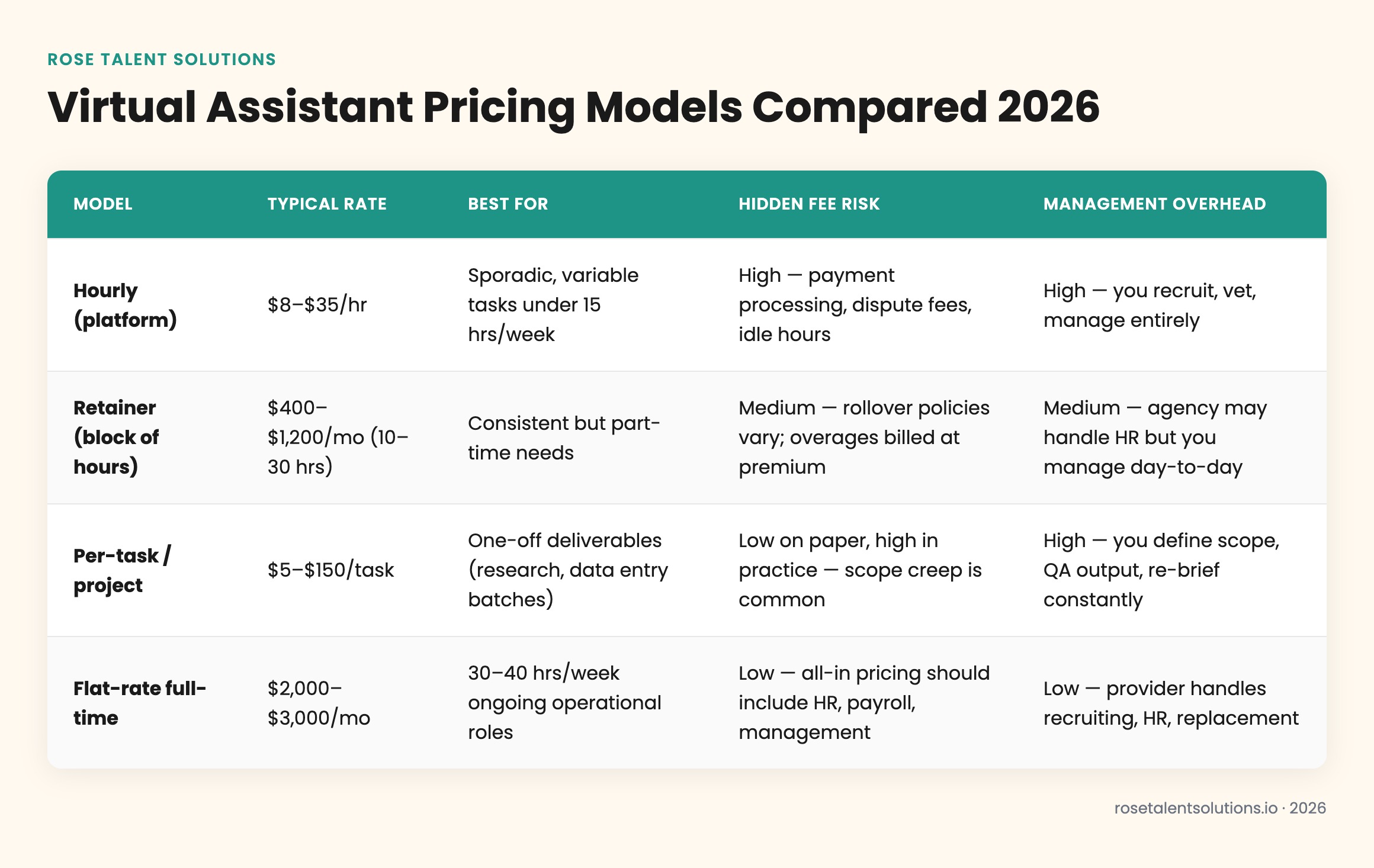
Here is how the four dominant models stack up across the dimensions that actually matter to a business owner:
| Model | Typical Rate | Best For | Hidden Fee Risk | Management Overhead |
|---|---|---|---|---|
| Hourly (platform) | $8–$35/hr | Sporadic, variable tasks under 15 hrs/week | High — payment processing, dispute fees, idle hours | High — you recruit, vet, manage entirely |
| Retainer (block of hours) | $400–$1,200/mo (10–30 hrs) | Consistent but part-time needs | Medium — rollover policies vary; overages billed at premium | Medium — agency may handle HR but you manage day-to-day |
| Per-task / project | $5–$150/task | One-off deliverables (research, data entry batches) | Low on paper, high in practice — scope creep is common | High — you define scope, QA output, re-brief constantly |
| Flat-rate full-time | $2,000–$3,000/mo | 30–40 hrs/week ongoing operational roles | Low — all-in pricing should include HR, payroll, management | Low — provider handles recruiting, HR, replacement |
How the Hourly Model Works — and Where It Breaks Down
The hourly model is the default on platforms like Upwork, Fiverr Business, and Freelancer.com. You post a job, candidates bid, you hire, and you pay by the tracked hour. The surface-level rate often looks compelling — $10–$15/hr is common for offshore VAs in the Philippines or India. But the effective hourly rate climbs fast once you account for what's excluded.
First, you carry all recruiting cost. The average time-to-hire on a freelance platform is 6–12 days, and a SHRM (2024) analysis pegs the average cost of a bad hire at 50–200% of the role's annual salary. On a $15/hr VA role, one mis-hire costs you more than six months of wages in lost productivity and re-hiring time. Second, there is no performance backstop — if the VA disappears or underperforms, you start over from scratch. For a full breakdown of how this model compares across source regions, see our nearshore vs. offshore vs. onshore virtual assistant comparison.
The hourly model is cost-effective only when you need fewer than 15 hours per week and can afford to spend 2–4 hours per week managing the relationship. At 30+ hours per week, the management overhead alone justifies switching to a flat-rate model.
How Retainer Pricing Compares to Flat-Rate Full-Time Models
Retainer pricing sits between hourly and full-time flat-rate. You prepay for a block of hours — typically 10, 20, or 30 hours per month — at a slight discount to the platform's standard hourly rate. This structure works well for part-time, recurring tasks like weekly bookkeeping reconciliations, monthly report pulls, or calendar management for a solo founder who doesn't need a full-time hire.
The problem is rollover policy. Most retainer agreements expire unused hours at month-end, and overages are billed at a premium rate — sometimes 1.5× the base rate. According to Bureau of Labor Statistics (BLS) (2024) data on contractor labor costs, businesses that use retainer arrangements for roles that average 35+ hours per week pay 22–28% more per productive hour than businesses using dedicated full-time arrangements. If your business has grown to the point where you actually need someone full-time, the retainer model is costing you money every month you stay on it.
For businesses evaluating whether a retainer or a flat-rate full-time model makes more sense, our nearshore virtual assistant cost guide for 2026 walks through the exact break-even calculation with real numbers.
How Flat-Rate Full-Time Pricing Actually Works in 2026
Flat-rate full-time pricing means you pay one fixed monthly fee — at Rose Talent Solutions, that's $2,500/month — and receive a dedicated team member working 40 hours per week, US business hours, from Latin America. The fee is all-in: recruiting, vetting, payroll, HR compliance, and ongoing management are included. There are no add-on invoices for background checks, no seat fees for software access, and no surprise overage billing.
This model is designed for roles that need to be filled with a real, reliable person — not a gig worker cycling between five clients. Think property management coordination, bookkeeping and accounts payable, customer service, or executive assistance. Because the team member works exclusively for you at a defined schedule, they build institutional knowledge — something an hourly freelancer juggling multiple clients simply cannot replicate.
"The biggest mistake I see small business owners make is treating a VA like a vending machine — you put money in, you get tasks out. The operators who get the most value treat their VA like a junior employee and invest two weeks in onboarding. The ROI difference is dramatic." — Matthew Mottola, Co-Founder at Venture L (2024)
The risk reversal on this model matters too. Rose's replacement guarantee means that if a team member isn't the right fit, they're replaced at no additional cost. That's a meaningful backstop given that a mis-hire on an hourly platform leaves you with nothing but lost time. Month-to-month terms with no long-term contract mean you're not locked in — 30 days written notice and you're done.

What Does "All-In" Pricing Really Mean — and What Should You Watch For?
Not every agency that advertises a flat monthly rate is actually quoting all-in. Before you sign anything, ask these four questions: (1) Is recruiting included or billed separately? (2) Are payroll taxes and employer-side contributions included? (3) Is there an onboarding or placement fee on top of the monthly rate? (4) What happens if the team member quits — is replacement covered?
According to McKinsey's People & Organizational Performance research (2024), the total cost of onboarding a new employee — including lost productivity during ramp-up — averages 1.5–2× the role's monthly salary. An agency that charges a separate placement fee (often $500–$2,000) and then bills you again for a replacement is essentially charging you the onboarding penalty twice. True all-in pricing eliminates that risk.
The IRS guidance on independent contractors vs. employees (2024) is also worth reviewing before you engage any VA through a platform: misclassification liability can fall on the business owner if the working arrangement looks more like employment than freelance contracting. A managed agency with proper payroll infrastructure removes that compliance exposure entirely.
If you're still deciding between using an agency and finding a freelancer on your own, our post on virtual assistant agency vs. freelancer — which is better covers the tradeoffs in detail, including who should use each model and why.
Some agencies quote a low monthly base rate — say $1,800/month — and then layer on a $1,500 placement fee, a $200/month "management fee," and overage billing above 160 hours. The total lands at $3,500+. Always ask for a full 12-month cost projection before comparing proposals.
How to Choose the Right VA Pricing Model in 2026: A Step-by-Step Framework
The right pricing model depends on three variables: how many hours per week you need, how much internal bandwidth you have to manage the relationship, and whether the role requires domain expertise (software fluency, industry knowledge, judgment calls). Use this framework to land on the right structure before you talk to any vendor.
Audit your weekly task volume
List every recurring task you'd hand off and estimate hours. If the total exceeds 25 hours per week, you're in flat-rate full-time territory — retainer and hourly will cost you more per productive hour.
Calculate your true management cost
Hourly and per-task models require you to recruit, onboard, QA, and manage. If your own hourly rate is $75+, spending 5 hours/week managing a $12/hr VA costs you more than the VA does. Factor this into every comparison.
Assess software and domain requirements
Roles inside platforms like AppFolio, Buildium, or QuickBooks need a VA who already knows the software. Rose's AI copilot advantage — covered in detail on the AI advantage page — means every team member ships pre-trained on their role-specific software stack, cutting ramp time significantly.
Ask for a 12-month total cost projection
Request: base rate × 12, plus placement fee, plus replacement policy terms, plus any overage rates. This single number makes vendor comparison honest. Most agencies won't volunteer it — you have to ask.
Check the replacement guarantee and exit terms
A legitimate flat-rate agency offers free replacement if the team member isn't a fit, and lets you exit with 30 days written notice — no long-term contract required. If a vendor pushes back on either, walk away.
Nearshore vs. Offshore Pricing in 2026: Why the Source Region Changes the Math
One variable that dramatically affects the true value of any VA pricing model is where the team member is based. Offshore VAs in the Philippines or India typically command lower headline rates — $8–$15/hr on platforms — but the 10–14 hour timezone gap creates real operational drag for US businesses. Every back-and-forth takes 24 hours. Approvals that should happen in real time get batched overnight. For roles that require live interaction — tenant calls, client communication, same-day task pivots — the timezone penalty is enormous.
Nearshore VAs in Latin America work US business hours natively. A VA based in Bogotá, Mexico City, or Buenos Aires is online when you're online. According to Gallup's employee engagement research (2023), real-time collaboration and responsiveness are among the top three drivers of remote worker productivity — advantages that nearshore staffing delivers structurally, not by chance. A separate Pew Research Center report (2023) found that 60% of workers in roles requiring real-time client communication rated timezone alignment as "very important" to their ability to perform effectively — a structural advantage nearshore staffing provides by default.
For a detailed breakdown of how these three source regions compare on cost, quality, and collaboration, the best nearshore virtual assistant companies guide for 2026 is worth reading before you shortlist vendors.
Flat-Rate Nearshore: Pros
- Fixed, predictable monthly cost — no billing surprises
- Recruiting, HR, and payroll handled by the agency
- US timezone overlap — real-time collaboration every day
- Free replacement if the team member isn't a fit
- Team member builds institutional knowledge over time
- English fluency screened to 8/10+ before placement
Flat-Rate Nearshore: Cons
- Higher monthly commitment than a part-time retainer
- Not ideal if you need fewer than 25 hours per week
- Requires a 2–3 week onboarding investment upfront
The bottom line: if you're staffing operational roles that need to run in real time during US business hours, the nearshore flat-rate model is almost always the most cost-effective structure once you account for timezone, management overhead, and replacement risk. Ready to see what a dedicated team member looks like for your business? Start the matching process here — most clients have a shortlist within seven business days.