
Nearshore virtual assistants hired through an agency and independent freelancers both promise to take work off your plate — but they are fundamentally different products. When you weigh a virtual assistant agency vs freelancer and ask which is better, the answer almost always depends on whether you need a one-off task completed or a reliable, ongoing team member embedded in your operations. One option comes with recruiting, vetting, payroll, HR, and a replacement guarantee baked in. The other is a single contractor you found on a marketplace, responsible for their own taxes, availability, and equipment. If you have ever hired a freelancer who went quiet at the worst possible moment, you already know which of those scenarios feels riskier at scale.
This guide breaks down the real differences between using a virtual assistant agency and hiring a freelancer in 2026 — covering cost, reliability, onboarding speed, legal exposure, and long-term fit — so you can make a clear, confident decision for your business.
What Is a Nearshore VA Agency — and How Is It Different from a Freelancer Platform?
A nearshore VA agency is a staffing company that recruits, screens, employs, and manages virtual assistants based in Latin America — specifically to serve US, Canadian, and UK businesses during North American business hours. The agency handles everything from background checks and English proficiency testing to payroll taxes and ongoing performance management. You pay one flat rate and get a fully supported team member.
A freelancer, by contrast, is an independent contractor you engage directly — typically through platforms like Upwork, Fiverr, or direct referral. You are responsible for vetting, onboarding, paying, and managing that person entirely on your own. There is no backup if they disappear, no HR escalation path, and no structured replacement process if the work quality slips.
According to the U.S. Bureau of Labor Statistics (2024), approximately 15% of US workers currently identify as independent contractors — a pool that has grown rapidly, but one with no standardized quality bar or accountability structure for buyers. So when you are comparing a virtual assistant agency vs freelancer to decide which is better, you are really comparing a managed system against a single unmanaged individual.

How the True Costs of a Virtual Assistant Agency vs Freelancer Compare in 2026
The freelancer's hourly rate always looks cheaper on the surface. A mid-level VA on Upwork might list at $12–$18/hour. Run that math at 40 hours a week and you land around $1,920–$2,880/month — close to, or even below, a flat agency rate. But that comparison ignores the real cost stack.
When you hire a freelancer directly, you absorb every management hour yourself. That means time spent sourcing, interviewing, onboarding, and re-hiring when the person ghosts — which happens to a significant share of first-time freelance hires. You also carry misclassification risk. The IRS has increased enforcement of worker classification since 2023, and improperly classifying a full-time contractor can trigger back taxes and penalties. You can read more about the full cost breakdown in our nearshore virtual assistant cost guide for 2026.
An agency absorbs those hidden costs. Recruiting, vetting, payroll compliance, HR management, and replacement are all included. According to SHRM's Human Capital Benchmarking Report (2024), the average cost to replace a failed hire equals 6–9 months of that employee's salary. For a $2,500/month role, a single bad freelancer hire and re-hire cycle can cost you $15,000–$22,500 in lost productivity and recruiting time alone.
"The biggest mistake small businesses make when hiring virtual assistants is optimizing for the lowest hourly rate instead of the lowest total cost of management. The hidden overhead of freelancer churn wipes out any rate savings within 60 days." — Matt Mottola, Co-Author of The Human Cloud and Future of Work Analyst (2023)
For a granular head-to-head on pricing models across sourcing types, our guide on how much a nearshore virtual assistant costs in 2026 covers exactly what line items you should be comparing.
Virtual Assistant Agency vs Freelancer vs Domestic Hire: The 2026 Comparison Table
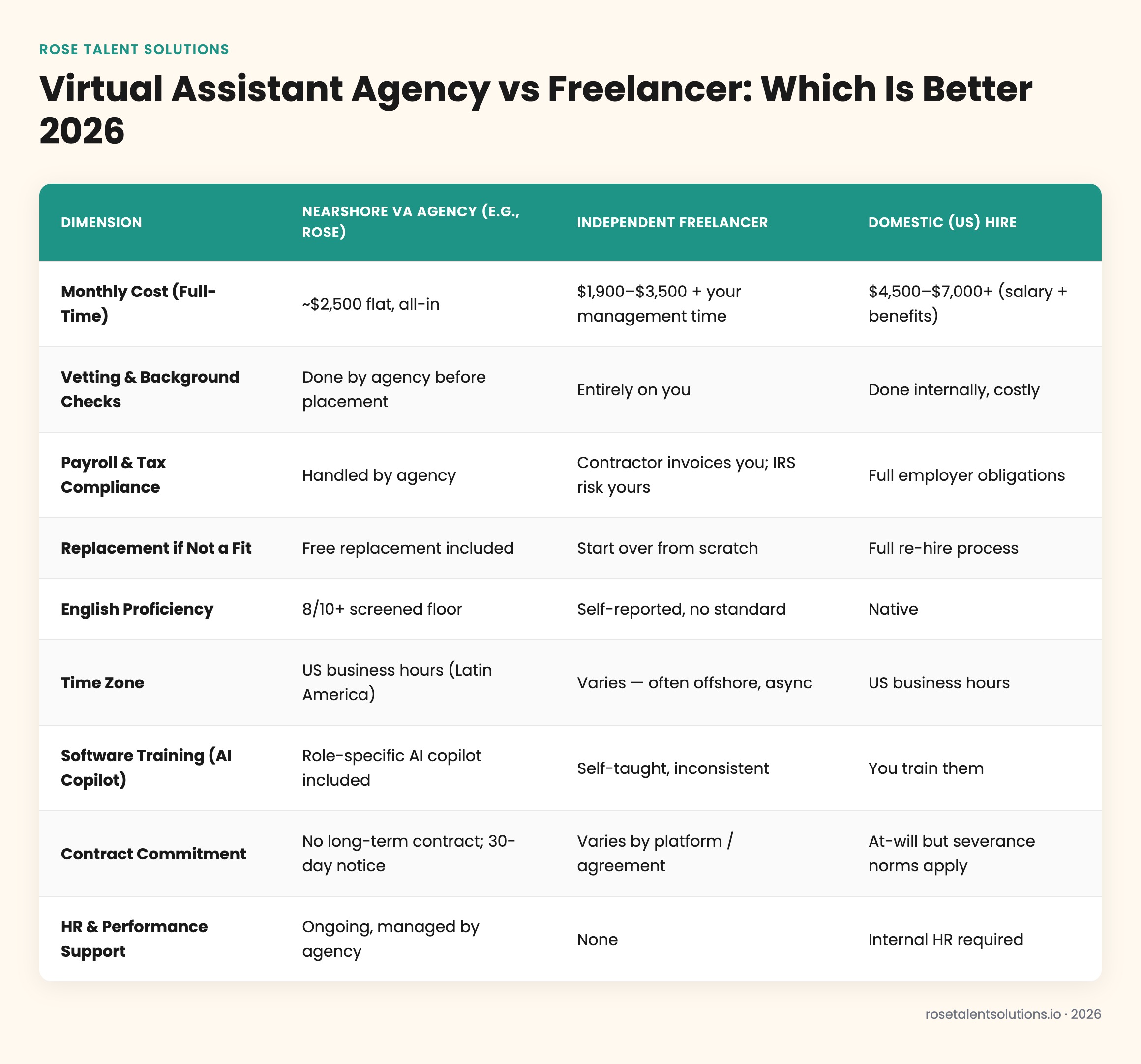
The table below compares the three most common staffing paths for business owners evaluating virtual support in 2026. Use it to match your priorities — whether that is cost, reliability, time zone alignment, or legal simplicity.
| Dimension | Nearshore VA Agency (e.g., Rose) | Independent Freelancer | Domestic (US) Hire |
|---|---|---|---|
| Monthly Cost (Full-Time) | ~$2,500 flat, all-in | $1,900–$3,500 + your management time | $4,500–$7,000+ (salary + benefits) |
| Vetting & Background Checks | Done by agency before placement | Entirely on you | Done internally, costly |
| Payroll & Tax Compliance | Handled by agency | Contractor invoices you; IRS risk yours | Full employer obligations |
| Replacement if Not a Fit | Free replacement included | Start over from scratch | Full re-hire process |
| English Proficiency | 8/10+ screened floor | Self-reported, no standard | Native |
| Time Zone | US business hours (Latin America) | Varies — often offshore, async | US business hours |
| Software Training (AI Copilot) | Role-specific AI copilot included | Self-taught, inconsistent | You train them |
| Contract Commitment | No long-term contract; 30-day notice | Varies by platform / agreement | At-will but severance norms apply |
| HR & Performance Support | Ongoing, managed by agency | None | Internal HR required |
How Reliability Differs Between a Virtual Assistant Agency and a Freelancer
Reliability is where the freelancer model most frequently breaks down for growing businesses. A freelancer is a single point of failure. If they get sick, take on a higher-paying client, lose internet connectivity, or simply stop responding, your operations stall. There is no backup team member, no account manager to escalate to, and no contractual SLA on responsiveness.
An agency structures around this problem. When a team member placed through Rose is not performing or becomes unavailable, the replacement process starts immediately — at no additional cost. That replacement guarantee is the core risk reversal: you are not gambling your workflow continuity on one person's professionalism.
According to Gallup's State of the Global Workplace Report (2023), disengaged workers cost the global economy $8.8 trillion in lost productivity annually. Independent contractors, who lack employer accountability structures, show significantly higher disengagement rates than agency-placed staff. The accountability layer an agency provides is not just administrative — it directly affects output quality day to day.
The hidden reliability cost of a freelancer is not their hourly rate — it is the 2–4 weeks of lost productivity every time you have to re-source, re-vet, and re-onboard after a failed placement. Agency replacements eliminate that cycle entirely.
For businesses that want to understand exactly how nearshore, offshore, and onshore models differ on reliability and accountability, our complete comparison of nearshore vs offshore vs onshore virtual assistants maps out those differences in detail.

How Onboarding and AI Tools Differ Between Agencies and Freelancers in 2026
Onboarding speed matters because every day between signing a contract and your new hire being productive is a day you are still doing that work yourself. When you compare a virtual assistant agency vs freelancer on onboarding, the gap is stark: freelancers typically take 2–4 weeks to become productive even when they are skilled, because you are doing the orientation, access provisioning, process documentation, and training entirely from scratch.
At Rose, every team member ships with a role-specific AI copilot pre-trained on the software they will use in your business — tools like AppFolio, Buildium, QuickBooks, and others. That means they arrive knowing the platform's vocabulary, workflows, and common edge cases before day one. You can explore the full scope of that capability on Rose's AI advantage page.
According to McKinsey's report on the economic potential of generative AI (2023), workers augmented with AI tools complete high-complexity administrative tasks 40–55% faster than those working without them. An agency that embeds AI support into every placement gives you that productivity multiplier immediately — a freelancer leaves you responsible for sourcing, licensing, and configuring those tools yourself.
VA Agency: Pros
- Vetted, background-checked talent delivered to you
- Payroll, HR, and compliance handled end-to-end
- Free replacement if the placement is not a fit
- Role-specific AI copilot included on day one
- No long-term contract; 30-day cancellation notice
- Dedicated account management and ongoing support
Freelancer: Cons
- You vet, hire, and onboard entirely alone
- IRS misclassification risk lands on your business
- No backup if they ghost, get sick, or quit
- No structured AI tooling — self-taught at best
- Rates often creep up after the first engagement
- Platform fees add 10–20% above stated hourly rate
When Does a Freelancer Actually Make Sense — and When Is a Virtual Assistant Agency Better?
Freelancers are not the wrong answer for every situation. They are the right answer for a narrow slice of use cases: a one-time project with a hard deadline, a specialized creative task that needs a single expert for under 20 hours, or a proof-of-concept before you commit to a full-time role. For anything that requires ongoing availability, process consistency, or integration into your operations — a virtual assistant agency is the lower-risk, lower-total-cost choice, which is why the answer to "which is better" skews decisively toward the agency model for most business owners.
If you are running recurring operations — whether that is property management, bookkeeping, customer support, or executive assistance — you need a team member, not a contractor. The distinction matters because operations run on consistency, and consistency requires accountability structures that the freelance model simply does not provide.
If you are weighing agency options specifically, our roundup of the best nearshore virtual assistant companies in 2026 gives you a clear basis for comparison across providers.
Submit Your Role Requirements
Tell Rose what function you need covered — property management coordination, bookkeeping, executive assistance, or another role. Takes under 10 minutes at rosetalentsolutions.io/start.
Receive Matched Candidates
Rose's team presents pre-vetted, English-proficient candidates from Latin America within days — each matched to your software stack and workflow needs.
Interview and Select
You interview your top match and confirm the placement. No long-term contract required — month-to-month with 30 days written notice to cancel.
Day-One Onboarding with AI Copilot
Your new team member starts with a role-specific AI copilot already configured for your tools — AppFolio, Buildium, QuickBooks, or others — so ramp time is days, not weeks.
Ongoing Support and Free Replacement
Rose manages HR, performance, and payroll. If the placement is not the right fit, Rose replaces the team member at no additional cost — no restart fee, no new recruiting bill.
If your business involves property management or bookkeeping specifically, Rose has dedicated practice areas built around those workflows. You can explore those at the property management virtual assistant page and the bookkeeping and accounting virtual assistant page.
According to Statista's global virtual assistant market data (2024), the VA services market is projected to exceed $25 billion by 2028, with the fastest growth concentrated in agency-model engagements rather than freelance platforms — a signal that businesses are learning from experience that managed placements outperform self-sourced contractors at scale. The data confirms what most operators eventually discover firsthand: when you compare a virtual assistant agency vs freelancer on every dimension that actually matters — reliability, compliance, AI tooling, and total cost — the agency wins for any business that depends on consistent daily output.