
What Are LATAM Virtual Assistant Companies — and Why Does "Nearshore" Matter in 2026?
Nearshore virtual assistant companies source talent from Latin America — countries like Mexico, Colombia, Argentina, Costa Rica, and Peru — to serve businesses in the US, Canada, and the UK. The "nearshore" label is not just geography. It signals same-timezone overlap, cultural alignment with North American business norms, and English fluency that offshore alternatives from Southeast Asia or South Asia frequently cannot match at the same price point.
A nearshore VA is a full-time remote professional who works your business hours, uses your existing software stack, and communicates in real time — not on a 6-to-12-hour delay. That distinction changes how fast decisions get made, how quickly tenant or client issues get resolved, and how much management overhead falls on you. If you have been comparing providers, our deep-dive on virtual assistant companies in Latin America lays out the full landscape of what the region offers.
The LATAM VA market has matured rapidly. Remote work normalization post-2020 accelerated hiring pipelines across the region, and by 2026 the talent pool spans property management coordinators, bookkeepers, executive assistants, marketing specialists, and customer support roles. According to Statista (2024), the global outsourcing market is projected to surpass $1 trillion by 2030, with nearshore Latin America capturing a fast-growing share driven by US employer demand for real-time availability.
How the Top LATAM VA Companies in 2026 Actually Differ From Each Other
Not every LATAM VA company operates the same way. The market splits into three rough models: marketplace platforms (you browse profiles, you hire, you manage), staffing agencies (they recruit, vet, and place; you manage), and fully managed services (they recruit, vet, place, run payroll, and handle ongoing HR). The model you choose determines how much internal bandwidth you spend on management versus actual work output.
Marketplace platforms look cheap on paper — hourly rates as low as $8–$12 — but the hidden costs compound fast. You spend 10–20 hours recruiting per hire, you absorb all payroll compliance risk, and when the placement doesn't work out, you restart from zero. According to SHRM (2022), the average cost to replace an employee ranges from 50% to 200% of annual salary — a number that stings even more when the hire was remote and took months to onboard.
Fully managed nearshore agencies like Rose Talent Solutions absorb recruiting, vetting, payroll, HR, and ongoing management into one flat rate. The $2,500/month all-in model means no surprise invoices, no compliance headaches, and a free replacement guarantee if the team member isn't a fit — so the financial risk of a bad match stays with the agency, not you.

For a structured side-by-side look at how these models stack up, our complete nearshore vs offshore vs onshore virtual assistant comparison breaks down total cost of ownership, timezone impact, and communication quality across all three sourcing models.
Nearshore vs Offshore vs Onshore: 2026 Comparison Table
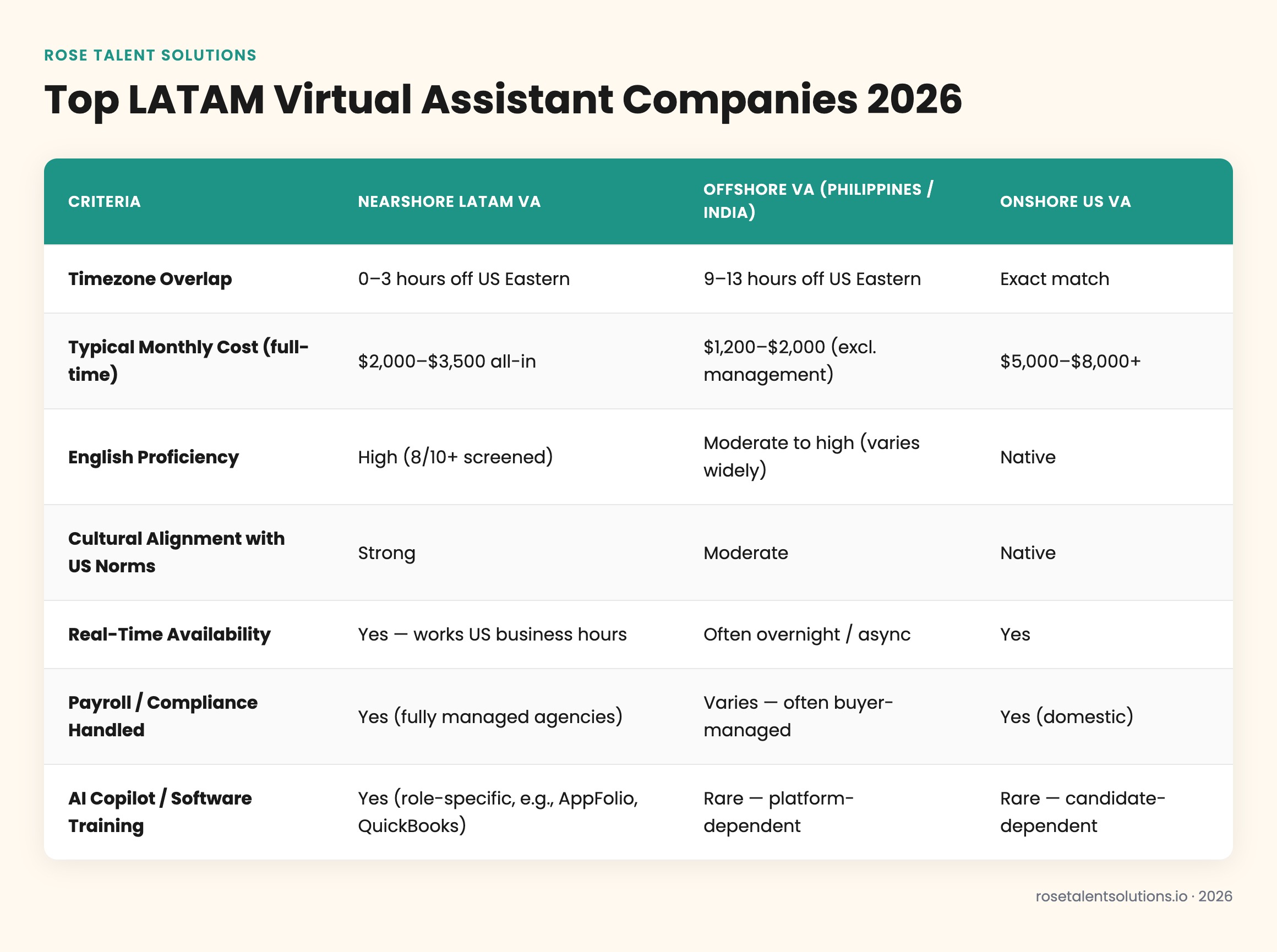
The table below compares the three main VA sourcing models across seven criteria that matter most to US business owners and property managers making a hiring decision in 2026.
| Criteria | Nearshore LATAM VA | Offshore VA (Philippines / India) | Onshore US VA |
|---|---|---|---|
| Timezone Overlap | 0–3 hours off US Eastern | 9–13 hours off US Eastern | Exact match |
| Typical Monthly Cost (full-time) | $2,000–$3,500 all-in | $1,200–$2,000 (excl. management) | $5,000–$8,000+ |
| English Proficiency | High (8/10+ screened) | Moderate to high (varies widely) | Native |
| Cultural Alignment with US Norms | Strong | Moderate | Native |
| Real-Time Availability | Yes — works US business hours | Often overnight / async | Yes |
| Payroll / Compliance Handled | Yes (fully managed agencies) | Varies — often buyer-managed | Yes (domestic) |
| AI Copilot / Software Training | Yes (role-specific, e.g., AppFolio, QuickBooks) | Rare — platform-dependent | Rare — candidate-dependent |
How AI-Augmented LATAM VAs Outperform Traditional Hires in 2026
The biggest shift in nearshore VA quality between 2023 and 2026 is not the talent pool — it is the tooling. The best LATAM VA companies now ship team members with role-specific AI copilots trained on the software their client already uses. A property management VA hired through Rose, for example, arrives pre-trained on AppFolio or Buildium workflows. A bookkeeping VA arrives with a QuickBooks-specific AI assistant that flags reconciliation exceptions before you even ask.
This matters because software ramp time has historically been the biggest hidden cost of any VA placement. According to Gallup (2019), US businesses lose approximately $1 trillion annually to voluntary turnover — a number that grows when you factor in the productivity gap during ramp periods. AI-augmented VAs compress that ramp from weeks to days. You can explore how this works in practice on Rose's AI Advantage page, which details the copilot stack each role comes with.
The hidden cost of a generic offshore VA isn't the hourly rate — it's the 6–13 hour timezone gap that turns every urgent tenant issue, client question, or vendor dispute into a next-day problem. Nearshore eliminates that lag entirely.
For property managers specifically, the AI advantage compounds fast. AppFolio's 2024 Property Management Industry Pulse found that PM companies using software-integrated workflows reported 31% faster maintenance resolution times compared to those using manual processes. A nearshore VA who already knows how to navigate AppFolio work orders on day one is not a convenience — it is a measurable operational advantage. If you run a residential or commercial portfolio, see how Rose's property management VA services are scoped for exactly this workflow.

The same AI advantage applies in finance and accounting roles. According to QuickBooks / Intuit research (2023), 60% of small business owners say bookkeeping errors have cost them money — a problem a pre-trained, AI-assisted bookkeeping VA directly addresses. Rose's bookkeeping and accounting VA services are built around exactly this use case.
The distinction between an AI-augmented nearshore VA and a generic remote hire is also why the best nearshore virtual assistant companies in 2026 all lead with software specialization, not just headcount or hourly rates. Specialization is the new moat.
"The integration of AI tools with human virtual assistants isn't replacing jobs — it's creating a new tier of remote worker that's dramatically more productive than either alone." — Matthew Mottola, Author of The Human Cloud and Future of Work analyst (2023)
How Rose Talent Solutions Matches and Onboards a LATAM VA in 2026
Understanding the sourcing and onboarding process helps you compare providers on more than price. Here is how Rose's placement process works from inquiry to day-one productivity.
Discovery Call
Rose scopes your role, software stack, working hours, and communication preferences. This call takes 20–30 minutes and produces a role spec the recruiting team works from immediately.
Candidate Matching
Recruiters surface 2–3 pre-vetted candidates from the LATAM talent network, each screened for English proficiency (8/10+ floor), relevant software experience, and role-specific skills. You interview only qualified finalists.
AI Copilot Configuration
Before day one, Rose configures the role-specific AI copilot for your software stack — AppFolio, Buildium, QuickBooks, or others — so the VA arrives ready to execute, not just observe.
Placement and Onboarding
Your new team member starts within approximately seven days of the discovery call. Rose handles payroll, HR administration, and ongoing management — you focus on delegating work, not managing a contractor relationship.
Replacement Guarantee
If the placement isn't the right fit, Rose replaces the team member at no additional cost. There is no long-term contract — month-to-month terms with 30 days written notice to cancel.
You can start this process directly at Rose's intake page, which walks through the role scoping questions in under five minutes.
Nearshore LATAM VAs: Honest Pros and Cons for 2026 Buyers
No sourcing model is perfect for every business. Here is an honest breakdown of what nearshore LATAM VAs deliver well — and where the model has real limitations worth acknowledging before you commit. For a deeper analysis of how onshore and offshore options compare on specific criteria, our onshore vs offshore virtual assistant breakdown covers the trade-offs in detail.
According to the U.S. Bureau of Labor Statistics (2024), median annual wages for US administrative support roles range from $42,000 to $58,000 — before benefits, payroll taxes, and overhead. A full-time nearshore VA at $2,500/month represents roughly $30,000 annually all-in. The savings are structural, not marginal.
Pros of Nearshore LATAM VAs
- Work US business hours in real time — 0–3 hour timezone gap
- English fluency screened before placement (8/10+ standard at quality agencies)
- Significant cost savings vs onshore US staff (40–60% on average)
- Cultural alignment with North American communication norms
- AI-augmented roles available with software-specific training baked in
- Fully managed agencies handle payroll, HR, and compliance
Cons / Things to Weigh
- Not the absolute lowest hourly rate — bare offshore platforms can undercut on raw cost
- Talent pool depth varies by niche — highly specialized technical roles may have fewer candidates
- Fully managed agencies require a monthly commitment vs pay-as-you-go gig platforms
- Still requires internal onboarding investment for company-specific workflows and culture
The real differentiator for most US businesses in 2026 is not cost alone — it is the combination of real-time availability, English fluency, and pre-configured AI tooling that nearshore LATAM companies now deliver as a standard package, not an upsell.