
Nearshore virtual assistants have become the go-to staffing solution for settlers — founders, property managers, small business owners, and operators who are building something real and need reliable remote support without the overhead of a full-time in-office hire. Whether you are managing a growing rental portfolio, running an administrative function, or simply drowning in inbox and scheduling tasks, the right VA can reclaim 20+ hours of your week. But "right" is doing a lot of heavy lifting in that sentence — and 2026 has made the differences between good and great crystal clear.
This guide breaks down what separates the settlers best virtual assistant options from the noise, why the nearshore model consistently outperforms offshore alternatives, and exactly what to look for before you spend a dollar on staffing.
According to SHRM's State of the Workplace research (2024), remote staffing adoption among small and mid-sized businesses accelerated sharply post-2022, with flexible staffing now the majority model for operations roles under 10 employees. That trend has only deepened heading into 2026 — and settlers, in particular, are leading the charge.
What Is a Nearshore Virtual Assistant — and Why Does It Matter in 2026?
A nearshore virtual assistant is a remote professional based in a geographically close country — for US, Canadian, and UK businesses, that means Latin America. Unlike offshore VAs in the Philippines or India, nearshore team members operate in overlapping or identical time zones to your business, making real-time collaboration the default rather than the exception. English proficiency is screened to a professional standard, and cultural alignment with North American business norms is strong.
This distinction is not semantic. Timezone overlap is the single biggest driver of VA effectiveness for settlers who need quick turnaround on tasks like tenant communication, appointment setting, bookkeeping entries, or customer support. When your VA is 0–2 hours offset from your local time, same-day resolution becomes the norm. When they are 10–12 hours away, you are building a delay into every single workflow.
If you want to go deeper on how these models stack up, Rose has published a detailed nearshore vs offshore vs onshore virtual assistant complete comparison that walks through every dimension — cost, quality, risk, and fit by use case.

How the Settlers Best Virtual Assistant Model Works in 2026
Settlers — people building something new, whether that is a property portfolio, a service business, or a startup operation — have a specific set of needs that differ from enterprise HR departments. You need speed, flexibility, and someone who can start producing value in days, not months. The staffing model that fits that profile best in 2026 is the all-in flat-rate nearshore placement.
Rose Talent Solutions places full-time nearshore virtual assistants at $2,500/month. That price includes recruiting, vetting, payroll, HR administration, and ongoing management. There is no long-term contract — you operate month-to-month with 30 days' written notice to cancel. If the team member is not a fit, Rose replaces them at no additional cost. That is the full risk profile, and it is clean.
Every Rose team member also ships with a role-specific AI copilot trained on the software your business already uses — AppFolio, Buildium, QuickBooks, and others. This is not a chatbot add-on; it is a trained assistant that helps your VA execute faster and with fewer errors from week one. Learn more about how this works on the AI advantage page.
"The businesses winning with remote staffing in 2026 are not the ones who found the cheapest hourly rate — they are the ones who matched the right time zone, the right skill set, and the right communication style to their actual workflow." — Matt Tanguay, Founder & CEO at Rose Talent Solutions (2025)
Nearshore vs Offshore vs Onshore: Which Is the Settlers Best Virtual Assistant Choice in 2026?
This is the comparison that matters most for settlers in 2026. The table below cuts through the noise and gives you an honest side-by-side across the dimensions that actually drive ROI for small and growing businesses.
| Dimension | Nearshore (Latin America) | Offshore (Philippines/India) | Onshore (US-based) |
|---|---|---|---|
| Monthly cost (full-time) | ~$2,500 all-in | ~$1,200–$1,800 | ~$5,000–$8,000+ |
| Timezone alignment (US hours) | Excellent (0–2 hr offset) | Poor (10–14 hr offset) | Perfect |
| English proficiency | High (8/10+ screened) | Variable (4–8/10) | Native |
| Software training included | Yes (AI copilot) | Rarely | Varies by agency |
| Ramp-up time | 3–7 days | 2–4 weeks | 1–3 weeks |
| Contract flexibility | Month-to-month | Often 3–6 month lock-in | Often annual |
| Cultural alignment (US norms) | Strong | Moderate | Strongest |
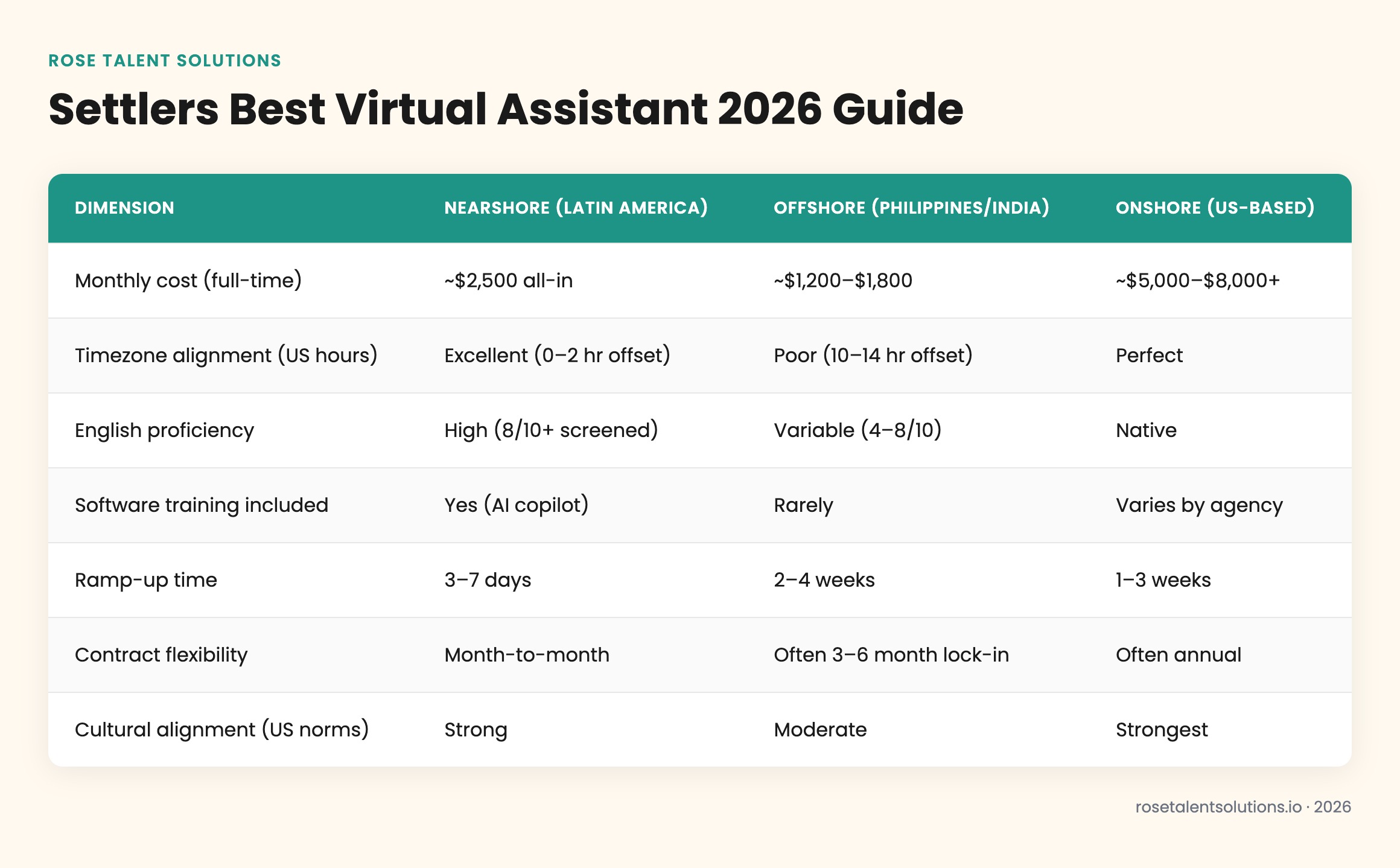
The data tells a clear story: nearshore hits the sweet spot between cost and quality for settlers who need real-time collaboration without onshore price tags. Offshore can look cheaper on paper, but the timezone gap creates compounding delays that erode those savings fast. For a full breakdown of how these models compare in real operating scenarios, see Rose's onshore vs offshore virtual assistant analysis.
How to Evaluate the Settlers Best Virtual Assistant Provider in 2026
Not every VA agency is built the same. Settlers who are hiring a VA for the first time often underestimate how much the agency's process matters — because when the placement goes wrong, you are the one who pays the cost in lost time and rework. Here is what to evaluate before you commit.
The hidden cost of a bad VA placement is not the monthly fee — it is the 40–80 hours of your own time spent training, correcting, and eventually replacing someone who was never properly vetted in the first place. A rigorous agency selection process is the best ROI decision you will make.
According to Gallup's Future of Hybrid Work report (2024), the top driver of remote worker underperformance is misalignment between role expectations and skill set at the point of hire — not motivation or work ethic. That means vetting quality at the agency level is the highest-leverage variable you control as a settler.
A strong VA provider will screen for English proficiency with a defined floor (Rose's is 8/10+), run role-specific skills assessments, check technical setup (reliable internet, quiet environment, hardware), and provide a replacement guarantee so you are not stuck with a bad fit. Understanding what Latin America virtual assistants are typically paid also helps you pressure-test whether an agency's pricing is sustainable or a race to the bottom.
Look also at what support the agency provides after placement. Does someone check in weekly? Is there a manager you can escalate to? Rose's model includes ongoing HR and management support as part of the $2,500/month — which means you are not solo-managing a remote employee in a foreign country. That matters more than most settlers realize until they have tried the unmanaged version.
According to the U.S. Bureau of Labor Statistics (2024), the median annual wage for a US-based administrative assistant exceeds $44,000 — or roughly $3,700/month before benefits, taxes, and overhead. At $2,500/month all-in for a full-time nearshore VA, the math is straightforward for most settlers.
Deloitte's research on distributed workforce models reinforces why structured staffing pays off. According to Deloitte's Global Human Capital Trends report (2024), organizations that invest in structured remote-hire onboarding reduce first-year turnover by up to 25% compared to organizations using informal processes. That finding holds for small businesses and solo operators, not just enterprise teams — which is exactly why the agency's post-placement management layer matters so much for settlers.

For settlers specifically, the use cases that drive the fastest ROI tend to be: inbox and calendar management, CRM data entry and follow-up, bookkeeping and accounts payable, tenant or customer communication, and research tasks. Rose's bookkeeping and accounting VA service and property management VA service are two of the highest-volume use cases — both involve repetitive, high-accuracy work that nearshore VAs execute extremely well.
How Rose Talent Solutions Places the Settlers Best Virtual Assistant in 2026
The placement process matters because speed and fit are both critical for settlers who cannot afford to spend six weeks in a hiring loop. Rose's process is built for fast, accurate matches.
Discovery Call
Rose's team learns your role requirements, software stack, working hours, and communication style in a 30-minute intake. This scopes the search before any candidates are pulled.
Candidate Matching
Rose screens from its existing Latin America talent pool — English proficiency tested, skills assessed, references checked. You receive 1–2 pre-vetted candidates within days, not weeks.
Interview and Selection
You interview the shortlisted candidates and make the call. Rose facilitates the process and advises on fit based on what it learned in discovery.
Onboarding and AI Copilot Setup
Your new team member starts, and their role-specific AI copilot is configured for your software stack. Rose manages payroll, HR, and ongoing check-ins from day one.
Ongoing Management and Replacement Guarantee
If the placement is not a fit at any point, Rose replaces them at no additional cost. Month-to-month terms mean you are never locked in.
For settlers ready to move, the fastest path is to start the process at Rose's intake page — most placements are completed within 7–10 business days of the initial call.
According to McKinsey's State of Organizations report (2023), companies that standardize their remote onboarding process see 2.3× faster time-to-productivity for new remote hires compared to ad-hoc onboarding. Rose's structured intake-to-placement workflow is designed precisely to capture that advantage for every settler client.
The best nearshore virtual assistant companies in 2026 roundup covers the top players, their pricing models, and where each one fits best by use case — worth a read before you finalize your agency decision.
One additional data point that often surprises settlers: according to Pew Research Center's analysis of technology adoption in the workforce (2023), businesses that integrate AI-assisted tools into remote worker onboarding report significantly higher satisfaction scores at the 90-day mark compared to those relying on manual handoffs alone. This is precisely the gap that Rose's role-specific AI copilot is designed to close — faster ramp, fewer errors, higher retention from the first week forward.
Why Nearshore Works for Settlers
- Same-day response on every task — no overnight queue
- English fluency at a professional standard (8/10+ screened)
- Full-time dedicated support at a fraction of onshore cost
- AI copilot trained on your actual software stack
- Month-to-month terms — no long-term contract commitment
- Free replacement if the fit is not right
When Nearshore Might Not Be the Right Fit
- Highly regulated roles requiring US licensure (e.g., licensed real estate broker functions)
- Tasks requiring physical presence or local market knowledge only a local holds
- Businesses not yet ready to document processes for remote delegation
The bottom line for 2026: settlers who want the best virtual assistant are choosing nearshore Latin America professionals because the combination of timezone alignment, English proficiency, software readiness, and transparent pricing creates a staffing model that is genuinely hard to beat at this price point. The days of "cheap offshore or expensive onshore" as the only two options are behind us.