
What Is Rose House Talent? A 2026 Plain-English Definition
Nearshore virtual staffing is the model at the heart of what people mean when they search "rose house talent." Rose Talent Solutions places full-time, Latin America-based professionals with businesses in the US, Canada, and UK — people who work your hours, speak fluent English, and arrive pre-equipped with an AI copilot trained on whatever software your team runs. That's the short version. The longer version explains exactly why the model is catching on fast in 2026, and whether it's the right fit for your operation.
"Rose house talent" is a phrase buyers use when they're trying to understand what kind of staff Rose actually delivers — are they contractors, freelancers, offshore generalists? None of the above. Every person Rose places is a dedicated, full-time team member: 40 hours a week, aligned to your time zone, screened to an English proficiency floor of 8/10 or higher, and supported by Rose's internal HR, payroll, and management layer so you never deal with the administrative overhead of a direct foreign hire.
According to the U.S. Bureau of Labor Statistics (2024), the average time-to-fill for an open administrative role in the United States now exceeds 40 days — and that's before onboarding. Rose's typical placement timeline runs 5 to 7 business days from brief to first day on the job.
How Does the Rose Talent Model Work in 2026?
The placement process is straightforward, but the infrastructure behind it is what most people underestimate. Rose handles every layer of the staffing relationship — recruiting, multi-stage vetting, English proficiency screening, software skills assessment, payroll processing, HR compliance, and ongoing performance management. You submit a brief, approve a candidate, and that person shows up ready to contribute on day one.
If you've ever read a detailed comparison of nearshore, offshore, and onshore virtual assistant models, you already know that the timezone problem is what kills offshore productivity for most US businesses. A virtual assistant based outside of Latin America — in a region 10 to 14 hours out of sync with US clients — creates a workflow where every question, every approval, and every escalation gets batched overnight. Nearshore eliminates that gap entirely because Latin America operates on US-aligned business hours.
The $2,500 monthly flat rate is all-in. No recruiting surcharges. No HR fees on top. No payroll processing markups. When businesses compare that to the true cost of a US-based administrative hire — salary, benefits, employer-side payroll taxes, office overhead — the math shifts fast. SHRM (2023) puts the average cost-per-hire in the US at $4,683, before you factor in the first year of salary and benefits for a full-time employee.
How Rose House Talent Compares to Offshore and Onshore Alternatives
The clearest way to evaluate rose house talent is to put it directly next to the alternatives. Below is a side-by-side breakdown of the three dominant staffing models US businesses consider when hiring remote or virtual support staff.
| Factor | Rose Nearshore (Latin America) | Offshore (Far East / South Asia) | Onshore US VA |
|---|---|---|---|
| Monthly cost (full-time) | $2,500 flat, all-in | $800–$1,500 (agency) or $400–$800 (direct) | $3,500–$6,000+ |
| Time zone alignment | Full US business hours overlap | 10–14 hr gap; async only | Full alignment |
| English proficiency | 8/10+ screened floor | Varies widely; often 5–7/10 | Native speaker |
| AI copilot (role-specific) | Included — trained on your software | Rarely included | Rare; depends on hire |
| Recruiting + HR included | Yes — fully managed | Varies by vendor | You manage or hire HR |
| Contract terms | Month-to-month, 30-day notice | Often 3–12 month minimums | At-will employment (complex) |
| Replacement if not a fit | Free replacement, no extra cost | Varies; often charged | You rehire from scratch |
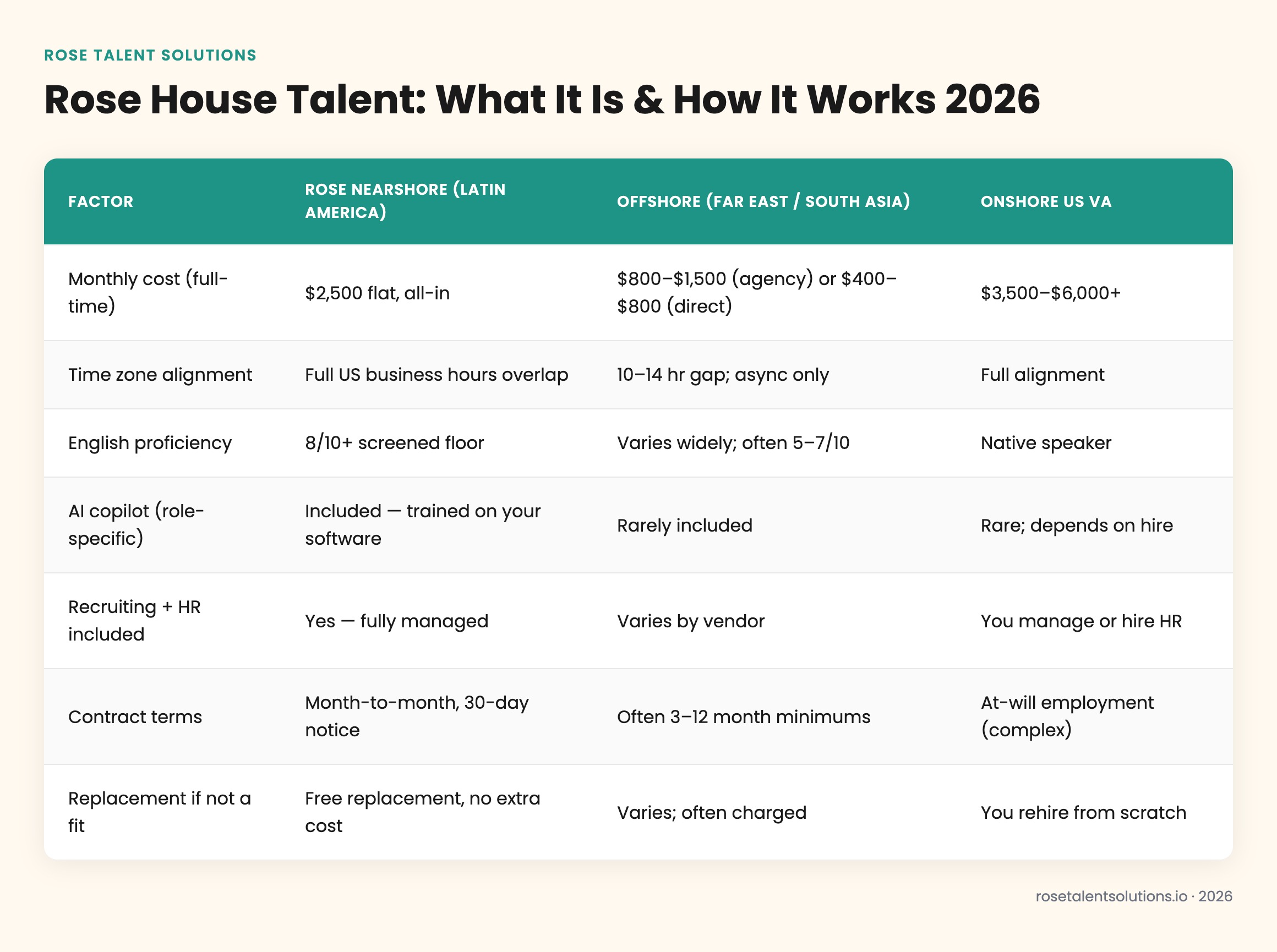
The offshore cost advantage looks compelling until you price in the productivity drag of a 10-to-14-hour timezone gap. If you want a deeper breakdown, this onshore vs. offshore virtual assistant analysis walks through the real-world cost differences side by side — including hidden costs most buyers miss on first pass.
What Roles Does Rose House Talent Fill in 2026?
Rose is most active in three verticals: property management, bookkeeping and accounting, and general business administration. Within those verticals, the AI copilot component is what separates Rose placements from generic VA hires. Each team member ships pre-trained on the software stack relevant to their role — AppFolio, Buildium, or Yardi for property management coordinators; QuickBooks or Xero for bookkeeping assistants; and tools like HubSpot or Salesforce for admin and operations roles.
According to Buildium's State of the Property Management Industry Report (2024), 82% of property management companies say staffing capacity is their biggest barrier to growth — not deal flow, not capital. They have the doors to fill; they don't have the people to manage the process. That's exactly the gap rose house talent is designed to close.
If you manage doors on AppFolio or Buildium, a Rose property management virtual assistant arrives already knowing the platform — maintenance coordination, lease renewals, vendor communication, inspection scheduling. If your bottleneck is on the financial side, a Rose bookkeeping and accounting VA can take over bank reconciliations, accounts payable, and owner reporting inside QuickBooks from week one.

The AI copilot isn't a chatbot bolted on for marketing purposes. It's a role-specific assistant trained on your team member's actual software environment — so when a maintenance request hits AppFolio at 8:47am, your VA has the suggested workflow, the vendor contact lookup, and the templated owner notification ready before they've even picked up the phone. That's what Rose's AI advantage actually looks like in daily operations.
Why Hire Rose House Talent Instead of an In-House Hire in 2026?
The most common question buyers ask before signing with Rose: "Why not just hire someone locally?" It's a fair question. The answer comes down to four variables — speed, cost, flexibility, and management overhead. A US-based full-time administrative hire takes 40+ days to fill, costs $4,000–$5,500/month fully loaded, locks you into employment law obligations, and requires you to manage performance directly with no HR buffer. Rose delivers a placed, vetted, AI-equipped team member in under a week, at $2,500 flat, on a month-to-month arrangement with no long-term contract and a free replacement guarantee if the fit isn't right.
There's also the flexibility argument. Gallup's research (2022) found that 48% of US workers were actively watching or searching for new opportunities — meaning your in-house hire has a near-coin-flip chance of walking within 18 months. When that happens, you restart the 40-day clock. With Rose, turnover is Rose's problem to solve, not yours. If a team member leaves or isn't performing, Rose replaces them at no additional cost.
For businesses already running lean, the deeper argument for nearshore over in-house is the avoided complexity. You don't manage payroll. You don't manage compliance. You don't handle PTO tracking or benefits administration. Rose's infrastructure absorbs all of that. If you're still weighing the full picture, this breakdown of why nearshore VAs outperform in-house hires for growing businesses covers the decision framework in detail, including how to calculate your true cost of ownership for each model.
"The companies that win the next decade won't be the ones that hired the most people — they'll be the ones that built the most efficient people-plus-AI teams." — Liam Martin, Co-founder at Time Doctor and Running Remote Conference (2024)
How the Rose Onboarding Process Works Step by Step
One of the most common anxieties buyers have is: "What does the first week actually look like?" The process is designed to be low-friction on your end. Here's how it runs from brief to day one:
Submit Your Role Brief
You describe the role, the software stack, the hours, and any specific experience requirements. Rose's intake takes about 20 minutes — you can start the process here.
Rose Matches and Vets Candidates
Rose's internal team sources from its Latin America talent network, screens for English proficiency (8/10+ floor), assesses software skills, and selects the best match for your brief — typically within 3 to 5 business days.
You Meet and Approve Your Candidate
You get a profile and a live introduction call. If you want a different match, Rose adjusts. You don't commit until you're confident in the fit.
Your Team Member Starts — AI Copilot Included
Day one, your new team member is logged in, briefed on your workflows, and running with an AI copilot already trained on your software environment. Rose handles payroll, HR, and ongoing management from here.
Free Replacement If the Fit Isn't Right
If at any point the match isn't working, Rose replaces your team member at no additional cost. There's no penalty, no restart fee — just a new match started immediately.
How Latin America Compares to Other Talent Regions in 2026
Latin America's rise as the dominant nearshore talent region for US businesses is well-documented. McKinsey's Future of Work research (2021, updated 2023) identifies proximity — both geographic and cultural — as one of the strongest predictors of remote team effectiveness. Latin American professionals share US cultural references, US business norms, and most importantly, US-aligned working hours. That's a structural advantage that no amount of project management tooling can fully compensate for when a team is many time zones out of sync.
If you're curious about what Latin America-based talent actually costs at the market rate — independent of Rose's all-in pricing — this breakdown of average salaries for Latin America virtual assistants gives you the raw market data by role and country, so you can understand exactly what's inside the $2,500 flat rate.
Why Latin America Nearshore Works
- Full US business hours overlap — real-time collaboration, no overnight batching
- Cultural alignment with US business norms and communication styles
- English proficiency rates have risen sharply — EF English Proficiency Index ranks several Latin American countries in the "high proficiency" tier
- Geographic proximity enables occasional in-person visits if needed
- Strong university-educated talent pipeline in Colombia, Mexico, Argentina, and Costa Rica
Where Buyers Need Realistic Expectations
- Not every role is available immediately — niche technical roles may take 7–10 days vs. 5
- Nearshore costs more than direct offshore freelancers — but the total cost of ownership including productivity is lower
- Not a fit if you need someone physically on-site in your US office
The evidence across the staffing industry consistently points in the same direction: timezone alignment and cultural fit are worth more than a lower hourly rate when your business depends on real-time responsiveness. For tenant calls, client escalations, vendor negotiations, or financial close processes — a team member who responds in minutes beats one who responds the following morning every single time.