
What Does a Remote Bookkeeper Actually Cost in 2026?
Nearshore bookkeeping has become the benchmark for US businesses that want full-time financial support without the $60,000+ annual salary of a local hire. Before you sign anything — freelance platform, local agency, or staffing partner — you need a clear picture of what every model actually costs, where the hidden fees live, and why the cheapest hourly rate is rarely the cheapest outcome.
The short answer: remote bookkeeper costs in 2026 range from roughly $15/hour on the low end to $75/hour on the high end, depending on the model you choose. But hourly rate alone is a misleading number. A "cheap" $18/hour bookkeeper working in a 10-hour time zone gap can cost you more in rework, delays, and management overhead than a $2,500/month flat-rate nearshore team member who works your hours and knows your software cold.
According to the U.S. Bureau of Labor Statistics (2024), the median annual wage for bookkeeping, accounting, and auditing clerks in the United States is $47,440 — roughly $22.80/hour before benefits, payroll taxes, and overhead. A full-time in-house hire typically costs employers 1.25–1.4× the base salary once you factor in benefits and employer taxes, pushing the real cost closer to $59,000–$66,000 per year.
Understanding these baseline numbers is the fastest way to evaluate whether any remote option actually saves you money — or just shuffles cost around.
How Each Hiring Model Prices Remote Bookkeeping in 2026
There are four main models businesses use to hire a remote bookkeeper. Each has a different cost structure, risk profile, and operational fit. Here is what each one looks like in practice.
Freelance platforms (Upwork, Fiverr, Bookkeeper.com): Hourly rates run $15–$50/hour for English-fluent bookkeepers. Most business owners underestimate how much time they spend sourcing, vetting, onboarding, and re-hiring when a freelancer churns. There is no HR layer. No replacement guarantee. No management. You are the agency.
Onshore US-based remote agencies: Managed bookkeeping services and local CPA-adjacent staffing typically run $500–$1,500/month for part-time support or $3,000–$6,000/month for full-service, full-time coverage. The quality ceiling is high, but so is the price.
Offshore staffing (various international markets): Hourly rates of $8–$18/hour look attractive on paper. The problems show up in execution: a 10–13 hour time zone gap means your bookkeeper is finishing your bank reconciliation while you are asleep, and any back-and-forth on a discrepancy stretches into days. If you are curious how software-specific pricing compares, our QuickBooks virtual bookkeeper cost breakdown for 2026 walks through what offshore vs. nearshore rates look like specifically for QuickBooks-trained hires.
Nearshore staffing (Latin America): Latin America-based bookkeepers working US business hours at flat monthly rates. Rose Talent Solutions charges $2,500/month — full-time, 40 hours/week, all-in (recruiting, vetting, payroll, HR, and ongoing management included). That works out to roughly $14.42/hour for a dedicated, software-trained professional who works your timezone and communicates in fluent English.

Remote Bookkeeper Cost Comparison Table: All Four Models in 2026
The table below puts all four hiring models side by side across the variables that actually affect your bottom line. Price is one column. Time zone, English level, and who handles HR are equally important.
| Model | Typical Monthly Cost | Hours/Week | Time Zone Overlap (US) | English Proficiency | HR/Payroll Included |
|---|---|---|---|---|---|
| Freelance (Upwork/Fiverr) | $600–$4,000 (variable) | Variable | Varies widely | Varies widely | No |
| Onshore US Remote Agency | $3,000–$6,000 | Full-time or part-time | Full overlap | Native | Typically included |
| Offshore (Non-aligned time zones) | $800–$2,200 | Full-time possible | Minimal (6–13 hr gap) | Good (6–7/10 avg) | Sometimes |
| Nearshore — Rose Talent Solutions (Latin America) | $2,500 flat | 40 hrs/week | Full overlap (same hours) | Fluent (8/10+ screened) | Yes — all-in |
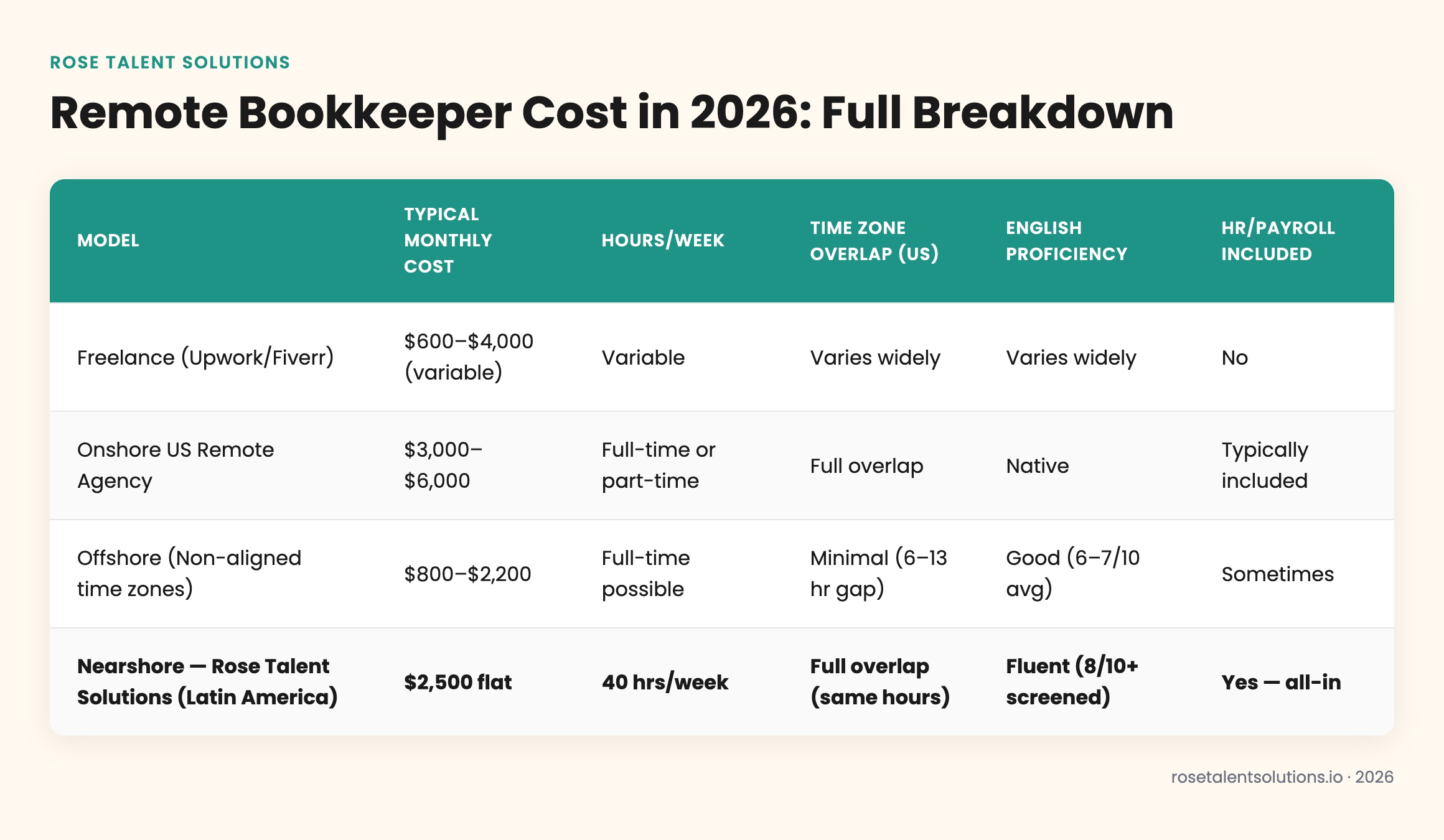
One pattern stands out clearly in the table: nearshore is the only model that combines full time-zone overlap with a fully managed flat rate. Offshore is cheaper on paper but requires you to manage the relationship yourself across a significant time gap. Onshore is fully aligned but costs 20–140% more per month for equivalent coverage.
What Does "All-In" Pricing Actually Include — and What Are the Hidden Costs Elsewhere?
When Rose says $2,500/month flat, that means recruiting, vetting, payroll processing, HR compliance, and ongoing team management are bundled. There is no separate placement fee. No long-term contract. Month-to-month with 30 days written notice to cancel. And if the team member is not a fit, Rose replaces them at no additional cost.
Compare that to what you do not get with freelance platforms. According to SHRM (Society for Human Resource Management) (2022), the average cost-per-hire in the US is $4,700 — and that does not count the productivity ramp time after the hire starts. Every time a freelance bookkeeper churns, you absorb that cost again. With a managed staffing partner, that risk sits on the provider's side.
According to Gallup (2023), workers who feel their employer does not invest in their development are twice as likely to leave within a year — a dynamic that amplifies churn risk in the unmanaged freelance model, where there is no employer relationship at all. Hidden costs in the freelance and offshore models also include:
- Software seat licensing (you provision the account)
- Onboarding and training time (often 2–4 weeks of reduced output)
- Rework when a task is completed in a different timezone without context
- Management overhead (you become the de facto HR department)
- Re-hiring costs if the freelancer drops off
If you are evaluating a specific platform's managed offering, our post on QuickBooks full service bookkeeping cost breaks down exactly what the QuickBooks Live tier includes and where it falls short for growing businesses.
The hidden cost of offshore bookkeeping is not the hourly rate — it is the 6–13 hour timezone gap that turns a 10-minute clarifying question into a 24-hour delay, and a simple bank reconciliation error into a three-day back-and-forth that crosses three weekends.
How Software Training Changes the Real Cost of a Remote Bookkeeper in 2026
A bookkeeper who already knows your software stack is worth materially more than one who needs to learn it on your dime. Onboarding a generalist remote bookkeeper to QuickBooks Online, Xero, or a more specialized platform like FreshBooks can take 3–6 weeks of reduced productivity — time you are paying for but not fully benefiting from.
Rose Talent Solutions equips every team member with a role-specific AI copilot trained on their assigned software. A bookkeeper placed for a QuickBooks-heavy client arrives already familiar with reconciliation workflows, categorization rules, and reporting templates in that platform. The same applies to Xero — if you are weighing that platform, our guide to hiring a Xero virtual bookkeeper covers what software-specific training looks like in practice and how it affects ramp time.
According to Intuit QuickBooks (2023), nearly 30% of small businesses report spending more than 80 hours per year on bookkeeping tasks they could delegate. At a conservative $50/hour value of owner time, that is $4,000/year in opportunity cost sitting in your books — not in your business.
The broader shift toward skills-based hiring is documented in Deloitte's Global Human Capital Trends (2023), which found that 93% of organizations cite skills-based hiring as important or very important for their talent strategy — a finding that validates why software-specific pre-training, not just general bookkeeping experience, is the new standard for remote financial roles.

The AI copilot advantage Rose builds in is also documented on our AI Advantage overview page — worth reading if you want to understand how this compares to hiring a generalist who learns your stack from scratch.
Is a Nearshore Remote Bookkeeper Right for Your Business in 2026?
The nearshore model works best for businesses that need full-time financial support, want real-time communication during US business hours, and are ready to move away from duct-taping together a freelancer relationship. It is not the right fit if you need a licensed CPA for tax strategy, require a physically on-site team member, or only have 5–10 hours per week of bookkeeping work (part-time hourly may be more cost-efficient at that volume).
For businesses in the 10–200 employee range — especially those in real estate, e-commerce, professional services, or property management — the math is straightforward. A nearshore bookkeeper at $2,500/month versus a local hire at $5,000–$6,000/month (salary plus benefits plus overhead) is a $30,000–$42,000 annual difference for equivalent coverage and skills. See how this plays out specifically for bookkeeping roles on our bookkeeping and accounting staffing page.
According to a McKinsey Global Institute report (2021), more than 20% of the workforce in advanced economies could work remotely three to five days a week as effectively as in-office — a figure that has only accelerated since. The infrastructure for remote bookkeeping is mature. The question is no longer whether remote works. It is which remote model delivers the best value.
Why Nearshore Wins
- Full US business hour overlap — no asynchronous delays
- Flat $2,500/month rate with recruiting, HR, and payroll bundled
- English proficiency screened to 8/10+ before placement
- Software-trained with AI copilot from day one
- No long-term contract — month-to-month with free replacement if not a fit
Where Other Models Fall Short
- Freelance: No management layer, high churn, re-hiring costs every time
- Offshore (non-aligned time zones): 6–13 hour gap creates daily operational friction
- Onshore agency: Same quality ceiling, but 20–140% higher monthly cost
- In-house hire: $59K+ true annual cost plus benefits administration burden
If you are ready to see what a dedicated nearshore bookkeeper looks like for your specific business, the fastest next step is a conversation — visit our get started page and tell us your software stack and volume. Most businesses are matched and introduced to a candidate within a week.
For a deeper look at how pricing breaks down specifically when QuickBooks is your primary platform, our post on QuickBooks bookkeeper cost walks through platform-specific rates, what is negotiable, and where most businesses overpay.
"The talent available through Latin American nearshore staffing right now is the closest thing to an unfair advantage I have seen in small business operations in the last decade. You are getting US-timezone, English-fluent, software-trained professionals for a fraction of domestic cost." — Greg Crabtree, CPA and Author of Simple Numbers, Straight Talk, Big Profits (2022)
The remote bookkeeper market in 2026 is more competitive and more transparent than it has ever been. That is good for buyers. The businesses winning right now are the ones who stopped comparing hourly rates and started comparing total cost — including their own time, rework, and the very real opportunity cost of a bookkeeper who works while they are asleep instead of alongside them.