
Nearshore bookkeeping has quietly become the most cost-effective way for US businesses to get a dedicated QuickBooks expert on their team — but before you decide how to staff your books, you need to understand what the hourly market actually looks like in 2026. Rates have shifted. The freelance pool has grown. And the total cost of an hourly bookkeeper is almost always higher than the number on the invoice.
This guide breaks down the real QuickBooks bookkeeper hourly rate by experience tier, hiring model, and geography — so you can compare apples to apples before you commit to anything.
That BLS median is the floor, not the ceiling. When you add employer payroll taxes, health insurance, paid time off, and software seat costs, a fully-loaded in-house bookkeeper typically costs 1.25–1.4× their base salary, according to the Society for Human Resource Management (SHRM). At the median, that's $55,000–$62,000 per year — or $4,600–$5,200 per month — before you've hired a single person above average skill.
What Is the QuickBooks Bookkeeper Hourly Rate in 2026?
The QuickBooks bookkeeper hourly rate in 2026 ranges from $25/hour at the low end (entry-level freelancers, minimal QBO experience) to $80+/hour at the high end (QuickBooks ProAdvisors with industry specialization). The market clusters in two bands: $30–$45/hour for competent generalists and $50–$75/hour for specialists who handle payroll, job costing, or multi-entity consolidations.
What drives someone toward the top of that range? Three factors: QuickBooks ProAdvisor certification, niche industry knowledge (real estate, construction, e-commerce), and whether they carry their own errors-and-omissions insurance. If you need all three, budget for the upper band. If you need clean categorization, bank reconciliation, and monthly reporting, the $35–$50/hour range covers it — but that still adds up fast on a full-time basis. If you want to go deeper on the full cost picture, our breakdown of QuickBooks bookkeeper costs beyond the hourly rate is worth reading alongside this guide.

How Hourly Rates Compare Across Hiring Models in 2026
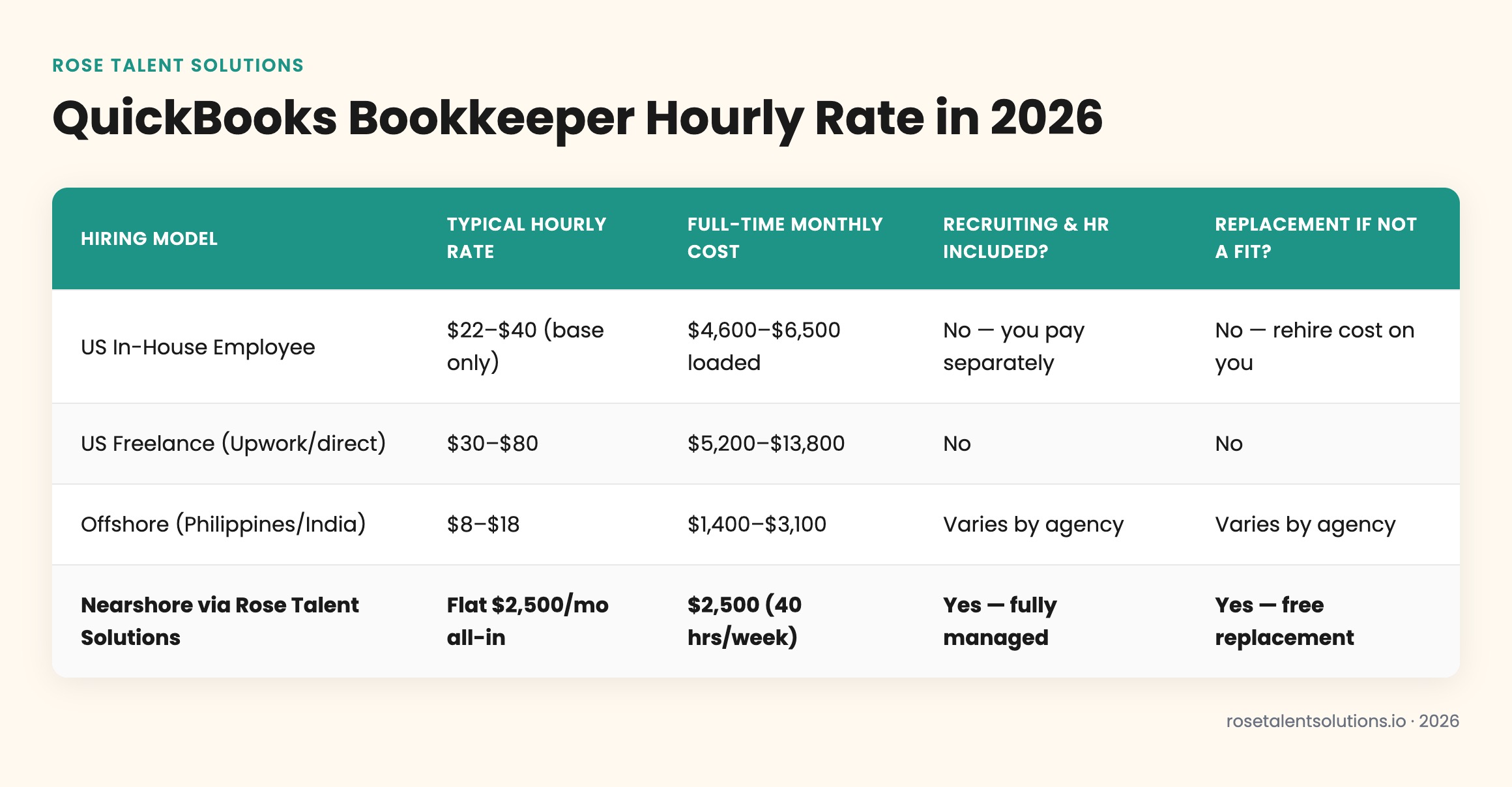
The hourly rate is only one dimension. The hiring model you choose determines your total monthly spend, your risk exposure, and how much management time you burn. Here's how the main options stack up side by side:
| Hiring Model | Typical Hourly Rate | Full-Time Monthly Cost | Recruiting & HR Included? | Replacement if Not a Fit? |
|---|---|---|---|---|
| US In-House Employee | $22–$40 (base only) | $4,600–$6,500 loaded | No — you pay separately | No — rehire cost on you |
| US Freelance (Upwork/direct) | $30–$80 | $5,200–$13,800 | No | No |
| Offshore (Philippines/India) | $8–$18 | $1,400–$3,100 | Varies by agency | Varies by agency |
| Nearshore via Rose Talent Solutions | Flat $2,500/mo all-in | $2,500 (40 hrs/week) | Yes — fully managed | Yes — free replacement |
Offshore options look cheap on paper, but the timezone gap is a real operational tax. When your bookkeeper is 11–13 hours ahead, a question you send at 3pm doesn't get answered until you're back at your desk the next morning. For month-end close, that's a problem. If you're weighing the offshore vs. nearshore question more carefully, our guide to nearshore bookkeeping covers the tradeoffs in detail.
What Does a QuickBooks ProAdvisor Charge — and Do You Need One?
A QuickBooks ProAdvisor is an individual who has passed Intuit's certification exam for QuickBooks Online, QuickBooks Desktop, or both. Certification signals product fluency — they know the software's reconciliation workflows, reporting modules, and automation features — but it does not, by itself, mean they understand your industry or your chart of accounts. According to Intuit's ProAdvisor program, there are over 600,000 certified ProAdvisors globally, which means supply is high and credentials vary widely in actual experience depth.
ProAdvisors typically charge $50–$80/hour for ongoing bookkeeping engagements, and $75–$150/hour for consulting or cleanup projects. Whether you need one depends on your situation. If your books are a mess and you need a diagnostic and cleanup, a ProAdvisor engagement makes sense. If you need ongoing monthly bookkeeping — reconciliations, categorization, reporting — a well-trained dedicated bookkeeper who is fluent in QuickBooks Online does the same work at a lower rate. You can also explore how QuickBooks bookkeeping pricing shifts depending on scope and engagement type.
"Certification tells you someone passed a test. What you actually want to know is: have they closed the books on 50 clients in your industry? That's the question most business owners forget to ask." — Michael Ly, Founder & CEO at Reconciled (2023)
Most small businesses don't need a ProAdvisor on retainer — they need a consistent, well-trained bookkeeper who shows up every day, knows their QuickBooks file inside out, and closes the month on time. A nearshore dedicated hire through a managed model delivers that at roughly half the cost of a US freelancer at $40–$50/hour.
How the AI Advantage Changes What You Get for Your Money in 2026
One factor that has shifted the value equation since 2024: AI-augmented bookkeeping. The question is no longer just "what's the hourly rate" but "what does the bookkeeper produce per hour." A bookkeeper working with an AI copilot trained on QuickBooks workflows can reconcile faster, catch categorization errors before they compound, and generate draft financial reports in a fraction of the time a manual workflow requires.
According to McKinsey & Company's analysis of generative AI in finance functions, AI assistance can automate 60–70% of routine data-processing tasks in accounting — meaning a bookkeeper's billable hours increasingly reflect judgment, review, and analysis rather than data entry. That's a meaningful shift: you're getting more thoughtful output per hour, not just faster data entry.
Every bookkeeper placed through Rose's AI advantage program ships with a role-specific AI copilot trained on their software stack — including QuickBooks Online, Xero, and other platforms. This isn't a generic chatbot bolted on; it's a workflow-specific tool calibrated to the bookkeeper's actual daily tasks. And if your team uses Xero in addition to QuickBooks, our overview of what a Xero virtual bookkeeper can handle covers that parallel use case.
According to Gallup's State of the Global Workplace report, employee engagement and responsiveness are significantly higher when teams operate in aligned time zones — a direct advantage of nearshore over offshore staffing for any role that requires real-time communication, including bookkeeping.
How Rose Talent Solutions Prices Full-Time QuickBooks Bookkeeping in 2026
Rose Talent Solutions places dedicated nearshore bookkeepers at a flat $2,500/month. That covers 40 hours per week of dedicated work — not shared, not fractional, not pooled. The rate includes recruiting, vetting, payroll administration, HR support, and ongoing management. There is no long-term contract; you can cancel with 30 days written notice. If the team member isn't a fit, Rose replaces them at no additional cost.
Compare that to a US freelancer at $40/hour working full-time: that's $6,400/month before any platform fees or management overhead. Or a US in-house hire at the BLS median: $44,000/year base plus roughly $12,000–$15,000 in employer taxes and benefits, landing at $56,000–$59,000/year — $4,650–$4,900/month. The nearshore flat-rate model saves most businesses $1,500–$4,000/month compared to those alternatives.
Team members are based in Latin America, work US business hours, and meet an 8/10+ English proficiency floor on Rose's screening. Every bookkeeper placed through Rose is trained on QuickBooks Online workflows before day one. To see what the engagement looks like end-to-end, visit the getting started page.
Intake call
Rose's team maps your bookkeeping scope — software stack, transaction volume, reporting needs, and any industry-specific requirements like job costing or multi-entity work.
Candidate matching
Within days, Rose identifies candidates from its Latin America talent network who have direct QuickBooks experience matching your use case. You review profiles and interview your top choice.
Onboarding & AI setup
Your bookkeeper starts with a role-specific AI copilot configured for your QuickBooks file. Rose's team handles all HR paperwork, payroll setup, and onboarding logistics.
Ongoing management
Rose handles HR, performance oversight, and any issues that arise. If the fit isn't right, Rose replaces the team member at no additional cost — no rehiring process on your end.
Should You Hire Hourly or Go Flat-Rate? How to Decide
Hourly bookkeeping makes sense in two specific scenarios: you have a one-time cleanup project with a defined end date, or your transaction volume is genuinely too low to justify a part-time hire (fewer than 50–75 transactions per month). In those cases, a ProAdvisor or freelancer at $40–$65/hour for a bounded engagement is the right call.
For everyone else — businesses with ongoing monthly bookkeeping needs, growing transaction volume, or any need for the bookkeeper to understand their business context over time — a dedicated model wins on both cost and quality. Hourly bookkeepers rotate; they don't accumulate institutional knowledge about your accounts. A dedicated hire who closes your books every single month learns your chart of accounts, your vendors, your seasonal patterns. That context compounds in value over time in ways an hourly engagement never can.
Flat-Rate Dedicated Model
- Predictable monthly cost — no invoice surprises
- Full-time availability, not queued behind other clients
- Bookkeeper builds deep knowledge of your accounts over time
- Recruiting, HR, and management included
- Free replacement if the fit isn't right
Hourly Freelance Model
- Unpredictable cost — busy months spike the bill
- Shared attention across multiple clients
- High turnover means re-explaining your books repeatedly
- You manage the relationship and quality directly
- No structured replacement process if it goes wrong
The math is straightforward for most growing businesses. If you need more than 20 hours of bookkeeping per month — which covers almost any business with more than 100 monthly transactions — the flat-rate model is cheaper and more reliable than an hourly freelancer at any rate above $31/hour. According to the U.S. Bureau of Labor Statistics Occupational Outlook Handbook, demand for bookkeeping services remains steady, with businesses increasingly choosing outsourced models over in-house hires to control fixed costs.