
Nearshore QuickBooks book keepers have quietly become the default choice for US small businesses that need full-time financial oversight without paying a full-time local salary. Hiring someone in Latin America who works your hours, speaks fluent English, and already knows QuickBooks inside out sounds almost too clean — but in 2026 it is straightforwardly real. This guide breaks down exactly what a QuickBooks book keeper does, what they should cost, how to evaluate candidates, and why the nearshore model outperforms both offshore and domestic options for most growing businesses.
What Is a QuickBooks Book Keeper?
A QuickBooks book keeper is a financial professional who uses QuickBooks — either QuickBooks Online (QBO) or QuickBooks Desktop — as the primary tool for recording, categorizing, and reporting a business's financial transactions. The role sits below a CPA or controller in the accounting hierarchy: book keepers handle the day-to-day data entry and reconciliation that keep your books audit-ready, while a CPA reviews the output and handles tax strategy.
Core responsibilities typically include recording income and expenses, reconciling bank and credit card statements, managing accounts payable and receivable, running aging reports, producing monthly profit-and-loss statements, and flagging discrepancies before they become costly problems. A strong QuickBooks book keeper reduces the time your CPA spends cleaning up before tax season — which directly lowers your accounting bill. The scope is deliberately operational: they keep the financial engine running so you and your accountant can focus on decisions, not data entry.
If you are deciding between platforms, it is worth reading our breakdown of hiring a Xero virtual bookkeeper versus a QuickBooks specialist — the tool choice matters more than most owners realize, and switching platforms mid-year is painful.
With Intuit reporting over 4.5 million QuickBooks subscribers worldwide (2024), the pool of businesses that need a dedicated QuickBooks book keeper is enormous — and still growing. That scale also means the labor market for qualified QuickBooks book keepers is competitive, which is exactly why nearshore staffing has become so attractive for founders who want the skill without the bidding war.
How Much Does a QuickBooks Book Keeper Cost in 2026?
Pricing varies dramatically depending on where you hire. A US-based bookkeeper typically earns between $45,000 and $65,000 per year in salary alone, according to the U.S. Bureau of Labor Statistics (2024). Add benefits, payroll taxes, software licenses, and office costs, and the all-in number often clears $80,000 annually. According to SHRM's workforce research (2024), the average US employer spends roughly 33% of an employee's salary on benefits and employment taxes alone — a cost that disappears entirely with a nearshore staffing model where the agency handles all employer-of-record responsibilities on the Latin America side.
Freelance platforms like Upwork price QuickBooks bookkeepers at $25–$75 per hour, which sounds cheaper until you need 40 consistent hours a week. The math breaks down fast: at $40/hour for 40 hours, you are already at $6,400 per month — more than double the nearshore flat rate. Our detailed post on QuickBooks bookkeeper cost walks through every pricing tier, but the headline is this: a full-time nearshore QuickBooks book keeper through Rose Talent Solutions costs $2,500/month flat. That is roughly $30,000 a year all-in — recruiting, vetting, payroll, HR, and ongoing management included. No hidden fees, no long-term contract.
If you want a deeper look at how platforms and agencies structure their rates, our QuickBooks bookkeeping pricing guide compares hourly, part-time, and flat-rate models side by side so you can see exactly where each option makes sense depending on your transaction volume and growth stage.

Nearshore vs. Offshore vs. Onshore: How Each Model Performs for QuickBooks Bookkeeping in 2026
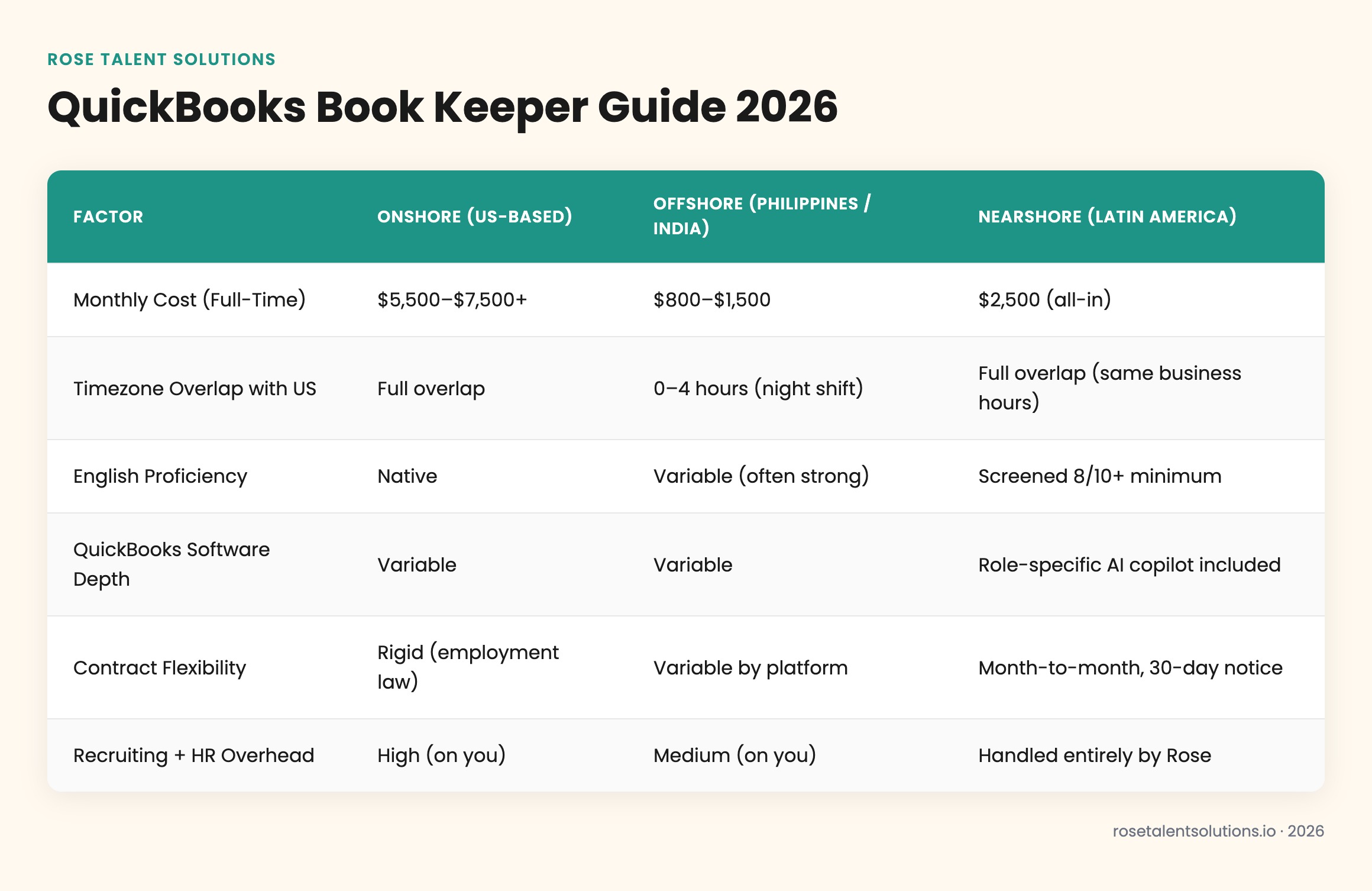
Not all remote book keepers are equal. The biggest variables are timezone overlap, English fluency, and QuickBooks software depth. Here is how the three main hiring models stack up on the factors that actually affect your day-to-day operations and monthly close speed:
| Factor | Onshore (US-Based) | Offshore (Philippines / India) | Nearshore (Latin America) |
|---|---|---|---|
| Monthly Cost (Full-Time) | $5,500–$7,500+ | $800–$1,500 | $2,500 (all-in) |
| Timezone Overlap with US | Full overlap | 0–4 hours (night shift) | Full overlap (same business hours) |
| English Proficiency | Native | Variable (often strong) | Screened 8/10+ minimum |
| QuickBooks Software Depth | Variable | Variable | Role-specific AI copilot included |
| Contract Flexibility | Rigid (employment law) | Variable by platform | Month-to-month, 30-day notice |
| Recruiting + HR Overhead | High (on you) | Medium (on you) | Handled entirely by Rose |
"Small businesses that use cloud accounting software and a dedicated bookkeeper close their books 60% faster than those relying on manual processes or periodic cleanup." — Intuit QuickBooks, State of Small Business Cash Flow Report (2023)
The offshore model looks attractive on price until you account for the timezone gap. A book keeper in Southeast Asia working your "business hours" is doing so in the middle of their night — which creates fatigue, turnover, and batched communication that slows your month-end close. Nearshore eliminates that gap entirely: your book keeper in Colombia or Mexico logs on at 9 AM Eastern and is available in real time all day, every business day. That real-time availability is especially important when a vendor payment is urgent or a bank flag needs an immediate response.
According to Gallup's research on remote work productivity (2023), workers with schedule alignment to their team report significantly higher engagement and output quality — a dynamic that directly affects the accuracy of your books when your bookkeeper is working in sync with your business day rather than against it.
What Skills Should a QuickBooks Book Keeper Have in 2026?
The baseline for any QuickBooks book keeper is QuickBooks certification — either Intuit's QuickBooks Online ProAdvisor certification or demonstrated hands-on experience with QuickBooks Desktop. Beyond the software itself, strong candidates understand double-entry accounting principles, can read a balance sheet without coaching, and know how to set up a chart of accounts appropriate for your industry. These are not optional: a bookkeeper who cannot interpret what they are recording creates downstream problems for your CPA and your tax filings.
In 2026, the differentiator is AI fluency. According to McKinsey's analysis of generative AI's economic potential (2023), finance and accounting functions are among the highest-impact areas for AI-assisted automation — meaning a book keeper who can use AI tools alongside QuickBooks will outperform one who relies on manual workflows alone. The gap between AI-enabled and non-AI-enabled bookkeepers will widen significantly over the next 12 to 24 months as Intuit continues embedding AI natively into QBO.
Every book keeper placed through Rose Talent Solutions ships with a role-specific AI copilot trained on their software stack — including QuickBooks, QuickBooks Payroll, and any integrations your business uses. This is not a chatbot bolted on after placement; it is part of the vetting and onboarding process, configured specifically for your chart of accounts and reporting preferences before day one.
A QuickBooks book keeper without AI fluency in 2026 is like a book keeper without spreadsheet skills in 2010. The gap compounds fast: AI-enabled book keepers catch categorization errors in real time, auto-draft reconciliation notes, and flag anomalies before month-end — saving hours every week and reducing the cleanup bill your CPA charges.
Other skills worth screening for include experience with QuickBooks integrations (Stripe, PayPal, Shopify, HubSpot CRM sync), familiarity with 1099 preparation workflows, and the ability to communicate financial summaries to non-accountant business owners without jargon. That last point matters more than most hiring managers anticipate — a technically excellent bookkeeper who cannot explain a cash flow issue in plain English forces you back into the weeds every single month.

How Rose Talent Solutions Matches You with a QuickBooks Book Keeper in 2026
The matching process at Rose is structured so that by the time a book keeper starts with you, they have already been screened on QuickBooks proficiency, English fluency (8/10+ minimum), and cultural fit with US business norms. The goal is a placement that works from week one, not a six-week probation period where you are doing the training yourself. Here is how the process works from intake to first invoice:
Intake Call
You describe your business, your current QuickBooks setup, and what you need the book keeper to own. Rose maps that to a role profile — not a generic VA job description — so the sourcing is targeted from day one.
Candidate Sourcing and Vetting
Rose screens candidates from its Latin America talent network on QuickBooks-specific tasks, English proficiency, and a live accounting scenario relevant to your industry. Only candidates who clear all three gates advance.
Your Interview
You interview the shortlisted candidate — usually one or two finalists — and make the call. No pressure, no hard sell, and no obligation to proceed if neither is the right fit.
AI Copilot Setup
Before day one, the book keeper's role-specific AI copilot is configured for your QuickBooks environment, integrations, and preferred reporting format. This step alone cuts typical ramp time significantly.
Ongoing Management
Rose handles payroll, HR, and performance oversight on an ongoing basis. If the placement is not a fit for any reason, Rose replaces them at no additional cost — that is the full risk reversal built into the model.
The flat $2,500/month covers every step above. To explore whether a dedicated bookkeeping and accounting specialist is the right hire for your stage of growth, the Rose bookkeeping page walks through which roles make sense at which revenue levels. And if you want to see what a QuickBooks book keeper actually owns versus what stays with your CPA, our post on what a QuickBooks bookkeeper actually does day-to-day lays that out in detail.
How to Evaluate Whether You Are Ready to Hire a QuickBooks Book Keeper in 2026
The right time to hire a dedicated QuickBooks book keeper is usually before you think you need one. Most founders wait until the books are two or three months behind, then spend twice as much on CPA cleanup as they would have spent on a bookkeeper. According to SCORE's research on small business failure (2023), poor cash flow management and inadequate financial records rank among the top reasons small businesses fail — and both are direct consequences of under-investing in bookkeeping early in the growth cycle.
If you are spending more than two hours per week inside QuickBooks yourself, or if your CPA routinely finds categorization errors at tax time, a dedicated book keeper pays for itself immediately. The $2,500/month Rose rate is often recovered within the first month simply by reducing CPA cleanup hours and catching deductible expenses that were previously miscategorized or missed entirely. Even a single missed deduction on a mid-size business can cost more than a full month of bookkeeping support.
Signs You Are Ready to Hire
- You are logging your own transactions and resent every minute of it
- Your books are two or more months behind
- Your CPA bills spike every tax season for cleanup work
- You have missed invoices or double-paid a vendor
- You cannot answer "what is my profit this month?" in under 60 seconds
- Your business revenue exceeds $15K/month consistently
Signs to Wait
- Revenue under $10K/month with very few monthly transactions
- You are already using a part-time bookkeeper effectively and costs are predictable
- Your CPA handles monthly reconciliation included in their existing retainer
When you are ready to move, the Rose intake form takes under five minutes to complete. You will describe your QuickBooks setup, your transaction volume, and the tasks you want owned — and the team will come back with a role profile and candidate timeline within one business day. The month-to-month structure means there is no long-term commitment required: you can scale up or cancel with 30 days written notice, giving you the operational flexibility that a traditional hire simply cannot match.
For a broader look at how virtual staffing fits into the property management and small business landscape, the Rose property management staffing page shows how the same nearshore model applies across roles beyond bookkeeping — from leasing coordinators to maintenance dispatchers — if you are building out a full support team.