
Nearshore QuickBooks bookkeepers have quietly become the default choice for US small businesses that need full-time financial support without a full-time payroll burden. If you've been burning hours reconciling accounts yourself, chasing down miscategorized expenses, or waiting days for a freelancer to respond, this guide will show you exactly what a QuickBooks bookkeeper does, what they cost in 2026, and how to hire one without making an expensive mistake.
The bookkeeping labor market shifted dramatically after 2022. Remote work normalized the idea of a full-time bookkeeper who never sits in your office — but businesses quickly learned that "remote" and "effective" aren't the same thing. Time zones, communication gaps, and inconsistent QuickBooks training separate a great hire from a costly one. Let's break it all down.
What Does a QuickBooks Bookkeeper Actually Do in 2026?
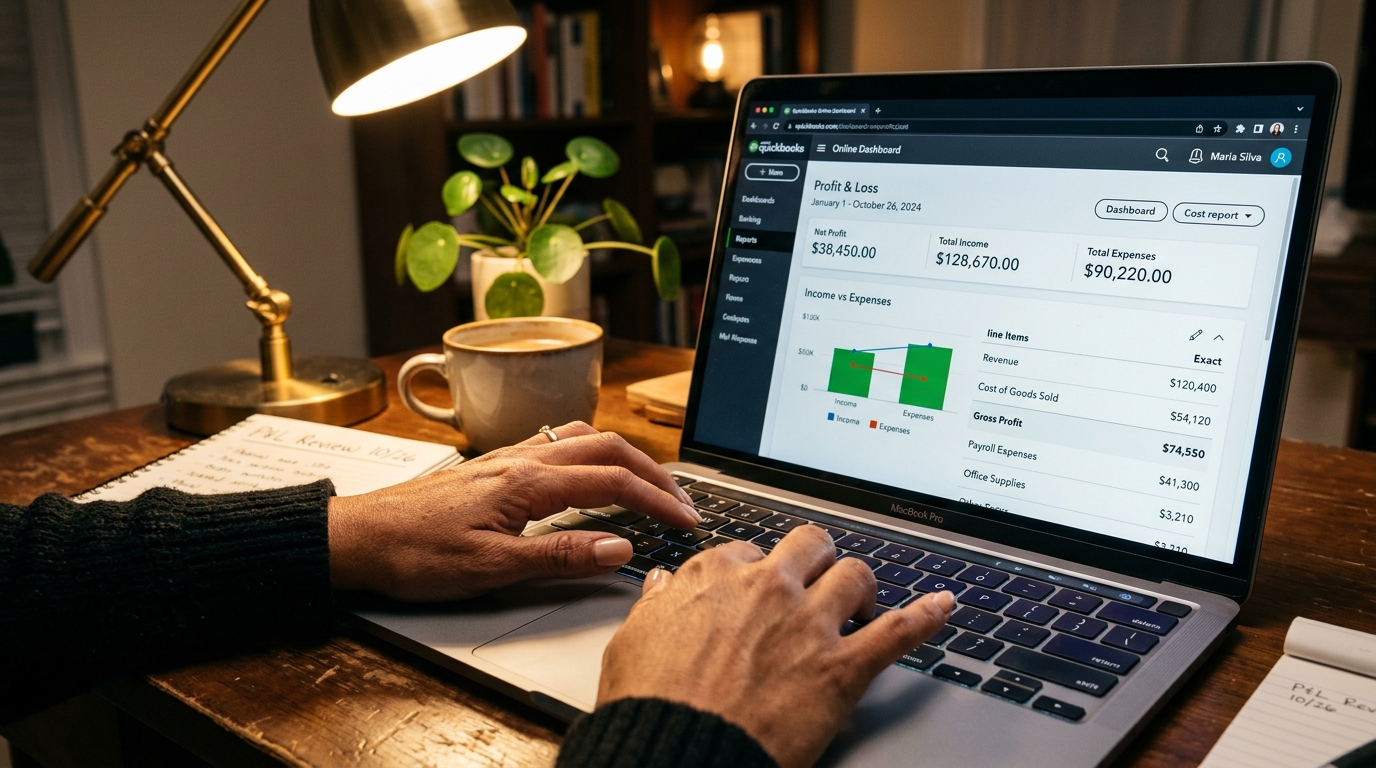
A QuickBooks bookkeeper is a financial operations specialist who lives inside your QuickBooks environment — whether that's QuickBooks Online, QuickBooks Desktop, or QuickBooks Enterprise. Their core job is to keep your books accurate, current, and ready for your accountant or CPA at tax time. That sounds simple, but the day-to-day work spans a wide range of tasks.
A skilled QuickBooks bookkeeper typically handles: bank and credit card reconciliation (weekly or monthly), accounts payable and receivable management, expense categorization and chart of accounts maintenance, payroll entry and reporting, invoice creation and follow-up, cash flow reporting, and preparation of monthly financial statements including P&L, balance sheet, and statement of cash flows. For businesses with inventory, they also manage COGS tracking and stock adjustments directly inside QuickBooks.
What a QuickBooks bookkeeper is not: they are not a CPA, and they should not be filing your tax returns or providing tax strategy advice. The bookkeeper keeps the data clean; the CPA interprets it. Many business owners conflate the two roles, which leads to overpaying a CPA for work a bookkeeper can do at a fraction of the cost — or underpaying a bookkeeper and then paying a CPA triple to clean up the mess.
According to the IRS Small Business recordkeeping guidance (2024), inadequate financial records are one of the primary triggers for small business audits — underscoring why consistent, professional bookkeeping is a compliance issue, not just an accounting preference.
If you're also evaluating cloud-based alternatives, it's worth reading how a Xero virtual bookkeeper compares to the QuickBooks model — the workflows differ more than most business owners expect.
How Much Does a QuickBooks Bookkeeper Cost in 2026?
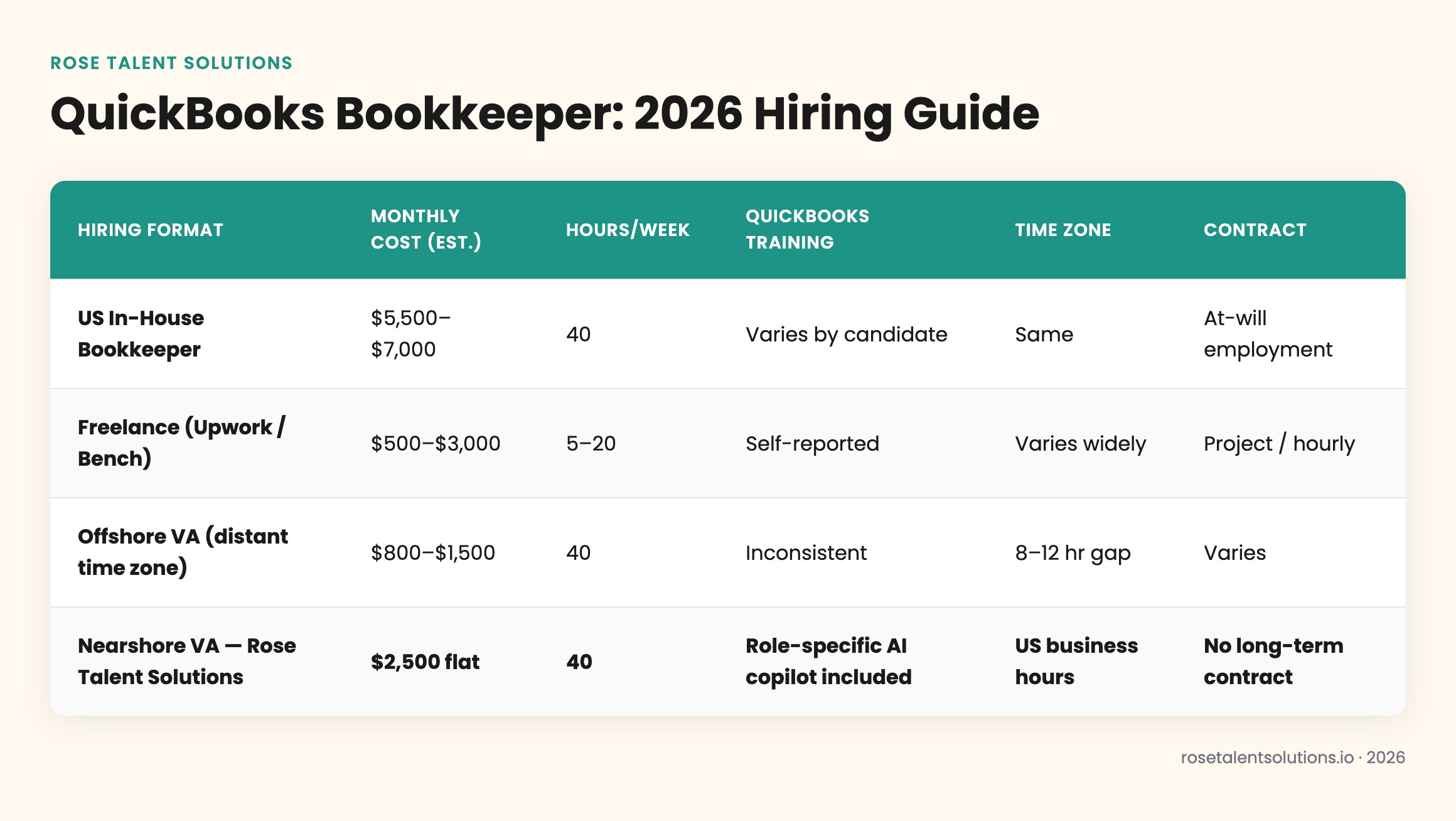
Cost is almost always the first question — and the answer depends heavily on the hiring format you choose. According to the U.S. Bureau of Labor Statistics (2024), the median annual wage for a bookkeeping, accounting, and auditing clerk in the United States is $47,440 — roughly $3,950 per month before you factor in payroll taxes, benefits, PTO, and recruiting costs. Add those in and an in-house bookkeeper in a mid-size US city easily runs $5,500–$7,000 per month in total cost of employment.
Freelance bookkeepers on platforms like Upwork or Bench typically charge $25–$75 per hour. At even 20 hours per month — which is barely enough for a small business — that's $500–$1,500 for part-time coverage with no continuity, no dedicated focus, and no accountability. For a detailed breakdown of what different engagement models cost side by side, see our post on QuickBooks bookkeeper cost.
The nearshore model changes the math entirely. A full-time, dedicated QuickBooks bookkeeper through Rose Talent Solutions runs $2,500 per month, flat — all-in, covering recruiting, vetting, payroll, HR administration, and ongoing management. No hidden fees, no long-term contract.
| Hiring Format | Monthly Cost (Est.) | Hours/Week | QuickBooks Training | Time Zone | Contract |
|---|---|---|---|---|---|
| US In-House Bookkeeper | $5,500–$7,000 | 40 | Varies by candidate | Same | At-will employment |
| Freelance (Upwork / Bench) | $500–$3,000 | 5–20 | Self-reported | Varies widely | Project / hourly |
| Offshore VA (distant time zone) | $800–$1,500 | 40 | Inconsistent | 8–12 hr gap | Varies |
| Nearshore VA — Rose Talent Solutions | $2,500 flat | 40 | Role-specific AI copilot included | US business hours | No long-term contract |
How Nearshore QuickBooks Bookkeepers Outperform Offshore Alternatives in 2026
The offshore bookkeeper pitch is attractive on paper — low hourly rates, large talent pools, and round-the-clock availability. In practice, the time zone gap is a structural problem that compounds every single day. A bookkeeper sitting 10–12 hours ahead of your business cannot respond to a vendor dispute in real time, cannot hop on a 10-minute call to clarify a transaction before you close a deal, and cannot attend your Monday morning financial review without staying up past midnight.
Nearshore bookkeepers based in Latin America work your business hours by design. Someone in Bogotá, Mexico City, or Buenos Aires is 0–3 hours from Eastern Time. They're online when you are, they respond to Slack messages the same way an in-house employee would, and they can join a Zoom call with five minutes' notice. That real-time availability changes the entire working relationship.
According to SHRM's research on workforce productivity (2023), communication lag is the single largest driver of rework in remote teams — and rework in bookkeeping means reconciling the same transaction twice, correcting misclassified expenses after the fact, or rebuilding financial reports from scratch. The time zone alignment of a nearshore model directly reduces this risk.
The hidden cost of distant-timezone bookkeeping isn't the hourly rate — it's the 8–12 hour communication gap that turns a 5-minute clarification into a 24-hour delay, repeated dozens of times per month. At scale, that gap costs more than the rate difference saves.
English fluency compounds the advantage. Rose's published minimum is 8/10 on English proficiency screening. Every team member is assessed before placement — not self-reported. That matters when your bookkeeper needs to communicate with vendors, respond to bank inquiries, or prepare client-facing financial summaries without you editing every sentence.
A Gallup State of the Global Workplace report (2024) found that businesses with fully engaged, dedicated support staff — rather than fractional or shared-service models — report 23% higher profitability on average. A dedicated nearshore bookkeeper who treats your books as their only job, not one of fifteen client files, is the operational model that reflects that finding.
For businesses evaluating their full bookkeeping engagement model — not just the hourly rate but the total structure — our breakdown of QuickBooks bookkeeping pricing covers how to think about value per hour versus value per outcome.

"Businesses that rely on asynchronous-only bookkeeping support consistently underestimate how much decision-making velocity they're sacrificing. Real-time financial visibility isn't a luxury — it's a competitive advantage." — Liz Scott, Accounting Technologist and QuickBooks ProAdvisor, Advisor Circle (2024)
What Is the AI Copilot Advantage for QuickBooks Bookkeepers in 2026?
Every Rose Talent Solutions team member ships with a role-specific AI copilot trained on their primary software stack. For a QuickBooks bookkeeper, that means the AI is trained specifically on QuickBooks Online workflows, reconciliation logic, chart of accounts best practices, and report generation sequences — not a generic chatbot bolted onto the side.
The practical result: a Rose QuickBooks bookkeeper doesn't need two weeks to find the reconciliation screen or six months to learn your report format preferences. The AI copilot surfaces the right workflow at the right moment, catches common categorization errors before they propagate, and helps the bookkeeper produce cleaner output faster. According to McKinsey & Company's analysis of generative AI in business functions (2023), AI-assisted workers in finance and accounting roles complete tasks 30–40% faster than unassisted peers performing the same work — with measurably lower error rates.
This is not the same as using a bookkeeping automation tool to replace the bookkeeper. The AI copilot augments a trained human who makes judgment calls — it doesn't replace the judgment. A categorization rule that QuickBooks auto-applies incorrectly still needs a human to catch it. The copilot helps the bookkeeper catch it faster.
According to Deloitte's research on AI and the future of work (2024), organizations that deploy AI as an augmentation layer — rather than a replacement layer — see 2x the productivity gains compared to firms attempting full automation of knowledge-worker tasks. The Rose AI copilot model is built on exactly this principle.
Businesses already using QuickBooks Online's native automation features will find that a Rose bookkeeper with an AI copilot works naturally alongside those features rather than around them. For a deeper look at how this model compares to hiring independently, see our post on QuickBooks virtual bookkeeper hiring.
How Rose Talent Solutions Matches and Onboards a QuickBooks Bookkeeper
Intake & Role Scoping
Rose's team interviews you about your QuickBooks version, transaction volume, industry, and specific pain points. This isn't a generic form — it determines the exact candidate profile they recruit against.
Candidate Vetting
Every candidate goes through QuickBooks proficiency testing, English fluency screening (8/10 minimum), and a background check before they're presented. You see pre-vetted finalists only.
Placement & AI Copilot Activation
Once you select a candidate, Rose activates their role-specific AI copilot trained on your software stack and coordinates the onboarding kickoff call with you and your new bookkeeper.
Ongoing Management
Rose handles payroll, HR, and performance oversight. If the placement isn't a fit, they replace the team member at no additional cost — the sole risk reversal built into the engagement.
The entire process from intake call to first day is typically under two weeks. Compare that to a US recruiting cycle for an in-house bookkeeper, which SHRM's Human Capital Benchmarking data (2024) puts at an average of 36 days to fill for finance and accounting roles — and that's before onboarding and ramp time.
Month-to-month terms mean you're not locked into a year-long commitment while you determine whether the role structure is right for your business. Cancel with 30 days' written notice. No long-term contract required.
Nearshore QuickBooks Bookkeeper — Strengths
- US business hours — real-time availability for calls, Slack, and reviews
- Full-time dedicated focus on your books, not split across 12 clients
- Flat $2,500/month — no variable billing surprises
- AI copilot trained on QuickBooks reduces ramp time and error rates
- Free replacement if the placement isn't a fit
- No long-term contract — month-to-month terms
Nearshore QuickBooks Bookkeeper — Limitations to Know
- Not a CPA — tax filing and advisory require a separate engagement
- Best fit for businesses needing 20+ hours/week of bookkeeping support (full-time model)
- Requires you to provide QuickBooks access and basic process documentation upfront
If your business needs more than one finance function covered — say, bookkeeping and accounts payable management — Rose's bookkeeping and accounting staffing practice can scope a team structure that covers both without doubling overhead. And if you're ready to get started, the intake process at Rose takes under 15 minutes to kick off.