
Nearshore bookkeeping outsourcing has quietly become the most cost-effective staffing decision a US business owner can make in 2026. The rate gap between a domestic bookkeeper and a fully managed nearshore virtual bookkeeper now exceeds $40,000 per year — and the nearshore hire often delivers more, not less. But "outsourcing bookkeeping rates" is a phrase that hides a lot of variation. Hourly freelancers, offshore firms, onshore CPAs, and nearshore virtual staff all carry different price tags, different risk profiles, and very different day-to-day experiences. This guide breaks every model down so you can make a straight comparison.
What Are the Main Outsourcing Bookkeeping Rate Models in 2026?
Bookkeeping outsourcing rates generally fall into four pricing structures. Understanding which structure you're buying matters more than the headline number.
Hourly freelance rates run $15–$40/hr offshore (Philippines, India) and $45–$85/hr onshore (US). These look cheap at first glance, but an hourly bookkeeper has zero incentive to work efficiently — slow work earns more. You also absorb all the management overhead yourself.
Project-based or task-based pricing is common with accounting firms. You pay per bank reconciliation, per financial statement, or per tax filing. Rates vary from $100–$500 per deliverable. This works fine for one-off cleanups but breaks down for ongoing operations that need consistent daily attention.
Monthly retainer pricing from bookkeeping firms (think Bench, Pilot, Bookkeeper360) ranges from $299/month for bare-bones automated categorization to $1,200–$2,500/month for a dedicated human bookkeeper. The catch: you're often paying for a shared resource who juggles 20+ clients.
Flat-rate dedicated staffing — the model Rose Talent Solutions uses — runs $2,500/month for a full-time (40 hrs/week), dedicated virtual bookkeeper based in Latin America. That rate includes recruiting, vetting, payroll, HR, and an AI copilot trained on your specific software stack. One person, all yours, every business day. If you want to understand exactly what a dedicated QuickBooks bookkeeper costs at different service levels, that breakdown is worth reading before you finalize your budget.

How Do Offshore, Nearshore, and Onshore Bookkeeping Rates Compare in 2026?
The rate difference between regions is real, but the real cost comparison has to include timezone friction, communication overhead, and turnover. According to the U.S. Bureau of Labor Statistics (2024), the median annual wage for a bookkeeping clerk in the United States is $47,440 — roughly $22.80/hr before benefits, payroll taxes, and overhead that push the true employer cost past $60,000/year. That context makes the comparison table below land harder.
| Model | Typical Rate | Hours | Time Zone Overlap with US | Dedicated? | HR/Payroll Included? |
|---|---|---|---|---|---|
| Onshore US bookkeeper (employee) | $47,000–$70,000/yr | 40/wk | Full overlap | Yes | No (you manage) |
| Onshore US bookkeeping firm | $75–$150/hr | Varies | Full overlap | Rarely | N/A |
| Offshore freelancer (Philippines/India) | $15–$40/hr | Varies | 0–4 hrs overlap | Sometimes | No |
| Offshore bookkeeping firm | $500–$1,200/mo | Part-time/shared | 0–4 hrs overlap | No (shared) | No |
| Nearshore VA — Rose Talent Solutions | $2,500/mo flat | 40/wk | Full US hours | Yes | Yes (all-in) |
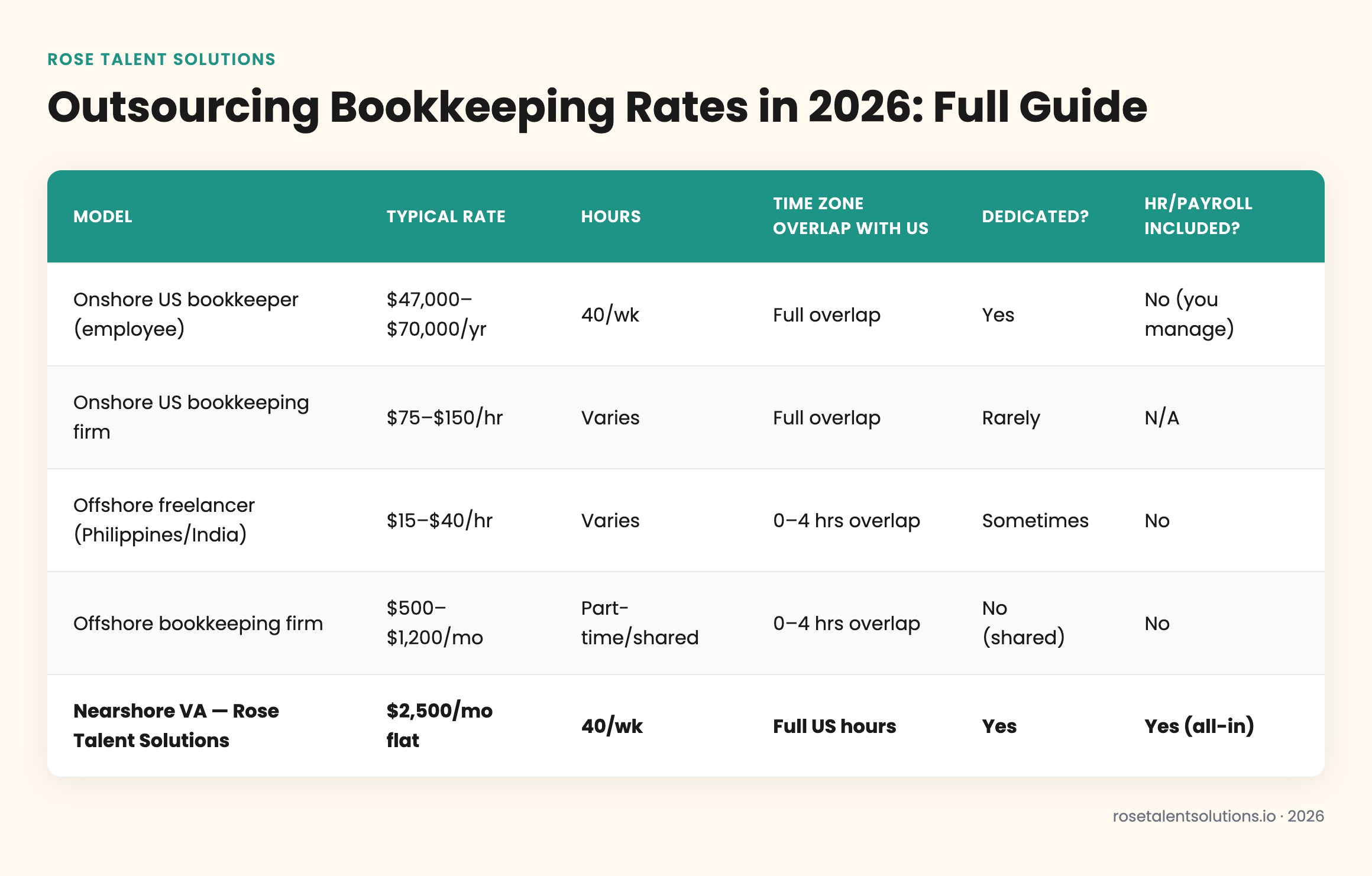
The table makes one thing clear: offshore bookkeeping looks cheapest on paper but delivers part-time, shared resources with a 6–12 hour timezone gap. Nearshore bookkeepers from Latin America work your exact US business hours — Eastern, Central, Mountain, or Pacific — so a question you send at 10am gets answered by 10:15am, not the next morning. For businesses comparing bookkeeping outsourcing companies side by side, timezone alignment consistently ranks as a top-three decision factor.
The global outsourcing market reflects this shift. According to Statista (2024), the business process outsourcing market is valued at over $280 billion globally, with finance and accounting functions representing one of the fastest-growing segments. US small and mid-size businesses are driving a disproportionate share of that growth — because at 2026 nearshore rate levels, the math is simply undeniable.
What Hidden Costs Drive Up Your Real Outsourcing Bookkeeping Rates?
The sticker rate is the least important number in the equation. Here's what most business owners don't price in when they compare bookkeeping outsourcing rates.
The hidden cost of offshore bookkeeping isn't the hourly rate — it's the 6–12 hour timezone gap that turns a 10-minute clarification into a 24-hour delay on every single transaction question, reconciliation hold, or vendor dispute.
Onboarding and ramp time. A bookkeeper who doesn't know your software costs you weeks of productivity. According to SHRM (2022), the average cost to hire and onboard a new employee exceeds $4,700 — and that's before they're productive. Rose's AI copilot, pre-trained on tools like QuickBooks, Xero, and FreshBooks, compresses that ramp period significantly from day one. If you're specifically running Xero, the ROI of hiring a Xero-trained virtual bookkeeper versus a generalist is measurable within the first billing cycle.
Turnover replacement costs. Freelance bookkeepers churn. When they leave, you lose institutional knowledge and pay to rehire. A flat-rate managed staffing model absorbs that risk — Rose replaces your team member at no additional cost if they're not a fit, and handles the full re-recruiting process internally.
Employer taxes and benefits. A $47,000/year US bookkeeper costs you closer to $62,000–$65,000 when you add FICA, unemployment insurance, health insurance, and PTO, according to data from the BLS Employer Costs for Employee Compensation report (2024). The $2,500/month nearshore flat rate already accounts for all of that on the vendor's side — you pay one number, full stop.
Productivity loss from misaligned hours. A Gallup (2023) analysis of workplace engagement found that employees working outside their team's core hours show measurably lower task completion rates and collaboration scores. That dynamic is exactly what you get when you hire an offshore bookkeeper in a 10-hour time difference — a structural productivity drain that compounds every day.

Software licensing and training. Many freelancers bill separately for software access or require you to provide it. A managed nearshore staffing model typically includes a team member who already holds platform certifications or has been screened for proficiency in your specific tools — so you're not paying for a learning curve on top of the base rate.
How Does Rose Talent Solutions' Bookkeeping Rate Work in Practice?
Rose charges $2,500/month. That is the entire invoice. No per-task fees, no overtime surprises, no HR administration bills. Here's what that single number covers from intake to ongoing operations.
Role Scoping Call
Rose's team maps your exact bookkeeping workflow — software, volume, reporting cadence — to define the candidate profile before recruiting begins.
Recruiting & Vetting
Candidates are screened for English proficiency (8/10+ floor), bookkeeping certifications, and hands-on software experience. You only meet finalists.
AI Copilot Activation
Your team member ships with a role-specific AI copilot pre-trained on your accounting software — QuickBooks, Xero, FreshBooks, or others — so they're productive fast.
Full-Time Placement
Your bookkeeper works 40 hours/week on your schedule, your time zone, integrated into your team's communication channels like any other staff member.
Ongoing HR & Management
Rose handles payroll, compliance, HR issues, and performance oversight. If the placement isn't a fit, Rose replaces them at no additional cost.
The arrangement runs month-to-month. There is no long-term contract. You cancel with 30 days written notice if your needs change. For businesses that have explored Rose's bookkeeping and accounting staffing options in detail, the all-in pricing model is consistently what moves them off the fence — no hidden fees, no share-of-seat arrangements, no surprise invoices.
The AI advantage deserves its own emphasis. Every Rose bookkeeper arrives with a copilot trained specifically on their role's software environment. This isn't a generic ChatGPT wrapper — it's a purpose-built assistant that surfaces relevant transaction categories, flags reconciliation anomalies, and drafts financial summaries in the format your reports require. You can read more about how that technology works across all Rose placements on the AI advantage page.
Is Nearshore Bookkeeping Outsourcing Right for Your Business in 2026?
Nearshore bookkeeping outsourcing is the right call if you need full-time bookkeeping coverage, want real-time timezone alignment, and don't want to manage HR, payroll, or recruiting yourself. It's less ideal if you only need 5 hours a month of bookkeeping — a part-time freelancer or an automated tool like QuickBooks Live is sufficient at that volume.
Nearshore Virtual Bookkeeper — Pros
- Full US business hours — real-time availability
- Dedicated to you, not shared across 20 clients
- All-in flat rate with no HR/payroll overhead
- AI copilot trained on your specific software
- English fluency at 8/10+ screened bar
- Free replacement if not a fit
- No long-term contract
Nearshore Virtual Bookkeeper — Considerations
- $2,500/month is overkill for very low-volume needs (<10 hrs/month)
- Not a CPA — can't sign off on audits or file taxes independently
- Requires you to provide software access and process documentation upfront
The volume threshold matters. A business processing more than 150 transactions per month, managing payroll for 5+ employees, or running multi-entity financials almost certainly needs dedicated full-time bookkeeping. At that point, the $2,500/month flat rate beats every alternative on a total cost basis. For niche use cases — such as healthcare accounts receivable outsourcing, which carries its own compliance and coding complexity — a role-specific nearshore specialist can handle the volume without the overhead of a domestic billing department.
According to a McKinsey Global Institute report (2023), finance and accounting functions rank among the highest-ROI targets for outsourcing and automation — with businesses that combine human expertise and AI tooling outperforming those using either alone. That's exactly the combination a nearshore bookkeeper with an AI copilot delivers.
"The businesses winning on cost efficiency aren't choosing between people and technology — they're combining talent with AI assistance to run lean finance operations that outperform teams three times their size." — Liam Fitzgerald, Partner at Deloitte Finance & Operations Practice (2024)
If you're ready to see how the placement process works end-to-end, the fastest path is a scoping conversation. You can get started with Rose in under five minutes — no lengthy intake forms, just a direct conversation about your bookkeeping workflow and what you need covered.