
Why Businesses Are Turning to Bookkeeping Outsourcing Companies in 2026
Nearshore bookkeeping outsourcing has moved from a niche cost-cut to a mainstream operating decision for small and mid-size businesses across the US, Canada, and the UK. The math is straightforward: a full-time, in-house bookkeeper in a mid-size US city now costs $55,000–$70,000 per year in salary alone — before benefits, payroll taxes, and PTO. Outsourcing the same role to a trained, English-fluent specialist based in Latin America routinely runs less than half that. And unlike the offshore models of a decade ago, today's nearshore providers deliver staff who work your business hours, speak fluent English, and arrive pre-trained on the software you already use.
According to the U.S. Bureau of Labor Statistics (2024), the median annual wage for bookkeeping, accounting, and auditing clerks in the United States is $47,440 — and that figure doesn't include employer-side costs that typically add 20–30% on top. For growing businesses watching every dollar, that gap between in-house and outsourced is impossible to ignore.
This guide breaks down what the best bookkeeping outsourcing companies actually offer in 2026, how to compare them honestly, and what separates a provider that saves you money from one that creates new headaches.
What Is a Nearshore Bookkeeping Outsourcing Company?
A nearshore bookkeeping outsourcing company places trained financial staff — bookkeepers, accounts payable specialists, payroll coordinators — in a geographically close, lower-cost country that shares or overlaps your time zone. For US and Canadian businesses, "nearshore" almost always means Latin America: countries like Colombia, Mexico, Argentina, and Costa Rica. This is distinct from offshore outsourcing, which typically routes work to the Philippines or India — locations with a 10–14 hour time difference that creates real operational friction.
The nearshore model matters because time zone alignment is the single most overlooked variable when businesses compare outsourcing options. A bookkeeper who can answer your call at 2pm EST, hop into a Zoom to walk through a vendor dispute, and close out a reconciliation before your team logs off is a fundamentally different resource than one who batches your questions overnight. If you want to go deeper on which specific providers operate in the region, our breakdown of top Latin America bookkeeping outsourcing companies covers the landscape in detail.

How 2026's Best Providers Compare: Nearshore vs. Offshore vs. Onshore
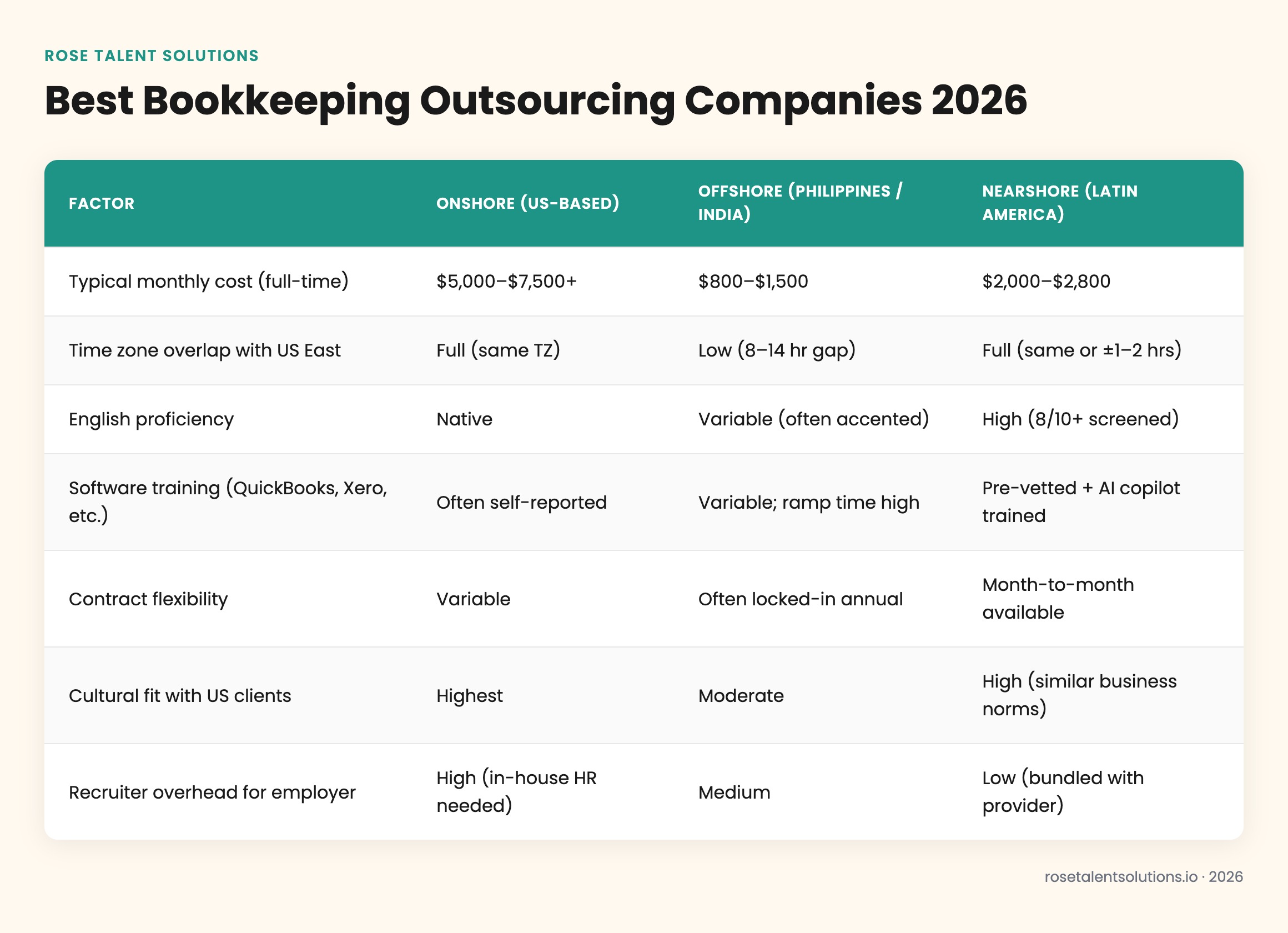
Not all bookkeeping outsourcing companies are built the same. The table below cuts through the marketing language and compares the three main delivery models on the dimensions that actually affect your day-to-day operations.
| Factor | Onshore (US-based) | Offshore (Philippines / India) | Nearshore (Latin America) |
|---|---|---|---|
| Typical monthly cost (full-time) | $5,000–$7,500+ | $800–$1,500 | $2,000–$2,800 |
| Time zone overlap with US East | Full (same TZ) | Low (8–14 hr gap) | Full (same or ±1–2 hrs) |
| English proficiency | Native | Variable (often accented) | High (8/10+ screened) |
| Software training (QuickBooks, Xero, etc.) | Often self-reported | Variable; ramp time high | Pre-vetted + AI copilot trained |
| Contract flexibility | Variable | Often locked-in annual | Month-to-month available |
| Cultural fit with US clients | Highest | Moderate | High (similar business norms) |
| Recruiter overhead for employer | High (in-house HR needed) | Medium | Low (bundled with provider) |
What Does a Bookkeeping Outsourcing Company Actually Cost in 2026?
Pricing varies more than most vendor websites admit. The three main models you'll encounter are: per-hour billing, per-transaction pricing, and flat monthly rates. Each has trade-offs.
Per-hour billing sounds transparent, but costs balloon the moment volume spikes — end-of-quarter reconciliations, tax season catch-up, a messy accounts payable backlog. Per-transaction pricing penalizes growth. Flat monthly rates are the cleanest model for businesses that want predictable operating costs. Rose Talent Solutions charges $2,500/month flat — that covers a dedicated, full-time (40 hrs/week) bookkeeper, including recruiting, vetting, payroll, HR administration, and ongoing performance management. No hidden add-ons, no long-term contract, and if the team member isn't a fit, we replace them at no additional cost.
If you're already using QuickBooks and want to understand what a trained specialist typically costs through different channels, our post on QuickBooks bookkeeper cost walks through the real numbers. And if you're evaluating subscription-based bookkeeping software vs. a live dedicated hire, the comparison in our QuickBooks bookkeeping pricing guide is worth a read before you sign anything.
According to SHRM (2024), the average cost per hire in the US is $4,700 — and that's before the new employee produces a single reconciled statement. When you factor in onboarding time (typically 30–90 days for a bookkeeping role to reach full productivity), the true cost of a traditional hire is significantly higher. Outsourcing eliminates that sunk cost entirely.
How AI Copilots Are Changing Bookkeeping Outsourcing in 2026
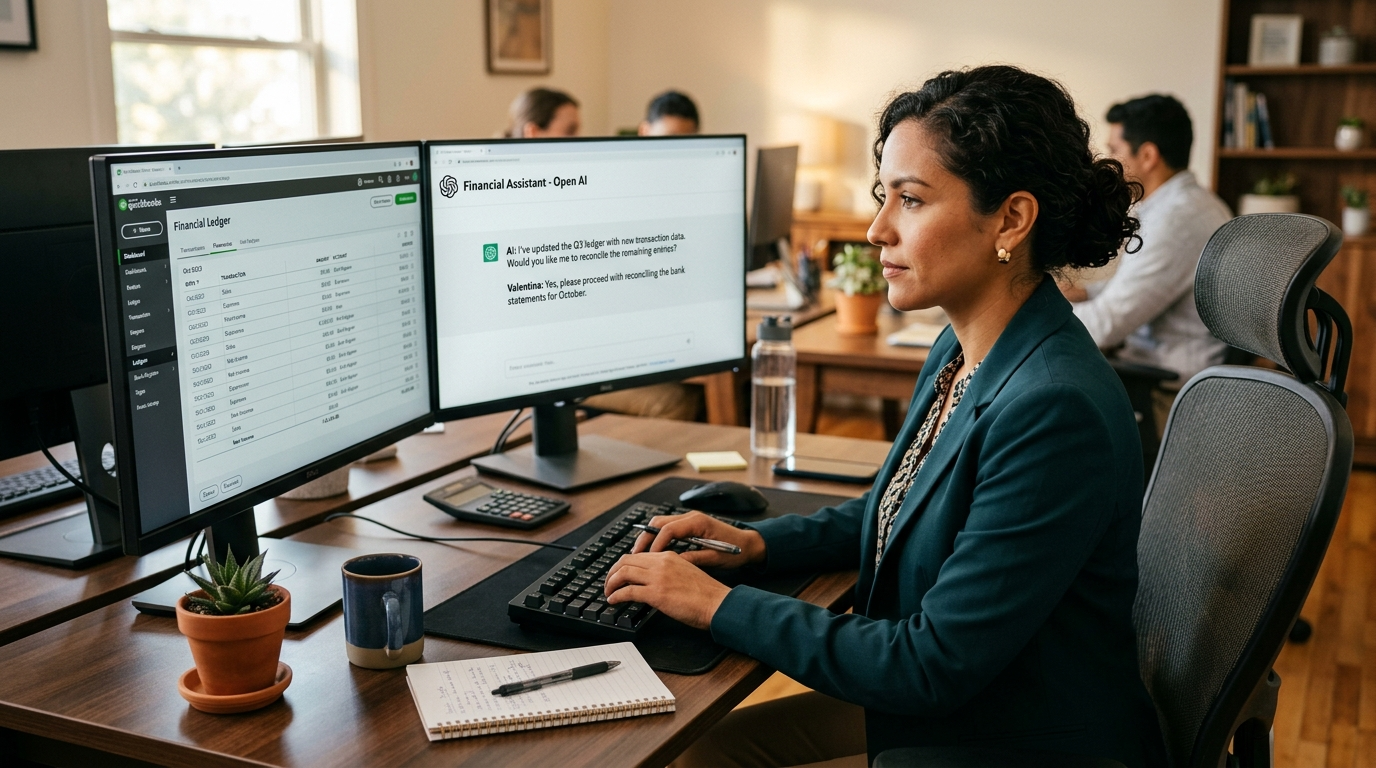
The best bookkeeping outsourcing companies in 2026 aren't just placing humans — they're placing humans who are augmented by software-specific AI tools. At Rose, every team member ships with a role-specific AI copilot trained on the exact software your business uses: QuickBooks, Xero, FreshBooks, Wave, or accounting modules inside platforms like AppFolio and Buildium for property management clients.
What does that mean in practice? Your bookkeeper doesn't spend the first two weeks figuring out where the bank reconciliation screen lives. They arrive with muscle memory baked in via AI-assisted training — and they have a context-aware copilot available to surface the right workflow when edge cases come up. This matters because McKinsey Global Institute (2023) estimates that generative AI tools can boost individual worker productivity by 20–45% in knowledge work tasks — bookkeeping sits squarely in that category.
If your business uses Xero specifically, it's worth understanding what a Xero virtual bookkeeper brings to the table versus a generalist — the software fluency gap between a trained specialist and a self-reported Xero user is significant enough to affect your month-end close timeline. You can also explore Rose's AI advantage to see how the copilot system works in practice.
"The accounting profession is not going away — but the manual, repetitive layer of bookkeeping is being compressed. Firms that pair skilled humans with the right AI tools will close books in days, not weeks." — Jody Grunden, Co-Founder of Summit CPA Group (2023)
The hidden cost of a generic bookkeeping outsourcing company isn't the monthly fee — it's the 4–6 week ramp time you absorb while a new hire learns your software from scratch. AI-copilot-equipped nearshore bookkeepers cut that ramp in half because the tool coaching happens before day one.
How to Evaluate Bookkeeping Outsourcing Companies in 2026: A Step-by-Step Process
Most buyers spend too long comparing price and not enough time evaluating the factors that actually predict whether the engagement will succeed. Here's the sequence that experienced operators use.
Define your software stack first
List every platform your bookkeeper will touch — QuickBooks, Xero, your invoicing tool, your payroll system. Any provider you evaluate should demonstrate pre-existing proficiency in all of them, not just the primary one.
Verify time zone coverage
Ask specifically: "Will my bookkeeper be available during my business hours?" Get the answer in writing. "Flexible hours available" is not the same as "works 9am–5pm EST by default."
Test English proficiency directly
Request a short video introduction or a live intro call with the candidate before placement. Rose screens to an 8/10+ English fluency floor — you should be able to confirm that standard yourself before committing.
Understand the replacement policy
Ask what happens if the placement isn't a fit after 30 days. A provider confident in their vetting will offer a free replacement. Anything that requires you to restart the process and pay again is a red flag.
Read the contract terms carefully
Month-to-month with 30 days written notice is the standard you should hold out for. Multi-year lock-ins are common in the offshore market — avoid them until you've validated the relationship first.
According to Deloitte's Global Outsourcing Survey (2022), 70% of companies cite "enabling focus on core business functions" as a primary driver for outsourcing — but 34% cite "managing service quality" as their biggest ongoing challenge. The evaluation process above is designed specifically to surface quality signals before you sign, not after.
Nearshore vs. Offshore Bookkeeping: Pros and Cons for US Businesses
If you're still weighing the two models, this honest breakdown will help. Both have legitimate use cases — but for businesses that need real-time collaboration, the gap is significant.
Nearshore (Latin America) — Pros
- Full US time zone alignment — no overnight batch delays
- High English fluency (screened, not assumed)
- Strong cultural overlap with US business norms
- Faster ramp with AI copilot support
- Month-to-month terms common among quality providers
- Real-time Zoom availability for client calls
Offshore (Philippines / India) — Cons
- 8–14 hour time gap means same-day turnaround is rare
- English fluency varies widely by provider and individual
- Annual contracts common, limiting your flexibility
- Longer ramp times when software training isn't pre-baked
- Harder to verify vetting standards from overseas providers
The decision often comes down to how integrated you need your bookkeeper to be with your daily operations. If you just need end-of-month reports and reconciliations and you're comfortable with async communication, offshore may work. If your bookkeeper needs to join team calls, respond to vendor inquiries in real time, or coordinate with your CPA during tax season, nearshore is the only model that scales without friction. You can explore Rose's bookkeeping and accounting staffing options to see what a full-time dedicated role looks like in practice, or get started with a placement conversation.
The Gallup Workplace Report (2023) found that employees who work in roles with high autonomy and clear expectations — exactly the structure a well-onboarded remote bookkeeper operates in — report 23% higher productivity scores than those in ambiguous or micromanaged roles. The setup matters as much as the hire.