
Nearshore outsourced SDR firms are reshaping how US companies build pipeline in 2026. Instead of hiring a $75,000-a-year in-house rep who takes three months to ramp, more sales leaders are turning to Latin America-based SDR teams who work US business hours, speak fluent English, and hit the phones on day one. This guide breaks down exactly what an outsourced SDR firm does, how to evaluate one, and what the nearshore model gets right that offshore alternatives consistently get wrong.
If you're running a lean sales org — or building one from scratch — the decision of where to source SDR talent is one of the highest-leverage choices you'll make this year. Get it wrong and you burn budget on ramp, timezone friction, and constant turnover. Get it right and you add a full pipeline-generation function for a fraction of the cost of one US hire.
According to SHRM (2024), replacing a single SDR costs between 50% and 200% of that rep's annual salary once you factor in recruiting, onboarding, and lost pipeline during the transition. That number alone explains why outsourced models are growing fast — the math just works differently when your provider handles recruiting, replacement, and management as part of a flat monthly rate.
What Is an Outsourced SDR Firm — and What Does One Actually Do?
An outsourced SDR firm is a company that places or manages sales development representatives on your behalf. SDRs (Sales Development Representatives) are outbound prospectors: they identify target accounts, make cold calls, send cold emails, run LinkedIn sequences, and book qualified discovery calls for your closing team. They do not close deals — that's the account executive's job. SDRs are the top-of-funnel engine that keeps your pipeline full.
An outsourced SDR firm handles the entire talent layer: recruiting the rep, vetting them for sales aptitude and English fluency, training them on your ICP (Ideal Customer Profile), loading them into your tech stack (HubSpot, Salesforce, Outreach, Apollo, etc.), and managing their daily performance. The best firms also provide a dedicated account manager who reviews metrics weekly and course-corrects before problems compound.
What separates a great outsourced SDR firm from a mediocre one comes down to three factors: timezone overlap, English communication quality, and how deeply the rep is trained on your specific tools and sequences. An SDR who works 9 am–5 pm in Manila — 12 hours behind EST — is going to miss most of your prospects' live call windows. That's not a timezone inconvenience; it's a structural pipeline leak.
If you're evaluating providers for a SaaS company specifically, our guide on how to hire outsourced SDR services for SaaS walks through the additional criteria that matter when your product has a longer technical sell.

How Nearshore SDR Firms Outperform Offshore Models in 2026
The offshore outsourcing playbook — built around rock-bottom hourly rates in the Philippines or India — made sense when the primary goal was cost reduction. In 2026, the primary goal for most companies is pipeline quality. Those are different optimization targets, and they require different sourcing decisions.
Latin America covers Colombia, Mexico, Argentina, and several other markets where English proficiency is high, business culture aligns closely with the US, and the timezone gap to the East Coast is zero to two hours. That means your nearshore SDR is dialing prospects at 9 am EST when your nearshore SDR is also at their desk at 9 am. No batched overnight messages. No delayed follow-ups. Live objection handling in real time.
Offshore providers in Southeast Asia often advertise lower per-hour rates, but the total cost picture shifts when you account for after-hours premiums, higher turnover rates, and the management overhead of supervising a team operating on the opposite side of the planet. A flat-rate nearshore model removes all of those variables.
"Timezone alignment is not a soft preference — it is a hard pipeline variable. Every hour of delay in prospect follow-up reduces qualification rates by double digits." — Jacco van der Kooij, Founder at Winning by Design (2023)
The quality gap also shows up in written communication. Cold email and LinkedIn outreach depend on nuanced, native-level English phrasing. According to EF Education First's English Proficiency Index (2024), several Latin American countries now score in the "high proficiency" band, outperforming many Southeast Asian markets that dominate offshore outsourcing. Rose Talent Solutions sets a minimum 8/10 English proficiency score on every screen — a bar most offshore providers do not publish at all.
For a detailed financial breakdown of what outsourcing actually costs versus building in-house, the outsourced vs. in-house SDR hiring ROI comparison runs the full numbers including salary, benefits, tools, and ramp time.
Outsourced SDR Firm Comparison: Nearshore vs. Offshore vs. Onshore in 2026
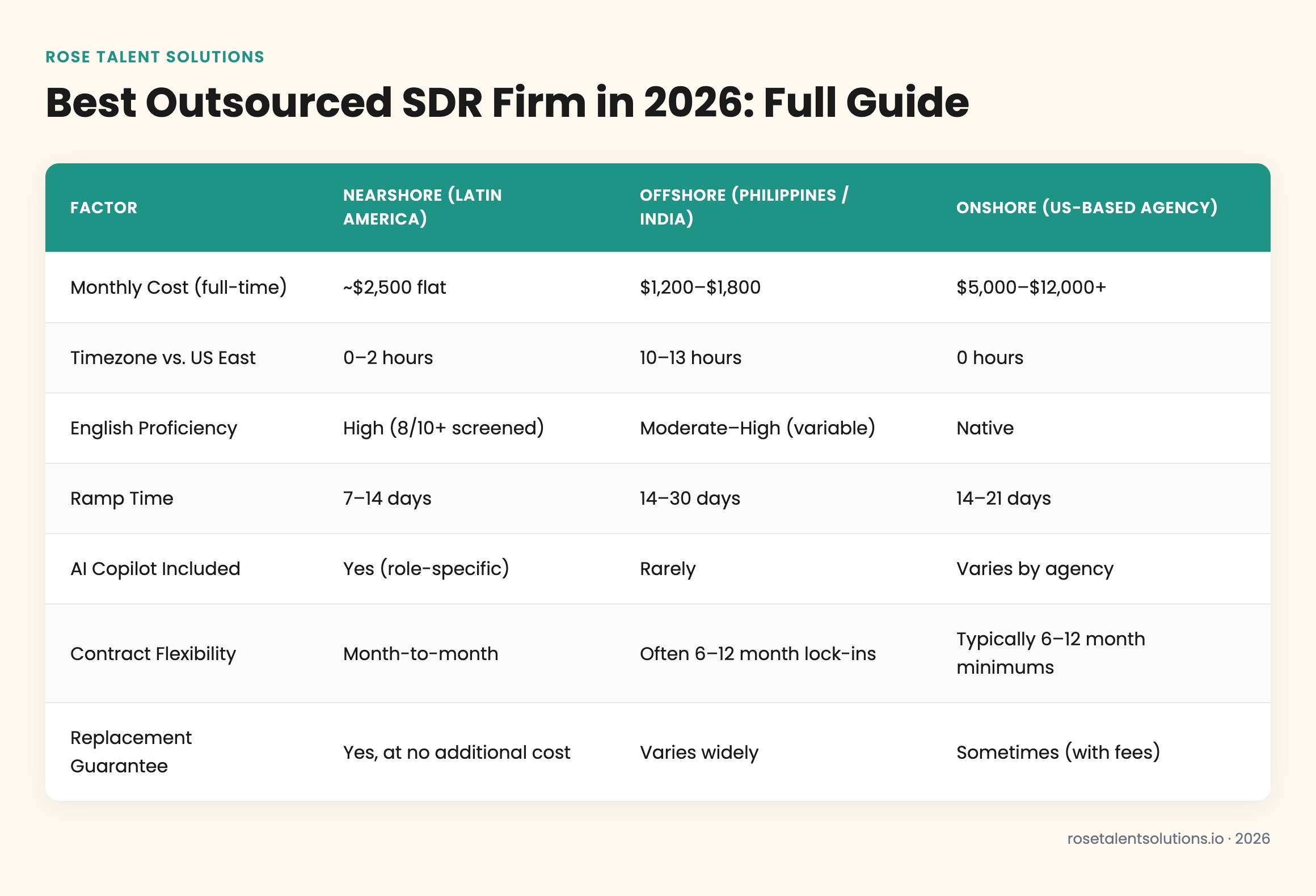
Not all outsourced SDR models are built the same. The table below compares the three dominant sourcing models across the dimensions that actually affect pipeline output.
| Factor | Nearshore (Latin America) | Offshore (Philippines / India) | Onshore (US-based agency) |
|---|---|---|---|
| Monthly Cost (full-time) | ~$2,500 flat | $1,200–$1,800 | $5,000–$12,000+ |
| Timezone vs. US East | 0–2 hours | 10–13 hours | 0 hours |
| English Proficiency | High (8/10+ screened) | Moderate–High (variable) | Native |
| Ramp Time | 7–14 days | 14–30 days | 14–21 days |
| AI Copilot Included | Yes (role-specific) | Rarely | Varies by agency |
| Contract Flexibility | Month-to-month | Often 6–12 month lock-ins | Typically 6–12 month minimums |
| Replacement Guarantee | Yes, at no additional cost | Varies widely | Sometimes (with fees) |
How an Outsourced SDR Firm Handles Cold Email at Scale in 2026
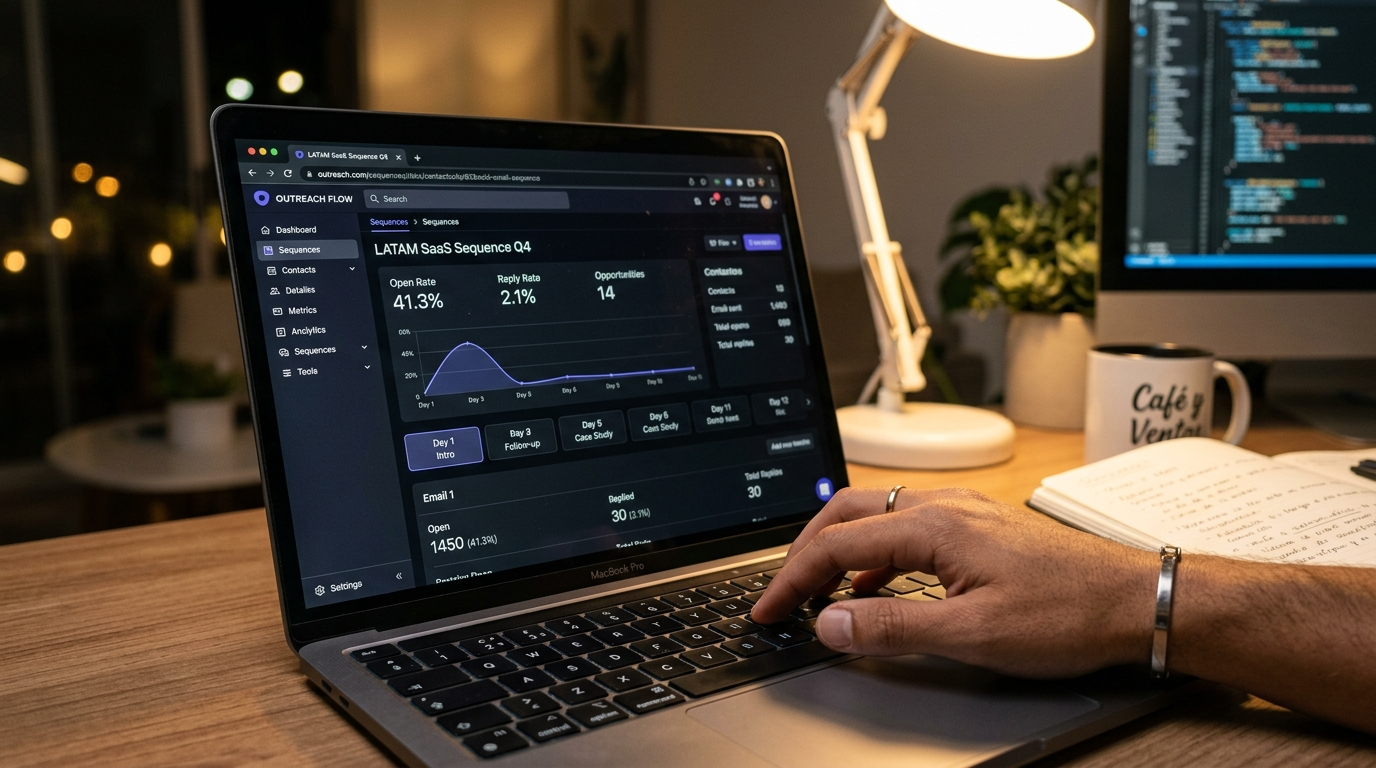
Cold email remains one of the highest-ROI outbound channels in B2B sales when executed correctly. According to McKinsey & Company (2024), personalized outbound email sequences outperform generic blasts by 6x on reply rate. That personalization requires SDRs who can research accounts, write crisp copy, and adapt messaging based on reply signals — skills that demand genuine English fluency and business acumen.
A professional outsourced SDR firm builds cold email infrastructure around your ICP from day one. That includes domain warming, deliverability monitoring, A/B testing subject lines, and rotating sending accounts to protect your primary domain's reputation. SDRs who are just "sending emails" without this infrastructure will burn your domain and crater your deliverability within 60 days.
The biggest cold email mistake isn't poor copy — it's poor infrastructure. Domain reputation, sending limits, and reply monitoring are operational disciplines that a qualified outsourced SDR firm handles as standard practice, not add-ons.
Every Rose Talent Solutions SDR ships with a role-specific AI copilot trained on your sales tools — whether that's HubSpot sequences, Apollo.io campaigns, or Outreach workflows. The AI layer accelerates personalization at scale: the rep sets the strategic direction, and the AI handles first-draft copy, subject line variants, and follow-up timing recommendations. That combination is what lets one nearshore SDR outperform two traditional offshore reps on raw output metrics.
For a deep dive into the operational mechanics, our post on how outsourced SDRs handle cold email at scale covers sending infrastructure, sequence architecture, and deliverability management in detail.
How to Evaluate an Outsourced SDR Firm Before You Sign
The outsourced SDR market is crowded with providers making similar claims. Here's how to cut through the noise and evaluate firms on substance.
Audit Their Vetting Process
Ask exactly how they screen SDR candidates. A rigorous firm publishes minimum English proficiency scores, tests cold call aptitude, and verifies CRM experience before placement — not after.
Confirm Timezone Coverage
Ask whether your SDR will work your business hours as a contractual commitment, not a preference. If the answer is vague, walk away. Timezone misalignment is the silent killer of outsourced SDR programs.
Get the Pricing in Writing
All-in flat pricing eliminates billing surprises. Avoid providers who charge base rates plus recruiting fees, platform fees, or management fees as line items — the total cost always drifts above the quoted rate.
Ask About the Replacement Policy
A confident firm offers replacement at no additional cost if the SDR isn't a fit. This is the standard risk reversal — if a firm won't commit to it, that tells you something about their confidence in their own vetting.
Check Contract Flexibility
Avoid firms that require 6–12 month commitments before you've validated performance. The right provider offers month-to-month terms with no long-term contract — so you're staying because the results justify it, not because you're locked in.
According to the US Bureau of Labor Statistics (2024), the median annual wage for a sales representative in the United States exceeds $67,000 before benefits, commission, tools, and management overhead. For small and mid-sized companies — especially those with fewer than 20 employees — that fully-loaded cost makes in-house SDR headcount nearly impossible to justify at early pipeline stages. Our post on the best B2B lead generation services for under-20-employee companies maps out the full landscape of options for lean teams.
What the Rose Talent Solutions Nearshore SDR Model Looks Like in Practice
Rose Talent Solutions places nearshore SDRs from Latin America at a flat rate of $2,500 per month — full-time, 40 hours per week. That rate includes recruiting, vetting, payroll, HR, and ongoing management. There are no recruiting surcharges, no platform fees, and no long-term contract. If the team member isn't a fit, Rose replaces them at no additional cost.
Every placement starts with a role-specific AI copilot trained on your stack. If your SDR is running sequences in HubSpot, the AI copilot knows HubSpot. If your team uses Apollo.io for prospecting, the copilot accelerates account research and personalization inside Apollo. This isn't a generic AI add-on — it's purpose-built tooling that cuts ramp time and raises per-rep output from week one. Learn more about how the AI advantage works across every role Rose places.
Why Nearshore SDRs Win
- Same-timezone as US prospects — dials live during business hours
- 8/10+ English proficiency screened at intake
- Flat $2,500/month — no recruiting or platform add-ons
- AI copilot trained on your specific sales tools
- Month-to-month terms — no long-term contract required
- Free replacement if the SDR isn't a fit
Where Offshore SDRs Fall Short
- 10–13 hour timezone gap eliminates real-time prospect calls
- Variable English quality with no published proficiency floor
- Hourly rates look cheaper but total costs drift with add-ons
- Lock-in contracts before you've validated performance
- No role-specific AI tooling standard
- Replacement policies inconsistent or fee-based
The engagement starts in days, not months. Once you start the process with Rose, the matching and vetting happens fast — most clients have a placed SDR within the first week. From there, your account manager handles daily oversight, performance reviews, and any escalations. You get a pipeline-generating function without the people-management overhead.
According to Gallup's State of the Global Workplace report (2024), employees who feel their managers actively support their development are 3.6x more likely to be engaged in their role. Rose's ongoing management model is built around that principle — your SDR isn't placed and forgotten. They're actively managed, coached, and measured against your specific pipeline goals week over week.