
What Is an Outsourced SDR — and Why Does 2026 Change the Calculation?
Nearshore outsourced SDRs are sales development representatives hired through a staffing or agency partner, based in Latin America, who work your time zone and handle the top of your sales funnel — cold outreach, lead qualification, and meeting booking — so your closers can close. The model has existed for years, but three things shifted in 2026: AI-assisted prospecting tools cut ramp time dramatically, rising US salary expectations made in-house SDRs harder to justify at early growth stages, and nearshore talent pools deepened significantly.
An outsourced SDR is not a freelancer you found on a job board. They work full-time, dedicated hours for your business. A good provider handles recruiting, vetting, payroll, HR compliance, and ongoing management — you direct the work, you don't administer the person. That distinction matters enormously for founders and revenue leaders who already have too much on their plate.
According to the U.S. Bureau of Labor Statistics (2024), the median base salary for a US-based inside sales rep exceeds $63,000 — before benefits, payroll taxes, recruiting fees, software seats, and management overhead. Fully-loaded, an in-house SDR often runs $90,000–$110,000 per year. Nearshore outsourced SDRs on a flat-rate model can deliver the same 40-hour week of prospecting activity for a fraction of that cost.
If you're weighing the full financial picture, the outsourced vs. in-house SDR hiring ROI comparison breaks down exactly where the numbers diverge — including hidden costs most founders miss on their first hire.
How Nearshore Outsourced SDRs Work in 2026
The workflow of a nearshore outsourced SDR mirrors what you'd expect from an in-house rep — just without the overhead. Your SDR logs on during your business hours (Eastern, Central, Pacific — your call), works inside your CRM (HubSpot, Salesforce, Close.io, whatever you use), runs sequences in your sales engagement platform, and books meetings directly onto your AEs' calendars. The difference is that the person sitting behind that workflow is based in Colombia, Mexico, Argentina, or another Latin American country, earning in a local cost structure while delivering North American-hours availability.
What makes the 2026 version of this model more powerful than what existed three years ago is the AI layer. At Rose Talent Solutions, every outsourced SDR ships with a role-specific AI copilot trained on the tools they'll actually use — whether that's drafting hyper-personalized cold email sequences, summarizing call notes into CRM fields, or flagging which leads to prioritize based on engagement signals. That copilot cuts ramp time and raises output quality from day one.
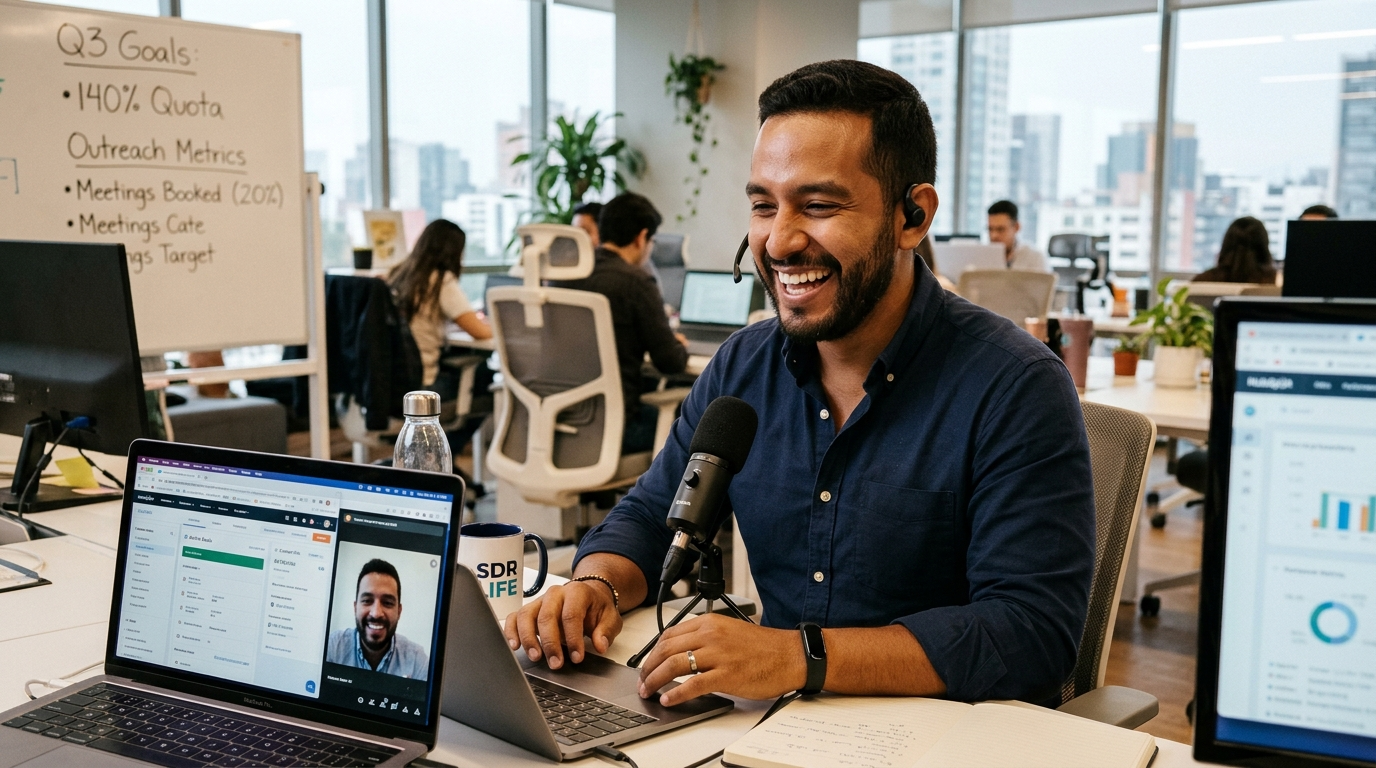
The AI advantage is not theoretical. According to McKinsey's State of AI in Sales report (2024), sales teams that use AI-assisted prospecting tools see a 10–15% increase in leads generated and a 15–20% reduction in cost per qualified meeting. When your outsourced SDR already arrives trained on those tools, you capture that lift immediately rather than spending weeks on onboarding.
Curious how the cold email side of this actually works at scale? The post on how outsourced SDRs handle cold email at scale goes deep on sequencing strategy, deliverability, and volume benchmarks — worth reading before you set expectations with your first outsourced SDR.
Nearshore vs. Offshore vs. Onshore: Which Outsourced SDR Model Wins in 2026?
Not all outsourced SDRs are the same. The sourcing geography matters enormously — not just for cost, but for communication quality, timezone alignment, and your ability to actually manage the relationship. Here is how the three main models stack up:
| Factor | Onshore (US/Canada) | Nearshore (Latin America) | Offshore (India/Philippines) |
|---|---|---|---|
| Typical monthly cost | $7,000–$10,000+ | $2,500–$4,000 | $1,200–$2,500 |
| Time zone alignment (US hours) | Perfect | Excellent (0–3 hr offset) | Poor (9–13 hr offset) |
| English fluency | Native | High (8/10+ screened) | Variable (accent, comprehension issues common) |
| Cultural fit with US buyers | Excellent | Strong | Moderate |
| Ramp time | 4–6 weeks | 1–2 weeks (AI copilot) | 4–8 weeks |
| Contract flexibility | Often locked in | Month-to-month | Variable |
| Replacement if not a fit | Rare | Yes (at no additional cost) | Rare |
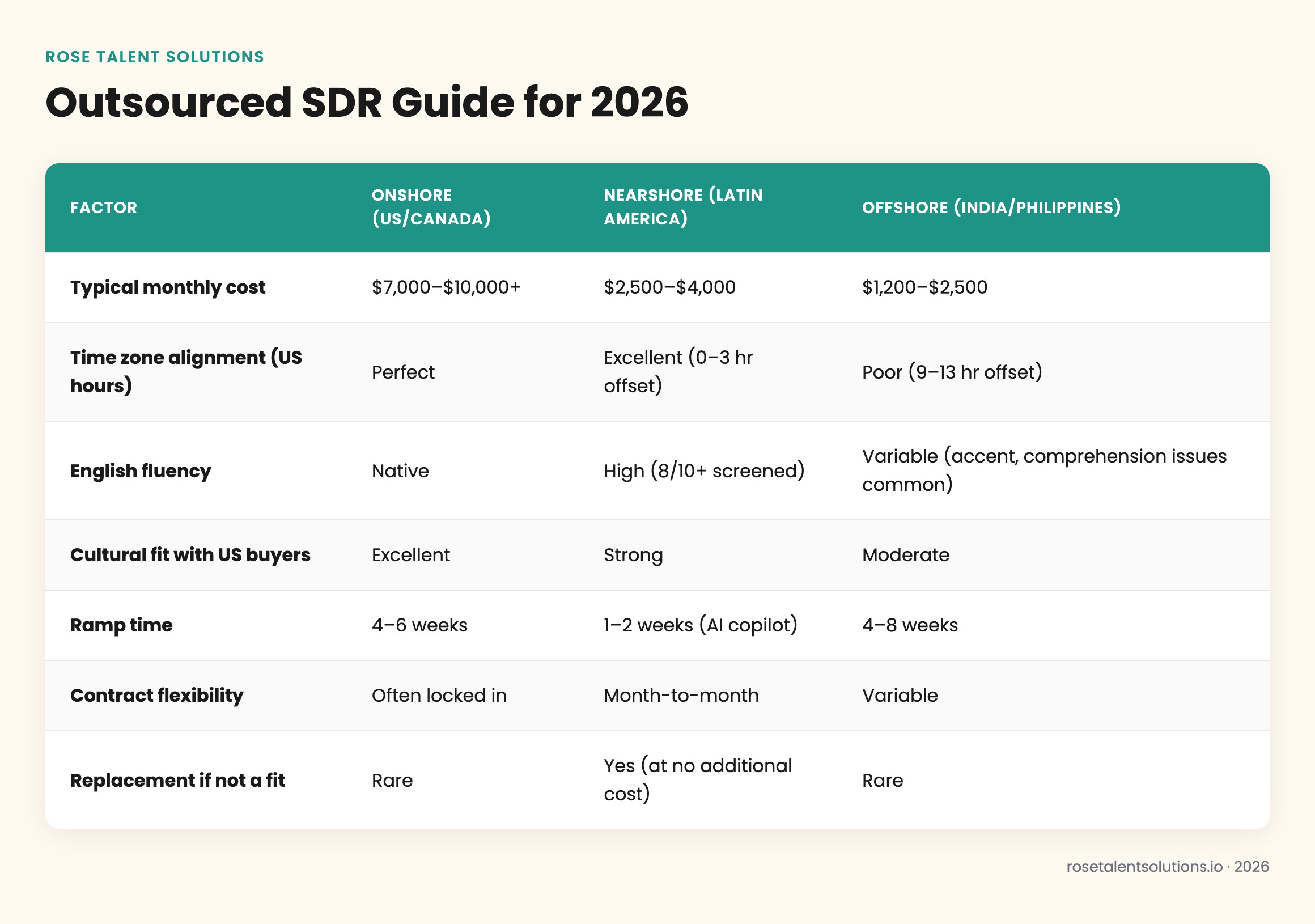
The offshore model looks cheapest on the surface, but the hidden friction compounds fast. A 10–12 hour time zone gap means your SDR is sending emails at 3am your time, can't join your team standup, and can't respond in real-time when a hot prospect replies. Time zone misalignment is the silent pipeline killer that never shows up in the cost-per-hour calculation.
"The number one mistake I see revenue leaders make when outsourcing SDR work is optimizing purely on hourly rate. The real ROI driver is response latency — how fast your SDR can engage an inbound signal or follow up on a warm reply. Offshore teams structurally cannot win that race." — Jeremey Donovan, EVP Revenue Strategy at Insight Partners (2023)
How Much Does an Outsourced SDR Actually Cost in 2026?
Pricing for outsourced SDRs varies widely depending on the model — project-based agencies, fractional reps, and full-time dedicated staff all carry different price tags and different risk profiles. Understanding what you're buying is as important as the number on the invoice.
At Rose Talent Solutions, the pricing is straightforward: $2,500 per month, flat. That's a full-time (40 hrs/week) nearshore SDR with recruiting, vetting, payroll, HR, and ongoing management included. No long-term contract — month-to-month with 30 days written notice. If the team member isn't a fit, Rose replaces them at no additional cost. That's the entire risk structure, clearly defined.
SDR agency retainers often run $8,000–$15,000/month for a fractional team that also works ten other clients simultaneously. A dedicated nearshore SDR at $2,500/month works exclusively for you, 40 hours a week, is managed by your process, and builds institutional knowledge of your ICP over time — a structurally different value proposition.
For a full breakdown of what different outsourced SDR arrangements cost — including agency retainers, fractional models, and dedicated staff — the post on outsourced sales development team cost gives you the complete picture with real market comps.
According to SHRM's workforce research (2024), the average cost to replace a single employee is 50–200% of their annual salary — meaning a failed in-house SDR hire could cost you $45,000–$130,000 all-in before you've booked a single meeting. The replacement guarantee built into a quality nearshore staffing model directly hedges that risk.

Industry research supports the cost-efficiency claim. Deloitte's Global Outsourcing Survey (2024) found that 70% of companies cite cost reduction as a primary driver for outsourcing — but among companies that have outsourced for 3+ years, quality and scalability overtake cost as the top reported benefit. That trajectory matches what Rose sees: clients start outsourcing SDRs for the savings, stay for the operational leverage.
How to Get Started with an Outsourced SDR — Step-by-Step for 2026
The process of hiring an outsourced SDR through Rose Talent Solutions is designed to get you a producing rep in days, not months. Here's how it works:
Define Your ICP and Outreach Goals
Before Rose sources candidates, you spend 30 minutes answering questions about your target market, your CRM stack, your current outreach playbook (or lack of one), and your volume expectations. This becomes the matching brief.
Rose Matches and Vets Candidates
Rose sources from its Latin American talent network, screens for English proficiency (8/10+ floor), sales aptitude, and tool familiarity. You receive a shortlist of 1–3 pre-vetted candidates — not a stack of raw resumes.
You Interview and Select
You run a short interview with your top candidate. Most clients confirm their pick within one conversation. Rose handles the offer, compliance, and onboarding paperwork on the back end.
AI Copilot Onboarding
Your SDR's role-specific AI copilot is configured to your tools — HubSpot, Salesforce, Apollo, Outreach, or whatever stack you run. This cuts the standard ramp period dramatically. Learn more on the AI advantage page.
SDR Goes Live — You Own the Direction
Your outsourced SDR works your hours, inside your systems, following your playbook. Rose provides ongoing HR and management support so the administrative layer never lands on you.
If your business is a SaaS company specifically, the guide on how to hire outsourced SDR services for SaaS covers ICP targeting frameworks, common sequencing mistakes, and how to structure a 90-day ramp plan for a nearshore rep in a product-led growth context.
Who Should — and Shouldn't — Hire an Outsourced SDR in 2026
Outsourced SDRs are not the right answer for every business at every stage. Being honest about fit matters more than making a sale.
Great fit for outsourced SDRs
- B2B companies with a defined ICP and repeatable outbound playbook
- Founders or revenue leaders who want to test outbound before building an in-house team
- SaaS, services, real estate, and professional services businesses with 1–3 month sales cycles
- Companies scaling from $1M to $10M ARR who can't yet justify a full SDR manager and team
- Businesses that have burned on expensive US-based agency retainers and want dedicated, manageable capacity
Poor fit for outsourced SDRs
- Companies with no defined ICP or value proposition — an SDR can't save a broken message
- Businesses requiring deep technical product knowledge that takes 6+ months to acquire
- Organizations that lack a CRM or sales engagement platform for the SDR to work inside
- Founders who want to fully delegate strategy, not just execution — SDRs need direction
According to Gallup's State of the Global Workplace report (2024), manager clarity is the single largest driver of employee engagement and performance — that holds for outsourced staff as much as in-house. The clients who get the best results from nearshore outsourced SDRs are the ones who invest 30 minutes a week in direction-setting and feedback, not the ones who hand off and disappear.
Rose's sales staffing model extends beyond SDRs — the get started page walks through the full range of roles Rose places, including account executives, customer success, and operations support. And if your revenue operations need back-office reinforcement alongside your outbound motion, Rose also places nearshore bookkeeping and accounting staff who work inside QuickBooks, Xero, and similar platforms.